The Atlantic, July/ August 2009

the atlantic july and august 2009We as a species are currently dumping massive amounts of carbon into the upper atmosphere.  Average temperatures around the world are rising at an alarming rate, evidently at least in part as a consequence of this dumping.  No movement is in prospect that would stop the dumping, or even reduce it substantially.  So, what to do?  Some scientists and engineers want to remake the rest of the earth’s climate to accommodate our carbon dumping habit.  How could this be done?  There are several possible methods. 

We could shoot sulphur dioxide into the upper atmosphere.  That would be remarkably affordable- for as little as a billion dollars, it could end global warming.  The drawback is that eventually sulphur would rain down from the sky, and if we stopped shooting new sulphur dioxide up there global temperatures would increase dramatically in a very short period.  Also it would cause severe droughts throughout central Africa, a region which has not exactly been among the big winners of industrialization to start with, so that seems unfair. 

Also we could dump iron powder in the Antarctic Ocean, causing a huge plankton colony to bloom and suck carbon dioxide out of the atmosphere.  We’d have to be a bit careful about that- half a supertanker’s worth of iron powder could feed a big enough plankton bloom to trigger a new Ice Age.  And when plankton dies, it releases methane, which is a much more effective greenhouse gas than carbon dioxide. 

There are also people who would like to block sunlight by shooting millions of clay discs at the Lagrange point between the earth and sun.  These skeets might well reduce average temperatures on the earth, but they could also stop the formation of ozone in the atmosphere.  And without an ozone layer, life as we know it could not exist on the surface of the earth.  So that’s a little bit on the risky side too.  So it seems like reducing carbon emissions might be worthwhile after all. 

Read the full post »

Jones’ BIG ASS Truck Rental and Storage

Find him on them internets.

The most ambitious installment of xkcd I’ve seen

overstimulated

The return of Weirdomatic?

Weirdomatic collects interesting pictures from around the web.  It was one of my favorite sites for quite a while.  It stopped updating last year, but now there’s a new gallery up.  I certainly hope it’s a sign of things to come. 

ice_cream_machine_25

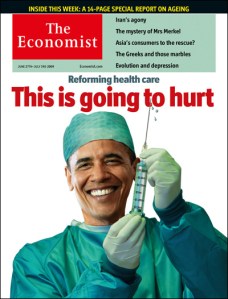
Some interesting things in this week’s issue of The Economist

economist 27 june 2009I subscribed to The Economist for years and years.  I liked its quick notes about little countries that major media outlets ignore completely.  After a few years of reading it regularly, it came to seem like a person.  In particular, it seemed like a 23 year old bond trader who thinks that he rules the world, or is about to.  Obnoxious as that fellow might be in person, in the form of a magazine he was, at his worst, something I could set on a table and forget about.  More often his outlandish politics were good for a laugh.  I still remember the first number of The Economist I read, a 1983 issue with Nicolae Ceaucescu’s picture on the front, labeled “The Sick Man of Communism.”  What sticks out is a leading column about Lebanon, the last paragraph of which began with some phrase like “Though colonialism is unfashionable at the moment,” and went on to suggest that the best thing for that country might be occupation and domination by Syria.  Time and again The Economist makes remarks like that, which only a staff as extremely young as that which in fact does produce the magazine could make innocently.  And it can be a useful read- if I’d bet against every market prediction they made in the 1990s, I’d be a millionaire today. 

This time around, they have a leader and an article about the new Acropolis Museum, each concerned chiefly with the effect this facility will have on the dispute between Britain and Greece over the ownership of the friezes Lord Elgin took from the Parthenon in the period 1801-1805.  The British Museum has been taking care of them for over 200 years, the Greek government has been campaigning for their return to the Acropolis for almost 30 years.  The Economist is impressed by the new museum on the Acropolis, and wishes the British Museum would lend the friezes to the Greeks.  This solution would require the Greeks to renounce their claim of formal ownership of the friezes.  Previous Greek governments have seemed willing to make this concession, but the current one is not.  The Economist predicts that an uncompromising stand by the Greeks could unravel a great deal of the progress that has been made since December of 2002, when the world’s leading museums issued a statement called “the Munich Declaration”: 

The Munich declaration, as it is called, asserts that today’s ethical standards cannot be applied to yesterday’s acquisitions; but in return it acknowledges that encyclopedic museums have a special duty to put world culture on display.

This has led to a new level of co-operation between museums over training, curating, restoration and loans. Thousands of works are now lent each year between museums on every continent.

All this apparently will come crashing down unless the Greeks take the advice of The Economist.  Considering that much of the 6 March 1999 issue of that magazine was devoted to dire warnings of the chaos the world would face in the next decade as the price of oil dropped below $5 a barrel and stayed there, I wouldn’t worry overmuch about its predictions. 

Read the full post »

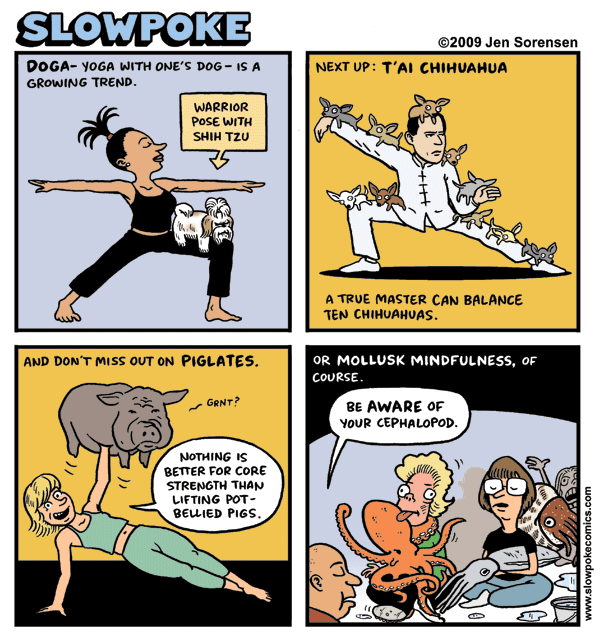
Doga Yoga

Here’s an edition of Jen Sorenson‘s Slowpoke from a few months back.

doga

The Atlantic Monthly, June 2009

the atlantic june 2009It’s hard to make South African president Jacob Zuma seem an attractive figure, and the profile of him here doesn’t try.  What intrigued me was its description of an art Zuma has mastered, Zulu stick fighting:

During my November 2007 visit to his homestead, I spoke with one of his brothers, Mike. As we stood by an enclosure where an ox had been slaughtered earlier in the day, Mike told me that his brother was clever, and should never be counted out. He said that from an early age, Zuma had been a masterful practitioner of traditional Zulu stick fighting. His distinctive technique had been to forego the formalities and hold his stick casually, as if he was on a lark. He’d turn away from his opponent, crack a joke, and smile. When it was least expected, he would sweep the other boy off his feet. Stick fighting is essentially a test of balance, not brute strength, in which one turns an adversary’s lunging attacks back on him.

That sounds like a martial art anyone with the makings of a successful politician would be well suited to practice. 

An article called “Do CEOs Matter?” describes the classification of corporate leaders into two major categories, “Unconstrained Managers” and Titular Figureheads.”  The men who coined these phrases were Professors Donald Hambrick and Sydney Finkelstein.  In the article where they introduced the dichotomy, Hambrick and Finkelstein wrote that “If we had to choose as a society between doing away with Figureheads or Unconstrained Managers, clearly it is the Figureheads we would keep.” 

Read the full post »

Gay Teen Undergoes Christian “Therapy”

3 times, at his request.

Why are there 60 minutes in an hour?

Thanks to 3quarksdaily for posting about this article that answers the question “How did the Sumerians count to 12 on one hand and to 60 on two?”

The Nation, 13 July 2009

nation 13 july 2009Alex Cockburn rages at the Americans who cheerlead for the protests in Iran while they ignore politics in their own country, giving the Obama administration carte blanche to break every promise Mr O made to help working people and curb the national security state.  As for Cockburn’s view of Iran, readers of his newsletter Counterpunch are familiar with his suspicion that the protests are something of a phony put up by advocates of war.   

An editorial about the Obama administration’s approach to the righs of sexual minorities begins by pointing out that in Mr O’s first bid for public office, for the Illinois state senate in 1996, he was asked where he stood on same-sex marriage.  Unlike other candidates, who either checked “yes” or “no,” Mr O went out of his way to add the sentence “I favor legalizing same-sex marriages, and would fight efforts to prohibit such marriages.”  At that time no state recognized same-sex marriages, and many criminalized same-sex sex.  Now, the country has moved on.  Even the governor of Utah has endorsed civil unions for same sex couples.  And Mr O has moved backward.  Now he opposes same-sex marriages, presides over the continuation of “don’t ask- don’t tell,” and hasn’t lifted a finger to support legislation to protect sexual minorities from workplace discrimination, legislation 89% of Americans say they favor.  The editorial sums it up: “At this rate, Obama is in danger of being outpaced on gay rights not just by the American people but by the nonsuicidal wing of the Republican Party.”  

Lisa Duggan celebrates Salt Lake City’s surprisingly visible, surprisingly politicized sexual minorities.  Countering those who have called for a boycott of Utah to protest the role of Mormons in the campaign to end gender-neutral marriage in California, Duggan quotes Salt Lake City residents who’ve called for a “New Queer Pioneer Movement,” one that would emulate the sect trains of the Mormon nineteenth century and flood the state with same-sexers. 

Joseph Stiglitz claims that the current global economic crisis presents us with a stark alternative: either we adopt nationalistic policies of subsidy and protection that mean we renounce economic globalization, or we adopt United Nations-based regulatory schemes that mean we embrace political globalization.  As Stiglitz is the head of the UN’s Commission of Experts on the crisis, it will not come as a complete surprise that he favors the latter option.

Read the full post »