

Non-Virtual WABAC Machine
Posted by CMStewart on December 21, 2009
https://losthunderlads.com/2009/12/21/non-virtual-wabac-machine/
Some whimsical pictures of ukuleles
Whether you think the ukulele is the instrument of Christ, of the Devil, or of an outline of a topless lady, this page on Ukulele Powa is for you.


Posted by acilius on December 19, 2009
https://losthunderlads.com/2009/12/19/some-whimsical-pictures-of-ukuleles/
Pete Seeger
Pete Seeger turned 90 in May; his birthday party, an intimate little gathering of 18,000 of his closest personal friends, was released on DVD this month, leading to some publicity. Here are a few videos in his honor.
If You Love Your Uncle Sam (Bring ’em Home.) Sadly, this Vietnam-era song is not just for nostalgia; here‘s an updated version.
Wimoweh, with the Weavers
Posted by acilius on December 18, 2009
https://losthunderlads.com/2009/12/18/pete-seeger/
The Answer is Y6
If “Y6” is the answer, what was the question? Was it to do with that yellow blob crashing into the cartoon woman’s lower back? I assume it’s crashing into her back, I suppose it might be a cloud of some kind emerging from her rear end. The stink lines coming off it would support this latter interpretation. Still, that doesn’t explain “Y6.”

Photo by Acilius
Posted by acilius on December 17, 2009
https://losthunderlads.com/2009/12/17/the-answer-is-y6/
The Nation, 4 January 2010
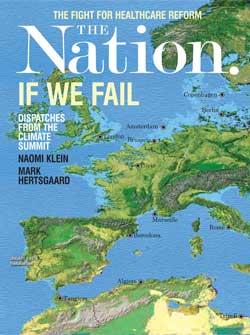 Several reports on the Copenhagen summit on climate change draw Alexander Cockburn out with a column trumpeting his dissent from the view that by dumping such great volumes of greenhouse gases in the upper atmosphere humans are doing enormous harm to the environment. Cockburn never convinces me when he mounts this hobby-horse of his, but I must confess to taking pleasure in the self-righteous sputtering that fills the letters to the editor in the subsequent issues. For every well-reasoned counterargument from someone with a grasp of the science and a solid case to make against Cockburn’s claims, the magazine must receive hundreds of letters from people who are not at all equipped to analyze climate data but who are entirely prepared to denounce a heretic and cast him out. I’m fairly sure that Cockburn is wrong and his detractors are right about climate. At the same time, I’m quite certain that he is doing a public service by luring would-be enforcers of orthodoxy into the open. He’s even doing a favor to them; if the self-appointed Grand Inquisitors have the sense to read their letters and realize that they have made fools of themselves, they might shed their crusading demeanor and adopt a more wholesome attitude.
On The Nation‘s website, there’s a piece about the president of Italy’s parliament, Gianfranco Fini. The piece notes the rather amazing fact that this man whose political career began in the neofascist Italian Social Movement has became “the country’s most responsible right-wing politician.” Several months ago, The Independent praised Fini’s willingness to stand up to Prime Minister Silvio Berlusconi in defense of values like accountable government, a secular state, and openness to immigration, values that liberals and socialists are supposed to care about but that the leaders of Italy’s center-left parties seldom lend their full-throated support. The Independent called Fini “the best leader the Italian Left never had.” This really is an extraordinary transformation; as recently as 1994, Fini described Benito Mussolini as “the greatest statesman of the twentieth century.” How anyone could possibly apply that label to il Duce is beyond me. Before Mussolini came to power he was in some ways an intriguing figure, I grant you. He led an highly colorful life, full of adventure and rich in ideas. As a national leader, however, Mussolini was a disaster by any standard of evaluation. The evil he did (for example, sending 3,000 Italian Jews to die in Hitler’s camps) infinitely outweighed any good with which he could be credited, yet in the end it was his sheer incompetence that triumphed even over his murderous villainy. This is a digression, I suppose; Gianfranco Fini seems to be highly competent, and no more likely to commit murder than the average Western European politician.
Katha Pollitt’s annual list of worthy charities includes, as usual, MADRE, a fund that backs various groups of women in poor countries who have organized themselves to combat their own problems on their own terms. For example:
In Iraq, it supports Yanar Mohammed’s network of secret shelters for women fleeing domestic violence and honor murder. In Kenya, it works on water purification projects that free women from the task of transporting water over long distances. In Bolivia, it helps indigenous women prepare to run for political office. Right now, 100 percent of your gift goes directly to projects.
Barry Schwabsky’s review of some recent retrospectives on abstract painting includes a snippet that may provoke a response. After telling us that he experiences art one work at a time and looks with a skeptical eye on all art history that describes movements and schools, Schwabsky says:
Abstraction arguably should have even less to do with movements than any other art: a movement of abstractionists would be a contradiction in terms, like a church of atheists. Abstractionists, like atheists, are united only in what they reject. Abstraction is not a specific way of doing art–on what basis can Jackson Pollock, Lucio Fontana and Daniel Buren be considered part of a single movement? Rather, it is a considered effort not to do what Western artists have made it their job to do for hundreds of years: namely, to construct credible depictions of people, places and things. What if anything else goes?
Perhaps that’s why, as Bob Nickas points out in his new book Painting Abstraction: New Elements in Abstract Painting (Phaidon Press; $75), “so many contemporary artists who paint nonrepresentational pictures reject the notion that their work is in fact abstract.” They realize that the name itself, as handy and unavoidable as it undoubtedly may be, conveys a false sense of unity. Other commonalities, even those that would rightly strike us as quite superficial, can be more important.
Tiger Woods crops up. Ever since news started hitting the papers of Woods’ very active extramarital sex life, I’ve been thinking of William Blake. “Tiger, tiger, burning bright,/ in the forests of the night…” Or is it “Tiger, Tiger, burning sensation/ experienced during urination…” Anyway, the item here is all about how Tiger Woods has spent his career promoting sleazy schemes by global bad actors such as Chevron and the Philippine government, all the while pretending that he had nothing to do with politics.
Posted by acilius on December 17, 2009
https://losthunderlads.com/2009/12/17/the-nation-4-january-2010/
Working Dogs
I would like to take this opportunity to give a shout out to CCI. They have been training assistance dogs for mor than 30 years. I have received two assistance dogs from them both of which made it possible (one is still making it possible) for me to lead a happy, productive life. I do not take the training of service dogs lightly. I just thought the video was cute.
Posted by believer1 on December 16, 2009
https://losthunderlads.com/2009/12/16/woring-dogs/
Crushie swims again
Here’s some imagery of our turtle Crushie swimming around his tank. You can see his pet, Red The Goldfish, in some of the frames.

Posted by acilius on December 16, 2009
https://losthunderlads.com/2009/12/16/crushie-swims-again/
Grade-schooler disciplined for drawing crucifix?

Posted by CMStewart on December 15, 2009
https://losthunderlads.com/2009/12/15/grade-schooler-disciplined-for-drawing-crucifix/
Prom Night: The Ukulele Orchestra of Great Britain Live at the Royal Albert Hall
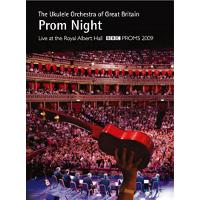 On Tuesday, 18 August 2009, the Ukulele Orchestra of Great Britain was a headline act at the BBC Proms, an annual festival more formally known as the Henry Wood Promenade. The BBC Proms goes on for about ten weeks and includes dozens of concerts in London’s Royal Albert Hall, as well as chamber music performances in nearby Cadogan Hall and a variety of lectures, films, and other fringe events devoted to music. The UOGB’s performance at this year’s Proms was a big hit; here’s a high-resolution picture of the audience (beware, it can hypnotize you; I just spent three solid minutes trying to follow people’s lines of sight and figure out who was looking at whom,) and an article from The New York Times (the NYT piece is the same one I linked to in my review of the UOGB’s album Live in London #2, if it looks familiar to you that may be why.)
A DVD of the performance went to press on the 3rd of this month, and today a copy of that DVD arrived at the Acilius household.
The UOGB has already released audio tracks of ten of the fifteen songs from this set. Performances of “Anarchy in the UK,” “Life on Mars,” “Teenage Dirtbag,” “Pinball Wizard,” “The Dambusters March,” “Melange,” and “Wuthering Heights” can be found on Live in London #1; “Silver Machine” and “Thunderball” are on Live in London #2; “Psycho Killer” is on Precious Little. Two songs, “Anarchy in the UK” and “Life on Mars,” are already available on their previous DVD, Anarchy in the Ukulele. The five numbers that are new to disc are “Puffin’ Billy,” “The Ride of the Valkyries,” “Danse Macabre,” a fragment of Beethoven’s Ninth Symphony “arranged for 1008 ukuleles”; and “Jerusalem.” Of those five, “Puffin’ Billy” is chiefly a setup for “Anarchy in the UK,” and “The Ride of the Valkyries,” while an astounding example of musicianship, turns out to be an extended intro for “Silver Machine.” Is it really worth paying £15.00 plus postage for so much old rope?
I say yes, emphatically yes. The disc records not only fifteen fine performances, but an extraordinary moment in the history of the ukulele. The most anticipated number was the Beethoven fragment, the UOGB leading 1000 audience members in the “Ode to Joy.” The camera pans through the audience, showing hundreds of ecstatic faces. A DVD extra shows the rehearsal the UOGB did with the uke-bearing members of the audience beforehand. The “Ode to Joy” is of course a setting of a poem about universal brotherhood; it’s a bit breath-taking to know that and see such a large and diverse crowd join in playing the piece. It’s almost a shame that UOGB does such a good job with the “Ode to Joy”; I wish it could become part of their regular repertoire, but where will they find 1000 sidemen to accompany every performance?
Emotions clearly ran high in the hall throughout the concert. Towards the beginning, Dave Suich recalls his last visit to the Royal Albert Hall, when he paid five shillings to sit in the gallery and listen to Black Sabbath. Peering up, apparently at the spot those five shillings had bought him, he seems amazed to be on stage. When Hester introduces “Teenage Dirtbag,” she makes a joke that it’s a poignant song for her because she’d expected to be alone on Prom Night; as she mentions the 6000 people in the hall and tens of thousands more listening on BBC 3, she loses her comic timing and seems to choke up. High definition usually isn’t a friend to anyone over 30; Hester is an exception. She doesn’t look a tenth of her true age, and the flicker of emotion on her face in that moment is worth a great deal. When I talked about Hester’s “Teenage Dirtbag” in my review of Live in London #1, I summarized it as a “ballad of adolescent lesbian angst”; it’s sobering to see how many visitors still come to this site having googled “hester goodman lesbian.” At the risk of drawing more of that traffic, I’ll say that the human race would be the poorer if some among us did not go through adolescent lesbian angst. I’d go so far as to label adolescent sexual angst in all its forms as an indispensable part of the human experience. Hester has produced a powerful testament to that form of adolescent angst, and my hat’s off to her for it. Not only mine; Mrs Acilius turned to me as we were watching “Teenage Dirtbag” and said the song filled her with pride every time she hears Hester sing it.
In a DVD extra showing the players getting ready, Kitty Lux confides to the camera that singing “Jerusalem” as a solo in the Royal Albert Hall is “a dream come true.” Introducing it on stage, she confesses that she isn’t sure she has the “temerity” to do it. She wasn’t feigning the nerves; she stumbles over the lines at one point, and at the end Richie and Will touch her shoulders to reassure her. With so much strong feeling, it’s only right that by the end of the evening hundreds in the audience are waving their ukuleles above their heads in time with the music.
I don’t want to give the impression that it’s all about weeping the tears of inspiration. “Puffin’ Billy,” a tune used as the theme song for a number of radio and TV programs for small children, leads into an especially hilarious rendition of “Anarchy in the UK.” “Ride of the Valkyries” and “Silver Machine” are a humorous pairing, and would get laughs even if Dave hadn’t made a comment comparing the “European” Wagner piece with the “British” rock tune. Peter plays it cool singing “Thunderball,” letting the words get the laughs. The moment in “Pinball Wizard” when the other seven shout at George to “Shu-duppa-yo-face!” is hilarious as audio, even funnier with video.
I first heard Saint-Saens’ “Danse Macabre” in school when I was a little boy. The recording our music teacher played for us featured pizzicato very prominently. I asked him what instrument that was; he said the violin, plucked rather than bowed. I wanted to sign up for violin lessons on the spot. What I really wanted, I now realize, was a ukulele. The UOGB’s version of the piece lets ukuleles sound like themselves, rather than trying to use violins to substitute for them. While George introduces the piece by warning us that the ukukele doesn’t have enough sustain to play the “Danse Macabre” quite the way Saint-Saens wrote it, the version they play is thoroughly excellent. Not least in its ability to get the listener up and dancing.
Most of the performances are the same musically as the versions on their albums, but the video adds a great deal nonetheless. For example, listening to “Psycho Killer” on Precious Little, you hear a rousing song and suspect that it’s supposed to be funny somehow. Seeing Will play the role of a seriously disturbed person as he sings about being a “psycho killer,” you laugh at the absurdity of the song, even while you want to dance.
The obvious place to end the set was with the “Ode to Joy,” but since most of the audience had just attended a rehearsal of that one, it wouldn’t have been much of a climax. The regular program ends rousingly enough with the “Dambusters March”; the first encore, “Melange,” would also have been a suitable conclusion, amazing the audience as it does with the UOGB’s ability to keep a common thread while each member of the band is alternating between 3 or 4 songs, most of which are solos. The second encore, “Wuthering Heights,” gives the audience the satisfaction of shouting “Heathcliffe!” en masse, but otherwise seems to be an odd choice to wind the concert up. Still, it’s very strong overall, and I recommend it highly.
Posted by acilius on December 15, 2009
https://losthunderlads.com/2009/12/15/prom-night-the-ukulele-orchestra-of-great-britain-live-at-the-royal-albert-hall/
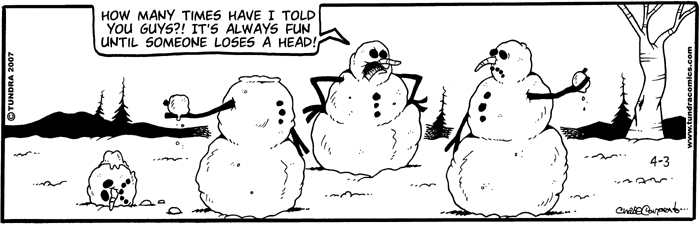
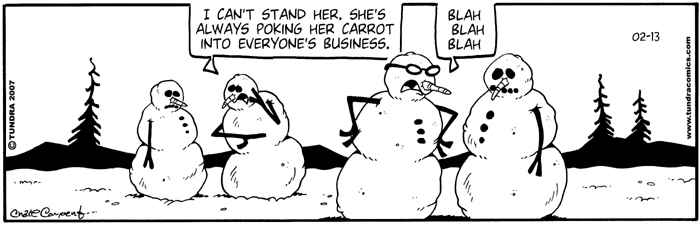
Snowman Comics


Posted by believer1 on December 15, 2009
https://losthunderlads.com/2009/12/15/snowman-comics/
Who writes this?
 acilius
 believer1
 lefalcon
 losthunderlads
 vthunderlad
 Panther Red
