
 At Language Log, Mark Liberman notes that a protest song young Iranians are singing these days has the same opening as “Bei mir bist du shayn,” a klezmer tune partly translated out of Yiddish that was a hit in the USA about 70 years ago. This rather surprising connection in turn leads Professor Liberman to quote one of Horace’s Odes and to compare that ode with a couple of English poems composed in tribute to it.
All posts in category Wars and Rumors of Wars
The swing vote in Iran
Posted by acilius on June 19, 2009
https://losthunderlads.com/2009/06/19/the-swing-vote-in-iran/
Wounded Knee, nanotech, Serbian broadcasting, and the car industry

The headquarters of Radio Television Serbia after the 23 April 1999 bombing
Go away for a month, and things pile up. Time to get back at it. Here are “Periodicals Notes” on three recent issues of Counterpunch.
16-30 April: Tiphaine Dickson reports on the case of Dragoljub Milanovic, the only person ever to have been tried and punished for NATO’s 23 April 1999 bombing of Radio Television Serbia (RTS), an attack on an undefended target that killed 16 civilians and served no military purpose other than to disrupt broadcasting between the hours of 2 and 5 AM that morning. The attack followed an ultimatum NATO issued to the Serbs that the station would be considered a legitimate target unless they consented to broadcast six hours a day of NATO-approved western programs, an ultimatum NATO dropped when the Serbs accepted it. Mr Milanovic has been in prison for seven years because of his role in this wanton act of murder. What was that role? He was one of NATO’s intended victims. The director of RTS, Mr Milanovic was at his desk in the building less than an hour before the bombing. Dickson details a story of the dizzyingly absurd injustices that Mr Milanovic has suffered, illustrating the workings of the West’s anti-Serb policies of the last couple of decades.
In the same issue, former US Senator James Abourezk (Democrat of South Dakota) gives a synopsis of the relations between the Minneconjou tribe of the Sioux nation and the US government before, during, and after the 1890 massacre of Minneconjou people at Wounded Knee in South Dakota. This is to serve as an introduction to Senator Abourezk’s recollections in the next issue of the 1973 occupation of Wounded Knee by militant American Indian Movement (AIM) activists.
1-15 May: Senator Abourezk tells the story of his trip to Wounded Knee in 1973, when he and George McGovern (his senior colleague in the US Senate from South Dakota) tried to mediate between AIM and the federal agents surrounding them. The senators left thinking that they had negotiated a peaceful resolution to the standoff, only to find that the Nixon administration had blocked the deal. Senator Abourezk suspects that the president wanted to keep the crisis going in order to stoke anti-Native feeling among whites.
In the same issue, Steven Higgs looks at nanotechnology. After listing such applications as self-cleaning eyeglasses (very attractive to me!), he quotes experts who are concerned that carbon nanotubes strongly resemble the microstructure of asbestos and that exposure to them may pose some of the same risks as does exposure to asbestos. Other nanotechnologies also seem to represent considerable dangers; for example, the minute portions of silver used in high-end washing machines can enter living cells and may alter DNA there, threatening cancer. Higgs notes that after years of federal inaction, the Obama administration has issued notice that it may begin a review of regulations in this area.
16-30 May: Eamonn Fingleton points out that all the explanations for the decline of the US auto industry favored by corporate media are bogus. For example, one often reads that the Big Three fail to produce any models with the steering wheel on the right, and that this explains why the Japanese won’t buy American cars. In fact, Fingleton reports, Detroit makes dozens of models with the steering wheel on the right, and has done so for years. We also hear that closing a country to imports will doom its manufacturers to eventual irrelevance in the global contest for shares of the export market. Yet the Japanese and Korean car markets have been the most tightly closed in the world for decades, as Japanese and Korean car makers have gone from strength to strength and now dominate the US market.
In the same issue, Bill Hatch reports on Michelle Obama’s visit to the University of California’s new campus at Merced. Hatch quotes Mrs O’s criticism of the University of Chicago’s development of the Hyde Park neighborhood as abuffer between itself and the South Side of Chicago, then points out that UC-Merced is trying to do exactly the same thing. Hatch tells how UC-Merced was built during the California real estate bubble, and how the construction of the university and the bubble worked together to shatter the working class town that had existed there. In Hatch’s telling, Merced sounds like a ghost town in the making.
Posted by acilius on June 11, 2009
https://losthunderlads.com/2009/06/11/wounded-knee-nanotech-serbian-broadcasting-and-the-car-industry/
The American Conservative, 20 April 2009
http://www.amconmag.com/issue/2009/apr/20/
 An old, and possibly apocryphal, story anchors Dermot Quinn’s appreciation of twentieth century German-Swiss economist Wilhelm Röpke. Röpke was walking along a road with Ludwig von Mises, the great champion of free-market economics. The two saw a neighborhood garden in a crowded urban center. Seeing land that was in high demand for residential and commercial development given over to an elaborate tangle of separate plots and shared irrigation,Mises sniffed that it was “a most inefficient way of producing vegetables.” Perhaps so, said Röpke. “But it is a most efficient way of producing human happiness.” Röpke has attracted every label in economics, from socialist to free marketer. None of those labels really fit Röpke, because they all classify thinkers by which answer they offer to questions about what sort of economic system allocates resources most efficiently. These questions struck Röpke as absurd. Though as a technical economist Röpke had few peers, his interests were always in human beings and their development, not in any of the fashionable abstractions of his time such as “The Economy” or “The Market” or “The State” or “The Proletarian Revolution” or “The Aryan Race.”
Barack Obama was elected president with the votes of millions of Americans who had had enough of war. Now that Mr O has announced plans to increase troop levels in Afghanistan and officials of his administration have suggested that they may expand the Afghan war into Pakistan, his antiwar supporters are hardly raising a peep. This leads Justin Raimondo to ask “Was the Left antiwar or just anti-Bush?” Raimondo started antiwar.com when President Bill Clinton ordered US forces to bomb Serbia in 1999. At the same time, your humble correspondent was also active in the antiwar movement. Like Raimondo, I was struck by the passivity with which the supposedly dovish members of the Democratic Party went along with that adventure. I’d always been curious about the antiwar Right, ever since I was a little kid hearing my parents reminisce about how their staunchly Republican parents had opposed FDR’s military interventionism with the same fervor that they opposed his economic interventionism. After 1999, I was convinced that the “Old Right” was indispensible to any effort to break America of its addiction to warfare.
The “Deep Background” column is less pessimistic about Afghanistan, pointing out that while “the nation-building agenda” that Mr O has publicly espoused for Afghanistan “is unrealistic and likely unattainable, a security framework to facilitate the kind of limited political consensus that would permit American withdrawal might just be achievable.” So, the grounds for hope is that the stated purposes of Mr O’s actions in Afghanistan are so patently absurd that they likely mask an unstated plan to withdraw American forces from the country.
Peter Hitchens, whose brother is also a magazine journalist, worries that all is not well in the new South Africa. President-designate Jacob Zuma’s fondness for the song “Bring Me My Machine Gun,” his closeness to the South African Communist Party, his refusal to be interviewed by journalists, his open practice of polygamy, his public boasts that he used to make a habit of beating homosexuals senseless, his apparent belief that HIV-AIDS is something that can be cured by a nice hot shower, and his former role as the defendant in a rape trial all combine to suggest to Hitchens that Zuma might be something less than the ideal leader for South Africa at this particular moment in its history.
Posted by acilius on April 16, 2009
https://losthunderlads.com/2009/04/16/the-american-conservative-20-april-2009/
The Nation, 13 April 2009
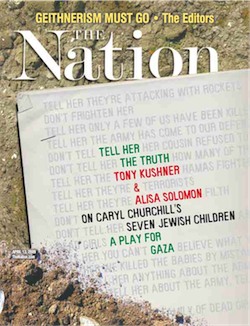 Tony Kushner and Alisa Solomon review Caryl Churchill‘s new play, Tell Her the Truth, which tells the history of the Arab-Israeli conflict in ten minutes. “Why is the play so short? Probably because Churchill means to slap us out of our rehearsed arguments to look at the immediate human crisis.” Churchill cares about what human beings are doing to each other and how they justify what they have done to themselves and to each other, especially in the justifications parents give their children. Tell Her the Truth consists of a series of lines giving the parents of seven unseen Jewish children advice as to what they should tell those children about various historical acts of violence, some committed against Jews in the name of antisemitism, some committed by Jews in the name of Zionism.
Tell Her the Truth, like every publication critical of Israeli policy, has attracted charges of antisemitism; much of the case against it apparently hinges on a line that does not appear in the play. Some have claimed that the play raises the spectre of “blood libel,” the old idea that Jews ritually murder Gentile children. “Those who level the blood-libel accusation insist that Churchill has written “tell her I’m happy when I see their children covered in blood.”” What she actually wrote was quite different: “tell her I look at one of their children covered in blood and what do I feel? tell her all I feel is happy it’s not her.” Kushner and Solomon interpret the real line thusly: “The last line of the monologue is clearly a warning: you can’t protect your children by being indifferent to the children of others.”
Posted by acilius on March 27, 2009
https://losthunderlads.com/2009/03/27/the-nation-13-april-2009/
Bush Truth Commission

Posted by CMStewart on March 24, 2009
https://losthunderlads.com/2009/03/24/bush-truth-commission/
The American Conservative, 9 March 2009

- Benjamin Disraeli as a Young Man
A review of Adam Kirsch’s biography of Benjamin Disraeli focuses on Kirsch’s idea that because Disraeli realized he could not stop his fellow nineteenth-century Englishmen from thinking of him primarily in terms of his Jewish ancestry, he “did not attempt to disguise his Jewish background. He embellished it.” Disraeli purported to be far more deeply involved with that side of his ancestry than he in fact was, even explaining his active membership in the Church of England as an example of his fealty to “the only Jewish institution that remains… the visible means which embalms the race.” Meanwhile, the Jewish characters and themes in Disraeli’s novels appall modern sensibilities. Sidonia, a character in the Young England trilogy (Coningsby, Sybil, and Tancred,) “looks like nothing so much as an anti-Semitic hate figure. It is amazing, in fact, how Disraeli manages to combine in this one character every malicious slander and paranoid fear that the anti-Semitic imagination can breed.” Disraeli’s manipulation of the label his fellows had imposed upon him enabled him to become prime minister of the United Kingdom. Disraeli’s ability to “outline [an] agenda of radical change to be achieved conservatively, a political program that allowed him to reinvent himself as the representative not only of the wealthy and the working class but of the Tory Party, too” has inspired rightist politicians like Richard Nixon and the neocons.
If Kirsch is right, Disraeli knotted his contemporaries’ perceptions of him around their image of “the Jew,” using their prejudices to transform himself from a marginal figure unlikely to make a mark in politics into a figure of England’s national mythology. Another complex of ideas twists around another such image in Brendan O’Neill’s analysis of the thoughts of some of Israel’s more fervent defenders in the West. O’Neill argues that the individuals he cites are less interested in Israel as an actual place inhabited by living people than they are in using a particular idea of Israel as a symbol for the values of the Enlightenment. “In effect, Israel is cynically, and lazily, being turned into a proxy army for a faction in the Western Culture Wars that has lost the ability to defend Enlightenment values on their own terms or even to define and face up to the central problem of anti-Enlightenment tendencies today.” This use of Israel as a pawn in cultural struggles centered elsewhere shades into philosemitism. “[A]s Richard S. Levy writes in his book Anti-Semitism: A Historical Encyclopedia of Prejudice and Persecution, simple philosemitism, like anti-Semitism, also treats the Jews as ‘radically different or exceptional’… Where anti-Semites project their frustrations with the world and their naked prejudices onto the Jews, and frequently onto Israel, too, the new philosemites project their desperation for political answers, for some clarity, for a return to Enlightenment values onto Israel and the Jews. Neither is a burden the Jewish people can, or should be expected to, bear.”
Posted by acilius on March 4, 2009
https://losthunderlads.com/2009/03/04/the-american-conservative-9-march-2009/
Latest out of Iraq Plan

Obama won’t be getting s out as soon as some of us thought.
Posted by believer1 on February 27, 2009
https://losthunderlads.com/2009/02/27/latest-out-of-iraq-plan/
The Nation, 9 March 2009
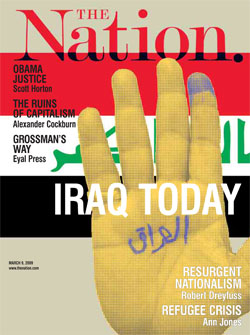 Robert Dreyfuss looks at the regional elections held in Iraq on 31 January and finds good news. A new alliance of Shi’a and Sunni groups is beginning to operate in Iraqi politics. Soon, Dreyfuss hopes, this alliance will be strong enough to present itself as a genuinely nationalist bloc and to insist on an end to the US occupation.
No such development is in sight in Afghanistan. An editorial expresses the fear that the Obama plan to send more US troops to that country will make “Bush’s War” into Mr O’s very own.
Katha Pollitt speaks up for free speech. On the twentieth anniversary of the Ayatollah Khomeini’s fatwah against Salman Rushdie, she finds fault with fellow leftists whose only response to violent behavior by Muslims who have taken offense at speech labeled anti-Islamic is to “see these incidents as gratuitous provocations by insensitive Westerners” and to support restrictions on speech that amount to blasphemy laws. She grants that many of the incidents that have generated violent responses in the Muslim world have indeed been gratuitous provocations by insensitive Westerners, and is happy to list extremists from other religious groups whose conduct has been every bit as deplorable as the worst we have seen from Khomeini and his coreligionists. But:
Appeals to the hurt feelings of religious people are just a dodge to protect the antidemocratic and retrograde policies of religious states and organizations. We’re all adults; we have to live with unwelcome expression every day. What’s so special about religion that it should be uniquely cocooned? After all, nobody at the UN is suggesting that atheists should be protected from offense–let alone women, gays, leftists or other targets popular with the faithful. What about our feelings? How can it be logical to say that women can’t point out sexism in the Bible or the Koran but clerics can use those texts to declare women inferior, unclean and in need of male control? And what about all the abuses religions heap on one another as an integral part of their “faith”?
An essay about Israeli novelist David Grossman of course concerns itself chiefly with Grossman’s insights into the Israeli/ Palestinian conflict. What sticks with me from the essay is this quote from Grossman about writing:
[Y]ears ago, reflecting on a story he was writing that featured a bitter, emotionally unstable protagonist, he described his desire to have the tale surprise him. “More than that, I want it to actually betray me,” he wrote.
To drag me by the hair, absolutely against my will, into the places that are most dangerous and most frightening for me. I want it to destabilize and dissolve all the comfortable defenses of my life. It must deconstruct me, my relations with my children, my wife, and my parents; with my country, with the society I live in, with my language.
Posted by acilius on February 22, 2009
https://losthunderlads.com/2009/02/22/the-nation-9-march-2009/
The Nation, 2 March 2009
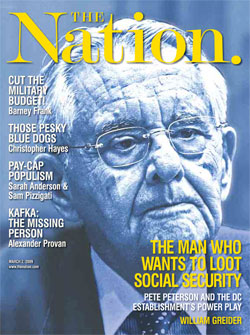 A review of several new books from and about Iran mentions the thinker Jalal Al-e Ahmad and his concept of gharbzadegi, or “intoxication with all things western” The reviewer assures us that this concept represents “one of the most influential critiques of the West.” In fact, he takes issue with some of the books under review for failing to presuming to discuss twentieth-century Iranian intellectual life, yet failing to mention the presence in that life of so towering a figure as Al-e-Ahmad. Since I’d never heard of Al-e-Ahmad or gharbzadegi, I thought I’d better make a note of this. So here are links to the Wikipedia articles about Al-e-Ahmad and gharbzadegi.
An interview with astrophysicist Adam Frank focuses on Frank’s religious ideas. Frank’s big idea seems to be that religious systems give us a way of processing and talking about emotions like awe and wonder that come upon us when we notice the scope and orderliness of natural phenomena. Frank shows his Astronomy 101 class a TV documentary about the origin of the universe, then asks them what they think of the music. His point is that the documentarians are packaging the Big Bang as a creation myth. Frank does not mean this as a condemnation of the show- on the contrary, he embraces this myth-making. Frank’s attitude reminds me of an idea I mentioned here a few days ago. I’ve long thought there was a great deal to be said about the relationship of scientific theories about the origin of the universe to traditional creation myths.
Posted by acilius on February 21, 2009
https://losthunderlads.com/2009/02/21/the-nation-2-march-2009/
The Nation, 5 January 2009

A few things stand out in this issue. Two pieces by A. C. Thompson, the cover story with a general focus and another about one particular case, detail acts of violence committed in the aftermath of Hurricane Katrina by groups of white homeowners who banded together to keep blacks out of their neighborhoods.
On a happier note, Katha Pollitt offers her annual list of do-gooders who deserve our financial support. Each of the ten she cites sounds terrific, I’d single out Iraq Veterans Against the War as the group with the most urgent agenda.
A collection of poems by the late Jack Spicer includes some love letters Spicer wrote, an editorial decision which moves the reviewer to comment on Spicer’s views about the relationship between poetry and correspondence. While Spicer often compared poems to personal correspondence, and “the idea or form of the letter underlies much of his published work,” in practice he always maintained a sharp distinction between the two genres. “What Spicer recognized as poetry was always fierce and contentious and, despite the devices that feign otherwise, written to no one and for no one. ” Indeed, Spicer’s discussion of Emily Dickinson centered on the difficulty of distinguishing between letters and poems, taking it for granted that this distinction was a needful one.
Posted by acilius on December 19, 2008
https://losthunderlads.com/2008/12/19/the-nation-5-january-2009/
Who writes this?
 acilius
 believer1
 lefalcon
 losthunderlads
 vthunderlad
 Panther Red