President-Elect Obama

It’s appropriate that Election Day should come so shortly after Halloween.  As the ghosts and ghouls vanish into their occult places when day breaks, so the bogeymen and superstars of the campaign season pass out of view once the election is over.  It’s back to Alaska with Sarah Palin, back to work for “Joe the Plumber,” back to the political science textbooks with the Bradley Effect, back to a museum of the 60s with the Weather Underground.  Four years from now another set of entertainments will rise from some unknown quarter and haunt us for a season. 

The candidates themselves do not go anywhere; they cease to exist.  The winning candidate is replaced by the office holder, the losing candidates are replaced by somewhat older, somewhat sadder versions of the people they were before they ran.  That’s why there’s a richer vein of literature about losing contenders for power than about winners.  Try to dramatize the winner and the best you can do is hint at what Shakespearean actors call “the man inside the king.”  The king is a symbol, he is power, he is majesty, he is order, and he is empty.  Art and literature can focus on the king only when the symbol fails and the human being emerges.  I think the Horace illustrates that process in his Ode 1.37.  As long as she is a contender for power, Cleopatra is at best a monster.  Defeated, she is one of us. 

Here’s Cedric Whitman’s translation of that poem.  Robert Frost defined poetry as “that which is lost in translation”; I’m afraid Whitman does not manage to defeat that definition.  But it does show the major gestures in Horace’s original, and unlike some other versions it is possible to read Whitman’s aloud.  I’ve appended Edward Wickham’s edition (from his Oxford Classical Text) of the original below. 

Drink, comrades, drum the ground, now it is time

for freedom’s dance; and call on all the gods

to come, lay out their gorgeous couches,

and let them recline at the feast of Mars.

It had been crime till now to pour good wine

from the crypts of our forefathers, while ruin poised

over the Capitol, and fevered madness

was winding cerecloth round our realm-

Dreams of the queen of half-men, girt by her crew

of sickly shame, and drunk with delirious hopes

grown fat and reckless on easy fortune!

But all that glare of frenzy waned

When scarce one vessel of her fleet sailed home

unscorched by flame; her mind, long tranced and dazed

on heady Egypt’s wine, now waking

to terror’s truth, found Caesar’s oars

hard pressing on her flight from Italy,

swift hawk on downy dove, hunter on hare

in snowy fields of Thrace, and ready

to fling her into chains, a beast

of ominous wonder.  But she had loftier thoughts,

to find out death; blades could not make her cheek

blanch like a girl’s, or drive her flying

with huddled sails to lurking shores. 

Her courage soared; with placid face she scanned

her fallen palace, and valorously reached

her hands to rasping snakes, sucking

their venom’s blackness through her limbs.

Once death was fixed, the fiercer grew her mind:

Indeed, she scorned his cruel galleys, and men

who would have had her walk uncrowned,

no spiritless woman, in triumph’s pride. 
(more…)

Nobody for President

Tuli Kupferberg of the 60’s band The Fugs presents a song called “Nobody for President.” 

Funny Times, November 2008

Many columns and cartoons this month ridiculing Wall Street and its enablers in Washington for the financial meltdown and the bailout that followed.  The “Minister of the Treasury of the Republic of America” joke email is included.

“Curmudgeon” gives a series of quotes about gluttony, fatness, and dieting.  The best is a line from P. G. Wodehouse: “She looked as if she had been poured into her clothes and had forgotten to say ‘when.'”

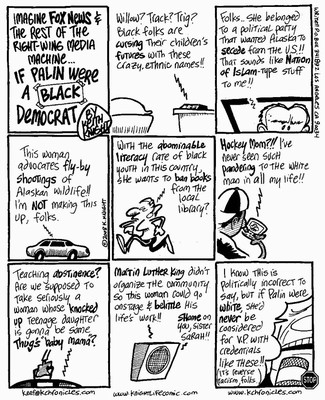
Keith Knight asks how the corporate media would treat Sarah Palin if she were black anda Democrat.  Here’s his scenario:

Chronicles, November 2008

Scott Richert expresses consternation that many who identify themselves as conservative Catholics support the vice presidential candidacy of Alaska Governor Sarah Palin.  Aren’t Catholics supposed to embrace what Pope John Paul II called “the theology of the body,” and with it the idea that women should not be in public life?  “I will offer a prayer on Election Day that Mrs. Palin’s presence on the ticket does not signal the final triumph of feminism over the traditional Christian understanding of the proper relationship between the sexes.” 

Thomas Fleming reviews Peter Green’s The Hellenistic Age, endorsing it overall but showing a bit of irritation that Green uses the word “racism” to describe bigoted attitudes the ancients exhibited.  Fleming claims that “racism as an ideology is a 19th century development that can only be applied by analogy to the ancient world.  To describe [theancient Greeks’] natural prejudices as ‘racism’ would be like describing infant exposure as ‘pro-choice’ or homosexuality as an expression of ‘gay rights.'”  Fleming has a point here, but I think he overstates it.  Certainly a word like “racism” carries powerful associations, bringing in not only the theoretical structures to which Fleming refers but also centuries of history and whole worlds of trauma that are quite distant from anything the ancients would have known.  Nonetheless, their attitudes can hardly be dismissed as “natural prejudices.”  While the ancients may not been shaped by the ideas of Gobineau or Francis Galton, they were indeed swaddled in myths promoting the superiority of their own groups and were taught to see natural slaves when they looked at people who did not resemble themselves.  

Most of the poems Chronicles runs are pretty bad, and I can’t really make much of a literary-critical case for this one.  But I’m such a pushover for dogs I’ll include it anyway.

Four Firsts and a Last, by Timothy Murphy

Her first retrieve shell: a shotgun shell

Fired and ejected with no warning.

How she adored that smell,

Charcoal, sulfur, and niter in the morning.

Her first bird was a crippled morning dove.

She somersaulted down a ditch

Head over heels in love,

Buttoned her bird and bounded up to the pitch.

Her first drake dropped beyond a refuge sign.

Wriggling under the lowest wire,

She swam a perfect line

As though posting proof of her desire.

Her first loss was her superhuman ear.

Hand signalled on an unmarked run,

She could no longer hear

Whistling wingtips; even, at last, the gun.

At fourteen she was walking into walls,

Fouling the carpet, losing teeth.

Farewell to mallard calls

And decoy spreads, wild roosters on the heath.

To St Francis of Fargo fell the chore,

The barbital a gentle thrust

To launch her from our shore.

The last look in her fearless eye was trust.

Masks

Halloween may be over, but that’s no reason to put all the masks away until next year.  The masks below are among several Indonesian masks featured in this gallery on weirdomatic.


Counterpunch, 1-15 Oct 2008

Alex Cockburn and Jeffrey St. Clair review some stories connected with soon-to-be-over presidential campaign.  They report that “a friend of ours in Landrum, South Carolina” has been making some inquiries.  Pretending to be a McCain/ Palin campaign worker, this friend attracted snarls of disgust in towns that voted almost unanimously for Bush/ Cheney in 2004.  In the countryside, the friend found that the GOP strategy  of trying to tie Mr O to terrorists and other scary types has had the effect of keeping elderly rural Republicans from putting up yard signs for McCain/ Palin.  Apparently they’re afraid Mr O will send the Weather Underground to bomb them. 

David Bonner reminisces about George DeMerle (aka George Demmerle, aka Prince Crazy, Son of Yippie,) a John Bircher who became a professional FBI informant in the 60s underground.  DeMerle earned his pay from the FBI by exposing his associates Jane Alpert, Sam Melville, Dave Hughey, and Patricia Swinton as they were in the act of planting bombs under US Army trucks at the 69th Regimental Armory in Manhattan.  DeMerle seems to have enjoyed playing the role of a far-out hippie and revolutionary radical, and even after he was exposed and rendered useless as an FBI asset he continued to live as Prince Crazy.  

As a fan of the Flashman novels, I’d be remiss if I didn’t mention that the Counterpunch website today has an article by Cockburn comparing Crazy John McCain to Sir Harry.

Some insignia and badges from the Royal Collection

The queen of England, she’s got a lot of stuff.  She has a website where she lets you look at some of it.  Here are a few items from the “Insignia and Badges” section. 

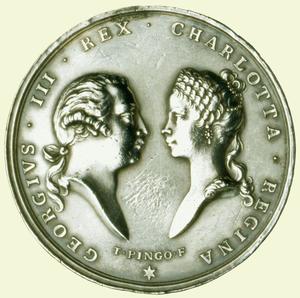
The birth of the future King George IV

The birth of the future King George IV


Medallion honoring Captain James Cook

Medallion honoring Captain James Cook


Cameo for a badge of the Order of Victoria and Albert

Cameo for a badge of the Order of Victoria and Albert


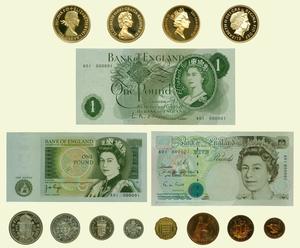
Coins and banknotes from the reign of Elizabeth II

Coins and banknotes from the reign of Elizabeth II

The American Conservative, 20 October 2008

Psychotherapist Jim Pittaway looks at John McCain and sees a man badly in need of psychiatric evaluation.  Pittaway stresses that he would never diagnose a patient whom he has not met, but published accounts of McCain’s experiences and behavior suggest that he may suffer from moderate Traumatic Brain Injury.  Pittaway writes:

There are three signal characteristics of moderate TBI: emotional disregulation (volatility), perseveration (inability to let go of thoughts or feelings or to see them in broader perspective), and concrete thinking (abstractions and nuance are compressed into right or wrong, good or evil, people are either “for me or against me.”) 

McCain’s notoriously bad temper (for example, hitting a 93 year old colleague on the Senate floor), his insistent repetition of ideas that have been proven false (for example, claiming that Iran was arming the anti-Iranian group “al Qaeda in Iraq,” a claim that earlier this year humiliated him when he had to be publicly corrected by a friend- and which he then continued to repeat at subsequent appearances), and his habit of describing every conflict as a moral struggle (for example, briefed on some structural difficulties in international finance his response was to ask the briefer “So, who’s the villain?”) suggest the behavior patterns associated with moderate TBI.  Torture and beatings McCain has described receiving from his North Vietnamese captors could hardly have failed to inflict substantial injury on his brain.  Psychiatric tests and neurological scans can rule TBI in or out rather easily, but McCain has made it clear he will never submit to such examination.  McCain’s stated belief that he avoided any psychological damage by sheer willpower is what psychologists call “magical thinking,” and suggests that his psychological wounds are surrounded with a formidable structure of denial. 

Pittaway himself has treated many TBI patients, and his description of their lives is terrifying if it applies to a man who may find his finger on the nuclear trigger.  “Difficulties with abstract thinking breed obsessive behaviors and tendencies to personalize issues in very concrete terms in lieu of dealing with nuance and complexity.”  Moreover:

In my work with TBI patients with moderate symptoms, I am invariably struck by the level of frustration they encounter on a daily basis.  Unless it is severe, brain injury is a closed wound.  Since victims appear undamaged, everyone around them expects- and they themselves often expect- normal skill sets, behaviors, and emotional ranges.  The energy it takes to compensate for functional deficits is extraordinary, and the absence of affirming feedback breeds a senseof isolation that morphs over time into deep-seated resentment.  It ismuch, much easier to stay focused on one thing, which accounts for the characteristic obsessiveness.  Execution is driven by resentment and anger rather than objective circumstances.  Thisbreeds a toughness that can endure enormous amounts of stress before decompensation- which is almost always of an extremely violent nature- occurs.

Elsewhere in the same issue, David Gordon looks at Public Choice Economics.  Public Choice economists argue that indifference to politics is rational among voters, inasmuch as no one vote is likely to decide an election.  Gordon points out that there are other motives for voting than the hope that one will decide the election.  For example, even votes for a losing candidate may send a message that the eventual winners will notice, and being among the winners of a high-profile contest brings a satisfaction that many people desire. 

John Derbyshire reviews the “Stuff White People Like” book.  Unlike The Atlantic‘s reviewer, Derbyshire doesn’t get the significance of the phrase “White People”-the targets of Lander’s mockery are trendy progressives who would hate to be labeled as typically white.  He does mention Lander’s personal favorite among sites that have imitated his, “White Stuff People Like” (plaster, cream cheese, plastic bags, swans, mayonnaise, cocaine, and snow are the list so far.)

The Nation, 3 November 2008

This issue starts with letters from writers upset with the magazine for publishing Sydney Schanberg’s piece on American POWs unaccounted for after the US disengaged from the Vietnam War.  These correspondents cite their own published work indicating that North Vietnam did not hold American POWs back and arguing that the story that it did merely enables Americans to see in their own captive countrymen as the main victims of the Vietnam War.  In response, Schanberg points out that his critics do not offer new information or level any specific criticisms of his research. 

Eric Foner reviews Philip Dray’s Capitol Men: The Epic Story of Reconstruction Through the Lives of the First Black Congressmen.  The sixteen African American members of Congress Dray discusses led exciting lives, and Foner mentions several of the rollicking tales of adventure featured in the book.

Counterpunch, 16-30 September 2008

Is McCain sicker than we know, ask Alex Cockburn and Fred Gardner.  Cockburn’s attitude towards McCain is properly lurid and sensationalistic; here he speculates that Crazy John might be in the terminal stages of melanoma. 

http://www.counterpunch.org/