Crooked Brains

Sometimes I look at Crooked Brains, a website that seems to consist mainly of pictures somebody collected by doing Google Images searches.  I first found it while doing a Google Images search to collect pictures for this site.  So here are a few of that person’s finds.  The captions are mine.

From a post called “Art with Eatables“:

Egg Pram

Egg Pram

Strawberry

Strawberry

Musk Melon

Musk Melon


From a post called “Perfect Timed Photos

Mismatch

Mismatch

(more…)

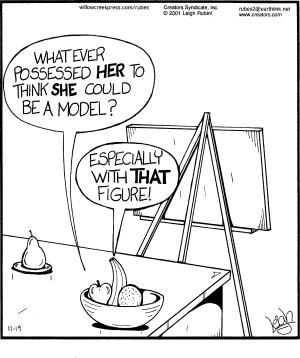
With that figure!

From yahoo:

with-that-figure

The Nation, 1 December 2008

Nick Turse looks into American forces’ conduct of the war in Vietnam’s Mekong Delta in the period from 1 December 1968 to 1 April 1969.  Turse concludes that the facts were much worse than has generally been known in the USA.  Civilians were targeted more systematically than has been acknowledged, more of them were killed than has been acknowledged, and a coverup of the some of the worst atrocities continued for decades.  Turse quotes a contemporary letter signed “Concerned Sergeant.”  The otherwise anonymous soldier denounced the operations to which he was attached and estimated that the rate at which unarmed civilians were being killed amounted to “a My Lai a month.” 

Ever since Studs Terkel died, The Nation has been memorializing him.  In this issue, his editor, Andre Schiffrin, remembers their attempt to put together an oral history on the topic of power.  The project failed because none of their prospective subjects would even admit that he held power, let alone give insight into what it was like to use it.  That’s hardly surprising when Schiffrin describes the key to Terkel’s work.  His subjects talked to him, Schiffrin explains, because “he approached people with utter respect.  Those he talked to immediately felt this and poured their hearts out.”  Powerful people usually seem to expect to be approached with utter respect, if not indeed with abject servility.  That so many people from so many backgrounds found it a shock to be approached with respect is a sad commentary on our society. 

Hoosiers and others marveling at the fact that Indiana voted for Obama will enjoy Mark Hertsgaard’s piece about Luke Lefever, a plumber (a real one!) who volunteered for the Obama campaign in Elkhart. 

Siddhartha Deb reviews several novels by Elias Khoury.  At first, Deb praises the “fragmented” style of Khoury’s work as suitable to his native Lebanon, but at the end he suggests that the time may have come for a smoother style of writing and, apparently, a more settled view of Lebanese identity.

This brings us to Barry Schwabsky’s review of Art Worlds by Howard S. Becker and Seven Days in the Art World by Sarah Thornton.   Becker’s newly reprinted 1982 book is a sociological study of various milieux from which products came that could be called “art,” while Thornton, also a sociologist, spent her time in “an art world that claims the right to call itself the art world.”  Schwabsky puts the question:

In the sociologist’s art world, hierarchies, rankings, and orders of distinction proliferate.  Status and reputation are all, and questions about them abound.  Why does the seemingly kitschy work of Jeff Koons hang in great museums around the world while the equally cheesy paintings of Thomas Kinkade would never be considered?… How do conflicting views on the value of different kinds of artworks jell into a rough and shifting consensus about the boundaries of what will be considered art in the first place?

That’s quite a weighty question.  As for the Koons/ Kinkade riddle, my suspicion is that perspective drawing and the rest of the conventional skills of representational art are not really all that difficult to master.  Some years ago I read an essay by Eric Gill called “Art in Education: Abolish Art and Teach Drawing,” in which he argued that given a chance virtually any child could and would learn these techniques.  I haven’t seen any scientific work testing this hypothesis, but it doesn’t seem fantastic to me to think that if all children were introduced to art in the same way that, let’s say, Thomas Kinkade was, that some large percentage of the population would grow up to paint pictures very much like his.  If that is so, then the problem with Kinkade isn’t that he’s cheesy, but just that they are nothing special.  If a collector wants to attain a high rank, s/he can hardly buy paintings that may be very pleasant but that could be equalled by, let’s say, a third of the adult population. 

(more…)

Banana Scrimshaw

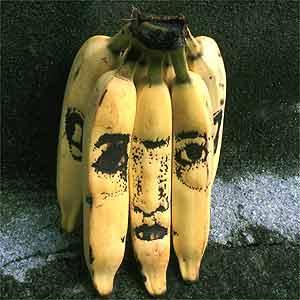
Here’s a form of banana art we’ve not yet covered on Los Thunderlads, art made by incising marks into the peels of bananas.  For example, this piece by Brazilian sculptor Tonico Lemo Auad, a face made of pinpricks that becomes visible only as the banana rots:

face

face

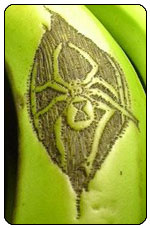
This one, via The Yummy Banana, apparently first appeared on The Tattooed Banana, but it seems to have been removed from that site.

Spider Tat

Spider Tat

(more…)

The American Conservative, 17 November 2008

In a used book store years ago, I bought some old issues, circa 1965, of National Review.  They weren’t all that interesting on their own merits.  What stuck in my mind about them was the sadness that ran through them.  Each article seemed to be a form of mourning for a kind of politics that was no longer possible, for a kind of country that no longer existed.

That’s very much the feeling I got from this issue of The American Conservative.  The cover features a checklist of G. W. Bush’s “Missions Accomplished”: “Start a war (or two); Shred Constitution; Crash economy” etc, etc.  Inside is a five article retrospective on the horrors of the Bush-Cheney administration (including articles by our old friends Alexander Cockburn and Allen Carlson.)  As Bush and company prepare to leave office, these articles take on a strangely distant sound.

Michael Brendan Daugherty looks at the results of California’s Proposition 8 and concludes that it is likely to be the last victory that he and his fellow opponents of same-sex marriage will be likely to celebrate.  Pointing out that Proposition 8 and similar measures have passed only because so many voters aged over 65 backed them, Daugherty claims that “Absent an incredible shift in attitudes, same sex marriage will soon command majority support.”

David Gordon gives a favorable review to James Kalb’s The Tyranny of Liberalism.  Apparently Kalb defines “liberalism” as “the rejection of moral authorities that transcend human purposes,” and from this definition lays great mischief at the feet of the liberal tradition.  I’ve read several interesting articles by Kalb, for example in the journal Telos, and have gone to his blog in hopes of finding more like those articles.  But I must say I’ve been disappointed.  His editors must add a lot of value to his work- the blog usually includes several overly abstract defenses of the Roman Catholic faith that Kalb has adopted, interspersed with current affairs commentary from what it might be charitable to call an anti-Zionist perspective.

I’m getting to be quite fond of their backpage columnist, Bill Kauffman.  This time around Kauffman remembers novelist John Gardner, who like him lived in Batavia, New York.  After describing the lengths to which he and his fellow Batavians have gone to keep the memory of Gardner and his works alive, Kauffman interjects, “You know what?  Gardner is not even among my hundred favorite American novelists.  But he is ours.  That is enough.”  When I was a teenager, I read Gardner’s The Art of Fiction.  I remember that it was pleasant to read, that’s all I do remember of it.

Spiderman opening

At noon on days when I was six, channel 44 from Chicago showed the Marvel Superhero cartoons from the sixties.  These cartoons were shorts featuring in turn six of that company’s characters, Spiderman, the Hulk, Captain America, Thor, Iron Man, and the Submariner.  The opening of the Spiderman cartoon gave me a thrill, a rush of tension in my upper arms and middle chest.  When I saw it on youtube, I still got precisely the same thrill.  It’s interesting how persistent a conditioned response can be!  So here’s the stimulus. 

The Nation, 24 November 2008

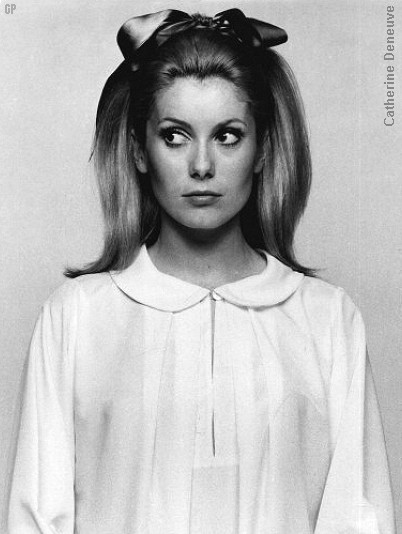
She doesn't look like this anymore(image)


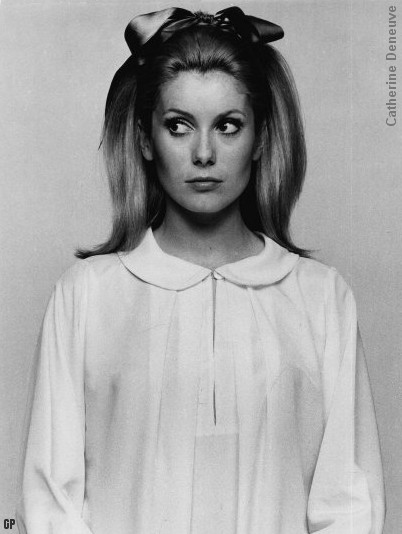
This issue is mostly topical and therefore unlikely to bring me back for a second look.  I always enjoy Stuart Klawans’ movie reviews, so I’ll make note of his contributions here on A Christmas Tale and Synecdoche, New York.  Catherine Deneuve is in A Christmas Tale, so I’ve included the image above (she doesn’t look like that anymore, but this is the most interesting photo of her I could find) (not counting nudes, of course.)

Obit Magazine

If you like obituaries, you’ll like Obit.  They have some nifty features, like pairing people who died on the same day.  For example, did you know that British writers C. S. Lewis and Aldous Huxley both died 45 years ago today, on 22 November 1963?  They don’t mention it, but President Kennedy did too.

Sydney Parkinson’s botanical drawings

Thanks to “The Artist and His Model” for posting a gallery of botanical drawings by Sydney Parkinson.  Evidently they found the drawings here.  All of the pictures are lovely; I’ve copied a few of my favorites below.

parkinson03

(more…)

Science and Buddhism

Heracles/ Vajrapani as the protector of the Buddha; a Greco-Buddhist relief from Gandhara

Heracles/ Vajrapani as the protector of the Buddha; a Greco-Buddhist relief from Gandhara

(image)

Via 3quarksdaily, a report on relations between some Buddhists and some scientists:

The Dalai Lama is keen for Buddhists and scientists to interact.

In the troubled relationship between science and religion, Buddhism represents something of a singularity, in which the usual rules do not apply. Sharing quests for the big truths about the Universe and the human condition, science and Buddhism seem strangely compatible. At a fundamental level they are not quite aligned, as both these books make clear. But they can talk to each other without the whiff of intellectual or spiritual insult that haunts scientific engagement with other faiths.

The disciplines are compatible for two reasons. First, to a large degree, Buddhism is a study in human development. Unencumbered by a creator deity, it embraces empirical investigation rather than blind faith. Thus it sings from the same hymn-sheet as science. Second, it has in one of its figureheads an energetic champion of science. The current Dalai Lama, spiritual leader of Tibetans, has met regularly with many prominent researchers during the past three decades. He has even written his own book on the interaction between science and Buddhism (The Universe in a Single Atom; Little, Brown; 2006). His motivation is clear from the prologue of that book, which Donald Lopez cites in his latest work Buddhism and Science: for the alleviation of human suffering, we need both science and spirituality.

(more…)