William Eggleston

From "Cadillac"

From "Cadillac"

The only thing I wanted to note about the January 12/19 issue of The Nation was a review of an exhibition of photographs by William Eggleston.  So here are some photos by Eggleston, courtesy of The Eggleston Trust.

From "Southern Suite"

From "Southern Suite"

Patrick McGoohan, RIP

prisoner-7718161

Fans of 60s TV shows aimed at people who want to feel smart will join me in mourning the death of Patrick McGoohan, star of The Prisoner.

Jem Cooke’s recent youtube videos

Some new Jem Cooke videos went up on youtube last month.  They are

Endings

“(It Happened) Yesterday,” a tribute to her parents on their 31st wedding anniversary

Where You Stand

New Year, Old Right

The latest issues of my two standard “paleocon” reads, The American Conservative and Chronicles, include fewer really noteworthy articles than average.  The election of Mr O as president and a solidly Democratic Congress freed them to turn from the constant struggle to show how they differ from the Bush/ Cheney Right and toward standard-issue conservative territory, denouncing government spending, unconventional family structures, etc. 

The contest, 1972

The contest, 1972

In The American Conservative, Daniel McCarthy argues that George McGovern’s 1972 presidential campaign triggered a transformation of the Republican Party by driving Cold War liberals into its ranks.  Mary Wakefield reviews Richard Dowden’s Africa: Altered States, Ordinary Miracles, Wakefield reports that Dowden, the current director of the Royal African Society, is deeply pessimistic about western programs to aid Africa, but deeply optimistic about Africans’ ability to build a future for themselves if left alone. 

Sheldon Richman offers a succinct explanation of the Austrian school of economics’ theory of malinvestment and uses this theory to explain the current financial crisis.  David Gordon reviews a book by the most celebrated living opponent of the theory of malinvestment, Paul Krugman. 

Aung San Suu Kyi

Aung San Suu Kyi

Jim Pittaway,  licensed psychotherapist and friend of the late Michael Aris, applies his professional expertise and his personal animosity to Aris’ widow, Aung San Suu Kyi, to an analysis of western policy towards Burma.  The professional expertise part is quite illuminating.  Suggesting that we should view the Burmese regime’s relationship to its people as one of captor to hostage, he asks us to apply “the biggest rule of hostage crises: unless you can take him out right now, don’t threaten the perp.”  Since the 1990 election, the West’s dealings with Burma have consisted primarily of a series of idle threats, and the hostages have paid the price. 

(more…)

Spinach and rice omelette

popeyes-date

If you have traditional ideas about breakfast food but you need to start the day with iron, you might try this quick and tasty meal.

 Take six ounces of canned spinach and squeeze it dry.  Mix it with one cup of cooked rice. 

Break three large eggs into a cup.  Add milk and stir until the mixture is even. 

Drop a pat of butter into a frying pan.  Heat the frying pan until the butter starts to melt.  Then pour the milk and eggs mixture in.  Stir the butter through the mixture a few times, then add the spinach and rice, one forkful at a time.

Click here for more omelette recipes.

Words with nonpejorative technical uses and nontechnical pejorative uses

There are some words which have both a technical meaning in some field of study and a pejorative meaning that is more widely known.  A notorious example is “Negro,” which now tends to be used as a slur in colloquial English but which physical anthropologists still use because none of the alternatives captures the meaning they need to express.  Another example would be “cult.”  In the study of religion, “cult” is the rites and practices of a particular group.  A scholar of religion could refer to any faith group as having a “cult” in this sense and be confident that no one would take offense.  Of course, there’s also the pejorative sense of “cult,” a sect considered false or extreme. 

The word “essentialism” is at the head of a whole category of examples.  Some philosophers hold that each entity in the universe has a number of qualities, that some of these qualities are more important to the entity than others, and that human reason is capable of distinguishing the more important qualities from the less important ones.  This view is called essentialism.  Essentialism in this sense is a perfectly respectable philosophical position, and from the days of Plato and Aristotle down to the present it has consistently commanded the allegiance of many eminent thinkers.  Few would claim that these thinkers have proven beyond doubt that essentialism is true, but it is certainly plausible.  Indeed, while virtually anyone who has read a little Plato can put up a reasonable case for essentialism, it takes a considerable philosophical background to make a sensible case against it. 

The same word is used in a different, though related sense.  Many postmodernist thinkers use the word “essentialist” as a sort of curse word.  In their parlance, “essentialist” often seems to mean something like “stereotyped” or “inattentive to details.”  The “essentialism” they invoke seems to be an image of a person who slaps hasty definitions on categories, assigns other people to those categories, and proceeds to interact with the people as if the only qualities they had were those that defined the categories to which they were assigned.  So, someone who decides to equate “ukuleleist” with “weirdo who doesn’t want to grow up” might meet someone who plays the ukulele and insist on always and only treating that person as a weirdo who doesn’t want to grow up.  Sociologists among you will be reminded of the role of labeling in social relationships, but I think you can see that this use of the word “essentialism” is a gross caricature of the philosophical position I sketched above. 

The names of many philosophical schools and positions have been subjected to this kind of semantic shift.  So the ancient Epicureans argued that pleasure was a positive good; their opponents transformed their name into a synonym for “gourmand.”  The Stoics argued that a right understanding of nature’s laws would free the mind from fear; now we say “stoic” when we mean “unemotional.” 

(more…)

Poems by Conrad Aiken and Robert Frost

Aurora e Titone, by Francesco de Mura

Aurora e Titone, by Francesco de Mura

 (image)

In Greek myth, Tithonus was a Trojan prince, the brother of King Priam.  According to a poem of the early seventh century BC, the Homeric Hymn to Aphrodite (lines 218-238,) Tithonus’ youthful good looks attracted the attentions of Eos, the goddess of the dawn.  Aphrodite had condemned Eos to lust after mortal men.  Eos abducted Tithonus and kept him in her mysterious land in the east.  She lavished him with gifts.  Eos went so far in her generosity to Tithonus as to ask Zeus to make Tithonus immortal.  That may have been going too far, or not far enough- Eos neglected to ask Zeus to stop Tithonus’ aging.  So he grew old, lost all ability to move his limbs, and took to babbling incessantly.  Eos locked him up in a golden chamber when this happened.  The hymn’s detail about Tithonus’ babbling may be reflected in later traditions that represent him as a great singer.  The fifth-century BC writer Hellanicus of Lesbos says that Eos took pity on him and turned him into a cicada, a creature whom the ancients suspected might be immortal.  In the poem below, Aiken follows the modern tradition of representing Tithonus as a grasshopper rather than a cicada.

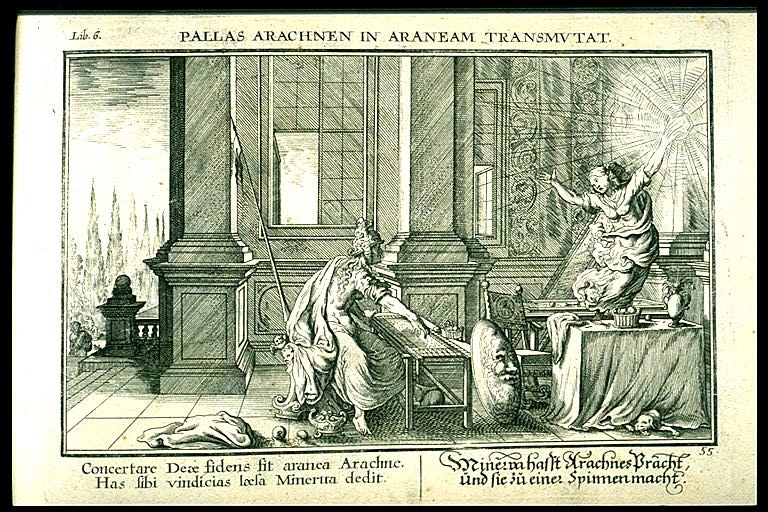
Arachne transformed, from a 1703 edition of the Metamorphoses of Ovid illustrated by Johann Wilhelm Bauer

Arachne transformed, from a 1703 edition of the Metamorphoses of Ovid illustrated by Johann Wilhelm Bauer

(image)

According to Ovid’s Metamorphoses, Arachne was a maiden from Lydia in Asia Minor who challenged the goddess Minerva (the Greeks would have said the goddess was Athena) to a weaving contest.  When Arachne won this contest, the goddess responded with such fury that Arachne hanged herself.  Taking pity on her victim, Minerva revived the girl in the form of a spider.  Ovid represents Arachne as an innocent, though she has been thought of in other ways at other times. The story of Arachne’s encounter with Tithonus appears to be Aiken’s own invention.  Aiken also takes some further liberties with the story, as you will see. 

(more…)

Boxing Day

Referee Micky Vann ends a fight between  Amir Khan and Martin Kristjansen, 5 April 2008:

Micky Vann

Micky Vann

Referee Ian St. John steps in between Kevin Mitchell and Carl Johanneson, 9 March 2008:

Ian St John

Ian St John


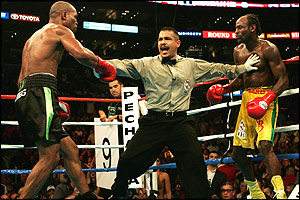
Referee Raul Caiz Jr separates Bernard Hopkins and Howard Eastman, 19 Feb 2005:

Raul Caiz, Jr.

Raul Caiz, Jr.

(more…)

Merry Christmas!

Seasons greetings from 1948:

Mr & Mrs Acilius

Mr & Mrs Acilius

Victoria Vox wants to spend Christmas with you