
Quite possibly the funniest character from any movie in the teens-in-a-cabin-get-mutilated genre:
All posts for the year 2008
Cabin Fever: Deputy Winston
Posted by CMStewart on December 13, 2008
https://losthunderlads.com/2008/12/13/cabin-fever-deputy-winston/
Cabin Fever: Pancakes!
Quite possibly the best scene from any movie in the teens-in-a-cabin-get-mutilated genre:
Posted by CMStewart on December 13, 2008
https://losthunderlads.com/2008/12/13/cabin-fever-pancakes/
Dreams on Screens
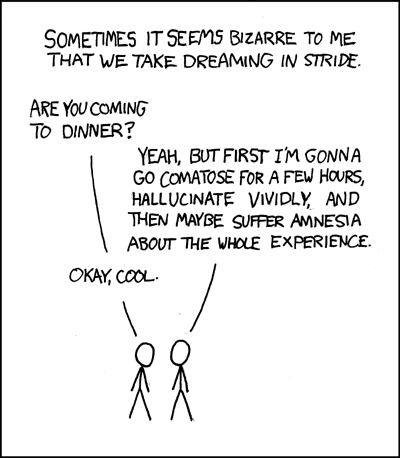
dreamcollector.wordpress.com cartoon by toby
http://news.yahoo.com/s/afp/20081211/sc_afp/sciencejapanbrainoffbeat_081211052641
Posted by CMStewart on December 12, 2008
https://losthunderlads.com/2008/12/12/dreams-on-screens/
Political Perceptions

http://rightwingnytimes.cf.huffingtonpost.com/
Scroll over The New York Times masthead for different perceptions.
Posted by CMStewart on December 11, 2008
https://losthunderlads.com/2008/12/11/political-perceptions/
They shall beat their swords into plush chairs
Thanks to haha.nu for posting about The Peace Art Project Cambodia, which turned decommissioned small arms into furniture and sculptures.

Posted by acilius on December 10, 2008
https://losthunderlads.com/2008/12/10/they-shall-beat-their-swords-into-plush-chairs/
Jake Shimabukuro on NPR
According to boingboing.net, NPR yesterday reaired its 2006 feature on ukulele virtuoso Jake Shimabukuro. Jake Shimabukuro had a big youtube hit two years ago with a Central Park performance of “While My Guitar Gently Weeps.”
Posted by acilius on December 10, 2008
https://losthunderlads.com/2008/12/10/jake-shimabukuro-on-npr/
Cuneiform tablets

A Mesopotamian cuneiform tablet in the British Museum
Thanks to 3quarksdaily for linking to this article in The London Review of Books about an ongoing British Museum show called “Babylon: Myth and Reality.” Apparently the exhibition concentrates on cuneiform tablets. The article explains what we know about cuneiform tablets as a medium and speculates on what we may yet learn about them.
Posted by acilius on December 10, 2008
https://losthunderlads.com/2008/12/10/cuneiform-tablets/
Disability visibility
Kay Jewelers has been running a series of ads this Christmas season about a deaf woman whose boyfriend is trying to learn sign language and regaling her with gifts of jewelry. The ads prompted me and Mrs Acilius to try to think of other commercials for products not specifically related to disabilities that feature disabled characters. We couldn’t remember ever having seen one. Can you?
Posted by acilius on December 10, 2008
https://losthunderlads.com/2008/12/10/disability-visibility/
A feature of Black English
John McWhorter on the tendency of Black English to drop the possessive -‘s case ending. I wonder if Black English is really different from other Englishes in this tendency, or if it is just more advanced. English speakers tend to drop case endings generally; so for many English speakers, alternations like I/me and we/us don’t come naturally any longer, and as a result we hear expressions like between you and I. All oblique case forms seem to be on the way out. Why would we expect -‘s to survive?
Posted by acilius on December 10, 2008
https://losthunderlads.com/2008/12/10/a-feature-of-black-english/
The Nation, 22 December 2008

Giorgio Morandi, Natura Morta, 1916
It’s usually the reviews that feature most prominently in my notes about The Nation. That’s because the notes are about things I might want to look up again, and The Nation‘s articles and columns are usually of strictly timely interest. This week’s issue is no exception.
In this issue, Arthur Danto reviews a retrospective of Giorgio Morandi‘s paintings currently showing at the Metropolitan Museum of Art. I’ve always had a fondness for Morandi’s subdued color schemes and restricted perspective. Danto claims that the objects in Morandi’s still lifes seem much more active than is typical for the genre; sometimes they seem “to interact and jostle” as if competing for space on the table. He cites this 1961 painting as an especially crowded one. He may be onto something; for example, this 1914 piece does seem to point forward to the Futurists. But more often when I look at Morandi I see pictures like the one I’ve posted here, quiet images that neither call out for attention with flash nor resist the viewer with trickery, but, rather, allow those who are so minded to take whatever look they wish.
Throughout a review of a reissue of Lionel Trilling’s The Liberal Imagination runs the question of what it might mean for literature to have, as Trilling always insisted it should have, a serious moral purpose. Trilling tries to answer the question with a remark about The Adventures of Huckleberry Finn, an answer the reviewer finds unsatisfactory:
“No one who reads thoughtfully the dialectic of Huck’s great moral crisis will ever again be wholly able to accept without some question and some irony the assumptions of the respectable morality by which he lives, nor will ever again be certain that what he considers the clear dictates of moral reason are not merely the engrained customary beliefs of his time and place.” One response to this might be to say that anyone capable of this kind of “thoughtful” reading is not likely to be a prisoner of social convention in the first place, and vice versa. The passage risks both patronizing the imagined reader and imputing an unrealistic power to Twain’s book. In such passages, the adjective “moral” appears overworked, now indicating the merely conventional social codes, now referring to the wider human vision offered by the critic.
A fair criticism, one must admit. Humanists from Plato on would have to plead guilty to the charges the reviewer levels against Trilling here.
Elsewhere in the issue, Katha Pollitt quotes New York University historian Linda Gordon, a founder of Feminists for Obama, calling on feminists to keep up pressure on Mr O, since that’s what their opponents will be doing. She also quotes an op-ed by economist Randy Albelda calling for increased investment in health, education, eldercare, and other industries that employ many women as part of any economic stimulus plan. Alexander Cockburn points out that in the aftermath of the Mumbai shootings, several top Indian officials were driven from office in disgrace, a stark contrast with the failure of any senior American to so much as admit error in the aftermath of 9/11. Stuart Klawans reviews recent films Milk, Australia, and Wendy and Lucy.
Posted by acilius on December 10, 2008
https://losthunderlads.com/2008/12/10/the-nation-22-december-2008/
Who writes this?
 acilius
 believer1
 lefalcon
 losthunderlads
 vthunderlad
 Panther Red