
“Tucson,” written by Victoria Vox; ukulele and vocals, Victoria Vox; cello, melaniejane.
All posts for the year 2008
Victoria Vox’ “Tucson” for ukulele and cello
Posted by acilius on October 8, 2008
https://losthunderlads.com/2008/10/08/victoria-vox-tucson-for-ukulele-and-cello/
More from the antiwar Right
The American Conservative, 8 September 2008
Two major articles deal with the fear that haunts many of the “Old Right” contributors to this publication, the fear that America is becoming dependent on foreign powers. An obituary for Lieutenant General William Odom discusses the testimony the general gave to the US Senate in early April, in which he pointed out that US forces in Iraq depend “on a long and slender supply line from Kuwait, which runs through territory controlled by Shi’ite forces friendly to Iran” [a quote from the obituarist, not Odom’s own words.) American service personnel in Iraq are therefore hostages at the disposal of Iran.
Andrew Bacevich attacks American consumerism and its economic consequences. Our insatiable appetite for luxuries, Bacevich argues, has saddled us with debts and a dependence on imported fuels that we can manage only by maintaining a constant war footing, while our wars serve only to increase our debts and deepen our dependence.
The American Conservative, 25 August 2008
Remember George W Bush saying that the fall of Saddam Hussein meant that the “rape rooms” in his prisons would forever close? Abu Ghraib made a sick joke out of that boast. Well, the return of rape rooms wasn’t the end of it. Since the current war began in March 2003, well over 2 million Iraqis have been forced from their homes. Most of them left empty-handed. How have they been surviving since? Kelley Beaucar Vlahos shows how; tens of thousands of Iraqi women and girls have been forced into prostitution. No one in authority is even collecting statistics about these victims of daily rape, much less trying to help them. On the contrary, when it was revealed that a major US defense contractor was shuttling women and girls between Kuwait and Baghdad to be used as sex slaves, the story went nowhere. The matter remained so obscure that even Vlahos misreports the name of the whistleblower who revealed it. She calls him Bruce Halley. His name is Barry Halley.
Posted by acilius on October 7, 2008
https://losthunderlads.com/2008/10/07/more-from-the-antiwar-right/
Samuel F. B. Morse
He invented Morse code, but he also painted. For example:

Above is one of his two most famous pictures, commissioned (but never paid for) by Congress; below is the other:
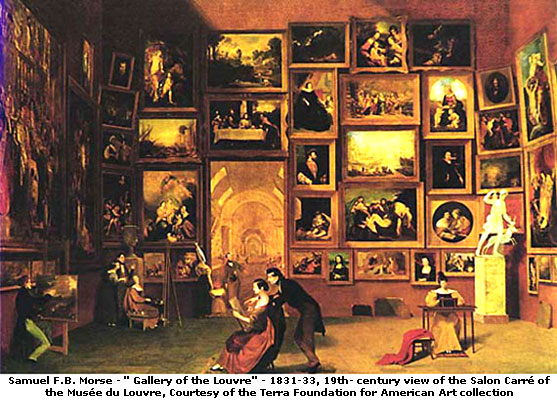
After the jump, some of his portraits.
Posted by acilius on October 7, 2008
https://losthunderlads.com/2008/10/07/samuel-f-b-morse/
The Atlantic Monthly, October 2008
This issue‘s cover features a controversial picture of Senator Crazy John McCain.

Hail the Leader!
The controversy mainly has to do with the photographer’s other images of McCain. The Atlantic defended the image above.
The legend, “Why War is His Answer,” seemed eerily apt- the magazine arrived in the same mail as a gift from a friend (thanks, cymast!) a Quaker “War is Not the Answer” bumper sticker.

Interesting points after the jump.
Posted by acilius on October 7, 2008
https://losthunderlads.com/2008/10/07/the-atlantic-monthly-october-2008/
Grandfather Sculpture






My Pap-pa Irvin Passed away in Jan. 2001. Around the same time I took an art class at Indiana State University. When the instructor said that he had some sculptures for sale I was happy because I really liked the Idea of owning an original piece of art. I chose this one because the story that went with it reminded me of my Pap-pa Irvin. Unfortunately I do not remember the story or the artist’s name. If I found out any of this important information I will post it.
LESSON LEARNED: write stuff down
Posted by believer1 on October 6, 2008
https://losthunderlads.com/2008/10/06/grandfather-sculpture/
Buddy 911
Remember Jake the amazing dog? Well, he is not the only dog who calls 911. Buddy, a german sheperd, assists his human by calling 911 when his human has a seizure. This is truly remarkable!
Posted by believer1 on October 3, 2008
https://losthunderlads.com/2008/10/03/buddy-911/
Henry Darger
The middle image from a triptych:

Religious education
You may have seen the 2004 movie In the Realms of the Unreal, a documentary about the life of artist Henry Darger. A friendless eccentric, Darger lived alone for decades. Only when he left his apartment for the last time to go to the hospital did his landlord discover a 15,000 page graphic novel, The Story of the Vivian Girls, in What is Known as the Realms of the Unreal, of the Glandeco-Angelinian War Storm, Caused by the Child Slave Rebellion. Darger had been writing and illustrating this work from 1909 to 1973. The haunting beauty of the book’s illustrations, the bizarre innocence of its story, and the extreme solitude of Darger’s life combined to make him an icon of the Romantic cult of the outsider artist. The movie enjoyed considerable success, several books about him have been published, and any number of museums have exhibited his works. The Story of the Vivian Girls has never been published in its entirety, though as Darger continues to attract attention it begins to seem possible that it might someday be. There are three more pictures after the jump.
Posted by acilius on October 3, 2008
https://losthunderlads.com/2008/10/03/henry-darger/
The Nation, September and October 2008
1/8 Sept– Kristina vanden Heuvel quotes Mikhail Gorbachev’s Washington Post op-ed on the Georgian crisis, claiming that “if we had heeded his vision of a truly post-Cold War world, we might not today be confronting such dangerous geoploitical gamesmanship.” Vanden Heuvel points out that in Kosovo, the West supported the KLA’s demands for independence on grounds that treated the right of self-determination as all-important, the sovereignty of the nation-state as unimportant. In Georgia, we oppose the Abkhazians and South Ossetians in their demands for independence on grounds that treat the sovereignty of the nation-state as all-important, the right of self-determination as unimportant. Unless we can practice foreign policy in such a way as to show equal respect to these twin principles, vanden Heuvel argues, there will be no hope for world peace.
Stuart Klawans recommends Trouble the Water, a documentary about the destruction of African-American New Orleans during and after Hurricane Katrina made by African-American New Orleanians in New Orleans during and after Hurricane Katrina.
15 Sept– Stephen F. Cohen on the lives of people released from Stalin’s gulag; David Schiff on the opera Peter Grimes; a poem by Mahmoud Darwish.
22 Sept– The first of four consecutive issues to feature the name “Palin” on the cover. Robert Grossman’s comic strip sets “The Legend of Flyboy McPlane” to music. Margot Canaday reviews William Eskridge’s history of sodomy laws in America.
29 Sept– The cover is a spoof of the New Yorker’s now famous Oval Office cartoon. After the jump, images.
D. D. Guttenplan on a couple of books about the history and meaning of comic books; Paula Findlen on Giordano Bruno’s life, his philosophy, and the power of his story as a rallying point for anticlerical sentiment.
6 Oct– I’d always thought of the idea that the Hanoi regime had withheld American POWs at the end of the war as a sick delusion. Sydney Schanberg gives reasons to think otherwise. Apparently there is a great deal of evidence to the effect that such a thing did happen, and Crazy John McCain has behaved rather unpleasantly in his role as one of the chief figures in the official effort to hush that evidence up.
13 Oct– Several contributors argue against the idea of bailing out major Wall Street firms, calling instead for an effort to rebuild the American economy from the bottom up.
Posted by acilius on October 3, 2008
https://losthunderlads.com/2008/10/03/the-nation-september-and-october-2008/
Everybody’s talking at Bosko & Honey
Here’s my favorite Australian ukulele duo playing a gentle version of a 60’s hit.
Their cover of the White Stripes’ “Seven Nation Army” is hypnotic.
Posted by acilius on October 3, 2008
https://losthunderlads.com/2008/10/03/everybodys-talking-at-bosko-honey/
The American Conservative, 14 July 2008 & 28 July 2008
14 July– A special issue on the causes and consequences of World War Two; the cover asks “How good was the good war?” Seven contributors disagree on various points, but all concur that the international situation confronting the United States today bears very little resemblance to that which confronted Britain and France at the Munich Conference in 1938. Several contributors cite Wilhelm II’s Germany on the eve of World War I as the state from which the USA could take the most powerful cautionary lesson.
Right-wing third party presidential candidates Bob Barr and Chuck Baldwin get friendly writeups.
Steve Sailer (lefalcon’s least favorite blogger, and for good reason) reviews Richard Florida’s Who’s Your City and slashes Florida’s claims about the “creative class” to bits. Florida claims that culturally tolerant cities are the places where it is likeliest that creative elites will form and develop new, commercially successful products and systems. Florida’s favorite example is Silicon Valley, which he says owed its genesis to the wide-open mores of San Francisco. Sailer points out that Silicon Valley is in Palo Alto, 33 miles from San Francisco. Sailer finds that Silicon Valley’s location is in fact typical of the geographical centers of innovation in today’s economy: “high tech regions don’t sprout in diverse cities but way out in the suburbs. Think of Route 128 outside of Boston, the Dulles Corridor in the Virginia suburbs of Washington DC, the two Silicon Prairies west of Chicago and north of Dallas, or the biotech office parks next to Torrey Pines golf course in scenic North San Diego County.” This pattern, Sailer asserts, holds because “Bohemians don’t invent gizmos. Nerds do. The geeks and the golf-playing sales guys who peddle their inventions are usually team players who are relatively monogamous and family-oriented. They soon wind up in the ‘burbs, where they find backyards and good public schools.” It’s after the inventions are made and the wealth starts coming in that the cultural openness and sophisticated urbanity Florida talks about comes in.
Fred Reed uses the inside back cover to take the USA to task for being a society that is “unrelaxed, therefore uncontemplative.” Perhaps that’s why he lives in Mexico now.
28 July– Leon Hadar believes that the US invasion of Afghanistan in 2001-2002 was a just war, but that it is now long past time to withdraw US troops from the country. He argues that it is unrealistic to expect a foreign army to bring order to Afghanistan.
Michael Brendan Dougherty reports on the apparently unanimous support that Roman Catholic bishops in the USA have given to the least restrictive immigration policies available.
David Gordon describes the “Rawlsekians,” a group of young libertarian thinkers who want to combine the egalitarian political philosophy of John Rawls with the neoliberal economics of Friedrich Hayek. He finds the results unsatisfactory.
Ed West provides an hilarious review of a new book about the bin Laden family. After running through many outlandish anecdotes about the family, he ends thus:
On the whole the bin Ladens seem to be a sympathetic bunch- charming fellows, mostly. One has to come to the same conclusion as the FBI: there are millions of bin Ladens running around, and “99.999999% of them are of the non-evil variety.”
Posted by acilius on October 3, 2008
https://losthunderlads.com/2008/10/03/the-american-conservative-14-july-2008-28-july-2008/
Who writes this?
 acilius
 believer1
 lefalcon
 losthunderlads
 vthunderlad
 Panther Red


