ALF

Merry Christmas Early!!  ‘A’ got me an ALF doll for christmas.  I love it.  I have wanted one since I was a kid.  My advice to all this season is to find a way to reconnect with a good childhood memory.  It’s wonderful and very healing. as well  as,  refreshing for the heart and sprit.  I miss the ALF show.  It was cute and funny.  I wonder if any of the 100s of TV channels show reruns.  I have not found them yet. 

Here Kity Kity. 

Victoria Vox on the Jay Leno Show

All honor to Al Wood’s Ukulele Hunt for posting a link to this video of Victoria Vox on the Jay Leno Show.  I missed Victoria’s blog posting announcing that she would be on, and of course I never watch the Jay Leno Show, so I wouldn’t have known about it but for Al. 

There’s a higher quality video on Facebook.

 Here, Victoria explains the mouth trumpet:

And here’s “Peeping Tomette,” a.k.a. “Chameleon,” which features one of Victoria’s best mouth trumpet solos:

“Chameleon” is the title track of Victoria’s terrific second album, which you can buy at her website.

Virtue Engendered; or, Big States Breed Small Souls

I found two highlights in this issue: a review of Michael Sandel’s Justice: What’s the Right Thing to Do? and a review of David Finkel’s The Good Soldiers

Harvard philosopher Michael Sandel is a major figure in the revival of “virtue ethics,” the school of thought pioneered by Aristotle.   As its name suggests, virtue ethics tends to emphasize the importance of developing particular character traits.  Virtue ethics was out of fashion among academic philosophers for quite a long time, but now it seems to be on an equal footing with the two other leading schools of ethical thought, utilitarianism and deontology. Utilitarianism is a set of approaches that take their cue from Jeremy Bentham’s definition of the Good as that which brings the greatest amount of pleasure to the greatest number of people; deontology first crystallized in the work of Immanuel Kant, defender of the idea that moral duty and rational understanding are inseparable one from another.  So, an advocate of utilitarianism might argue that we should sustain friendships because societies composed of people who like each other tend to have lots of healthy and cheerful citizens, and an advocate of deontological ethics might argue that we should sustain friendships because the universe only makes sense to people who recognize a duty to grow close to each other.  An advocate of virtue ethics, on the other hand, might argue that being a friend means developing traits of character that are valuable in themselves and that can be attained in no other way.     

Sandel, like other virtue ethicists, is associated with a tendency in political theory called “communitarianism.”  Communitarians criticize classical liberalism for its image of the individual human being as a self-contained unit.  As The Nation‘s reviewer puts it:

Nearly thirty years ago, in his massively influential debut in political theory, Sandel argued that communal belonging precedes individual freedom–that, in his language, the self is “encumbered” and therefore not altogether prior to the ends it chooses. An intrepid technical dissection of his colleague [John] Rawls’s epoch-making A Theory of Justice (1971), Liberalism and the Limits of Justice made Sandel’s name as a “communitarian.” Sandel demonstrated that for Rawls, the freedom of individual choice alone is the morally relevant starting point for inquiry into justice, an assumption that renders things like family ties, religious belief, group loyalty and historical identity irrelevant, except as a secondary extra. Communitarians like Sandel, Charles Taylor (with whom Sandel studied as a Rhodes scholar at Oxford) and Michael Walzer responded that most people, even in liberal societies, prize those things at least as much as personal autonomy. The most attractive part of Sandel’s criticism was his contention that relationships, rather than being the result of previous choices, are the sphere in which identity is possible at all. (To put it in more technical terms, there is no individual subject not intersubjectively constituted from the first.) Ever since making these claims, even as political theory has substantially evolved, Sandel has continued to argue for the priority of the communal good in an account of justice, even as he recognizes its risks for liberty.

Because a person’s virtues are part of his or her identity, communitarianism and virtue ethics inevitably go hand in hand.    

The same review discusses a book by Amartya Sen that prompts the reviewer to mention that many philosophers were dismayed when political theorist John Rawls declared that the nation-state was “the natural forum for justice.”  Otherwise dedicated Rawlsians rebelled against this pronouncement, arguing that justice requires a worldwide framework.  I value Sandel and the communitarians because their position points to a different response to Rawls.  I haven’t studied Rawls’ work deeply, but what I have read suggests to me that his theory does indeed presuppose the nation-state as the standard of community.  The communitarians, on the other hand, have the intellectual resources to challenge that standard, not by arguing that the nation-state is too small to be just, but that it is too big.  The nation-state, especially in the form of continental behemoths like the USA or the former USSR or China or India or the European Union, is bloated beyond any capacity to nurture healthy relationships.  The only connection citizens of such enormous empires can achieve with each other is the one they feel when they cheer their rulers on and rejoice as their warriors smash the Enemy, whoever that Enemy may be at the moment.  The qualities of character that we develop when we do those things are hardly to be called virtues. 

That big states breed small souls is supported by material cited from David Finkel’s reports from Iraq.  The American public is separated from the perspective of the American soldier by official censorship, and so has a distorted view of what is being done in its name in Iraq.  Senior American commanders, too, have a distorted view, in their case because sycophantic briefing officers tell them what they want to hear rather than what their subordinates on the ground are actually seeing and doing.  The reviewer describes a scene in which Finkel reports on a briefing given to the celebrated General David Petraeus.  Finkel attended the briefing, and had been an eyewitness of the firefights deascribed in the briefing.  He makes it clear that what the general heard had little or no relationship to the events Finkel saw.  Even ground troops themselves see an ever smaller portion of what they are doing; “the Pentagon’s continued dependence on unmanned Predator drone attacks in Afghanistan and Pakistan means that even soldiers aren’t seeing the full contours of the global battlefield,” as the reviewer points out.  Of course, it’s long been an axiom of military history that a researcher should ask a participant in a battle for eyewitness accounts only of events that took place within a meter of that participant’s face, and shouldn’t expect extreme clarity even in those accounts.  But these added degrees of separation certainly don’t improve our ability to take responsibility for what is done in our name.  Finkel apparently pulls out the emotional stops in an attempt to protest against this separation:

The chasm between over here and over there is central to another heartbreaking sequence, when the wife of a severely wounded soldier transferred from Iraq to the National Naval Medical Center in Bethesda, Maryland, remembers a visit from President Bush. Finkel recounts not only what the soldier’s wife said to the president–“Thank you for coming”–and not only what she wished she had said to him–“He doesn’t know how it feels”–but why she hadn’t said it: “Because I felt it would not have made any difference.” Communication is fruitless, because if Bush can’t see the problem staring at him from that hospital bed, he’s already living on too remote a planet.

Read the full post »

Disability Visibility, again

From The New York Times, 30 November 2009:

The fashion world may be the last bastion of prejudice, a field that overtly discriminates against people because of their looks. So there is something both bold and troubling about “Britain’s Missing Top Model,” a reality show that begins on Tuesday on BBC America that pits disabled women against one another to compete for a photo spread in the U.K. edition of Marie Claire magazine.

One thing never changes in the beauty industry, however: an ounce of fat is a greater hurdle than a missing limb. “Rebecca’s disability didn’t cause me any problems,” a photographer says after shooting Rebecca, 27, a stunning brunette who was born with a deformed hip and wears a prosthetic leg. “It was just the fact she’s not really in shape. Most models are pretty toned, slimmer, more agile.”

In other words, this is pretty much like any season of “America’s Next Top Model,” except when it’s not. This series comes with a paradoxical premise: it’s a contest designed to raise the profile and confidence of disabled women but makes a spectacle of their hunger for acceptance. “Missing Top Model” tries to bolster self-esteem yet revels in the piquancy of physically imperfect women competing in a profession that demands physical perfection, which one judge defines this way: “It’s what 99 percent of the population do not have and never will.”

The show wants to enlighten viewers and also keep them amused; it tries to be considerate, yet reality shows are by definition cruel.

These conflicts pop up in almost every scene, and are captured best not by the judges or the aspiring models, but by two passers-by in London who stare through a lingerie store’s window at a disabled model posing in a lacy bra and thong. A young man in a fleece cap says he is impressed that she is not scared to show her stump, “because she’s beautiful at the same time, so she’s got nothing to hide.” A middle-aged woman agrees, but worries about using amputees to appeal to prurient tastes. “Personally I think it should be emphasized,” she says. “But if it’s to sell something like lingerie I think people are going to be troubled.”

The women themselves, though, are delighted by the exposure. “I don’t know if people were really looking only at my arm,” Debbie, a 22-year-old who lost an arm in a bus crash, says, noting jubilantly that everyone was looking at her breasts instead.

I find it creepy when people have a fetish for amputees, and I suspect that many amputees find it creepy as well.  But if the premise of the project is that it’s empowering to be a model and stimulate men’s prurient interests (“everyone was looking at her breasts”,) how can you justify excluding amputees from lingerie ads?

Jesus and Mary Sightings

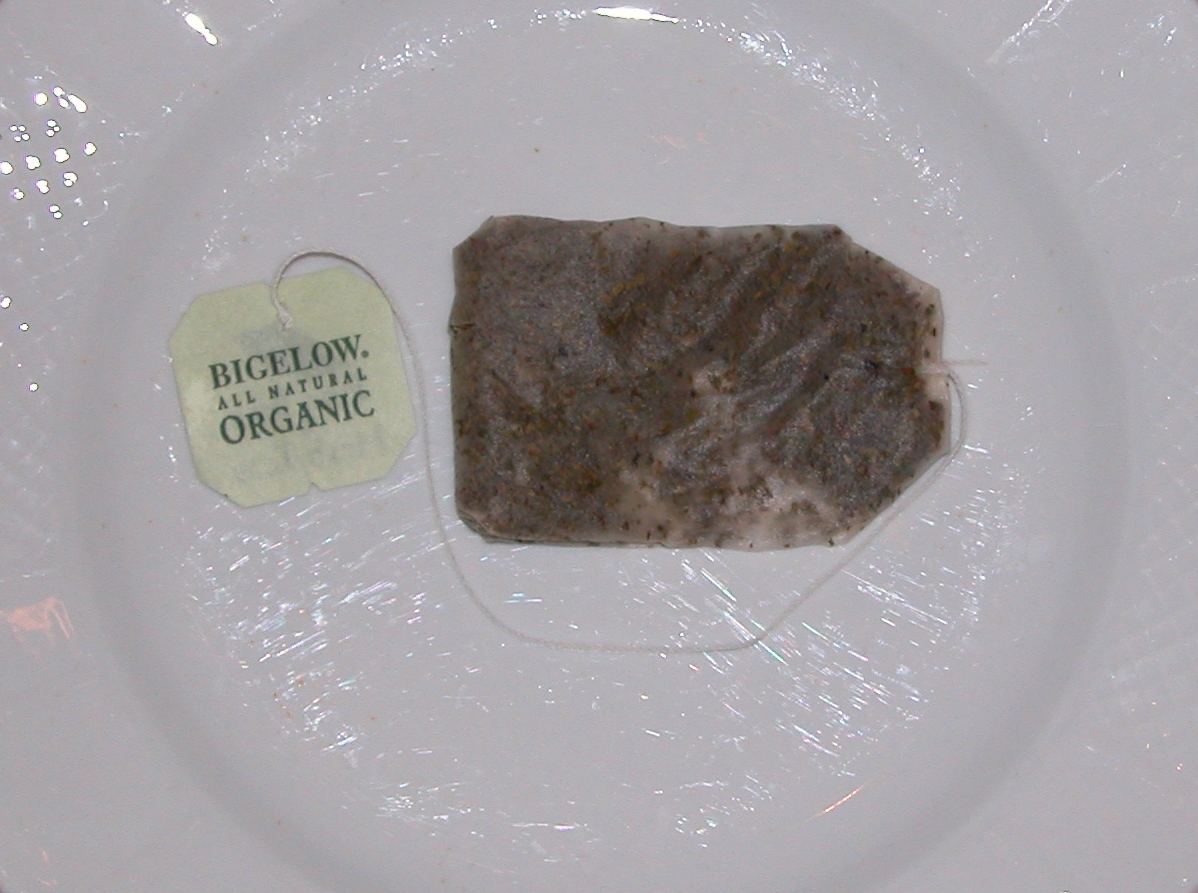
When I read about the latest Jesus sighting in Methuen, Massachusetts, I thought about making the 1 1/2 hour pilgrimage to see the iron Jesus, but then I remembered I see Jesus in my tea bag every morning.

Teasus

The image of Jesus is clearly visible within the bagged tea leaves.

New Posts on Weirdomatic

After a hiatus of several weeks, two new galleries have gone up at one of our favorite sites, Weirdomatic.  The title of “Mary Poppins Lost Her Umbrella” reminded me of Hester Goodman’s “The Mary Poppins Experience“; the pictures in the gallery don’t have much to do with Mary Poppins, but show a number of interestingly designed umbrellas.  Such as:

The other gallery, “The Invisible One,” is a tribute to artist Liu Bo-Lin, who paints himself to match  his surroundings.  The effect is to make him seem transparent, or at least translicent.  For example:

And here’s a video from “The Mary Poppins Experience”:

What is a word for “grandparents of the same child”?

A simplified chart of Latin kinship terms

At Language Log, a post asks whether many English speakers use the expression “brothers-in-law” to refer to men whose relationship is that their wives are sisters and “sisters-in-law” to refer to women whose relationship is that their husbands are brothers.  So would it be idiomatic to say that my wife and my brother’s wife  are one another’s sisters-in-law?  Commenters on that post have mentioned the poverty of English vocabulary in kinship terms as compared to other languages.  One linked to a Wiktionary article about the expression “co-mother-in-law,” an article which ends with sixteen examples of languages which do have words in widespread use that mean “the mother of one spouse, in relation to the parents of the other spouse.” 

For a long time it’s struck me as strange that English has so few kinship terms.   About 14 years ago, I was in graduate school and I read an article that was then already rather old, “What does Latin tell us about the Romans?” by Carl R. Trahman.  If you have access to JSTOR, here’s a link to Trahman’s article; if you don’t, you can go to the nearest research library, look up volume 67, number three of The Classical Journal (February/ March 1972,) and turn to pages 240-250.  Here’s one thing Latin told Trahman about the Romans:

Perhaps the most telling evidence, in the case of the Romans, that the vocabulary of a language will lead to an understanding of its users lies in the terminology of Latin for family relationships.  In English we are content to speak of “in-laws,” of “cousins once removed,” of “uncles on the father’s side.”  Latin has specific words for all of these and for dozens more such affinities.  Your great-great-grandmother is your abavia; your uncle on your father’s side is patruus, but on your mother’s side is avunculus.  Your mother-in-law is socrus.  The hated step-mother is noverca and the stepson privignus.  Does your husband have a sister?  The word is glos.  Does he have a brother?  The word is levir.  In such matters, the Romans truly had a word for it.  They actually possessed a word to denote the relationship of two women married to two brothers: they were ianitrices.  Now what is the significance of such precision?  It indicates the immense importance of the family in Roman life.  If we had no other testimony of this feeling for family, which can hardly be overstated, this amazingly rich terminology would be more than enough.  It is interesting that two of the phrases used for our word prejudice, for which as I have said Latin had no proper word, are iudicia iam facta domo (Cicero) and domo adlata opinio (Seneca.)  They suggest family councils at which policy was determined and the stand to be taken by the gens on public issues yet to be debated.  (page 244)

Writing in the early 1970s, Trahman devoted a fair bit of space to the Sapir-Whorf hypothesis, an idea that the structural limitations of a given language are in some way commensurate with the range of thoughts available to the speakers of that language.   In its most extreme form, the Sapir-Whorf hypothesis can be identified with the view that a people whose language lacks a word for a given concept must therefore lack that concept.   Trahman himself clearly does not go to that extreme.  In the passage quoted above, Trahman identifies the concept expressed by Latin phrases like iudicia iam facta domo and domo adlata opinio with the concept that we express by the single word prejudice.  So he believes that they had the concept, even though they lacked a specific word for it.  Trahman does seem to suggest that something like the Sapir-Whorf hypothesis was already familiar to the ancients.  He quotes the Roman poet Ennius who said that because he spoke Latin, Greek, and Oscan he had three hearts; Trahman elaborates, “The word he used was cor, which in his day meant not only ‘heart’ but ‘mind and soul’ as well.  So [Ennius had] it all, and it could not be improved upon.” 

So we can’t say that English speakers have a poorer set of concepts for family relationships than did Latin speakers just because we have so much poorer a vocabulary through which to express those concepts.  What we can say is that the Romans probably talked about those relationships more often than we do.  This isn’t surprising.  Most people in the developed world today live in nuclear family households and see members of their extended families only occasionally, so it isn’t especially likely on any given day that you will have to explain that someone is your spouse’s sibling’s sibling’s spouse.  If it takes several words and repeated case-endings to identify that person, you probably won’t lose much time over the course of a long life.  But in the ancient world it was more usual for several generations of a family to live under the same roof, grandparents and their siblings, parents and their siblings, one’s own siblings and their spouses and children and grandchildren, one’s own spouse and children and grandchildren, etc etc, and to spend all day working side by side with other members of that population.  So of course you would need single words that could express those relationships quickly and easily.  Not only might it become tiresome to have to speak a lot of words every time you had to clarify a family relationship, but it would certainly be taxing to have to listen to a lot of convoluted phrases connecting one kinship title to another.  If you tell me that some person is your spouse’s sibling’s sibling’s spouse, I’m likely to come away thinking that the person is your sibling’s spouse’s sibling’s spouse unless I concentrate.  If we have a word like ianitrix in common, we can relax. 

So why does it strike me as strange that we have fewer kinship terms in English than the Romans had in Latin?  For one thing, because English has such a huge vocabulary overall; for another, because it doesn’t seem English was particularly rich in kinship terms even when most English speakers lived in extended family groups.  But most of all because there are a number of relationships that really are quite important to English speakers that have no simple names in English.  For example, I would think it was safe to say that most grandparents would agree that they have something important in common with their grandchildren’s other grandparents.  Yet they have no single word to express that relationship.  And a Google search for “grandparents of the same child” brings up just two hits, as I write this.  “Co-grandparent” produces hits for laws concerning grandparents in the state of Colorado (postal abbreviation CO,) for “The Grandparent Company,” and for a number of uses of “co-grandparent” meaning something like  “honorary grandparent.” 

At about the same time Trahman was writing his article, Archie C. Bush published an article in the journal Ethnology under the title “Latin kinship extensions: An interpretation of the data.”  Here’s a JSTOR link; the citation is Ethnology, volume 10, number 4, (Oct 1971) pp 409-432.  Bush opens with a list of Latin names for 110 family relationships, sorted into six grades of consanguinity.  The system of grades derives from Roman law; a text attributed to the jurist Julius Paulus listed 448 family relationships. 

Strikingly, there is no Latin word for “grandparent of the same child” on Bush’s list or in Paulus, nor can I come up with such a word in any of the dictionaries to which I have ready access at the moment.  This is really amazing.  Most marriages in the ancient world were arranged by the couple’s parents in order to build a kinship relation between one household and another household.  In that sense, one could say that the basis of marriage in those days was the hope of the parents of the bride and groom that they would be bound together as grandparents of the same child.  One could hardly imagine a more highly valued relationship.  Yet it was a relationship with no name of its own.

New UOGB Video

The DVD of the Ukulele Orchestra of Great Britain’s triumphant performance at August’s BBC Proms is available for preorder at their site.  They’ll start shipping the discs on 3 December.  They’ve posted this audience-member video to entice you:

We’ve placed our order, of course.  Look for a review in this space, likely sometime after Christmas.

Venue

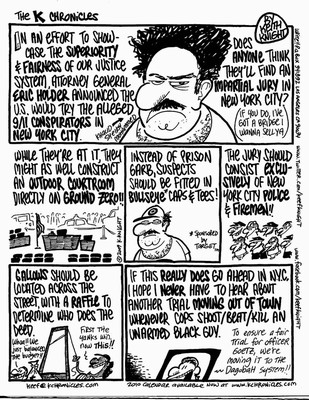
Keith Knight’s latest K Chronicles cartoon:

Some recent comments by Barack Obama, and a little joke about them:

In an interview with NBC News, Obama said those offended by the legal privileges given to Mohammed by virtue of getting a civilian trial rather than a military tribunal won’t find it “offensive at all when he’s convicted and when the death penalty is applied to him.”

Obama quickly added that he did not mean to suggest he was prejudging the outcome of Mohammed’s trial. “I’m not going to be in that courtroom,” he said. “That’s the job of the prosecutors, the judge and the jury.”

 The president then elaborated: “I’m not going to be on the jury that will report its guilty verdict at 3pm on September 11, 2010, nor will I be the one who administers the lethal injection that will kill Khalid Sheikh Mohammed a week before Election Day 2012.  I used to teach constitutional law, so I can tell you that it would be a violation of due process for me to do those things.”   

In fact, I do believe that they can find an impartial jury in New York City.  I would go so far as to say that Manhattan is probably the one place in the USA where it would be easiest to empanel twelve jurors who can judge the case against Khalid Sheikh Mohammed on its merits.  That’s not only because the island is a bastion of liberalism, but also because the further you go from Ground Zero the more Americans you find who feel they have to prove that 9/11 was an event in their own lives and not just something they saw on TV.  If as Knight sarcastically suggests they did set up a temporary courtroom on the former site of the World Trade Center, the attacks would have a definite reality for the jurors- they would be real events, with specific causes, specific consequences, specific forms that could be examined empirically.  Go a thousand miles away, and the attacks become a symbol with an infinite variety of overpowering emotional associations.  That’s part of the reason why the Bush-Cheney administration had an easier time using the attacks to sell its agenda to voters far outside of New York than to those in the city in those first years of the “War on Terror.”

Singular and plural

There don’t seem to be any rules in English about which collective nouns will be treated as singular and which will be treated as plural.  By some arbitrary process, English speakers settle on singular forms for some collective nouns and plural forms for others.  Yesterday’s Andy Capp got me thinking about this:

Of course,  the joke doesn’t make sense- no one says “”I was just wondering how my saving is doing?,” no matter how logical it might be to say such a thing.   

The question that all this raises, of course, is why I read Andy Capp.   To which the answer is, it was in the paper when I was five, and I thought then that the reason it never made me laugh was that I wasn’t sufficiently grown-up for it.  By the time it occurred to me that there might be a different reason, I was in the habit.