Justified True Belief

There are a couple of passages where Plato seems to define knowledge as “justified true belief.”  So, if you have enough evidence that you have a right to accept a given proposition as true, if you do in fact exercise this right and accept that proposition as true, and if  it so happens that the proposition is true, then Plato might have said that your belief in that proposition is an example of knowledge.

This definition was occasionally challenged in an oblique sort of way in the first 24 centuries after Plato put it forward, but it was still uncontroversial enough that philosophers could use it matter-of-factly as late as the 1950s.  In 1963, Professor Edmund L. Gettier of Wayne State University wrote a very short, indeed tiny, article in which he gave two counterexamples to the definition of knowledge as justified true belief.  Here is example one:

Suppose that Smith and Jones have applied for a certain job. And suppose that Smith has strong evidence for the following conjunctive proposition:

  1. Jones is the man who will get the job, and Jones has ten coins in his pocket.

Smith’s evidence for (d) might be that the president of the company assured him that Jones would in the end be selected, and that he, Smith, had counted the coins in Jones’s pocket ten minutes ago. Proposition (d) entails:

  1. The man who will get the job has ten coins in his pocket.

Let us suppose that Smith sees the entailment from (d) to (e), and accepts (e) on the grounds of (d), for which he has strong evidence. In this case, Smith is clearly justified in believing that (e) is true.

But imagine, further, that unknown to Smith, he himself, not Jones, will get the job. And, also, unknown to Smith, he himself has ten coins in his pocket. Proposition (e) is then true, though proposition (d), from which Smith inferred (e), is false. In our example, then, all of the following are true: (i) (e) is true, (ii) Smith believes that (e) is true, and (iii) Smith is justified in believing that (e) is true. But it is equally clear that Smith does not know that (e) is true; for (e) is true in virtue of the number of coins in Smith’s pocket, while Smith does not know how many coins are in Smith’s pocket, and bases his belief in (e) on a count of the coins in Jones’s pocket, whom he falsely believes to be the man who will get the job.

Here Smith is justified in believing that “The man who will get the job has ten coins in his pocket,” and it is in fact true that the man who will get the job has ten coins in his pocket.  However, the same evidence which justifies that true belief also justifies Smith’s false belief that Jones will get the job.  In Smith’s mind, these two beliefs are so intertwined that the true proposition is unlikely to figure in any line of reasoning uncoupled from the false one.  Moreover, since Smith does not realize that he himself has ten coins in his pocket, nor presumably that there is any applicant for the job other than Jones who has ten coins in his pocket, there is no reason to suppose that he would regard such a proposition as anything other than a statement that Jones will get the job.  So, true though the proposition may be, and justified as Smith may be in accepting it as true, his belief in it can lead him to nothing but error.

This counterexample is of course highly contrived, as is Professor Gettier’s second counterexample.  That doesn’t matter.  His only goal was to show that there can be justified true beliefs which we would not call knowledge, not that such beliefs are particularly commonplace.  Having given even one counterexample, Professor Gettier showed that justified true belief is not an adequate definition of knowledge.  Needless to say, Plato himself would probably have been thrilled with these counterexamples.  One can easily imagine him starting from them and proceeding to spin out a whole theory of justification, perhaps based on the idea that what we have a right to believe varies depending on the plane of existence to which our belief pertains, or that justification isn’t really justification unless the subject is approaching the topic in the true character of a philosopher, or some such Platonistic thing.

As it happens, Professor Gettier’s article was followed by a great many publications giving “Gettier-style” counterexamples, including many that are far more natural and straightforward than his original two.  Evidently all that needed to be done was to give some counterexamples, and the floodgates of creativity came open.  Professor Gettier himself did not write any of these articles, or indeed any articles at all after his 1963 paper.

Once you’ve read the 1963 paper, you may begin to notice naturally-occurring Gettier-style counterexamples.  The first novel I read after I was introduced to this topic about 20 years ago was Anthony Trollope’s The Eustace Diamonds.  Trollope is not often called a philosophical novelist.  However, a Gettier-style counterexample lies at the heart of this novel.  Lizzie Eustace is the childless widow of Sir Florian Eustace.  Among Sir Florian’s possessions had been a diamond necklace valued at £ 10,000.  Lady Eustace claimed that Sir Florian wanted her to have the necklace, and so insisted on treating it as her own; however, the Eustace family lawyer claimed that it was a family heirloom, entailed to Sir Florian’s blood relations, and so that it should revert to the family in event of his death without issue.   While this dispute was moving towards the courts, a person or persons unknown broke into a safe where Lady Eustace was known to keep the necklace.  The burglary was discovered; the necklace was not there.  Lady Eustace did not tell the police what was in fact true, that she had taken the necklace from the safe before the burglary and still had it in her possession.  The leader of the police investigation is Inspector Gage, a wily and experienced detective who quickly arrives at the conclusion that Lady Eustace has stolen the necklace herself, likely in conjunction with her lover, Lord George de Bruce Carruthers.

In fact, Inspector Gage is mistaken not only about Lady Lizzie’s complicity in the burglary, but also about the nature of her relationship with Lord George and about Lord George’s character.  For all that they seem like lovers, and for all that Lady Eustace would like to become Lord George’s lover, they never quite come together.  And for all that Lord George’s sources of income are shrouded in mystery, he proves in the end to be thoroughly law-abiding.  However, the collection of evidence on which the inspector bases his theory is so impressive that if it did not justify him believing it, one can hardly imagine how anyone could be justified in believing anything.  So those three propositions could be classified as justified false beliefs.  At the nub of them all, however, is a justified true belief: that the necklace is in the possession of Lady Eustace.  Surrounded as it is by these false beliefs, false beliefs which would prevent the inspector from forming a true theory of the case, he cannot be said to know even this.

Cartoonist Zach Weiner devoted a recent installment of his Saturday Morning Breakfast Cereal to laying out some thoughts about Gettier-style counterexamples:


I want to make a few remarks about this strip.  First, it doesn’t seem right to say that Professor Gettier proposed a “philosophical problem.”  To the extent that there is a “Gettier problem,” it is a problem with Plato’s proposed definition of knowledge.  By finding a weakness in that definition, Professor Gettier may have reopened philosophical problems that some had hoped to use the definition to mark as solved, but his article does not in itself suggest any new problems.  To jump directly from Professor Gettier’s challenge to Plato’s definition to a statement that “humans find the order of events to be cute” is to introduce quite an unnecessarily grandiose generalization.

Second, it’s clever that the irate child denounces “the Gettier ‘problem'” with a claim that “Maybe all the ‘problems’ of philosophy are just emergent properties that disappear when you simplify.”   Professor Gettier’s 1963 paper includes just three footnotes.  One refers to the two passages where Plato floats the definition of knowledge as justified true belief (“Plato seems to be considering some such definition at Theaetetus 201, and perhaps accepting one at Meno 98.”)  The other two cite uses of the definition by Roderick Chisholm and Alfred Ayer, two very eminent philosophers working in the Anglo-American tradition of analytic philosophy (“Roderick M. Chisholm, Perceiving: A Philosophical Study (Ithaca, New York: Cornell University Press, 1957), p. 16,” and “A. J. Ayer, The Problem of Knowledge (London: Macmillan, 1956), p. 34.”)  Much of the analytic tradition stems from the suspicion that “all the ‘problems’ of philosophy are just emergent properties that disappear when you simplify,” and Ayer and Chisholm both had interesting things to say about this suspicion.

Third, by what criterion can brain cells be regarded as “small stuff” and consciousness as “big stuff”? I’d say the only person to whom that idea makes sense is one who has heard straightforward explanations of the basics of brain anatomy and woolly explanations of the metaphysics of consciousness.  Everyone who is likely to read this strip either is, or has at some time been, awake.  Consciousness is thus familiar to all of them, an everyday thing, the very smallest of the “small stuff.” Conversely, brain cells are knowable only to people who have access to a microscope or to findings arrived at by use of a microscope.  They are, therefore, a relatively recherche topic, and most definitely “big stuff” to any truly naive subject.  To connect the phenomena of consciousness with brain cells, or with brain anatomy, is not only an even more sophisticated topic, but is at present wildly speculative.

Fourth, it’s clever to have the irate child find that “the small stuff” is no easier to understand than “the big stuff.”  I think Plato would have liked the strip, not for its defense of his definition, but for its illustration of the difficulty of separating “the small stuff” from “the big stuff.”  After all, probability wobbles and the rest of quantum theory are, so far as we are concerned, highly abstract.  We may use various images to make physics intelligible, but the deeper we enter into the subject the more thoroughly mathematical it becomes.  As the final nose-flicking indicates, our experience of “facts” and “brain cells” and “stuff that happens” are also theory-laden, so that it is an empty boast to claim that one regards them as real and the ideas behind them as unreal.

Some interesting titles from Lexington Books

Lexington Books is an imprint of Rowman and Littlefield.  They send me some of their catalogues, including their catalog of books in religious studies.  The latest one showed up in my mailbox yesterday.  I’m not planning to order anything from it, but several titles in it caught my attention for a moment or two.  Among them:

Medieval America: Cultural Influences of Christianity in Law and Public Policy, by Andrew M. Koch and Paul H. Gates. The authors argue that “promoting and maintaining a free, open, and tolerant society requires the necessary limitation of religious influence in the domains of law and policy.”  That seems to go beyond the usual US doctrine of separation of church and state, and to head in the direction of the French tradition of laïcité.

Theology and the Soul of the Liberal State, edited by Leonard V. Kaplan and Charles L. Cohen.  In opposition to the apparent gravamen of Medieval America’s argument, this book’s essays hold “that the liberal state cannot keep theology out of public discourse and may even benefit from its intervention.”

The Weimar Moment: Liberalism, Political Theology, and Law, edited by Leonard V. Kaplan and Rudy Koshar.  I’ve long been intrigued by Carl Schmitt, who lived under the Weimar Republic and developed the theory of “political theology” (putting it crudely, political theology is the proposition that all political ideas are simply theological ideas in disguise.)  Judging by its title, it would appear that this book is likely to discuss Schmitt.  I can’t be sure, since the description currently posted on the publisher’s website linked above is gibberish, and there don’t seem to be any reviews yet.  The book hasn’t been printed yet, so that situation isn’t surprising.

Theology and Public Philosophy: Four Conversations, edited by Kenneth L. Grasso and Cecilia Rodriguez Castillo.  They’ve attracted some very distinguished contributors; the catalogue lists “Charles Taylor; Fred Dallmayr; William Schweiker; Nicholas Wolterstorff; J. Budziszewski; Jeanne Heffernan Schindler; Joshua Mitchell; Robin Lovin; Charles Mathewes; Jonathan Chaplin; Michael L. Budde; Jean Porter; Eloise A. Buker; Christopher Beem; Peter Berkowitz and Jean Bethke Elshtain.”  To keep a conversation going, the editors avoid the explosive topics that usually bring theological commitments to the surface in political debate, and give the book a structure that is designed to ensure a variety of viewpoints: “Each of the book’s four sections consists of an original essay by an eminent scholar focusing on a specific aspect of the problem that is the volume’s focus followed by three responses that directly engage its argument or explore the broader problematic it addresses. The volume thus takes the form of a dialogue in which the analyses of four eminent scholars are each engaged by three interlocutors.”

What Democrats Talk About When They Talk About God: Religious Communication in Democratic Party Politics, edited by David Weiss.  It wasn’t all that long ago that American politicians generally avoided religious references in their public statements.  Nowadays they all seem to be auditioning for a pulpit.  So it might be interesting to analyze the use of religious language, public and private, by members of the USA’s two major parties.

Radical Religion: Contemporary Perspectives on Religion and the Left, edited by Benjamin J. Pauli.  The online catalogue summarizes it thus: “The political Left has had a turbulent relationship with religion, from outright hostility to attempts to meld religious faith with progressivism. Confronted with contemporary social ills, the progressive Left continues to disagree about the role that religion should play, whether in understanding social challenges and solutions, or stimulating social critique and reform. Radical Religion presents valuable insights, from both religious and secular perspectives, for progressives today as they struggle to formulate a coherent agenda and effective strategies for social change. This book presents arguments from a diverse group of scholars, and offers a snapshot of contemporary, progressive thinking about religion.”

The Rise and Fall of Triumph: The History of a Radical Roman Catholic Magazine, 1966-1976, by Mark D. Popowski.  I’m interested in movements that are conservative in some senses and radical in others.  Readers of this site will have noticed that I pay a great deal of attention to the antiwar right and the anticapitalist right, for example.  And I love magazines.  So this book sounds like it would be right up my alley: “Triumph’s editors formed the magazine to defend the faith against what they perceived as the imprudent and secular excesses of Vatican II reformers, but especially against what they viewed as an increasing barbarous and anti-Christian American society. Yet Triumph was not a defensive magazine; rather, it was audaciously triumphalist—proclaiming the Roman Catholic faith as the solution to America’s ills. The magazine sought to convert Americans to Roman Catholicism and to construct a confessional state, which subjected its power to the moral authority of the Roman Catholic Church.”   So, the magazine tried to sustain a premodern perspective, which at least left its contributors free to oppose militarism, hyper-capitalism, nationalism, and other delusions specific to our age of bigness.

Marriage and Metaphor: Constructions of Gender in Rabbinic Literature, by Gail Labovitz.  Dr Labovitz is a married woman and an ordained rabbi who does not shy away from elements of the rabbinic tradition that make it awkward for a person such as herself to exist.  “Labovitz shows how rabbis use the concepts of property and ownership to discuss the roles of a husband and wife, thereby modeling marriage after a business transaction-one in which the wife is seen as an acquisition owned by and subject to the husband. This ownership metaphor is clearly present in all strata of rabbinic literature and the book explores how it continues to guide rabbinic thinking, serve as a tool for legal reasoning, and produce new linguistic applications. With a close and careful reading of rabbinic texts, Labovitz applies metaphor theory and feminist linguistics to demonstrate the ways in which rabbis regularly use information from the realm of property and commercial transactions to structure their understanding of marriage and gender relations.”  I’m always suspicious of religious types who find that their ancient traditions and sacred texts, if interpreted correctly, agree with their own favorite ideas.  Conversely, when a lady rabbi says that the rabbinical tradition is full of strictures against lady rabbis, I’m put at ease.

Charles Sanders Peirce and a Religious Metaphysics of Nature, by Leon Niemoczynski.  The catalog says that “Niemoczynski points to Peirce’s phenomenological and metaphysical understanding of possibility-the concept of ‘Firstness’-as especially critical to understanding how the divine might be meaningfully encountered in religious experience.”  I’d never thought of Peirce as either a metaphysician or as a thinker who would be in any way attractive to religious believers, but apparently I was wrong.

Nietzsche and Zen: Self-Overcoming Without a Self, by Andre van der Braak.  One of my principal intellectual influences is Irving Babbitt, who was among other things a student of Buddhism.  When Babbitt looked at Buddhism, he saw a corrective to the excesses of late Romanticism.  When he looked at Nietzsche, Babbitt saw an exemplar of those excesses.  So I’d be interested to see a study of the overlap between Nietzsche’s thought and Buddhism.

Buddhism and Postmodernity: Zen, Huayan, and the Possibility of Buddhist Postmodern Ethics, by Jin Y. Park.  “Buddhism and Postmodernity is a response to some of the questions that have emerged in the process of Buddhism’s encounters with modernity and the West. Jin Y. Park broadly outlines these questions as follows: first, why are the interpretations and evaluations of Buddhism so different in Europe (in the nineteenth century), in the United States (in the twentieth century), and in traditional Asia; second, why does Zen Buddhism, which offers a radically egalitarian vision, maintain a strongly authoritarian leadership; and third, what ethical paradigm can be drawn from the Buddhist-postmodern form of philosophy?”  While these questions may not seem to have much in common, Professor Park evidently proposes a model which enables her to address all three at the same time.

The Political Problem of Religious Pluralism: And Why Philosophers Can’t Solve It, by Thaddeus J. Kozinski.  Apparently the author holds that for the philosopher, the only good pluralism is a self-extinguishing pluralism.  “Drawing on a diverse number of sources, Kozinski addresses the flaws in each philosopher’s views and shows that the only philosophically defensible end of any overlapping consensus political order must be the eradication of the ideological pluralism that makes it necessary. In other words, a pluralistic society should have as its primary political aim to create the political conditions for the communal discovery and political establishment of that unifying tradition within which political justice can most effectively be obtained.”  I suppose every ideology and political system extinguishes itself sooner or later, so to evaluate pluralism in terms of its ability to give rise to unity isn’t particularly unfair.

God and Money: A Theology of Money in a Globalizing World, by Nimi Wariboko.  The print catalogue quotes a blurb in which Peter J. Paris of the Princeton Theological Seminary tells us that in this book, “the author helps his readers see money not as a material thing alone but as a social relation.  This is an altogether new perspective, not only describing the moral dimension of money itself but inspiring readers to discern the ethical issues implicit in the global monetary system.”  That sounds like a tremendous contribution to the understanding of economic life.  On the other hand, Rowman and Littlefield’s online catalogue summarizes the book this way: “Making a case for a denationalized global currency as an alternative to the dollar, euro, and yen as the world vehicular and reserve currencies, God and Money explores the significance and theological-ethical implications of money as a social relation in the light of the dynamic relations of the triune God. Wariboko deftly analyzes the dynamics at work in the global monetary system and argues that the monarchical-currency structure of the dollar, euro, and yen may be moving toward a trinitarian structure of a democratic world currency.”  Which sounds idiotic.  According to the book’s acknowledgements, Professor Paris worked closely with Professor Wariboko while he was writing it, so it is likely that he has a firmer grasp of its contents than does the editorial assistant who had to crank out the description in the catalogue, but still, it gives pause.

Biblical Bethsaida: A Study of the First Century CE in the Galilee, by Carl E. Savage.  “Using archaeological data from Bethsaida itself, Savage investigates the material practices of Bethsaida’s ancient inhabitants, describing these practices as significant indicators of their sense of place both ideologically and geographically. He evaluates the historical plausibility of various social reconstructions for the region, and finds that the image that emerges of first-century Bethsaida is one similar to those of other Jewish communities in the Galilee.” I’m slightly curious about the interaction between Jews and non-Jews in the communities where Christianity first arose, so I look at archaeological accounts of the first century Galilee from time to time.

Something about the prices struck me as rather odd.  Most of the books cost about $60 in hardback, while volumes that are of interest to more than one academic discipline cost about $100.  That’s a fairly typical range of prices from a publisher aiming at university libraries.  The odd thing is the price of the ebook editions.  For most of those, they charge the hardback price minus one cent.   So, Medieval America is $60 hardback, $59.99 as an ebook.  The Rise and Fall of Triumph is $75 hardback, $74.99 as an ebook.  The Weimar Moment is $100 hardback, $99.99 as an ebook.  That reminds me ofone of David Letterman‘s Top Ten Lists from many years ago, “Top Ten OtherFailed McDonald’s Promotions.”  On the list was “Get 500 Quarter Pounders for the price of 499!”

“If you see it in the Sun, it’s so.”

If you have enough money and you have access to an unrestricted market, you can find someone who will, for a price, do virtually any task you disdain to do yourself.  If the task you want to delegate to someone else is a task that a great many other people also want to avoid doing, then someone might well find a way of providing a service to many people all at once, collecting a small payment from each.

So far, so obvious.  If economics were a subject in the Kindergarten, so much might be a lesson there.  Why isn’t economics a subject in the Kindergarten?  Perhaps the text below, printed in The New York Sun on 21 September 1897 but extremely familiar to everyone who has ever spent the month of December in the USA, will elucidate:

“DEAR EDITOR: I am 8 years old.
“Some of my little friends say there is no Santa Claus.
“Papa says, ‘If you see it in THE SUN it’s so.’
“Please tell me the truth; is there a Santa Claus?

“VIRGINIA O’HANLON.
“115 WEST NINETY-FIFTH STREET.”

VIRGINIA, your little friends are wrong. They have been affected by the skepticism of a skeptical age. They do not believe except [what] they see. They think that nothing can be which is not comprehensible by their little minds. All minds, Virginia, whether they be men’s or children’s, are little. In this great universe of ours man is a mere insect, an ant, in his intellect, as compared with the boundless world about him, as measured by the intelligence capable of grasping the whole of truth and knowledge.

Yes, VIRGINIA, there is a Santa Claus. He exists as certainly as love and generosity and devotion exist, and you know that they abound and give to your life its highest beauty and joy. Alas! how dreary would be the world if there were no Santa Claus. It would be as dreary as if there were no VIRGINIAS. There would be no childlike faith then, no poetry, no romance to make tolerable this existence. We should have no enjoyment, except in sense and sight. The eternal light with which childhood fills the world would be extinguished.

Not believe in Santa Claus! You might as well not believe in fairies! You might get your papa to hire men to watch in all the chimneys on Christmas Eve to catch Santa Claus, but even if they did not see Santa Claus coming down, what would that prove? Nobody sees Santa Claus, but that is no sign that there is no Santa Claus. The most real things in the world are those that neither children nor men can see. Did you ever see fairies dancing on the lawn? Of course not, but that’s no proof that they are not there. Nobody can conceive or imagine all the wonders there are unseen and unseeable in the world.

You may tear apart the baby’s rattle and see what makes the noise inside, but there is a veil covering the unseen world which not the strongest man, nor even the united strength of all the strongest men that ever lived, could tear apart. Only faith, fancy, poetry, love, romance, can push aside that curtain and view and picture the supernal beauty and glory beyond. Is it all real? Ah, VIRGINIA, in all this world there is nothing else real and abiding.

No Santa Claus! Thank God! he lives, and he lives forever. A thousand years from now, Virginia, nay, ten times ten thousand years from now, he will continue to make glad the heart of childhood.

Virginia O’Hanlon of 115 West Ninety-Fifth Street was a real person, and later in life she confirmed that she had in fact written the letter the Sun published.  Her great-granddaughter displayed the original letter, in Virginia O’Hanlon’s handwriting, in 1997.    Virginia O’Hanlon’s father, who told her that “If you see it in the Sun it’s so,” was a medical doctor named Philip O’Hanlon.

What service did Dr O’Hanlon expect to the New York Sun to perform in return for his subscription?  An article in the far-right Taki’s Magazine proclaims that the newspaper’s response is a remarkably shameless lie; that article prompts me to wonder if lying to his daughter was the very task Dr O’Hanlon hoped the newspaper would take off his hands.  Surely he knew full well that the newspaper would not dare publish a statement denying that the beloved figure of childhood fantasy really existed, and that any response they printed would have to affirm Santa Claus’ reality.  By thus delegating the lie to someone else, he could distance himself from it, not leaving his daughter with a visual memory of his face as he told her something he knew to be false, and indeed to be an insult to her intelligence.  Of course, if he knew that the newspaper would say something that he knew to be false, then statement  that “If you see it in the Sun it’s so” was also a lie on Dr O’Hanlon’s part, but one that he might more plausibly be able to defend than he could defend a claim that Santa Claus existed.  On the other hand, a moralist might say that “If you see it in the Sun it’s so” was a far worse lie than “There is a Santa Claus.”  After all, telling Virginia that there was a Santa Claus might have been telling her a single, discrete, self-contained lie, while to tell her that “If you see it in the Sun it’s so” is to instruct her to put down her guard and swallow everything that might appear in that paper, day after day.

Who was Dr O’Hanlon?  He was, among other things, a functionary of New York City’s Tammany Hall political machine.  During Tammany’s dominion over city politics, Dr O’Hanlon worked for the city as an assistant coroner and as police surgeon.  When the reform wing of the Democratic Party briefly took power, Dr O’Hanlon was arrested on charges relating to his habit of helping himself to the stock of dry goods stores without bothering to pay the merchants.  In court on these charges, he boasted of his Tammany Hall loyalties.  When Tammany returned to power, Dr O’Hanlon’s legal troubles came to an end. So it’s hardly surprising that the doctor was a fan of the pro-Tammany New York Sun.

Tammany’s restoration must have been a relief to the O’Hanlon family, since Dr O’Hanlon’s had name also appeared in connection with a much more serious criminal case.  A friend of his, Dr Andre L. Stapler, had in August 1910 performed an abortion for a woman named Louise Heinrich.  Abortion was at that time illegal in New York state, and therefore unregulated.  In the course of the procedure, Mrs Heinrich died.  Dr O’Hanlon signed a death certificate saying that her death was the result of natural causes.  The state prosecuted Dr Stapler, arguing that his carelessness killed her.  Prosecutors alleged that Dr O’Hanlon’s death certificate was a fraud meant to cover up his friend’s culpability in Mrs Heinrich’s death.   Convicted of manslaughter, Dr Stapler confessed that he was part of a group of doctors who performed illegal abortions under unsanitary conditions, and that as a coroner’s assistant Dr O’Hanlon routinely filed false reports covering up the deaths of the women in their care.  Dr O’Hanlon does not appear to have been prosecuted as a result of Dr Stapler’s statement.   The doctor appears to have continued his medical and political careers without having to answer any inconvenient questions about falsified papers and dead women.  If Dr Stapler’s confession was true, then woman-killing doctors delegated a job of lying to Dr O’Hanlon, even as Dr O’Hanlon had delegated a job of lying to the Sun.

The History of English in Ten Minutes

Here’s something funny that was produced for the Open University this summer.  Everyone else has been posting it this week, I decided to join the herd.

Why isn’t life on earth more diverse than it in fact is?

Via Kottke, a New Scientist piece on the hypothesis that the earliest common ancestor of all life on earth was a mega-organism of planetary scale.  That’s one way of solving a problem that I sometimes wonder about.  If, as we now hear from exobiology types, life can be expected to originate wherever in the universe conditions will sustain it, how many times did it arise on this planet?  If the answer is “many times” and life has arisen independently many times in the history of the earth, why do all of the organisms we see look so similar that they might have a common ancestor?  Of course several solutions have been proposed to this problem, but the idea of a mega-organism that assimilated some previous life-forms and drove the rest to extinction would seem to be another.

I like Pandora

I’ve been putting in some long hours on the job recently, which is why I haven’t been posting much.  One thing I do to break up the monotony of long sessions of paperwork is to let one or another of our Pandora stations play in the background.  Pandora has introduced me to a lot of music that I like very much.  For example, I’d never heard of Labi Siffre until “Bless the Telephone” popped up on some station or other, now he’s one of my favorites.  Nor had I heard of Polk Miller until “Pussycat Rag” ” (download it for free here) came on our station devoted to the Hoosier Hotshots, now I can’t get enough of him either.   So here are YouTube embeds featuring those two artists.

Labi Siffre, “Bless the Telephone

Polk Miller and the Old South Quartette, “What a Time

Also, here’s Labi Siffre’s own website.  Since Polk Miller died in 1913, he doesn’t maintain a website, but here’s a review of a CD release of his recordings.

A threat to the Internet

The US Congress is considering the “Stop Online Piracy Act,” a bill which, if passed, would greatly increase the power of corporations to censor websites, either by insisting on government action or by directly intervening.  Here are a few links to reports about how bad the bill is and what can be done to stop it.

Huffington Post, “Internet Companies and Lawmakers Speak Out Against the Stop Online Piracy Act

Ars Technica, “Republicans, Democrats, Google, and the Church of Sweden Unite to Stop Hollywood

BoingBoing, “Stop SOPA, save the Internet

BoingBoing, “How SOPA will change the net

BoingBoing, “Joe Biden: SOPA is un-American- but not when America does it

Composite faces

This gallery consists of computer-generated 41 composite photographs.  Each composite was made by overlaying digital images of several women of the indicated ethnicity and averaging their facial characteristics.

Back in February, this gallery provoked a great deal of public discussion.  Some people behaved as though it revealed a deep truth about the racial divisions of humankind, while others not only rejected this idea but regarded the whole thing as a joke in questionable taste.

What I’ve been waiting for is for someone use the same technology to to do something useful, or at least something more interesting than this.  For example, a composite photo of the 43 men who have served as US president might be interesting, especially if presented as a series of 43 slides.  Slide 1 would show George Washington, slide 2 would show George Washington + John Adams, slide 3 would show George Washington + John Adams + Thomas Jefferson, etc.  The change in appearance of the composite would of course be less each time, as  each successive president contributed a smaller share to the adjusted average, but it might be interesting to see the final image gradually crystallize.  It would be especially intriguing to compare the development of that composite with a similarly presented composite of a line of hereditary monarchs.

Star Pilot 6

I just found issue 6 of my new favorite comic book, Star Pilot, in my mailbox.  It’s another good one.  It has to with the violin, mountaineering, and helicopters.

Jokes about Charlie Brown

Charlie Brown, main character of Peanuts, in a typical situation

For some reason, people have been making lots of jokes recently about the titles of books, television programs, and other media products associated with Peanuts, a daily comic strip that Charles M. Schulz created and drew for decades until his death in 2000.  During Schulz’ lifetime, his characters were featured in televised animation with titles like “It’s the Great Pumpkin, Charlie Brown!,” “A Charlie Brown Christmas,” “It’s Christmastime Again, Charlie Brown!,” and “You’re in Love, Charlie Brown!”  There was a hit Broadway musical called You’re a Good Man, Charlie Brown!, and any number of paperback books collecting the strips.

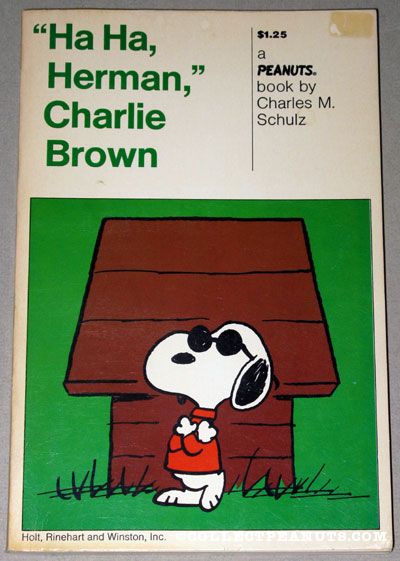
One of the top hashtags on Twitter at the moment is #RejectedPeanutsSpecials.  One of my favorite tweets under this heading is this from Keith Powell: “We’re concerned about your drinking, Charlie Brown.”  There’s also a website called “Paperback Charlie Brown,” a.k.a. “Something Something Something Charlie Brown,” which shows images of the paperback books that collected the strips, often leaving the cover art unchanged, but altering the title.  So, this original cover ,with its image of Charlie Brown’s dog Snoopy as a mid-60s hipster and the phrase “Ha Ha Herman” (a chant the characters in the strip use when they play a modified version of “Hide and Seek,”*) becomes more menacing:


*In most forms of “Hide and Seek,” exactly one seeker tries to find one or more hidden people.  In “Ha Ha Herman,” multiple seekers try to find exactly one hidden person.  The hidden person’s title is “Herman,” and the seeker who finds Herman shouts “Ha Ha Herman,” announcing to the other seekers that the game is over.  Schulz apparently invented this game for the characters to play in the strip.