http://rightwingnytimes.cf.huffingtonpost.com/
Scroll over The New York Times masthead for different perceptions.
http://rightwingnytimes.cf.huffingtonpost.com/
Scroll over The New York Times masthead for different perceptions.
Posted by CMStewart on December 11, 2008
https://losthunderlads.com/2008/12/11/political-perceptions/

A Mesopotamian cuneiform tablet in the British Museum
Thanks to 3quarksdaily for linking to this article in The London Review of Books about an ongoing British Museum show called “Babylon: Myth and Reality.” Apparently the exhibition concentrates on cuneiform tablets. The article explains what we know about cuneiform tablets as a medium and speculates on what we may yet learn about them.
Posted by acilius on December 10, 2008
https://losthunderlads.com/2008/12/10/cuneiform-tablets/
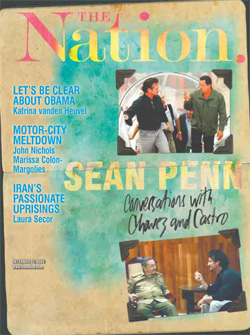 Highlights of this issue include a review of Passionate Uprisings: Iran’s Sexual Revolution, a study of sexual behavior among well-to-do young heterosexual Tehranis by Iranian-American anthropologist Pardis Mahdavi. In the course of extensive field work, Professor Mahdavi discovered that worries older Iranians routinely express about risky sexual behavior among the young are quite well-founded, at least as regards the population she studied. Group sex seems to be common. Evidently repressive laws against premarital sex, enforced ignorance of birth control and STDs, and an intensely patriarchal family structure don’t guarantee universal chastity after all. Who knew? The reviewer, Laura Secor, wishes for further studies that would systematically compare the experiences of Iranians of different social classes, sexual identities, and geographical locations. With that kind of research, we might be able to figure out what if anything this risky behavior means for Iranian politics. Of course, a study like that would be unlikely to take place in today’s Iran. To illustrate the difficulty, Secor begins her review by quoting Mahdavi’s meeting with an Iranian sex ed teacher who could not understand why her students were reluctant to tell her about their sex lives. The woman was wearing a double hijab that gave her such an imposingly traditional appearance that even Professor Mahdavi became self-conscious.
William Greider points out that New York Federal Reserve chief Timothy Geithner, President-elect Obama’s pick to be the new treasury secretary, was the negotiator who worked out many of the worst parts of the Wall Street bailout; Greider frets that Mr O may go down in history as the man responsible for the economic meltdown if he doesn’t withdraw Geithner’s name and rethink his approach to the crisis.
Posted by acilius on December 3, 2008
https://losthunderlads.com/2008/12/03/the-nation-15-december-2008/
According to this article in Slate, brain scientists have recently begun to study an emotion they call “elevation.” High-falutin’ rhetoric, like that associated with Barack Obama, can inspire it. The closing paragraphs point out that when seen in other people, elevation can look ridiculous or disgusting. Of course, the same is true of other emotions as well. But we need all of them, if not always in the ways we get them. So perhaps we need elevation too.
Posted by acilius on December 3, 2008
https://losthunderlads.com/2008/12/03/relatively-obscure-emotional-states/
“The Fall Books Issue“- it seems a bit late this year… but worth the wait.
Torie Osborn wonders how California could have passed anti-same sex marriage Proposition 8. Her view is that No on 8 forces neglected Los Angeles County, despite decades of experience showing that antigay measures win or lose based on the margins in that county. She also has some harsh words for the Obama campaign for allowing voters to believe (mistakenly!) that Mr O backed Proposition 8.
Christine Smallwood reviews a new edition of George R. Stewart’s 1945 book Names on the Land. A collection of anecdotes about how various places in the USA got their names, this highly regarded work inspires Smallwood’s unreserved praise. She goes on at some length about Stewart’s other works, including environmental fiction like Earth Abides, “the first American postapocalyptic thriller,” and Ordeal by Hunger, a novelization of the Donner Party. She tells us that Names on the Land was Stewart’s own favorite of his books. It raises no less a question than “what is America?,” Smallwood says. And answers that question: “Not the leader of the Free World and not the scourge of the world, but a history of settlement.” This answer would hardly have been extraordinary in 1945. The book does sound interesting. The cover of the first edition illustrates Smallwood’s review, and is reproduced below.

Posted by acilius on December 1, 2008
https://losthunderlads.com/2008/12/01/the-nation-8-december-2008/
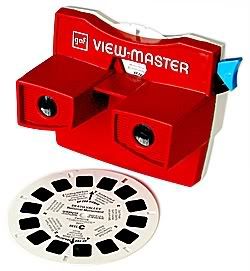
Viewmaster
(image)
News in the latest email from Las Vegas’ 3D Stereo Store:
View-Master Closing:
On a sad note, Mattel/Fisher-Price has announced the permanent closing of the Custom/Commercial/Scenic View-Master division of View-Master. Scenic reels and the Classic Model L will cease to exist. All of the special special 3 Reel sets such as Old TIme Cars, and the on-location ones such as Grand Canyon will no longer be produced. No more commercial Reels either.The economic downturn and Mattel/Fisher-Price’s association with China has claimed another victim. And even though, at least, executive salaries and bonuses will be saved by pending layoffs in excess of a thousand U.S. workers, an era that lasted almost seven decades comes to an end.
Children’s titles produced with Wal-Mart’s approval are planned to be continued for the present.
What’s to be done? I don’t know. It sounds like a done deal.
Stereoscopy in general and Viewmaster in particular have a great deal to offer adults. To peer into the viewer and tease out 3D effects is a meditative exercise. Not only is it an extremely relaxing use of a few minutes, it also trains the eye to take a more attentive look at the world. Trade with China, disparity between workers’ wages and executive compensation, the recession, the power of Walmart, etc, all play into the decline of the medium, but the root cause is something deeper. The people in charge of corporations like Mattel just don’t believe that American adults are interested in sitting still and using their minds. They may be right. But if they are, it becomes a vicious circle. Loud entertainment systems that allow their users to be passive sell quite well, so capital devotes all its resources to promoting loud entertainment systems that allow their users to be passive. After a while, we as a society forget the use of quietness, the value of stillness, the importance of simplicity.
Posted by acilius on November 25, 2008
https://losthunderlads.com/2008/11/25/sad-news-for-viewmaster-fans/
Nick Turse looks into American forces’ conduct of the war in Vietnam’s Mekong Delta in the period from 1 December 1968 to 1 April 1969. Turse concludes that the facts were much worse than has generally been known in the USA. Civilians were targeted more systematically than has been acknowledged, more of them were killed than has been acknowledged, and a coverup of the some of the worst atrocities continued for decades. Turse quotes a contemporary letter signed “Concerned Sergeant.” The otherwise anonymous soldier denounced the operations to which he was attached and estimated that the rate at which unarmed civilians were being killed amounted to “a My Lai a month.”
Ever since Studs Terkel died, The Nation has been memorializing him. In this issue, his editor, Andre Schiffrin, remembers their attempt to put together an oral history on the topic of power. The project failed because none of their prospective subjects would even admit that he held power, let alone give insight into what it was like to use it. That’s hardly surprising when Schiffrin describes the key to Terkel’s work. His subjects talked to him, Schiffrin explains, because “he approached people with utter respect. Those he talked to immediately felt this and poured their hearts out.” Powerful people usually seem to expect to be approached with utter respect, if not indeed with abject servility. That so many people from so many backgrounds found it a shock to be approached with respect is a sad commentary on our society.
Hoosiers and others marveling at the fact that Indiana voted for Obama will enjoy Mark Hertsgaard’s piece about Luke Lefever, a plumber (a real one!) who volunteered for the Obama campaign in Elkhart.
Siddhartha Deb reviews several novels by Elias Khoury. At first, Deb praises the “fragmented” style of Khoury’s work as suitable to his native Lebanon, but at the end he suggests that the time may have come for a smoother style of writing and, apparently, a more settled view of Lebanese identity.
This brings us to Barry Schwabsky’s review of Art Worlds by Howard S. Becker and Seven Days in the Art World by Sarah Thornton. Becker’s newly reprinted 1982 book is a sociological study of various milieux from which products came that could be called “art,” while Thornton, also a sociologist, spent her time in “an art world that claims the right to call itself the art world.” Schwabsky puts the question:
In the sociologist’s art world, hierarchies, rankings, and orders of distinction proliferate. Status and reputation are all, and questions about them abound. Why does the seemingly kitschy work of Jeff Koons hang in great museums around the world while the equally cheesy paintings of Thomas Kinkade would never be considered?… How do conflicting views on the value of different kinds of artworks jell into a rough and shifting consensus about the boundaries of what will be considered art in the first place?
That’s quite a weighty question. As for the Koons/ Kinkade riddle, my suspicion is that perspective drawing and the rest of the conventional skills of representational art are not really all that difficult to master. Some years ago I read an essay by Eric Gill called “Art in Education: Abolish Art and Teach Drawing,” in which he argued that given a chance virtually any child could and would learn these techniques. I haven’t seen any scientific work testing this hypothesis, but it doesn’t seem fantastic to me to think that if all children were introduced to art in the same way that, let’s say, Thomas Kinkade was, that some large percentage of the population would grow up to paint pictures very much like his. If that is so, then the problem with Kinkade isn’t that he’s cheesy, but just that they are nothing special. If a collector wants to attain a high rank, s/he can hardly buy paintings that may be very pleasant but that could be equalled by, let’s say, a third of the adult population.
Posted by acilius on November 24, 2008
https://losthunderlads.com/2008/11/24/the-nation-1-december-2008/
Canadian artist Kristan Horton has imitated stills from DR STRANGELOVE using household objects. The project has resulted in a book, Dr Strangelove Dr Strangelove. The picture below is an example:
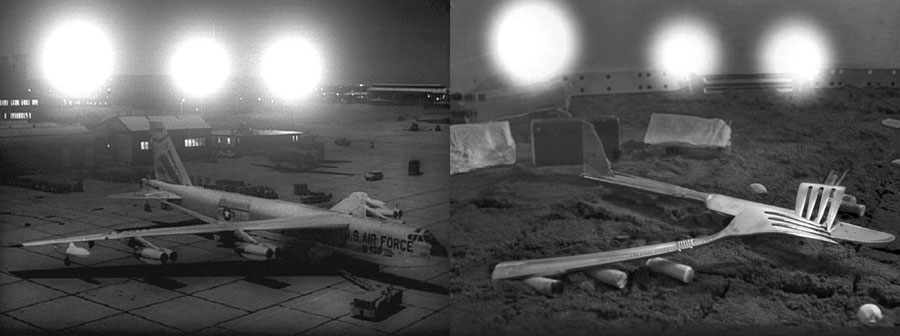
A big plane, like a 52- you should see it some time!
Posted by acilius on November 18, 2008
https://losthunderlads.com/2008/11/18/dr-strangelove-dr-strangelove/
This has been embedded in about a million websites over the last several days, it might as well be here too. It’s kind of stupid for the first minute, then extremely funny for about 30 seconds, then goes back and forth between annoyingly stupid and screamingly hilarious for the remaining two minutes.
Posted by acilius on November 14, 2008
https://losthunderlads.com/2008/11/14/you-have-earned-the-new-puppy-thats-coming-with-us-to-the-white-house/
The usual news report about the results of a presidential election will include a map that looks like this:

A familiar image, but one which does not tell us who won the election. Change the size of the states in proportion to their population, and you produce a less familiar, but more useful image:

Maps like this are called cartograms. This guy can help you make your own cartograms, if you are so inclined.
Posted by acilius on November 12, 2008
https://losthunderlads.com/2008/11/12/2008-presidential-election-results/
 acilius
 believer1
 lefalcon
 losthunderlads
 vthunderlad
 Panther Red