
Newsweek thinks Mississippi’s Governor Haley Barbour looks like a future president:

I think he looks more like a figure from the past:

Newsweek thinks Mississippi’s Governor Haley Barbour looks like a future president:
I think he looks more like a figure from the past:
Posted by acilius on January 6, 2010
https://losthunderlads.com/2010/01/06/separated-at-birth/
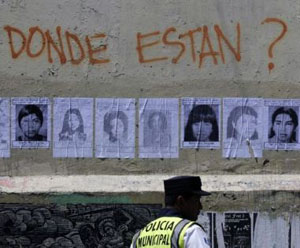
“There are about 100 million women less on this earth than there should be. Women who are ‘missing’ since they are aborted, burnt, starved and neglected to death by families who prefer sons to daughters. . The estimated number of women who are missing are 44 million in China, 39 million in India, 6 million in Pakistan and 3 billion in Bangladesh. This is the single largest genocide in human history.” -Lucinda Marshall, Feminist Peace Network
“More than 3,800 women and girls have been murdered in Guatemala since the year 2000. What local activists are calling ‘femicide’ is spreading in Guatemala and throughout Latin America. . Guatemala’s femicides are notable for their brutality as well as the impunity that exists for the perpetrators. Countrywide, a mere 1-2% of crimes against life are effectively prosecuted, meaning that someone who commits murder in Guatemala has a 98-99% chance of escaping prosecution and punishment.” -Center for Gender and Refugee Studies
Posted by CMStewart on January 6, 2010
https://losthunderlads.com/2010/01/06/femicide/
Posted by CMStewart on December 31, 2009
https://losthunderlads.com/2009/12/31/cybugs/
Pete Seeger turned 90 in May; his birthday party, an intimate little gathering of 18,000 of his closest personal friends, was released on DVD this month, leading to some publicity. Here are a few videos in his honor.
If You Love Your Uncle Sam (Bring ’em Home.) Sadly, this Vietnam-era song is not just for nostalgia; here‘s an updated version.
Wimoweh, with the Weavers
Posted by acilius on December 18, 2009
https://losthunderlads.com/2009/12/18/pete-seeger/
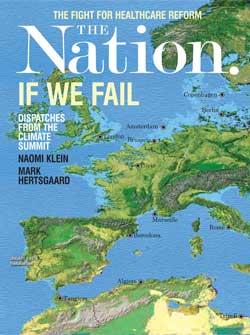 Several reports on the Copenhagen summit on climate change draw Alexander Cockburn out with a column trumpeting his dissent from the view that by dumping such great volumes of greenhouse gases in the upper atmosphere humans are doing enormous harm to the environment. Cockburn never convinces me when he mounts this hobby-horse of his, but I must confess to taking pleasure in the self-righteous sputtering that fills the letters to the editor in the subsequent issues. For every well-reasoned counterargument from someone with a grasp of the science and a solid case to make against Cockburn’s claims, the magazine must receive hundreds of letters from people who are not at all equipped to analyze climate data but who are entirely prepared to denounce a heretic and cast him out. I’m fairly sure that Cockburn is wrong and his detractors are right about climate. At the same time, I’m quite certain that he is doing a public service by luring would-be enforcers of orthodoxy into the open. He’s even doing a favor to them; if the self-appointed Grand Inquisitors have the sense to read their letters and realize that they have made fools of themselves, they might shed their crusading demeanor and adopt a more wholesome attitude.
On The Nation‘s website, there’s a piece about the president of Italy’s parliament, Gianfranco Fini. The piece notes the rather amazing fact that this man whose political career began in the neofascist Italian Social Movement has became “the country’s most responsible right-wing politician.” Several months ago, The Independent praised Fini’s willingness to stand up to Prime Minister Silvio Berlusconi in defense of values like accountable government, a secular state, and openness to immigration, values that liberals and socialists are supposed to care about but that the leaders of Italy’s center-left parties seldom lend their full-throated support. The Independent called Fini “the best leader the Italian Left never had.” This really is an extraordinary transformation; as recently as 1994, Fini described Benito Mussolini as “the greatest statesman of the twentieth century.” How anyone could possibly apply that label to il Duce is beyond me. Before Mussolini came to power he was in some ways an intriguing figure, I grant you. He led an highly colorful life, full of adventure and rich in ideas. As a national leader, however, Mussolini was a disaster by any standard of evaluation. The evil he did (for example, sending 3,000 Italian Jews to die in Hitler’s camps) infinitely outweighed any good with which he could be credited, yet in the end it was his sheer incompetence that triumphed even over his murderous villainy. This is a digression, I suppose; Gianfranco Fini seems to be highly competent, and no more likely to commit murder than the average Western European politician.
Katha Pollitt’s annual list of worthy charities includes, as usual, MADRE, a fund that backs various groups of women in poor countries who have organized themselves to combat their own problems on their own terms. For example:
In Iraq, it supports Yanar Mohammed’s network of secret shelters for women fleeing domestic violence and honor murder. In Kenya, it works on water purification projects that free women from the task of transporting water over long distances. In Bolivia, it helps indigenous women prepare to run for political office. Right now, 100 percent of your gift goes directly to projects.
Barry Schwabsky’s review of some recent retrospectives on abstract painting includes a snippet that may provoke a response. After telling us that he experiences art one work at a time and looks with a skeptical eye on all art history that describes movements and schools, Schwabsky says:
Abstraction arguably should have even less to do with movements than any other art: a movement of abstractionists would be a contradiction in terms, like a church of atheists. Abstractionists, like atheists, are united only in what they reject. Abstraction is not a specific way of doing art–on what basis can Jackson Pollock, Lucio Fontana and Daniel Buren be considered part of a single movement? Rather, it is a considered effort not to do what Western artists have made it their job to do for hundreds of years: namely, to construct credible depictions of people, places and things. What if anything else goes?
Perhaps that’s why, as Bob Nickas points out in his new book Painting Abstraction: New Elements in Abstract Painting (Phaidon Press; $75), “so many contemporary artists who paint nonrepresentational pictures reject the notion that their work is in fact abstract.” They realize that the name itself, as handy and unavoidable as it undoubtedly may be, conveys a false sense of unity. Other commonalities, even those that would rightly strike us as quite superficial, can be more important.
Tiger Woods crops up. Ever since news started hitting the papers of Woods’ very active extramarital sex life, I’ve been thinking of William Blake. “Tiger, tiger, burning bright,/ in the forests of the night…” Or is it “Tiger, Tiger, burning sensation/ experienced during urination…” Anyway, the item here is all about how Tiger Woods has spent his career promoting sleazy schemes by global bad actors such as Chevron and the Philippine government, all the while pretending that he had nothing to do with politics.
Posted by acilius on December 17, 2009
https://losthunderlads.com/2009/12/17/the-nation-4-january-2010/
Posted by CMStewart on December 15, 2009
https://losthunderlads.com/2009/12/15/grade-schooler-disciplined-for-drawing-crucifix/
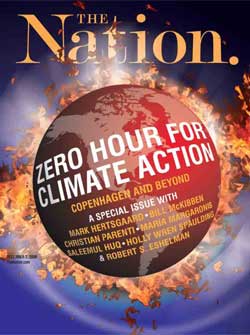 I found two highlights in this issue: a review of Michael Sandel’s Justice: What’s the Right Thing to Do? and a review of David Finkel’s The Good Soldiers.
Harvard philosopher Michael Sandel is a major figure in the revival of “virtue ethics,” the school of thought pioneered by Aristotle. As its name suggests, virtue ethics tends to emphasize the importance of developing particular character traits. Virtue ethics was out of fashion among academic philosophers for quite a long time, but now it seems to be on an equal footing with the two other leading schools of ethical thought, utilitarianism and deontology. Utilitarianism is a set of approaches that take their cue from Jeremy Bentham’s definition of the Good as that which brings the greatest amount of pleasure to the greatest number of people; deontology first crystallized in the work of Immanuel Kant, defender of the idea that moral duty and rational understanding are inseparable one from another. So, an advocate of utilitarianism might argue that we should sustain friendships because societies composed of people who like each other tend to have lots of healthy and cheerful citizens, and an advocate of deontological ethics might argue that we should sustain friendships because the universe only makes sense to people who recognize a duty to grow close to each other. An advocate of virtue ethics, on the other hand, might argue that being a friend means developing traits of character that are valuable in themselves and that can be attained in no other way.
Sandel, like other virtue ethicists, is associated with a tendency in political theory called “communitarianism.” Communitarians criticize classical liberalism for its image of the individual human being as a self-contained unit. As The Nation‘s reviewer puts it:
Nearly thirty years ago, in his massively influential debut in political theory, Sandel argued that communal belonging precedes individual freedom–that, in his language, the self is “encumbered” and therefore not altogether prior to the ends it chooses. An intrepid technical dissection of his colleague [John] Rawls’s epoch-making A Theory of Justice (1971), Liberalism and the Limits of Justice made Sandel’s name as a “communitarian.” Sandel demonstrated that for Rawls, the freedom of individual choice alone is the morally relevant starting point for inquiry into justice, an assumption that renders things like family ties, religious belief, group loyalty and historical identity irrelevant, except as a secondary extra. Communitarians like Sandel, Charles Taylor (with whom Sandel studied as a Rhodes scholar at Oxford) and Michael Walzer responded that most people, even in liberal societies, prize those things at least as much as personal autonomy. The most attractive part of Sandel’s criticism was his contention that relationships, rather than being the result of previous choices, are the sphere in which identity is possible at all. (To put it in more technical terms, there is no individual subject not intersubjectively constituted from the first.) Ever since making these claims, even as political theory has substantially evolved, Sandel has continued to argue for the priority of the communal good in an account of justice, even as he recognizes its risks for liberty.
Because a person’s virtues are part of his or her identity, communitarianism and virtue ethics inevitably go hand in hand.
The same review discusses a book by Amartya Sen that prompts the reviewer to mention that many philosophers were dismayed when political theorist John Rawls declared that the nation-state was “the natural forum for justice.” Otherwise dedicated Rawlsians rebelled against this pronouncement, arguing that justice requires a worldwide framework. I value Sandel and the communitarians because their position points to a different response to Rawls. I haven’t studied Rawls’ work deeply, but what I have read suggests to me that his theory does indeed presuppose the nation-state as the standard of community. The communitarians, on the other hand, have the intellectual resources to challenge that standard, not by arguing that the nation-state is too small to be just, but that it is too big. The nation-state, especially in the form of continental behemoths like the USA or the former USSR or China or India or the European Union, is bloated beyond any capacity to nurture healthy relationships. The only connection citizens of such enormous empires can achieve with each other is the one they feel when they cheer their rulers on and rejoice as their warriors smash the Enemy, whoever that Enemy may be at the moment. The qualities of character that we develop when we do those things are hardly to be called virtues.
That big states breed small souls is supported by material cited from David Finkel’s reports from Iraq. The American public is separated from the perspective of the American soldier by official censorship, and so has a distorted view of what is being done in its name in Iraq. Senior American commanders, too, have a distorted view, in their case because sycophantic briefing officers tell them what they want to hear rather than what their subordinates on the ground are actually seeing and doing. The reviewer describes a scene in which Finkel reports on a briefing given to the celebrated General David Petraeus. Finkel attended the briefing, and had been an eyewitness of the firefights deascribed in the briefing. He makes it clear that what the general heard had little or no relationship to the events Finkel saw. Even ground troops themselves see an ever smaller portion of what they are doing; “the Pentagon’s continued dependence on unmanned Predator drone attacks in Afghanistan and Pakistan means that even soldiers aren’t seeing the full contours of the global battlefield,” as the reviewer points out. Of course, it’s long been an axiom of military history that a researcher should ask a participant in a battle for eyewitness accounts only of events that took place within a meter of that participant’s face, and shouldn’t expect extreme clarity even in those accounts. But these added degrees of separation certainly don’t improve our ability to take responsibility for what is done in our name. Finkel apparently pulls out the emotional stops in an attempt to protest against this separation:
The chasm between over here and over there is central to another heartbreaking sequence, when the wife of a severely wounded soldier transferred from Iraq to the National Naval Medical Center in Bethesda, Maryland, remembers a visit from President Bush. Finkel recounts not only what the soldier’s wife said to the president–“Thank you for coming”–and not only what she wished she had said to him–“He doesn’t know how it feels”–but why she hadn’t said it: “Because I felt it would not have made any difference.” Communication is fruitless, because if Bush can’t see the problem staring at him from that hospital bed, he’s already living on too remote a planet.
Posted by acilius on December 3, 2009
https://losthunderlads.com/2009/12/03/virtue-engendered-or-big-states-breed-small-souls/
Keith Knight’s latest K Chronicles cartoon:
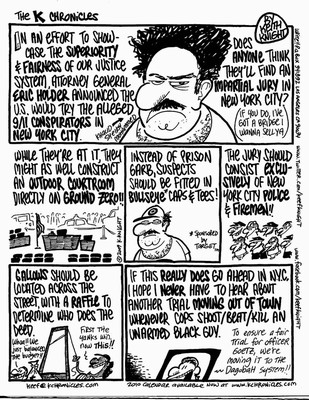
Some recent comments by Barack Obama, and a little joke about them:
In an interview with NBC News, Obama said those offended by the legal privileges given to Mohammed by virtue of getting a civilian trial rather than a military tribunal won’t find it “offensive at all when he’s convicted and when the death penalty is applied to him.”
Obama quickly added that he did not mean to suggest he was prejudging the outcome of Mohammed’s trial. “I’m not going to be in that courtroom,” he said. “That’s the job of the prosecutors, the judge and the jury.”
The president then elaborated: “I’m not going to be on the jury that will report its guilty verdict at 3pm on September 11, 2010, nor will I be the one who administers the lethal injection that will kill Khalid Sheikh Mohammed a week before Election Day 2012. I used to teach constitutional law, so I can tell you that it would be a violation of due process for me to do those things.”
In fact, I do believe that they can find an impartial jury in New York City. I would go so far as to say that Manhattan is probably the one place in the USA where it would be easiest to empanel twelve jurors who can judge the case against Khalid Sheikh Mohammed on its merits. That’s not only because the island is a bastion of liberalism, but also because the further you go from Ground Zero the more Americans you find who feel they have to prove that 9/11 was an event in their own lives and not just something they saw on TV. If as Knight sarcastically suggests they did set up a temporary courtroom on the former site of the World Trade Center, the attacks would have a definite reality for the jurors- they would be real events, with specific causes, specific consequences, specific forms that could be examined empirically. Go a thousand miles away, and the attacks become a symbol with an infinite variety of overpowering emotional associations. That’s part of the reason why the Bush-Cheney administration had an easier time using the attacks to sell its agenda to voters far outside of New York than to those in the city in those first years of the “War on Terror.”
Posted by acilius on November 18, 2009
https://losthunderlads.com/2009/11/18/venue/
Posted by CMStewart on November 17, 2009
https://losthunderlads.com/2009/11/17/leopard-seal-encounter/
Welcome to the wartime contracting bazaar in Afghanistan. It is a virtual carnival of improbable characters and shady connections, with former CIA officials and ex-military officers joining hands with former Taliban and mujahedeen to collect US government funds in the name of the war effort.
In this grotesque carnival, the US military’s contractors are forced to pay suspected insurgents to protect American supply routes. It is an accepted fact of the military logistics operation in Afghanistan that the US government funds the very forces American troops are fighting. And it is a deadly irony, because these funds add up to a huge amount of money for the Taliban. “It’s a big part of their income,” one of the top Afghan government security officials told The Nation in an interview. In fact, US military officials in Kabul estimate that a minimum of 10 percent of the Pentagon’s logistics contracts–hundreds of millions of dollars–consists of payments to insurgents.
Understanding how this situation came to pass requires untangling two threads. The first is the insider dealing that determines who wins and who loses in Afghan business, and the second is the troubling mechanism by which “private security” ensures that the US supply convoys traveling these ancient trade routes aren’t ambushed by insurgents.
Read the article.
Posted by acilius on November 12, 2009
https://losthunderlads.com/2009/11/12/how-the-us-funds-the-taliban/


 acilius
 believer1
 lefalcon
 losthunderlads
 vthunderlad
 Panther Red