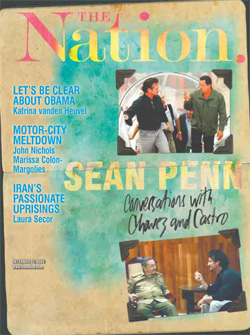
The Nation, 22 December 2008

morandi_02_l1

Giorgio Morandi, Natura Morta, 1916

It’s usually the reviews that feature most prominently in my notes about The Nation.  That’s because the notes are about things I might want to look up again, and The Nation‘s articles and columns are usually of strictly timely interest.  This week’s issue is no exception.

In this issue, Arthur Danto reviews a retrospective of Giorgio Morandi‘s paintings currently showing at the Metropolitan Museum of Art.  I’ve always had a fondness for Morandi’s subdued color schemes and restricted perspective.   Danto claims that the objects in Morandi’s still lifes seem much more active than is typical for the genre; sometimes they seem “to interact and jostle” as if competing for space on the table.  He cites this 1961 painting as an especially crowded one.  He may be onto something; for example, this 1914 piece does seem to point forward to the Futurists.  But more often when I look at Morandi I see pictures like the one I’ve posted here, quiet images that neither call out for attention with flash nor resist the viewer with trickery, but, rather, allow those who are so minded to take whatever look they wish.   

Throughout a review of a reissue of Lionel Trilling’s The Liberal Imagination runs the question of what it might mean for literature to have, as Trilling always insisted it should have, a serious moral purpose.  Trilling tries to answer the question with a remark about The Adventures of Huckleberry Finn, an answer the reviewer finds unsatisfactory:

“No one who reads thoughtfully the dialectic of Huck’s great moral crisis will ever again be wholly able to accept without some question and some irony the assumptions of the respectable morality by which he lives, nor will ever again be certain that what he considers the clear dictates of moral reason are not merely the engrained customary beliefs of his time and place.” One response to this might be to say that anyone capable of this kind of “thoughtful” reading is not likely to be a prisoner of social convention in the first place, and vice versa. The passage risks both patronizing the imagined reader and imputing an unrealistic power to Twain’s book. In such passages, the adjective “moral” appears overworked, now indicating the merely conventional social codes, now referring to the wider human vision offered by the critic.

A fair criticism, one must admit.  Humanists from Plato on would have to plead guilty to the charges the reviewer levels against Trilling here. 

Elsewhere in the issue, Katha Pollitt quotes New York University historian Linda Gordon, a founder of Feminists for Obama, calling on feminists to keep up pressure on Mr O, since that’s what their opponents will be doing.  She also quotes an op-ed by economist Randy Albelda calling for increased investment in health, education, eldercare, and other industries that employ many women as part of any economic stimulus plan.  Alexander Cockburn points out that in the aftermath of the Mumbai shootings, several top Indian officials were driven from office in disgrace, a stark contrast with the failure of any senior American to so much as admit error in the aftermath of 9/11.  Stuart Klawans reviews recent films Milk, Australia, and Wendy and Lucy.

UOGB’s latest

aaaorangehowfi_m

Teamwork

Last month, I mentioned that  the Ukulele Orchestra of Great Britain was releasing two new albums.  Our copies arrived last week, and Mrs Acilius and I can give them enthusiastically positive reviews. 

fidicula-inter-angelosThe Christmas album, referred to on their website as “Christmas with the Ukulele Orchestra of Great Britain” but labeled as Fiducula inter Angelos (“Miniature Lyres among the Angels,”)  does not after all include the performances they issued last year as a virtual album called “Never Mind the Reindeer.”  Those performances are still available on iTunes.   I do miss the rendition of “The Holly and the Ivy” from last year, but new tracks like the “Wenceslas Canticle” and a vocalese version of  “Winter Wonderland” more than make up for its absence.  Their “Jingle Bells Canticle” gets us (Mr & Mrs Acilius and the dogs) dancing every time we hear it.  Here’s ukulelehunt‘s review of the album. 

live-in-londonIn a comment on last month’s post, ukulelehunt’s proprietor Al Wood, a.k.a. Woodshed, gave it as his opinion that Live in London #1 is the UOGB’s best album yet.   I agree, though Mrs Acilius still leans toward Precious Little.  She plans to walk down the aisle to that album’s recording of “Finlandia” when we make the “Mrs” part official in May, so it has a sentimental importance to her.  Though when we listened to Live in London #1 and heard Hester Goodman’s rendering of “Teenage Dirtbag” as a ballad of adolescent lesbian angst, Mrs Acilius was so enthusiastic I wondered if she was about to suggest using that instead.  She assured me that her enthusiasm was strictly political, stemming from a conviction that sexual minorities need representation in music.  That she has a crush on Hester is purely by the way.  Here is an unflattering picture of Hester sitting next to George Hinchliffe that I could look at if I were in a jealous mood, which of course I never am.    

(more…)

Smoochers beware!

The BBC tells of a tragic case of enthusiastic kissing.

Translating Games

Grocery Checkers, by Scott Moore

Grocery Checkers, by Scott Moore

Is it possible to translate games as we translate language?  That is, can a particular instance of game- one round of table tennis, say-  be said to represent a particular instance of another game- say, one swim meet- in the same way that a particular sentence of English can be said to represent a particular sentence of Latin?  It would seem obvious that the answer is no, and it probably is.  But here’s an argument that the answer might not be so obvious.  Follow the argument to the end, and you begin to suspect that if games can’t be translated into each other, then metaphors in general might be trickier than they at first seem.

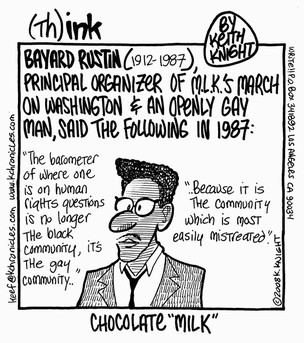
Keith Knight quotes a figure from American history

rustin1

Attention Phranc Phans!

Here’s her latest installment of Phranc Talk, her youtube variety show.  She sings about the sea, accompanying herself on the ukulele.  Then she talks about seashells.  Pickles squawks a lot throughout the whole thing.   

A strangely fascinating website

genealogy_skeletonThe Mathematics Genealogy Project is a vast family tree connecting mathematicians to their dissertation advisors, going back in some lines to the 15th century.   It can be a compelling toy- after I mentioned Georg Christoph Lichtenberg in a post Thursday, I looked up a math professor who works across the street from me and traced his lineage back to Lichtenberg.  That’s pretty easy to do- of about 130,000 mathematicians indexed, 23,522 are descendants of one or the other of Lichtenberg’s two advisees, Heinrich Brandes and Bernhard Thibault.  So you have about a 1/5 chance that any living mathematician you choose will be a descendant of Lichtenberg.  

I don’t know anything about how mathematics works as a field, but I do know enough of certain other fields to say that a reference tool like this would be of great value to them.  For example, the research careers of most classical scholars are largely defined by their dissertations, so it would be natural to sort classicists into families defined by dissertation advisor.  Efforts have been made to copy the Mathematics Genealogy Project in some other fields; here for example is “The Philosophy Family Tree.”

The Midas Touch

Thanks to haha.nu for linking to this video offering a new version of an ancient myth

Here’s another reimagining, from a few years back:

What is my body?

Body Swappers at Work

Body Swappers at Work

Body Swappers at Work

Body Swappers at Work

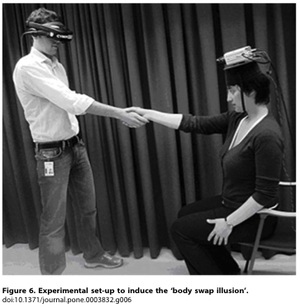
My favorite 18th century philosopher, Georg Christoph Lichtenberg, defined his body as “That part of the world which I can change simply by thinking about it.”  Now experiments are underway to test this insight and replace it with a body of scientific laws.  Here is a paper about the results of one such experiment.  Thanks to BoingBoing for the link.

The Nation, 15 December 2008

nation-15-dec-08Highlights of this issue include a review of Passionate Uprisings: Iran’s Sexual Revolution, a study of sexual behavior among well-to-do young heterosexual Tehranis by Iranian-American anthropologist Pardis Mahdavi.  In the course of extensive field work, Professor Mahdavi discovered that worries older Iranians routinely express about risky sexual behavior among the young are quite well-founded, at least as regards the population she studied.  Group sex seems to be common.  Evidently repressive laws against premarital sex, enforced ignorance of birth control and STDs, and an intensely patriarchal family structure don’t guarantee universal chastity after all.  Who knew?  The reviewer, Laura Secor, wishes for further studies that would systematically compare the experiences of Iranians of different social classes, sexual identities, and geographical locations.  With that kind of research, we might be able to figure out what if anything this risky behavior means for Iranian politics.  Of course, a study like that would be unlikely to take place in today’s Iran.  To illustrate the difficulty, Secor begins her review by quoting Mahdavi’s meeting with an Iranian sex ed teacher who could not understand why her students were reluctant to tell her about their sex lives.  The woman was wearing a double hijab that gave her such an imposingly traditional appearance that even Professor Mahdavi became self-conscious.    

William Greider points out that New York Federal Reserve chief Timothy Geithner, President-elect Obama’s pick to be the new treasury secretary, was the negotiator who worked out many of the worst parts of the Wall Street bailout; Greider frets that Mr O may go down in history as the man responsible for the economic meltdown if he doesn’t withdraw Geithner’s name and rethink his approach to the crisis.