
This week brings an especially good selection of youtube embeds on Ukulele Hunt. I’ve had them on in the background as I’ve been working. This one is especially well-suited to that purpose; a rousing tune, an intense performance, and lyrics that don’t distract me because they’re in Italian.
All posts for the month April, 2009
La Crisi, by Fabio KoRyu Calabro
Posted by acilius on April 11, 2009
https://losthunderlads.com/2009/04/11/la-crisi-by-fabio-koryu/
Lonnie Loves Jesus, Kathryn Loves Lonnie
Posted by CMStewart on April 10, 2009
https://losthunderlads.com/2009/04/10/lonnie-loves-jesus-kathryn-loves-lonnie/
The Nation, 27 April 2009
 Classicist Emily Wilson reviews Anne Carson‘s An Oresteia. Carson translates Aeschylus’ Agamemnon, Sophocles’ Electra, and Euripides’ Orestes to make a trilogy that not only tells why the legendary prince Orestes killed his mother Clytemnestra and what consequences that matricide had in their world, but a trilogy that also suggests how the moral ideas of the Athenians might have changed in response to the social and political crises of the fifth century BC.
Aeschylus’ Agamemnon was produced in 458 BC, when Athens’ empire was at its zenith and its form of democracy seemed infinitely adaptable to whatever challenges the future might present. In the Agamemnon, Aeschylus puts the motivations of the gods and of humans on display together, suggesting that while each may be temporarily obscure, nonetheless both can ultimately become transparent. When Clytemnestra kills her husband Agamemnon, her children inherit from their father the responsibility to avenge him by killing their mother. Faced with this horrifying duty, Orestes and his sister Electra seem as though they may have been plunged into an incomprehensible moral universe. Yet democracy, Athenian democracy, will settle the matter and allow the survivors of the cycle of violence to reason together once more. Orestes will ultimately appear before Athens’ Areopagus Council, which will sit in judgment of his case and reach a verdict that even the Furies themselves must accept.
Sophocles’ Electra dates from a time much later than that of Aeschylus’ play, probably the last decade of the fifth century. By that time, Athens had been embroiled in the Peloponnesian Wars for a generation. Isolated in mainland Greece, Athens had suffered heavy defeats in one theater after another. To many Athenians, it seemed that the war had discredited democracy. Not only had the war the people voted to enter brought Athens actual disaster and likely destruction, but the heaviest of all Athens’ losses were suffered in a war with another radical democracy, Syracuse. In 411, Sophocles himself would figure prominently in a move to scrap democracy and institute a government by an oligarchic group known as “the Four Hundred.” The Four Hundred didn’t last long, but the optimism of Aeschylus’ day would never be possible to the Athenians again. Accordingly, Sophocles’ view is darker Aeschylus’. Wilson says that for Sophocles, “the will of the gods is hard to interpret, and the focus of the play is on the turbulent feelings of human characters and the contradictory narratives they create to serve their advantage.” For my part, I think it would be better to say that for Sophocles, the gods are not on display- we may be visible to them, but they are never truly visible to us. We can understand only his human characters, and then only by discovering the ways in which they have deceived themselves. Wilson writes that “The play is disturbing in both its emphasis on desperate grief and the suggestion that the only cure for such pain is retribution reaped with scams and lies. Unlike in Aeschylus, there is no hope of a political solution.”
Orestes, produced in 408, is in some ways Euripides’ strangest play, and Wilson labels it the darkest of the three Carson has chosen. Euripides is closer to Aeschylus than to Sophocles in his belief that the motivations of gods and humans are intelligible, but unlike them in his doubt that understanding those motivations will bring us any closer to a world that we can judge fairly. (more…)
Posted by acilius on April 10, 2009
https://losthunderlads.com/2009/04/10/the-nation-27-april-2009/
Yet Another “Best Job in the World”

Yet another Samatha Brown.
The top 50 minus 1 from the original “Best Job in the World” have been invited to do this.
Not in the top 50 minus 1? Go here.
Posted by CMStewart on April 9, 2009
https://losthunderlads.com/2009/04/09/yet-another-best-job-in-the-world/
The UOGB (or a piece of it) plays “I’m Gonna Be”
I’ve been looking for this clip for quite a while now. The Ukulele Orchestra of Great Britain (well, four members of the Ukulele Orchestra of Great Britain, and someone else) plays The Proclaimers‘ “I’m Gonna Be” on the BBC.
UPDATE: The “someone else” is Leisa Rea of “Adams & Rea.”
Posted by acilius on April 7, 2009
https://losthunderlads.com/2009/04/07/the-uogb-or-a-piece-of-it-plays-im-gonna-be/
The Ascension, or Six Hundred Days In Her Life

Tonight’s stir fry (chicken and veg, fairly bland thrown-together sauce of:
- non-fiery “fiery sauce” +
- non-spicy “spicy habanero sauce” +
- soy sauce (the only reliable sauce in there!)
Yakisoba (lightly fried thin noodles) not shown.
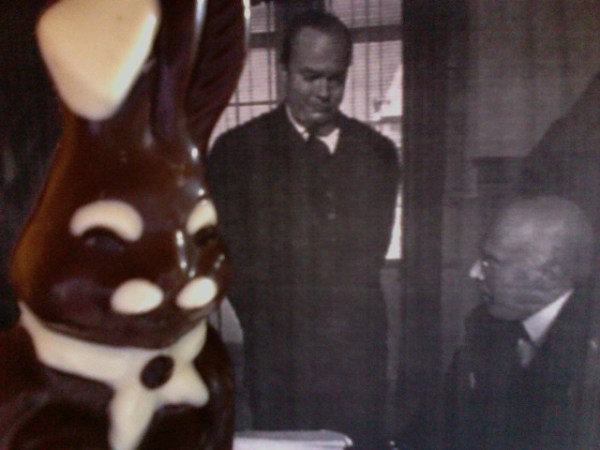
I found this chocolate bunny which apparently honors the character Charles Foster Kane. Admirable!
Posted by vthunderlad on April 6, 2009
https://losthunderlads.com/2009/04/06/the-ascension-or-six-hundred-days-in-her-life/
If Wikipedia were a guy, and he dated this girl, how would it turn out?
Thanks to the great Ukulele Hunt for featuring this video:
Posted by acilius on April 6, 2009
https://losthunderlads.com/2009/04/06/if-wikipedia-were-a-guy-and-he-dated-this-girl-how-would-it-turn-out/
The Nation, 20 April 2009

Businessman Leo Hindery and former US Senator Donald Riegle write a proposal for “The Jobs Solution” to our country’s current economic woes. Point 3 reads:
Concrete efforts to restore the essential tax-policy link between productivity growth and wage gains, which will almost surely mean adopting a value-added tax of the sort nearly every other developed country already has.
The Value Added Tax seems to be showing up everywhere these days; I’m starting to lean prettily heavily in favor of the idea of abolishing the corporate income tax and payroll taxes and replacing them with an American version of VAT.
Stuart Klawans reviews a movie that our own LeFalcon and VThunderlad seem to find infinitely fascinating, Watchmen. To be precise, the headline of his column lists Watchmen as one of the movies he will review, but what he actually does is open with a few paragraphs satirizing the disillusioned tough-guy prose style that apparently characterizes the Watchmen franchise, then tell a story about how he was shown the wrong movie at the critics’ preview. The high point of this story comes when he claims that he thought he was seeing one of the most discussed visuals from Watchmen, that is, the long blue penis of a character who is naked throughout the movie, only to realize that his eyes were playing tricks on him:
The movie starts. Immediately, I see the blue penis, and the special effects are staggering. It walks on its own. It speaks. I suddenly realize it is Clive Owen, clean-shaven for a change, striding up to inspect Julia Roberts’s cleavage at a garden party. This is not Watchmen. It is Duplicity.
Posted by acilius on April 3, 2009
https://losthunderlads.com/2009/04/03/the-nation-20-april-2009/
Can a robot think? Ask one.

dvice.com
Posted by CMStewart on April 3, 2009
https://losthunderlads.com/2009/04/03/can-a-robot-think-ask-one/
Chronicles, April 2009
George McCartney’s review of the movie The Reader begins with a description of a comedy sketch in which Kate Winslet said that making a movie about the Holocaust is a sure way to win an Oscar. That part starts at 3:13 in the clip below.
McCartney argues that the movie misses the moral point of Bernhard Schlink’s novel. Movie and novel both dramatize a sexual relationship in the late 1950s between Hanna, a former Nazi concentration camp guard, and Michael, at the time a 15 year old boy. The two see each other again years later, when Hanna and other war criminals are on trial and Michael is a law student observing the process. For McCartney, the key scene in the novel comes at this trial:
In the novel, Schlink’s point is that Hanna is being personally scapegoated for crimes that many others participated in, whether actively or passively. To prosecute her without admitting this is to perpetuate the nation’s guilt and ramify its bitter consequences. The novel fully dramatizes the wholly unwarranted self-righteousness of the other young German law students as they observe the trial. They take it as an occasion to despise the older generation, including their parents, for their complicity in the policies of the Third Reich. Michael would undoubtedly be with them but for his relationship with Hanna. As it is, he’s left with the impossible burden of coming to terms with her culpability in the midst of his lingering feelings for her.
Questioned at this trial about mass murders in which she participated, Hanna asks the judge in a state of true bewilderment, “What would you have done?”
Of course, with the moral clarity available after events, it’s all too obvious what she should have done. Schlink’s larger point is that it’s also obvious what the Germans should have done about their Nazi rulers. But as Hitler rose to power and the Nazis took command of state institutions, barraging the populace with ceaseless propoaganda complemented by a relentless program of civilian surveillance, what course was safely open to the ordinary individual? It’s easy, Schlink implies, for those who enjoy freedom today to say their elders should have resisted. Of course they should have. So should the Russians have resisted the rise of the Bolsheviks and Stalin’s police state. So should all Americans have denounced George W. Bush’s criminal policies. Schlink argues that these should haves are only helpful in the present if applied by those who realize that they themselves may not have had the moral heroism necessary to stand up to those in power.
The novel “does a fair job of examining” the “deformation of a soul” like Hanna’s, a deformation which made it possible for her to commit acts of immense violence while seeing herself only as a victim. The movie, by contrast, dwells on the actors’ physical nakedness, offering little insight into the psychological terrain in which the characters made their decisions. “We need to see more than the actors’ breasts, buttocks, and genitalia to understand them. We need principally to understand what happened to Hanna to make her the way she is. On screen, we never do.”
McCartney also objects to the fact that the sex scenes are played out between an 18 year old man playing a 15 year old boy and a 33 year old woman. “In a film that means to expose the ongoing effects of abuse, we’re edified by the spectacle of a boy actually being abused by his director and his costar. What else can we call what happens to David Kross in this movie?… [I]s 18 the age whhen, for professional reasons, a boy can disregard the sexual appeal of a nude 33 year old actress pressing against his naked body? Who’s kidding whom?”
Posted by acilius on April 3, 2009
https://losthunderlads.com/2009/04/03/chronicles-april-2009/
Who writes this?
 acilius
 believer1
 lefalcon
 losthunderlads
 vthunderlad
 Panther Red