

mc.maricopa.edu
mc.maricopa.edu
Posted by CMStewart on February 22, 2009
https://losthunderlads.com/2009/02/22/primate-shame/
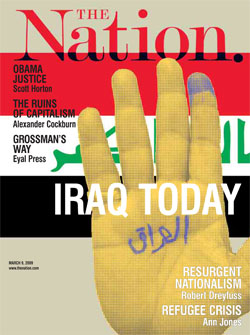 Robert Dreyfuss looks at the regional elections held in Iraq on 31 January and finds good news. A new alliance of Shi’a and Sunni groups is beginning to operate in Iraqi politics. Soon, Dreyfuss hopes, this alliance will be strong enough to present itself as a genuinely nationalist bloc and to insist on an end to the US occupation.
No such development is in sight in Afghanistan. An editorial expresses the fear that the Obama plan to send more US troops to that country will make “Bush’s War” into Mr O’s very own.
Katha Pollitt speaks up for free speech. On the twentieth anniversary of the Ayatollah Khomeini’s fatwah against Salman Rushdie, she finds fault with fellow leftists whose only response to violent behavior by Muslims who have taken offense at speech labeled anti-Islamic is to “see these incidents as gratuitous provocations by insensitive Westerners” and to support restrictions on speech that amount to blasphemy laws. She grants that many of the incidents that have generated violent responses in the Muslim world have indeed been gratuitous provocations by insensitive Westerners, and is happy to list extremists from other religious groups whose conduct has been every bit as deplorable as the worst we have seen from Khomeini and his coreligionists. But:
Appeals to the hurt feelings of religious people are just a dodge to protect the antidemocratic and retrograde policies of religious states and organizations. We’re all adults; we have to live with unwelcome expression every day. What’s so special about religion that it should be uniquely cocooned? After all, nobody at the UN is suggesting that atheists should be protected from offense–let alone women, gays, leftists or other targets popular with the faithful. What about our feelings? How can it be logical to say that women can’t point out sexism in the Bible or the Koran but clerics can use those texts to declare women inferior, unclean and in need of male control? And what about all the abuses religions heap on one another as an integral part of their “faith”?
An essay about Israeli novelist David Grossman of course concerns itself chiefly with Grossman’s insights into the Israeli/ Palestinian conflict. What sticks with me from the essay is this quote from Grossman about writing:
[Y]ears ago, reflecting on a story he was writing that featured a bitter, emotionally unstable protagonist, he described his desire to have the tale surprise him. “More than that, I want it to actually betray me,” he wrote.
To drag me by the hair, absolutely against my will, into the places that are most dangerous and most frightening for me. I want it to destabilize and dissolve all the comfortable defenses of my life. It must deconstruct me, my relations with my children, my wife, and my parents; with my country, with the society I live in, with my language.
Posted by acilius on February 22, 2009
https://losthunderlads.com/2009/02/22/the-nation-9-march-2009/

Posted by acilius on February 22, 2009
https://losthunderlads.com/2009/02/22/a-banana-by-andy-warhol/
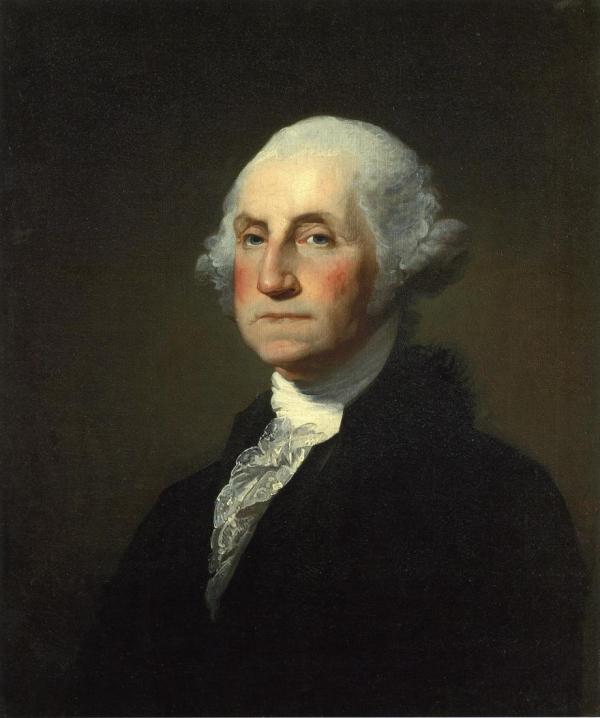
Since today is George Washington’s birthday, I decided to include my favorite of his writings, his letter to the Congregation Yeshuat Israel of Newport, Rhode Island.
Letter from George Washington to the Hebrew Congregation at Newport
c. August 1790
Gentlemen:
While I received with much satisfaction your address replete with expressions of esteem, I rejoice in the opportunity of assuring you that I shall always retain grateful remembrance of the cordial welcome I experienced on my visit to Newport from all classes of citizens.
The reflection on the days of difficulty and danger which are past is rendered the more sweet from a consciousness that they are succeeded by days of uncommon prosperity and security.
If we have wisdom to make the best use of the advantages with which we are now favored, we cannot fail, under the just administration of a good government, to become a great and happy people.
The citizens of the United States of America have a right to applaud themselves for having given to mankind examples of an enlarged and liberal policy—a policy worthy of imitation. All possess alike liberty of conscience and immunities of citizenship.
It is now no more that toleration is spoken of as if it were the indulgence of one class of people that another enjoyed the exercise of their inherent natural rights, for, happily, the Government of the United States, which gives to bigotry no sanction, to persecution no assistance, requires only that they who live under its protection should demean themselves as good citizens in giving it on all occasions their effectual support.
It would be inconsistent with the frankness of my character not to avow that I am pleased with your favorable opinion of my administration and fervent wishes for my felicity.
May the children of the stock of Abraham who dwell in this land continue to merit and enjoy the good will of the other inhabitants—while every one shall sit in safety under his own vine and fig tree and there shall be none to make him afraid.
May the father of all mercies scatter light, and not darkness, upon our paths, and make us all in our several vocations useful here, and in His own due time and way everlastingly happy.
G. Washington
Posted by acilius on February 22, 2009
https://losthunderlads.com/2009/02/22/george-washingtons-letter-to-the-hebrew-congregation-of-newport-rhode-island/
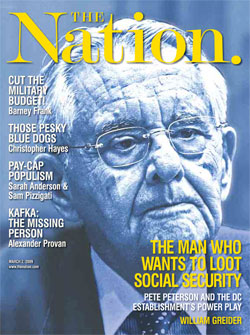 A review of several new books from and about Iran mentions the thinker Jalal Al-e Ahmad and his concept of gharbzadegi, or “intoxication with all things western” The reviewer assures us that this concept represents “one of the most influential critiques of the West.” In fact, he takes issue with some of the books under review for failing to presuming to discuss twentieth-century Iranian intellectual life, yet failing to mention the presence in that life of so towering a figure as Al-e-Ahmad. Since I’d never heard of Al-e-Ahmad or gharbzadegi, I thought I’d better make a note of this. So here are links to the Wikipedia articles about Al-e-Ahmad and gharbzadegi.
An interview with astrophysicist Adam Frank focuses on Frank’s religious ideas. Frank’s big idea seems to be that religious systems give us a way of processing and talking about emotions like awe and wonder that come upon us when we notice the scope and orderliness of natural phenomena. Frank shows his Astronomy 101 class a TV documentary about the origin of the universe, then asks them what they think of the music. His point is that the documentarians are packaging the Big Bang as a creation myth. Frank does not mean this as a condemnation of the show- on the contrary, he embraces this myth-making. Frank’s attitude reminds me of an idea I mentioned here a few days ago. I’ve long thought there was a great deal to be said about the relationship of scientific theories about the origin of the universe to traditional creation myths.
Posted by acilius on February 21, 2009
https://losthunderlads.com/2009/02/21/the-nation-2-march-2009/
Here’s the latest installment of “Phranc Talk.” No music in this one, but dog lovers will be fascinated.
Posted by acilius on February 21, 2009
https://losthunderlads.com/2009/02/21/phranc-records-a-canine-agility-contest/
 Moron.
 Loser.
There’s been some talk going around about re-instituting the Fairness Doctrine (whatever that is!). The phrase “the Fairness Doctrine” has, I guess, been floating around for years, but I’ve never known exactly what it was. I proceeded to “conduct Internet research,” i.e. look it up on Wikipedia. Noble Wikipedia describes it thusly:
“The Fairness Doctrine was a policy of the United States Federal Communications Commission (FCC) that required the holders of broadcast licenses both to present controversial issues of public importance and to do so in a manner that was (in the Commission’s view) honest, equitable and balanced.”
Ha ha ha. Do they mean like “fair and balanced”?
The Wikipedia article includes this quote, which provides a more specific description of the doctrine:
“The Fairness Doctrine had two basic elements: It required broadcasters to devote some of their airtime to discussing controversial matters of public interest, and to air contrasting views regarding those matters. Stations were given wide latitude as to how to provide contrasting views: It could be done through news segments, public affairs shows, or editorials. The doctrine did not require equal time for opposing views but required that contrasting viewpoints be presented.”
FAUX News and other outlets would, naturally, claim that they’re already doing this. But perhaps worth pondering is: HOW are they doing it?
The format of brief, rapid, superficial debates among panelists claiming to represent the different sides of an issue, seems to have become furiously prevalent on the TV news channels. But I’ve seen countless of those little debates where one or more important perspectives on the issue simply weren’t articulated by anyone on the panel. It gives the illusion of a nice, pluralistic discussion; but in actuality, the range of possible opinions that are allowed to be expressed is severely constrained. (And the public cannot get up in arms about not being exposed to certain areas of opinion which are being kept so tightly hidden from them, they are, by consequence, not really aware those opinions even exist. Stated differently: How can you agitate for airtime for suppressed views you’re not even cognizant of?)
Alternatively, a channel like FAUX will often present the controversial or non-doctrinal viewpoint … but not in a persuasive or serious way. Rather, the guest with that viewpoint is made to look like an idiot or a nut; and essentially functions as a foil or punching-bag to which the more “level-headed” guests can construct their arguments in counter-point.
And all of this, naturally, begs the question of: Is it really even possible for a government bureau to monitor the level of “fairness” contained in media outlets’ presentations? In some absolute way: NO.
But on the other hand, if we imagine that there is something like collective, communal consensus in our society … and that this consensus reflects a conglomeration and mushing together of everyone’s attitudes, beliefs, shared concepts, values, etc. … and that this big body of mush can be reduced down into some approximate, comprehensible “average,” i.e. a rough consensus that’s more-or-less apparent to us as inhabitants of / participants in society … is it TRULY unreasonable to ask that broadcasting outlets – reaching millions upon millions of listeners / readers / viewers – take some responsibility for remaining (kinda .. sorta .. to some extent) plausibly inside the *gravitational field* of that shared consensus .. as opposed to consistently and intentionally violated it and going against its grain, in order to candycoat and propagate an agenda coinciding only with the interests of the socio-economic ultra-elite (by cloaking it in a fallacious veil of trite buzzphrases about populism)?
My local AM station’s current weekday schedule includes:
Rush Limbaugh: noon-3:00pm
Dennis Miller: 3:00-4:00pm
Sean Hannity: 7:00-10:00pm
Dennis Miller (again!): 10:00pm-1:00am
That’s TEN HOURS of ultra-rightwing commentary in every 24-hour period … on the only station receivable during daytime on the AM band, in arguably most liberal/progressive community in the state.
The situation is obviously at crisis-level in a society that claims to possess some kind of “democratic” system. The problem is that the Fairness Doctrine, while a superb idea in abstract, winds up being just too sketchy on how it could be effectively implemented … to result in a more pluralistic, representative discourse … instead of just transferring tyrannical thought-control over from corporate entities into government hands. Government and the media outlets are already in such deep collusion, state control of the media would hardly constitute a different situation from what we’re already living under. It might even be a productive step, in that it would make the control more obvious, more overt; and help to dispel the ridiculous but widely-held apprehension that media discourse is by-and-large “free.”
Posted by lefalcon on February 21, 2009
https://losthunderlads.com/2009/02/21/the-fairness-doctrine/

Whitsunday Islands
Posted by CMStewart on February 20, 2009
https://losthunderlads.com/2009/02/20/wanted-professional-blogger-down-under/
A couple of years ago, LeFalcon sent me a link to a set of maps like these, which codify the counties of the USA by the percentage of the population who adhere to particular religious groups. It’s fascinated me ever since. Below, as an example, is the map for Quakers.

You can see that Quakers are rather thin on the ground everywhere. In their uniformity, they are unusual. The striking thing about the maps is how divided the USA is regionally. So, look at the distribution of Baptists:

And compare it with the distribution of Roman Catholics:

The overall map shows just how strong these regional divisions are.
Posted by acilius on February 19, 2009
https://losthunderlads.com/2009/02/19/demographic-maps-of-the-usa-by-religious-affiliation/
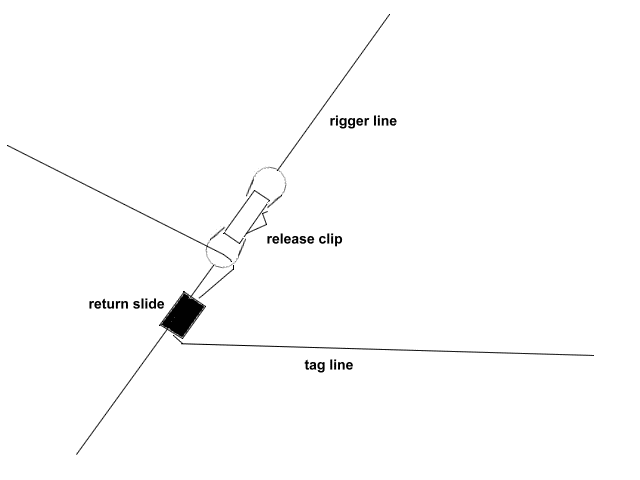 LeFalcon opines that it’s time to retire the tagline which has been on the masthead of this site for some months now: “Los Thunderlads are here to change the world! Or at least to talk a heck of a lot about it!”
I agree with him about that, but disagree with his suggestion that we ought to return to the old tagline, “Los Thunderlads are laying down some cable.” So, if anyone has any ideas, please tell me about them in the comments.
In case  the black and white diagram of a tagline above is too boring for you, here’s a color picture of kids playing tag. They’re kind of in a line, I suppose.
Posted by acilius on February 19, 2009
https://losthunderlads.com/2009/02/19/tagline/
 acilius
 believer1
 lefalcon
 losthunderlads
 vthunderlad
 Panther Red
