Science and Buddhism

Heracles/ Vajrapani as the protector of the Buddha; a Greco-Buddhist relief from Gandhara

Heracles/ Vajrapani as the protector of the Buddha; a Greco-Buddhist relief from Gandhara

(image)

Via 3quarksdaily, a report on relations between some Buddhists and some scientists:

The Dalai Lama is keen for Buddhists and scientists to interact.

In the troubled relationship between science and religion, Buddhism represents something of a singularity, in which the usual rules do not apply. Sharing quests for the big truths about the Universe and the human condition, science and Buddhism seem strangely compatible. At a fundamental level they are not quite aligned, as both these books make clear. But they can talk to each other without the whiff of intellectual or spiritual insult that haunts scientific engagement with other faiths.

The disciplines are compatible for two reasons. First, to a large degree, Buddhism is a study in human development. Unencumbered by a creator deity, it embraces empirical investigation rather than blind faith. Thus it sings from the same hymn-sheet as science. Second, it has in one of its figureheads an energetic champion of science. The current Dalai Lama, spiritual leader of Tibetans, has met regularly with many prominent researchers during the past three decades. He has even written his own book on the interaction between science and Buddhism (The Universe in a Single Atom; Little, Brown; 2006). His motivation is clear from the prologue of that book, which Donald Lopez cites in his latest work Buddhism and Science: for the alleviation of human suffering, we need both science and spirituality.

(more…)

Human/ Banana Ripeness Chart

From thesneeze, a chart about aging.  This chart was posted on 3 October 2004.  Michael Fernandes did something very similar at a Nova Scotia gallery four years later, as I noted previously.   The posting on thesneeze includes lots of explanatory comments under the pictures, some of them funny, while Fernandes did not include explanatory text with his installation.  Also, Fernandes reversed the usual chronology of maturation and decay by setting out fresher bananas each day.    

Childhood

Childhood

Teenage years

Teenage years

20s

20s

30s-40s

30s-40s

50s-60s

50s-60s

Old Age

Old Age

Death

Death

The Nation, 17 November 2008

This issue includes a note by Robert Pollin about the late economist Hyman Minsky, noting a recent vogue for Minsky and praising him as “his generation’s most insightful analyst of financial markets and the causes of financial crises.”   So he may have been, but Pollin doesn’t show why.  I suspect he would have needed more space to do that.  For example, Pollin writes that for Minsky, “financial crises and recessions actually serve a purpose in the operations of a free-market economy… Minsky’s point is that without crises, a free-market economy has no way of discouraging investors’ natural proclivities towards ever greater risks in pursuit of ever higher profits.”  Minsky may have had original ideas on this point, but this statement doesn’t bring them out- what Pollin has given as “Minsky’s point” is precisely the Austrian economists’ theory of malinvestment.  Indeed, what Pollin presents as “another of Minsky’s major insights- that in the absence of a complimentary regulatory system, the effectiveness of bailouts will diminish over time”- is a statement of another aspect of the Austrian theory of malinvestment, that regulation and subsidy imply one another.  I’m willing to believe that Minsky had original insights.  Perhaps Pollin made it clear how Minsky advanced on the work of Hayek & co. in the article he submitted and the Nation‘s editors cut the key parts for space.  What sticks in my mind is Pollin’s closing quote from Minsky’s 1986 book Stabilizing an Unstable Economy,  “Only an economics that is critical of capitalism can be a guide to successful policy for capitalism.”

Ange Mlinko reviews Susan Stewart’s poetry collection, Red Rover, praising the humanity of Stewart’s dirge for the Amish girls killed in the October 2006 massacre at their schoolhouse near Lancaster, Pennsylvania, the austere simplicity of her nature poems, and her commitment to slowness.  Mlinko quotes from Sterwart’s poem “The Forest”; Stewart posted “The Forest” in full at the Academy of American Poets website, and it’s worth reading a few times.

A critique of Chomskyanism

Mark Rosenfelder reviews Michael Tomasello’s 2003 book, Constructing a Language, focusing on Tomasello’s critique of Noam Chomsky’s theories.

Leonard Cohen’s Hallelujah

Leonard Cohen may have been Canada’s answer to Bob Dylan, and he may have a devoted following.  But he is not a cult figure.  Here’s proof:

 cohentology-sign

For some reason, Leonard Cohen’s Hallelujah has been playing in my head for the last few days.  So I’ll banish it from there to here.  To make sure it stays out, I’ll include five video performances from youtube.

Here’s the most popular youtube video of Cohen himself performing it:

(more…)

Dr Strangelove Dr Strangelove

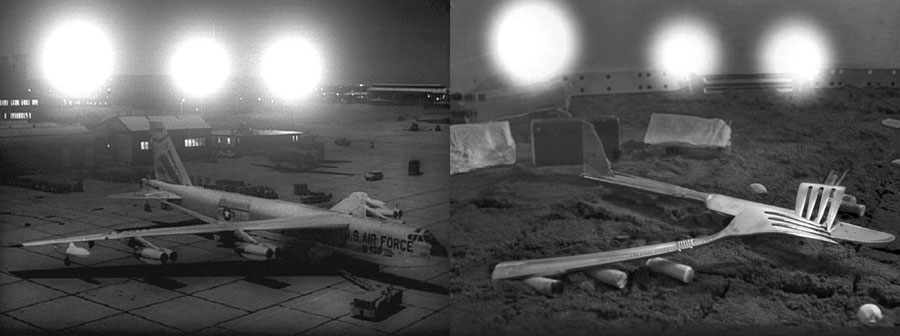
Canadian artist Kristan Horton has imitated stills from DR STRANGELOVE using household objects.  The project has resulted in a book, Dr Strangelove Dr Strangelove.  The picture below is an example:

A big plane, like a 52- you should see it some time!

A big plane, like a 52- you should see it some time!

(more…)

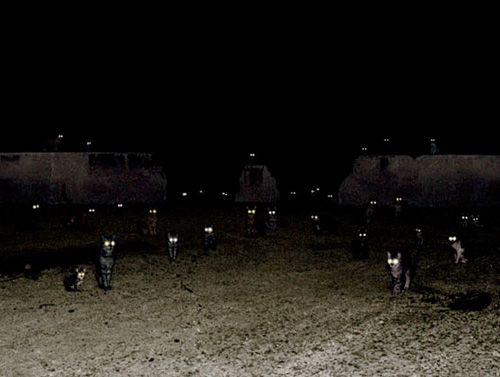
Glaring of Cats

uncredited photo

uncredited photo

New albums from the Ukulele Orchestra of Great Britain

Many thanks to the world’s greatest website, ukulelehunt, for announcing that UoGB is releasing two new albums.  The Christmas album includes several terrific tracks they’ve made available for free as MP3s in the past as well as a good deal of new material, the other album is live.  They offer free samples as well as an opportunity to pre-order the CDs at the link I’ve given. 

At the same time you buy these two albums, you can also buy Will Grove-White and the Others.  We bought our copy of it some time ago and it’s lived in our CD player ever since.  Highest recommendation!

You have earned the new puppy that’s coming with us to the White House

This has been embedded in about a million websites over the last several days, it might as well be here too.  It’s kind of stupid for the first minute, then extremely funny for about 30 seconds, then goes back and forth between annoyingly stupid and screamingly hilarious for the remaining two minutes. 

Pickle Recipes

Tom Rubnitz’s Pickle Surprise:

Alton Brown’s Deep-Fried Pickles:

approximately 2 1/2 – 3 quarts peanut oil
1 quart dill pickles
1 cup buttermilk
2 cups cornmeal
1 tablespoon kosher salt
 

Place enough peanut oil in a 4 – 5-quart cast iron Dutch oven to come halfway up the side. Place over medium-high heat to fry at 390 – 400 degrees F.  

Remove pickles from brine and quarter lengthwise. Pat dry with paper towels.

Pour buttermilk in a shallow dish. Mix cornmeal and salt in a separate dish.

Dip pickle spears, 1 at a time, first in buttermilk, then in cornmeal/salt, then repeat.

Carefully place each spear in hot oil and fry until golden brown, approximately 2 minutes. Fry 3 – 4 pickles at a time. Maintain constant temperature of 390 – 400 degrees F. Transfer pickles to cooling rack set over baking sheet. Cool 5 minutes.

foodnetwork.com

foodnetwork.com


Here’s my own Mashed Potatoes and Pickles recipe:

hot mashed potatoes

cold sweet pickle chips

Arrange pickles on potatoes and serve.

thefind.com

thefind.com