Presenting Stubby and Ting, for your viewing pleasure:
All posts for the year 2008
DomestiCats


Posted by CMStewart on November 10, 2008
https://losthunderlads.com/2008/11/10/domesticats/
The Ukulele Orchestra of Great Britain Plays “Misirlou”
Here’s an old favorite, UoGB style.
Posted by acilius on November 8, 2008
https://losthunderlads.com/2008/11/08/the-ukulele-orchestra-of-great-britain-plays-misirlou/
SEXBOT

uncredited photo
Posted by CMStewart on November 8, 2008
https://losthunderlads.com/2008/11/08/sexbot/
GMO Farmers in India

Burning GM Cotton in India
Posted by CMStewart on November 7, 2008
https://losthunderlads.com/2008/11/07/gmo-farmers-in-india/
How to tie a bow tie
Yesterday afternoon a friend of mine asked me how to tie a bow tie. Since I didn’t have a bow tie with me, I couldn’t show him, and it isn’t the sort of thing you can express very well in words alone. We went on youtube and found this instructional video. We wound up watching it three times, mainly because we were fascinated by the expression on the face of the man around whose neck the knot is being made.
As I was getting dressed this morning, I chose a bowtie. I tried to tie it as this video recommends, since this is clearly superior to the way I have been using. Muscle memory defeated me- I kept starting it the new way, then switching in mid-move back to my old way, and ending up with at most half a knot. I’ll have to train myself to get in the habit of doing it right.
Posted by acilius on November 7, 2008
https://losthunderlads.com/2008/11/07/how-to-tie-a-bow-tie/
The Nation, 10 November 2008
As you would expect from its cover date, this issue was devoted primarily to the 2008 presidential election. As that event recedes into the past, I find it hard to imagine myself going back to re-read any articles about it. Perhaps I may wake up some morning and find it impossible to believe that it ever really happened, and may want to look up this issue as proof that it did.
What I want to note now is a review essay by Moustafa Bayoumi. Bayoumi treats three books, Mirror of the Arab World: Lebanon in Conflict, by Sandra Mackey; Artillery of Heaven: American Missionaries and the Failed Conversion of the Middle East, by Ussama Makdisi; and Origins: A Memoir by Amin Maalouf. Bayoumi aligns Mackey’s book with “a budding movement on anthropology’s right wing.” Thinkers associated with this movement look at Arab societies and see one institution as paramount, the tribe. Bayoumi cites Philip Carl Salzman, who argues (in Bayoumi’s paraphrase) “that Arabs, universally and throughout history, organize their societies along a series of ‘nested’ relationships- family, lineage, clan, tribe, confederacy, sect, and religion- with each group larger than the preceding one. Indeed, Islam, on this account, postdates tribalism; with its ability to magnify the difference between believer and nonbeliever, it’s simply the largest tribe of all.” The tribalist school has had great influence in recent US policy in the Middle East; a 2003 Brookings Institution report on Iraqi tribalism (“The Iraqi Tribes and the Post-Saddam System,” Brookings Iraq Memo #18, 8 July 2003) has apparently served as one of the blueprints for US occupation policy in Iraq. Inasmuch as, according to Bayoumi, “tribalist theory presumes that tribes always impede the growth of the state,” the influence of the tribalist school over Iraq’s occupiers may explain why so little appears to have been done in the last five and a half years to develop a viable state in Iraq.
Posted by acilius on November 6, 2008
https://losthunderlads.com/2008/11/06/the-nation-10-november-2008/
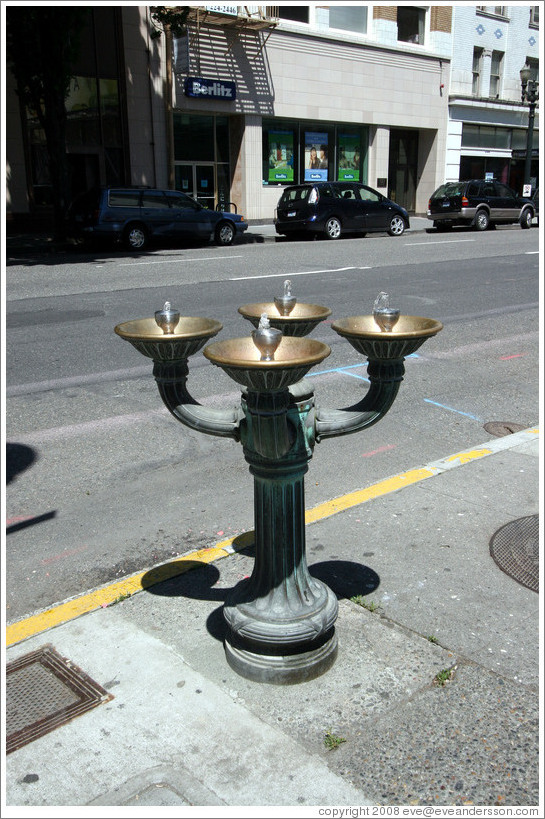
Drinking fountains
Here are some drinking-fountain themed pix from around the web.
The international symbol for drinking fountains:

In Portland, Oregon:
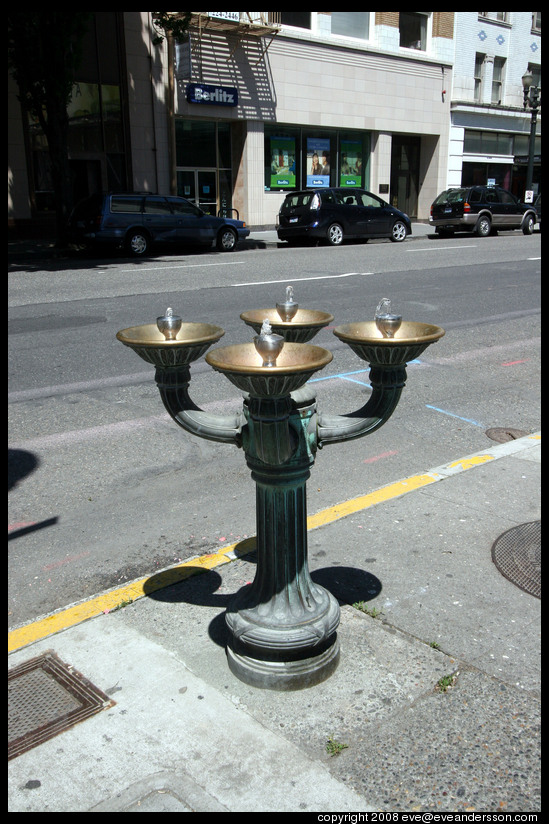
Photo by Eve Andersson
Posted by acilius on November 6, 2008
https://losthunderlads.com/2008/11/06/drinking-fountains/
Cashew and Libby

Posted by CMStewart on November 6, 2008
https://losthunderlads.com/2008/11/06/cashew-and-libby/
President-Elect Obama
It’s appropriate that Election Day should come so shortly after Halloween. As the ghosts and ghouls vanish into their occult places when day breaks, so the bogeymen and superstars of the campaign season pass out of view once the election is over. It’s back to Alaska with Sarah Palin, back to work for “Joe the Plumber,” back to the political science textbooks with the Bradley Effect, back to a museum of the 60s with the Weather Underground. Four years from now another set of entertainments will rise from some unknown quarter and haunt us for a season.
The candidates themselves do not go anywhere; they cease to exist. The winning candidate is replaced by the office holder, the losing candidates are replaced by somewhat older, somewhat sadder versions of the people they were before they ran. That’s why there’s a richer vein of literature about losing contenders for power than about winners. Try to dramatize the winner and the best you can do is hint at what Shakespearean actors call “the man inside the king.” The king is a symbol, he is power, he is majesty, he is order, and he is empty. Art and literature can focus on the king only when the symbol fails and the human being emerges. I think the Horace illustrates that process in his Ode 1.37. As long as she is a contender for power, Cleopatra is at best a monster. Defeated, she is one of us.
Here’s Cedric Whitman’s translation of that poem. Robert Frost defined poetry as “that which is lost in translation”; I’m afraid Whitman does not manage to defeat that definition. But it does show the major gestures in Horace’s original, and unlike some other versions it is possible to read Whitman’s aloud. I’ve appended Edward Wickham’s edition (from his Oxford Classical Text) of the original below.
Drink, comrades, drum the ground, now it is time
for freedom’s dance; and call on all the gods
to come, lay out their gorgeous couches,
and let them recline at the feast of Mars.
It had been crime till now to pour good wine
from the crypts of our forefathers, while ruin poised
over the Capitol, and fevered madness
was winding cerecloth round our realm-
Dreams of the queen of half-men, girt by her crew
of sickly shame, and drunk with delirious hopes
grown fat and reckless on easy fortune!
But all that glare of frenzy waned
When scarce one vessel of her fleet sailed home
unscorched by flame; her mind, long tranced and dazed
on heady Egypt’s wine, now waking
to terror’s truth, found Caesar’s oars
hard pressing on her flight from Italy,
swift hawk on downy dove, hunter on hare
in snowy fields of Thrace, and ready
to fling her into chains, a beast
of ominous wonder. But she had loftier thoughts,
to find out death; blades could not make her cheek
blanch like a girl’s, or drive her flying
with huddled sails to lurking shores.
Her courage soared; with placid face she scanned
her fallen palace, and valorously reached
her hands to rasping snakes, sucking
their venom’s blackness through her limbs.
Once death was fixed, the fiercer grew her mind:
Indeed, she scorned his cruel galleys, and men
who would have had her walk uncrowned,
no spiritless woman, in triumph’s pride.
Posted by acilius on November 5, 2008
https://losthunderlads.com/2008/11/05/president-elect-obama/
Funky President
Posted by CMStewart on November 5, 2008
https://losthunderlads.com/2008/11/05/funky-president/
Who writes this?
 acilius
 believer1
 lefalcon
 losthunderlads
 vthunderlad
 Panther Red