An unexpected visitor

It was Thursday, 23 May 2002.  I walked to school.  About halfway there a little reddish dog with a twisting tail started following me. 
I tried to ignore him, couldn’t completely as there was some traffic and I didn’t want to be responsible for him getting hit.  He passed up several other pedestrians to stick with me.  When I got to the door of North Quad I had to make a decision.  Would I let him in to my office and call animal control, or would i shut him out of the building?  He was awfully thin, reminded me of a dog found half-starved whose picture was in the paper the week before.  Being so thin, with his red fur and pointy ears, he almost looked more like a fox than a puppy.  So I let him into the office. 
The class was very small, just 8 students; that happens sometimes in the summer.  At that time my office was in a room off a little conference area.  The class met in that area.  So the dog came into the classroom with me. 
It was a 95 minute class.  Throughout it the students were playing with the dog and telling storis about dogs who had followed them.   From the table where we sat you could see out the window to the southwest entrance to the building.  We all glanced out that window from time to time, hoping that animal control would get there.  Class ended and animal control still hadn’t shown up.  A student got up to leave.  He opened the door, and the dog ran out.  We all jumped up to herd him back into the room.  Glancing over my shoulder at the window, I saw him bolt out. 
I don’t know if it was the same dog, but starting a few weeks later I would occasionally see a very similar little dog, same shade of red, same twist in his tail, following a homeless man around the neighborhood I lived in at the time.  I saw them together scores of times.  It was a couple of years before I saw the homeless man without the dog.  I asked the man what had happened to him.  He lit up and described the good home he’d found for the dog.  A nice house, fenced-in yard, and a loving family.  Then he went back about his business, picking up cans off the street.   
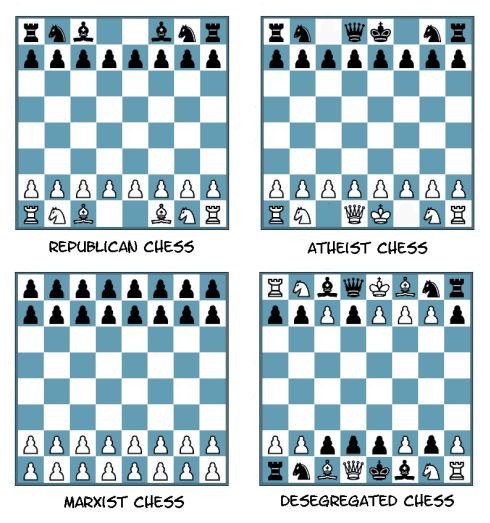
Altered Chess

Thanks to haha.nu for pointing to this Russian site that illustrates alternative versions of chess.  A few examples:

26461-114131-9c9f7c3de8a337e21165bab121d7b7fb

(more…)

Victoria’s Security Secret?

artsomerville.org

artsomerville.org

Not long after 9-11 I flew to Hawaii in a trench coat. Underneath I wore a skimpy sheer camisole (no bra) and long pants. I was asked to remove my coat to go through security. I started to slip my coat off my shoulders, and the security guy blushed and waved me through. On the plane, the passenger sitting next to me kept insisting I share her sandwich with her. She reached into her purse and casually pulled out a standard kitchen knife. Then she cut her sandwich in half while I braced myself for the SWAT team that didn’t show up. The rest of the flight was without incident. Once in Hawaii, I waited several hours for my luggage to show up.

Phoenician remains

Phoenicians bartering

Phoenicians bartering

(image)

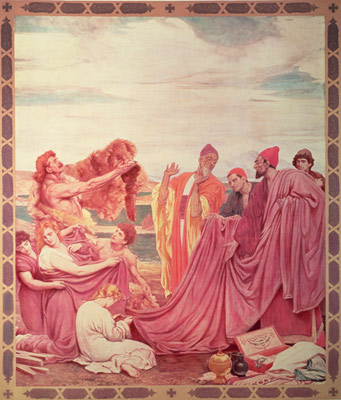
The ancient Phoenicians made the MSN homepage today, with this article about a 2900 year old cemetery unearthed near Beirut.

When language was first spoken, how many languages were spoken?

You might think it would be obvious- one.  Many theorists would agree with you, and you may all be right.  But you may not be.  Click here to see why.

Tall buildings with a single bound

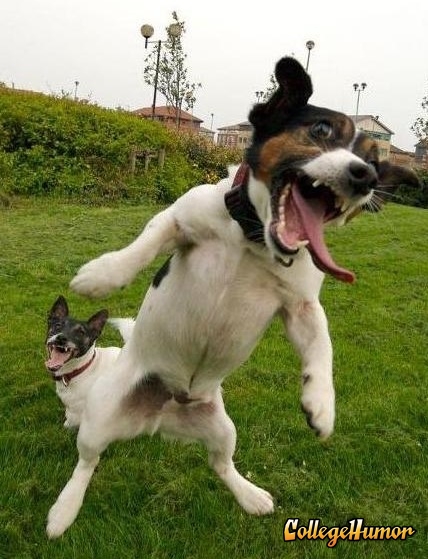
From the hated CollegeHumor, a compelling image.

collegehumor_d838c76622357ba0cef911a96926667c

2008 Presidential Election Results

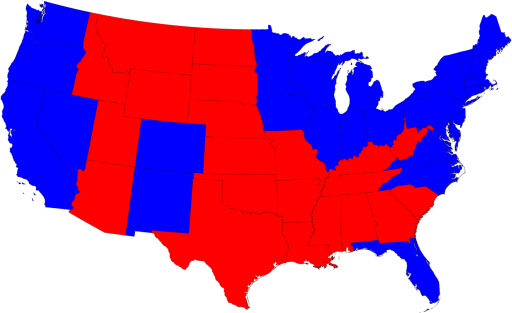
The usual news report about the results of a presidential election will include a map that looks like this:

statemapredbluer512

A familiar image, but one which does not tell us who won the election.  Change the size of the states in proportion to their population, and you produce a less familiar, but more useful image:

statepopredblue512-cartogram

Maps like this are called cartogramsThis guy can help you make your own cartograms, if you are so inclined.

The American Conservative, 3 November 2008

The cover of this issue features caricatures of Senators John McCain and Barack Obama, advertising 18 short pieces by various contributors explaining how they reacted to the presence of that pair as candidates for US president.  Of those 18, 4 expressed support for Obama, 3 for McCain, 2 for Constitution Party nominee Chuck Baldwin, 2 for Libertarian Party nominee Bob Barr, 1 each for non-candidates Ward Connerly and Ron Paul, and the remaining 5 backed no one

John Schwenkler reports from the Middlebury Institute’s Third North American Secessionist Conference in Manchester, New Hampshire.  Headed by old-time New Left leader Kirkpatrick Sale, the Middlebury Institute gives equal footing to far left groups like the Second Vermont Republic and far right groups like the League of the South, much to the dismay of bien-pensant liberals.  Sale and company argue that “the so-called American Revolution… was a war of secession, not a revolt” and that separatism has a long history in American history, a history reaching far beyond the late unpleasantness between the states.  Schwenkler quotes Emory University philosopher Donald Livingston, a scholar of the Scottish Enlightenment who has apparently turned in recent years to Aristotle’s Politics and its emphasis on the proper scale of human communities.  Aristotle might have argued that the United States is simply too big to do any good.  Aristotle followed Plato in his belief that there was an appropriate size for a human society, that too small a group would be doomed to perpetual poverty while too large a group would lack any real bond of community.  This focus on the need for human communities to be built on a human scale has been one of the recurring themes in political theory ever since.  Because Livingston has spoken harsh words against Abraham Lincoln and the centralization of power in Washington that followed the Civil War, he has occasionally been smeared as a racist. 

Austin Bramwell argues that conservatives would be better off if there were no conservative political movement.  One may be tempted to add that in this they are like everyone else.  Bramwell’s claim is that what conservative intellectuals have to offer is something of value to independent minded individuals, but useless as a battle cry for partisans.  As examples of the kind of conservative intellectuals he has in mind, Bramwell offers Joseph Schumpeter, Jane Jacobs, Tom Wolfe, Jacques Barzun, Noam Chomsky, E. O Wilson, and Steven Pinker.  Bramwell classifies Schumpeter as conservative for precisely the reason so many on the right are uncomfortable with him today, his support for a “semi-feudal, mixed constitution” that would act to temper capitalism.  Jacobs self-identification as a leftist does not trouble Bramwell; her focus on the need for society to be constituted on a human scale and her opposition to centralized planning put her in his camp.  Chomsky, Wilson, and Pinker make the list because of the defenses each has offered for the idea that human behavior has biological bases that social planning cannot overwrite.  Indeed, Bramwell turns Chomsky’s ceaseless denunciations of US foreign policy into a conservative credential by pointing out that “Chomsky describes his politics as an attack on social engineering as he perceives it.” 

Howard Anglin reviews Marilynn Robinson’s novel Home, declaring that “Without artists like Robinson, without books like Home and the institutions they celebrate, our civilization cannot last long… If Marilynn Robinson is a liberal, then America needs more liberals.”  Considering that the review opens by quoting Robinson’s 2004 statement that “I am myself a liberal,” this last sentence would seem rather odd in a magazine called The American Conservative.  The rest of the quote (from her 2004 essay “The Tyranny of Petty Coercion” ) shows that she is about as conservative as Noam Chomsky and Kirkpatrick Sale:

I am myself a liberal.  By that I mean I believe that society exists to nurture and liberate the human spirit, and that large-mindedness and openhandedness are the means by which these things are to be accomplished.  I am not ideological.

(more…)

Snoopy

Common drinking facilities and common decency

Sexuality in the arts posts a review of Bob Dylan and Barry Feinstein’s Hollywood Foto-Rhetoric that also serves as a response to California’s vote to ban same-sex marriage.  It includes some images of drinking fountains and bars.