Pretty in pink?

Yesterday, many US comic strips were loaded with pink in a campaign to raise awareness of breast cancer.  For examples, see the Comics Curmudgeon.  When I read the paper yesterday morning, what all that pink in fact reminded me of was the Financial Times:

Maybe the FT has been on a campaign to raise awareness of breast cancer for all these years, and it has just neglected to tell anyone about it.

Helping others, hurting oneself

In a recent issue of The Nation, Miriam Markowitz reviewed a biography of a remarkable figure named George Price.  The opening paragraph is an attention-grabber:

George Price was born a Jewish half-breed to parents who kept his Semitic side a secret; lived much of his life an aggressive atheist and skeptic of the supernatural; and died a Christian, twice converted, albeit, to his mind, a defeated one. Several years before he abandoned his career in a mission to shelter and comfort homeless alcoholics, he made a number of extraordinary contributions to evolutionary biology, a field in which he had no training. Educated as a chemist, Price had worked previously for the Manhattan Project on uranium enrichment, helped develop radiation therapy for cancer, invented computer-aided design with IBM and dabbled in journalism.

I suppose if your name is Miriam Markowitz you can use phrases like “Jewish half-breed,” though I for one would just as soon you didn’t.

In 1970, Price used a mathematical model rooted in game theory to revise an equation that William D. Hamilton had proposed as a means of analyzing altruistic behavior.  Hamilton and others saw that Price’s equation made it possible to analyze self-sacrificing behavior at many levels of selection at once, and to do so without appealing to notions of group selection.   This last point was especially attractive to Hamilton; as Markowitz explains, “Hamilton’s theory of inclusive fitness was a riposte to what he considered the naïve and ‘woolly’ group selectionism in vogue until the late 1960s, which explained altruistic behaviors with vague gestures toward ‘the good of the species.'”  Hamilton’s consistent opposition to all forms of group selectionism, be they woolly or threadbare, was one of the reasons Richard Dawkins named him as one who may have been “the greatest Darwinian since Darwin.”   Price’s theoretical work is basic to biological explanations of altruistic behavior; his own personal determination to lead a life of altruism, however, was infinitely less successful.  None of the homeless alcoholics he sought to help took much interest in his ministrations.  Despairing, Price committed suicide in 1974.

Read the full post »

What Fred Reed understands

From a column by Fred Reed:

I understand that Americans have no interest in Mexico other than to give jobs to illegals and then complain that they have them. And of course to buy drugs and then complain that Mexicans sell them. But a bit of attention, even of realism, might have its virtues. Afghanistan is somewhere else. Mexico isn’t.”

Liberalism versus Sex

In the USA, it’s customary to divide the political spectrum into liberal and conservative, where “liberal”= “left” and “conservative”=”right.”  This tends to leave Americans perplexed when they hear people in other countries denouncing hypercapitalist economic policies as neoliberal or ultraliberal.  The easiest way I’ve found of explaining this usage to my countrymen is to mention H. G. Wells.   When Wells visited America in 1906, he remarked that the United States lacked two of the three major political parties that existed almost everywhere in Europe.  One of these was a socialist party.  While there was a socialist movement in the USA in 1906, no socialist party was a leading contender for power in national politics.  The other missing party was a conservative party.  Not only was there no major contender for power in the USA that stood for monarchy, an established church, and the traditional relationship between peasant and aristocracy; there was no constituency in American society that could possibly demand such a platform.  The parties that Wells did find in America would in the UK have been represented by the left and right wings of the Liberal Party:

It is not difficult to show for example, that the two great political parties in America represent only one English political party, the middle-class Liberal Party, the party of industrialism and freedom.  There is no Tory Party to represent the feudal system, and no Labor Party… All Americans are, from the English point of view, Liberals of one sort or another.  (The Future in America: A Search after Realities, pages 73-74)

Liberalism, in all its forms, holds out the promise of a social order based on reason.  Left liberals, including some who call themselves Greens or Social Democrats, want to reform the public sphere so that rational dialogue among individuals will dominate politics, and through politics rational dialogue will provide a meeting ground where a diverse population can live together peacefully.  Right liberals, including some who call themselves Conservatives or Libertarians, want to reform the economic system so that the rational self-interest of individuals will dominate the marketplace, and through the marketplace rational self-interest will generate an free and orderly society.  In either form, liberalism places its faith in the power of reason.

Such a faith can be very comfortable indeed.  Liberals left and right sometimes annoy their opponents by seeming so “terribly at ease in Zion.”  Even the most complacent liberal, however, can hardly fail to notice that some extremely important areas of human life do not seem to invite reason’s governance.  Among the most obvious examples is sexual behavior.  Decades ago, science fiction writer Robert Sheckley imagined what a perfectly rational lover would be like; in his 1957 story “The Language of Love,” Sheckley presented a character named Jefferson Toms who learned how to make love without compromising reason in any way.  Toms discovers why the species that invented this art went extinct when he finds that no potential lover can tolerate his scrupulously accurate endearments.

Of course, Jefferson Toms’ namesake Thomas Jefferson was at once one of the supreme exponents of the liberal tradition and a man who likely followed his sexual urges to betray every principle that tradition exalted.  When they consider sexual behavior, liberals typically speak of “consent.”  That “consent” is a technical term which has little meaning outside the legal processes where it arose becomes clear when we speculate on what may have happened between Thomas Jefferson and Sally Hemings.  As Jefferson’s slave, Hemings could not legally consent to enter a sexual relationship with him, or with anyone else.  The law of a liberal society would thus label any sex act in which she participated as rape.  Hemings may indeed have experienced her encounters with Jefferson as rape.  We certainly don’t know enough to defend him in any way.  But surely it must give us pause to realize that our idea of “consent” implies that none of the billions of human beings who have lived as slaves has ever engaged in a wholesome sex act.  A non-liberal Right might claim that this implication reduces the whole liberal project to absurdity, and throws us back to traditional definitions of social roles, rather than individual self-determination, as the proper standard for judging the moral status of any action, sexual or otherwise.

A non-liberal Left might respond differently, but with equal certitude that it had found a fatal flaw in liberalism.  In our own times, Catharine MacKinnon and the late Andrea Dworkin exposed the shallowness of the notions of “consent” that underpin liberal definitions of rightful sexual behavior.*  Those notions imagine a man and a woman facing each other as equals and deciding, by a rational process, whether they will engage in a particular sex act.  At a minimum, an act can be consensual if and only if both parties are consenting to the same thing.  This in fact never happens, nor can it happen in a patriarchal society.  Wherever men as a group are recognized as dominant and women as a group are labeled as submissive, a man will gain power over women and status among other men if he extorts sex from women, while a woman will pay a price for resisting this extortion.  Because of these facts, men and women make such radically different cost/benefit analyses before agreeing to sex that the parties can never be said to have consented to the same thing.  For this reason, Dworkin wanted to excise the word “consent” from rape laws.

Read the full post »

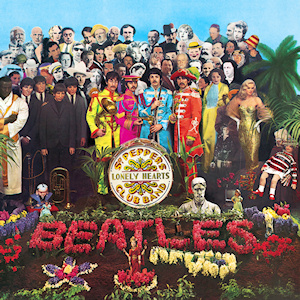
Who among the people depicted below is still alive?

For some time now I’ve kept typing into Google variations on this question: “Which of the people represented on the cover of Sgt Pepper’s Lonely Hearts Club Band are still alive?”  Lots of sites identify the people, but nowhere does it seem that there is a list of who’s alive and who’s dead.  So I decided to take a few minutes on Wikipedia and make up such a list myself.

Alive (UPDATED)

Larry Bell

Dion diMucci

Bob Dylan

Paul McCartney*

Ringo Starr

Dead (date of death in parentheses)

Bobby Breen (19 September 2016)

Shirley Temple Black (10 February 2014)

Tony Curtis (29 September 2010)

Richard Merkin (5 September 2009)

Karlheinz Stockhausen (5 December 2007)

Marlon Brando (1 July 2004)

Albert Stubbins (28 December 2002)

George Harrison (29 November 2001)

Huntz Hall (30 January 1999)

William S. Burroughs (2 August 1997)

Terry Southern (29 October 1995)

Marlene Dietrich (6 May 1992)

Fred Astaire (22 June 1987)

Diana Dors (4 May 1984)

Johnny Weissmuller (20 January 1984)

H. C. Westermann (3 November 1981)

John Lennon (8 December 1980)

Mae West (22 November 1980)

Richard Lindner (16 April 1978)**

Issy Bonn (21 April 1977)

Wallace Berman (18 February 1976)

Sonny Liston (30 December 1970)***

Already dead when the album was released:

Lenny Bruce (3 August 1966)

Simon Rodia (16 July 1965)

Stan Laurel (23 February 1965)

Aldous Huxley (22 November 1963)****

Max Miller (7 May 1963)

Marilyn Monroe (5 August 1962)

Stu Sutcliffe (10 April 1962)

Carl Gustav Jung (6 June 1961)

Tyrone Power (15 November 1958)

Oliver Hardy (7 August 1957)

Albert Einstein (18 April 1955)

Dylan Thomas (9 November 1953)

Parmahansa Yogananda (7 March 1952)

George Bernard Shaw (2 November 1950)

Tommy Handley (9 January 1949)

Aleister Crowley (1 December 1947)

W. C. Fields (25 December 1946)

H. G. Wells (13 August 1946)

Tom Mix (12 October 1940)

Sigmund Freud (23 September 1939)

Sri Yukteswar Giri (9 March 1936)

T. E. Lawrence (19 May 1935)

Oscar Wilde (30 November 1900)

Stephen Crane (5 June 1900)

Aubrey Beardsley (16 March 1898)

Lewis Carroll (14 January 1898)

Sri Lahiri Mahasaya (26 September 1895)

Karl Marx (14 March 1883)

David Livingstone (1 May 1873)

Robert Peel (2 July 1850)

Edgar Allan Poe (7 October 1849)

*If you are of this opinion, go ahead and comment.  Someone might respond.  I won’t, but someone might.

**He died on his 50th birthday

***That’s when the police say he died, but there’s a controversy about it

****The same day C. S. Lewis died.  And John F. Kennedy, also.

Gorilla Man, by Caitlin Rose

Humble Uker embedded this irresistible video in a post yesterday:

Ukulele news on NPR this morning

About an unsuccessful attempt in San Francisco to set a record for largest uke ensemble:

http://www.npr.org/templates/story/story.php?storyId=130148461

I think you should be more explicit here in step two

Recently I took a lot of books to the nearest used book store.  My main goal was to free up space in the apartment, but since the guy doesn’t pay cash for books and I’m not inclined to give him books for free I had to take store credit.  That meant picking up a few books.  What he had that I could imagine myself reading were popular science books about cosmology written in the 1950s, 1970s, and 1990s.  It’s been fun looking through those.  It’s as if I’ve been mentally reenacting the development of grand scale physical theory as it has played out over the last 60 years.  So I started with The Nature of the Universe,  a series of lectures delivered in 1950 by Fred Hoyle, who coined the phrase “Big Bang” as a silly name for what he regarded as a ludicrous hypothesis.  Then I moved on to a somewhat later book suggesting that the hypothesis might not be so ludicrous, to a still later book that explains it as a settled fact, and then to a relatively recent book which shows impatience with people who still talk about the Big Bang when the the real questions are all about the period of extremely rapid cosmic inflation that followed immediately after the Big Bang.

Seeing how dramatically cosmology has changed in the last 60 years and how much more powerful its arguments have become, it’s easy to think that physics must have reached maturity in that time.  One might think that physicists are done making great discoveries, and that in the next few years they will tidy up the few remaining problems facing their discipline.  Looking more closely, a different picture emerges.  So, reading one of the more recent books I came upon a reference to proton decay, including the casual remark that in the distant future, several trillion years from now, there won’t be any protons left.  I was curious as to how long it takes a proton to decay and what happens to the little fellow while he is decaying.  So I googled “how long does it take a proton to decay?”  That brought up some articles saying that we don’t know how long it takes protons to decay, and that as a matter of fact we have no proof that they decay at all.  No one has ever seen a proton decay, and since we know virtually nothing about the internal structure of the proton we cannot very well describe the process by which that structure would dissolve.  Knowing so little about the proton, we are in the dark not only about the origin and future of the proton, but we are also in the rather embarrassing position of not being able to explain why objects have mass.  The Large Hadron Collider is supposed to inform this ignorance, but at the moment physics is left with an enormous blank space.  This blank space suggests, not a mature science with only a few loose ends left to tie up, but a young science whose greatest discoveries are very likely still to be made.

Perhaps I will cap off my read-through of old popularizations of cosmology with a look at Stephen Hawking‘s forthcoming book. This book has already received a great deal of commentary, most of in response to this quote:

Because there is a law such as gravity, the universe can and will create itself from nothing. Spontaneous creation is the reason there is something rather than nothing, why the universe exists, why we exist.

I haven’t yet seen the book, and these two sentences are not included in this excerpt from it published in Time magazine, or this one from the Wall Street Journal.   So I don’t know what Hawking is driving at with this line.  Since the book only became available on the 7th of this month, few in the armies of commenters can have seen it either.  Not even philosopher Ervin Laszlo quotes any part of the book aside from these 35 words.

It would therefore be both unfair to Hawking and superfluous for me to become yet another person who has reacted to these two sentences without reading the book from which they are taken.  So I will confine myself to mentioning some ideas of which this line has reminded me, ideas which I do not attribute to Hawking.

The discussion surrounding Hawking’s two sentences tends to be summed up in headlines like “Stephen Hawking: God Was Not Needed to Create the Universe,” “”Hawking’s Rejection of God Unpersuasive, Say Faith Leaders,” and “God Has No Role in the Universe, Says Stephen Hawking.”  The idea that the existence of the physical universe in some way or other proves the existence of a supernatural being who created and governs that universe is known as “the argument from design.”  To the extent that the 35 words quoted above summarize Hawking’s project fairly, that project would represent an attempt to refute the argument from design.  Over the centuries, other arguments have been advanced to prove that God exists; I very much doubt that an attempt to refute the ontological proof or the transcendental argument would inspire the furious reaction these 35 words have elicited in so many quarters.  Many people who are quite willing to see the other arguments as exercises for logic students to work through seem to be passionately attached to the argument from design, even to equate acceptance of its soundness with religious belief.

This state of affairs puzzles me.  As a teacher in a university classics program, I often talk with students about the mythological ideas of the ancient Greeks and Romans.  In these ideas, we see a culture which showed an intense concern with the birth of the gods, and an equally intense concern with the origins of various human populations.  The ancients usually worshipped their gods, not one at a time, but in groups.  Therefore, they needed stories that included descriptions of the primordial cosmos to explain what the kinship relations were among the gods.  Only with that knowledge could they properly appease the unseen forces that they believed to hold great power over their lives.  Most of the ancients lived, not as atomized individuals, but as members of close-knit kinship groups.  Therefore, they needed stories that included descriptions of the origins of the human race to know who their relatives were, and which groups were offshoots of other groups.  What pagan Greeks and Romans did not seek to find in myth was an account of the origin and basic governance of the physical universe.  Greek and Latin mythological texts simply take it for granted that “there is something rather than nothing,” that “the universe exists.”

To give just one example, the most famous Greek mythological text treating of the world before humans was Hesiod’s Theogony.  Not only does Hesiod say that the first cosmic entities emerged spontaneously from the void; this idea doesn’t even strike him as something needing explanation.  The gods did not create the physical world, as they were all descended from the entities formed in that first moment of spontaneous generation.  Hesiod does not appeal even obliquely to any process that might have produced the Earth.  “At first there was a gaping void, and then came into being deep-breasted Earth, the unshaken foundation of all the immortal gods who occupy the snowy peaks of Olympus, and shadowy Tartarus deep in the Earth’s wide ways, and Eros, most lovely of the immortals, who undoes the strength of minds and limbs and counsels both human and divine .”  And that’s it- from there on out we’re on to the interesting part, the cosmic family tree.

This blasé disregard for the origin of the physical world did not set the Greeks and Romans apart from their neighbors in the ancient Mediterranean world.  The ancient Hebrews, for example, were so bored by the topic that they placed two contradictory accounts of the origin of the world side by side in chapters one and two of Genesis, and then spent a good many centuries producing sacred texts that barely mention either account.  Having established that they were not an subgroup of any other existing nation, the Hebrews could go on to other subjects.

It has only been in the modern world that the idea has taken hold that the physical world operates like a machine, and that if there are gods who govern it they must be machinists.  With the prevalence of this idea, the “argument from design” became vitally important to believers of many stripes.  Thomas Aquinas (1225-1274) is often cited as the father of the argument from design, but it is worth pointing out that he in fact rejected the forms of the argument that are familiar today.  In Question 2, Article 3 of the Summa Theologica, Thomas pairs the following objection and response:

Read the full post »

What we’ve posted on the Tumblr site

Since our most recent substantive post here, we’ve posted all of this stuff on our Tumblr site:

-a recent Jem Cooke video

– a picture of a funny sign

-a link to the announcement of a new comic book a friend of ours made

-a video of classical ukuleleist Valèry Sauvage playing Ken Middleton’s arrangement of a traditional Irish tune

-a little joke about a political controversy that’s been raging in the USA

-a one-panel comic about Botticelli’s Birth of Venus

-a video of ukuleleist The Bradlands playing Mrs Brown You’ve Got a Lovely Daughter, accompanied by a link to Phranc’s ukulele version of the same song

-a video of Bosko and Honey performing with The Uke Box

-an animated short, made in 1973 and narrated by Orson Welles, dramatizing Plato’s allegory of the Cave

We haven’t moved from this site to that one.  It’s just that we’ve all been a bit busy, and it’s been easier to find a couple of minutes to slap a video or a link on Tumblr than to do the sort of writing we usually produce for this site.  We’ll post more stuff here soon.

Our Tumblr site

We should probably mention that we’ve been posting things at our Tumblr site, “Thunderlads After Hours,” lately.  We’ve made no attempt to publicize it, so we’ve attracted a grand total of one follower so far; but she is ukulele superstar Victoria Vox, so we’re quite pleased.