In 1968, designers Charles and Ray Eames released a short film called “Powers of Ten.” Here it is:
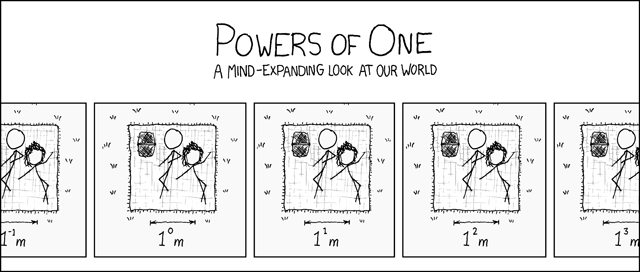
Here’s a tribute to the film that appeared as xkcd #271:
There’s something I occasionally wonder about. People sometimes say that hearing about the scale of the universe at its largest makes them feel small and unimportant. On that scale, the earth figures as a minuscule portion of a solar system that is itself a minuscule portion of a galaxy that is in turn a minuscule portion of one of countless clusters of galaxies in the universe. When I hear that remark, I think about the scale of the universe at its smallest. Tiny as our world is in comparison with the deepest reaches of the sky, how large do we bulk in comparison with the smallest units of the submicroscopic world?
This flash animation from Cary and Michael Huang, released a couple of days ago as a followup to a similar project they put out in 2010, takes us from the Planck length, which is evidently the smallest size a thing can be, up to what theorists currently suspect is the total size of the universe, which extends at least 7000 times as far as we will ever be able to see. The latest theories hold that the total size of the universe might be about 1.6 times 10 to the 27th power meters. That theory may be as mistaken as all the previous theories about the same thing have been, but it’s the best we have going at the moment. So, if that theory is correct and you were to lay humans end to end, the number of them you would need to stretch from one end of the universe to the other would be 28 digits long. The Huang brothers note in their animation that the total height of all living humans is much shorter than that, of course; in fact, if we were all to lie down end to end we would only reach about 1o million kilometers, only about 1/15 of the way from the earth to the sun. Even if all 100,000,000,000 humans who ever lived were to be reincarnated and join us, we would still reach less than 15 billion kilometers, which would barely get us from one side of the Solar System’s Kuiper Belt to the other.
So, compared to the largest scale of structure in the universe, we are indeed quite small. But let’s take a moment and look at the smallest scale of things in the universe. The Eameses stopped their exploration at the level of the proton. In 1968, there wasn’t much point in trying to delve deeper. Since then, science has made advances. The Planck length is 1.6 times ten to the minus 35th power meters; so, if you laid the shortest possible objects end to end, the number of them it would take to stretch from one end of your body to the other would be 36 digits long. A 36 digit number is of course bigger than a 28 digit number, vastly bigger. So our size is much closer to that of the entire universe than it is to that of an object that exists on the scale of the Planck length. The 2010 version of the Huangs’ flash animation illustrated this dramatically, with a human symbol standing well to the right of the center of the zoom bar. If contemplating the scope of the universe as a whole makes us feel small and insignificant, does contemplation of the Planck length make us feel large and mighty?
Perhaps it does. If it doesn’t, I can think of two possible reasons. First, it might be that the feature of astronomy that gives people the feeling of smallness and weakness is not the size of the structures astronomers study, but the fact that those people don’t understand what astronomers are talking about and don’t feel confident in their ability to figure it out. That sense of smallness is not likely to be relieved when the conversation turns from light-years and dark energy to yoctometers and the quantum foam.
Second, it might be the legacy of monotheism. When we visualize the universe on the largest scale, we imagine ourselves to be standing outside it, taking it in at a glance. To minds formed under the influence of a belief in an all-powerful, all-knowing, ever-present Creator God, such a visualization is clearly an imitation of God. In such an imagination, it shows an awesome power to zoom in and find individual humans, to number the hairs on their heads (between 50,000 and 200,000, according to the Huang brothers) and keep an eye on the sparrow. On the other hand, to look up from the level of the Planck length may not suggest much to such a mind. It’s true that medieval theologians like Albertus Magnus and Thomas Aquinas developed ideas about angels as one-dimensional beings who had the power to assume visible form as the situation required; to those titans of Scholasticism, the idea of two-dimensional strings vibrating at the smallest levels of scale in the universe and forming the basis of the physical world might have been extremely interesting. Still, to the extent that people think about angels today, it’s in terms that neither Albertus nor Thomas would have recognized as rational, or even as Christian. Aside from a few eccentric philosophers like Massimo Cacciari and the late Mortimer Adler who maintain an interest in the Scholastic conception of angels, the only people who bring them up nowadays seem to be those who believe that the souls of holy people become angels. For the Scholastics, this would have been rank heresy. They believed that angels represented an order of creation separate from humans, who may operate within time and space on occasion, but who are not generally subject to the passage of time or extended in three-dimensional space. Humans, they held, were destined either to be resurrected in perfected bodies, as Jesus had been, or to be cast into Hell. In either case, we would continue to be three-dimensional beings of something about a meter and a half in height. I can’t see what motive believers in the Hollywood-derived conception of the afterlife would have for attaching any special significance to a view of the universe that looks up from the smallest scale, and indeed they do not seem to be excited about the submicroscopic world.
The February 2012 issue of The American Conservative includes several pieces that reflect, directly or indirectly, on the presidential campaign currently underway in the USA, and a couple that have a broader interest.
The American Conservative started in 2002 as a forum for right-wingers who did not want the US to invade Iraq. It continues to give voice to conservative anti-militarism. Several items in this issue further develop right-wing arguments against warfare, among them: Doug Bandow’s “Attack of the Pork Hawks” (subtitle: “Loving the Pentagon turns conservatives into big-spending liberals”); William S. Lind’s “Clearing the Air Force,” which argues that the only useful functions of the United States Air Force are those that support operations led by the Army and Navy, and therefore that those functions should be transferred to those services while the independent Air Force is dissolved; and Kelly Beaucar Vlahos’ “Gitmo’s Prying Eyes,” about the Defense Department’s attempt to erase attorney-client privilege for the “unlawful combatants” it holds at Guantánamo Bay and elsewhere. Noah Millman’s review of Gershom Gorenberg’s The Unmaking of Israel identifies Mr Gorenberg not by his usual sobriquet of “left-wing Zionist,” but as a “Jewish nationalist” who accepts a deeply conservative conception of nationhood as the maturity of a people, and who opposes Israeli occupation of the Palestinian territories because that occupation reduces Israel from achieved nation-state to insurgent revolutionary movement.
The cover story, Scott McConnell’s “Ron Paul and his Enemies,” notes that Dr Paul’s campaign has inspired levels of alarm and anger from various elite groups in official Washington far out of proportion to the modest levels of support the good doctor has attracted. Mr McConnell’s explanation of this is that those bêtes-noires of The American Conservative, the “neocons,” fear that Dr Paul will trigger a movement that will threaten the prestige they enjoy in policy-making circles in the American government. The neocons are the neo-conservatives, adherents of an intellectual movement that traces its origins to the anti-Stalinist Left of the 1930s and 1940s and its rise to political salience in the work of a group of activists, academics, and functionaries who attached themselves to the Senator Henry M. Jackson in the 1960s and 1970s. Like the late Senator Jackson, the neo-conservatives are generally sanguine about the ability of the US government to do good by means of large scale programs intervening in the domestic affairs of both of the United States itself and of other countries. The group around The American Conservative consists of old-fashioned conservatives and libertarians who are deeply skeptical of Washington’s potential as a doer of good in any sphere. Mr McConnell’s argument, summed up in his piece’s subtitle– “An effective antiwar candidate is what the neocons fear most”– is that, even though neoconservatives now hold such a stranglehold on respectability in foreign policy discussions in official Washington that the manifest failure of their signature project, the invasion and occupation of Iraq, could not weaken it, they know that it is in fact very tenuous. The mobilization of a powerful antiwar constituency within the Republican Party could send the neocons to the sidelines very quickly, he believes. Therefore, they must move quickly to silence Dr Paul, lest the 29% of Republicans who tell pollsters that they share his antiwar views should crystallize into a force that could shift the national discussion away from the presuppositions of militarism.
One stick with which neoconservative spokesmen and others have beaten Dr Paul is a series of racially charged columns that appeared in newsletters he edited in the early 1990s. Mr McConnell discusses the controversy over these columns thus:
Here the reprise of the story of the newsletters published under Ron Paul’s name 20 years ago proved critical. TheNew Republic had made a national story of them early in the 2008 campaign. James Kirchick reported that numerous issues of the “Ron Paul Political Report” and the “Ron Paul Survival Report” contained passages that could be fairly characterized as race-baiting or paranoid conspiracy-mongering. (Few in Texas had cared very much when one of Paul’s congressional opponents tried to make an issue of the newsletters in 1996.). With Paul rising in the polls, the Weekly Standard essentially republished Kirchick’s 2008 piece.
I’ve seen no serious challenge to the reporting done four years ago by David Weigel and Julian Sanchez for Reason: the newsletters were the project of the late Murray Rothbard and Paul’s longtime aide Lew Rockwell, who has denied authorship.* Rothbard, who died in 1995, was a brilliant libertarian author and activist, William F. Buckley’s tutor for the economics passages of Up From Liberalism, and a man who pursued a lifelong mission to spread libertarian ideas beyond a quirky quadrant of the intelligentsia. He had led libertarian overtures to the New Left in the 1960s. In 1990, he argued for outreach to the redneck right, and the Ron Paul newsletters became the chosen vehicle. For his part, Rockwell has moved on from this kind of thing.
Intellectual honesty requires acknowledging that much of the racism in the newsletters would have appeared less over the top in mainstream conservative circles at the time than it does now. No one at the New York Post editorial page (where I worked) would have been offended by the newsletters’ use of welfare stereotypes to mock the Los Angeles rioters, or by their taking note that a gang of black teenagers were sticking white women with needles or pins in the streets of Manhattan. (Contrary to the fears of the time, the pins used in these assaults were not HIV-infected.) But racial tensions and fissures in the early 1990s were far more raw than today. The Rockwell-Rothbard team were, in effect, trying to play Lee Atwater for the libertarians. A generation later, their efforts look pretty ugly.
The resurfacing of the newsletter story in December froze Paul’s upward movement in the polls. For the critical week before the Iowa caucuses, no Ron Paul national TV interview was complete without newsletter questions, deemed more important than the candidate’s opposition to indefinite detention, the Fed, or a new war in Iran. On stage in the New Hampshire debate, Paul forcefully disavowed writing the newsletters or agreeing with their sentiments, as he had on dozens of prior occasions, and changed the subject to a spirited denunciation of the drug laws for their implicit racism. This of course did not explain the newsletters, but the response rang true on an emotional level, if only because no one who had observed Ron Paul in public life over the past 15 years could perceive him as any kind of racist.
If the Weekly Standard editors hoped the flap would stir an anti-Paul storm in the black community, they were sorely disappointed. In one telling Bloggingheads.tv dialogue, two important black intellectuals, Glenn Loury and John McWhorter, showed far more interest in Paul’s foreign-policy ideas, and the attempts to stamp them out, than they did in the old documents. Atlantic blogger Ta-Nehisi Coates likened Paul to Louis Farrakhan. He didn’t mean it as a compliment, but the portrait fell well short of total scorn. It was difficult to ignore that the main promoters of the newsletters story, TheNew Republic and the Weekly Standard, had historically devoted exponentially more energy to promoting neoconservative policies in the Middle East than they had to chastising politicians for racism.
In 2008, Mr McConnell, then The American Conservative‘s editor, had responded to Mr Kirchick’s original piece with stern reproof for Dr Paul. The magazine then endorsed Dr Paul for president anyway, though Mr McConnell himself would later express his preference for Barack Obama. In the paragraphs above, Mr McConnell seems to be rather straining to downplay the newsletter matter. For one thing, while Glenn Loury and John McWhorter are by anyone’s standards “important black intellectuals,” each of them is rather conservative and neither of them could be accused of having a low tolerance for white-guy B.S.- rather the opposite, in fact. It is true that the early 1990s were a time of unusually raw tension between whites and African Americans; indeed, the late 1980s and early 1990s were an extremely strange period in American history, as Dr Paul’s 1988 appearance on The Morton Downey, Jr Show should suffice to demonstrate. But this does not excuse Dr Paul’s pandering to the racialist right in those years. Rather, it makes it all the more culpable. In 1991, many parts of the USA, from Crown Heights in New York City to South Central Los Angeles, were teetering on the brink of race riots. In that year, a majority of white voters in Louisiana pulled the lever in support of the gubernatorial campaign of Neo-Nazi David Duke. To peddle racially charged rhetoric at that time was, if anything, more irresponsible, because more dangerous, than it would be today.
An editorial in the same issue discusses Dr Paul from a slightly different perspective. In a single page, it dismisses the newsletters twice, once as “artifacts of a time- the Andrew Dice Clay era in American politics, when the populist right reacted to political correctness– then a new phenomenon– by sinning in the opposite direction”; then with this line: “The Rodney King era is a distant memory; the wars and economic outrages of our bipartisan establishment are still very much with us.” If these dismissals leave you unsatisfied, there is still a refuge for you on The American Conservative’s webpage, where blogger Rod Dreher has repeatedly expressed his objections to Dr Paul’s newsletters in very strong terms (see here for one of the strongest of these objections.)
No discussion of “the Rodney King era” would be complete without a reference to The Bell Curve, in which psychologist Richard Herrnstein and historian Charles Murray argued that American society was becoming more stratified by cognitive ability, that cognitive ability is largely inherited, and therefore that America’s class system will likely become more unequal and less fluid as the highly intelligent pull ever further away from the rest of us. Four chapters of the book dealt with race, analyzing the average IQ scores of various ethnic groups and concluding that African Americans as a group are likely to be among the hardest hit by the adverse consequences of this trend. Professor Herrnstein and Mr Murray offered chillingly few suggestions as to how this grim scenario could be prevented or ameliorated; Mr Murray’s right-of-center libertarianism led him always to emphasize out the ways in which social programs intended to broaden opportunity sometimes redound to the disadvantage of their intended beneficiaries, an emphasis which, in conjunction with the book’s overall argument, seemed to suggest that there is no escape from the most dystopian version of its predictions. Published in 1994, The Bell Curve rose to the top of the bestseller lists and garnered enormous attention; today, it would be difficult to imagine a major publisher agreeing to release it. The nativist theory of IQ which is at its heart, and particularly the explicit development of that theory’s implications in the four chapters on race, makes it such an easy target for anti-racist spokesmen that a publisher who released it nowadays would be risking public infamy. Yet in those days, The Bell Curve hardly represented the far edge even of acceptable public discourse. So the far more aggressively anti-black Paved With Good Intentions, by Jared Taylor (a self-styled “white nationalist”,) found a major publisher and considerable sales when it was published in 1992; his recent followups to that book have been self-published.
Mr Murray has returned to the scene with a new book, Coming Apart: The State of White America, 1960-2010. By focusing exclusively on whites, Mr Murray need not dwell explicitly on racial differences in average IQ score or any theory as to what causes these differences; by setting 2010 as an ending date, he need not dwell on its grimmest implications for the future. Reviewer Steve Sailer, himself a tirelessadvocate of the nativist theory of IQ, reviews this new book and finds some interesting nuggets in it. For example, Mr Sailer refers to figures, evidently included in the book, which indicate that while 40 percent of affluent American whites are now unaffiliated with any religion (as compared with 27% of their counterparts in the early 1970s,) 59% of less well-off whites are now religiously unaffiliated (as compared with 35% of the same group in the earlier period.) That leads me to wonder if the very conservative, rather militant forms of Evangelical Christianity that are so popular among the white working class, as well as the right-wing political views that so often accompany that form of Christianity, are a sign that the individuals who profess them identify themselves as cadet members of the professional classes. Their militancy, even when presented as a challenge to some relatively liberal subset of the upper middle class such as elite academics or Democratic Party politicians or leaders of mainline Protestant churches, advertises to all that they are church-goers, and thus strivers, not to be confused with the defeated mass who have lost interest in such institutions and faith in the promises they represent.
Timothy Stanley’s “Buchanan’s Revolution” looks back at the last antiwar rightist to make a splash as a US presidential candidate, Patrick J. Buchanan. Mr Buchanan was one of the founders of The American Conservative, and the magazine still runs his column (including a recent one lauding Ron Paul.) So it is no surprise that the treatment of him here is respectful. However, in light of what was going on with race relations in the USA in 1992, it is sobering to see these passages:
Of all Pat’s buddies, the one most excited by his campaigns was columnist Samuel Francis, who had worked for North Carolina senator John East before landing a job with the Washington Times. Physically, he was a fearsome toad. The journalist John Judis observed that “he was so fat he had trouble getting through doors.” He ate and drank the wrong things and the only sport he indulged in was chess. The mercurial, funny, curious Francis was an unlikely populist. But he was ahead of the curve when it came to Pat’s insurgency.
Back in the 1980s, Francis had predicted an uprising against the liberal elite that governed America. The only people who would break their stranglehold were the ordinary folks who made up the ranks of the “Middle American Radicals,” or MARs. Mr. MARs was Mr. Average. He was either from the South or a European ethnic family in the Midwest, earned an unsatisfactory salary doing skilled or semi-skilled blue-collar work, and probably hadn’t been to college. He was neither wealthy nor poor, living on the thin line between comfort and poverty. All it took to ruin him was a broken limb or an IRS audit.
But Francis argued that the Middle American Radicals were defined less by income than by attitude. They saw “the government as favoring both the rich and the poor simultaneously… MARs are distinct in the depth of their feeling that the middle class has been seriously neglected. If there is one single summation of the MAR perspective, it is reflected in a statement … The rich give in to the demands of the poor, and the middle income people have to pay the bill.”
Preferring self-reliance to welfare feudalism, the MARs felt that the U.S. government had been taken captive by a band of rich liberals who used their taxes to bankroll the indolent poor and finance the cultural revolution of the 1960s. The MARs were a social force rather than an ideological movement, an attitude shaped by the joys and humiliations of middle-class life in postwar America. Any politician that could appeal to that social force could remake politics.
Two things made the MARs different from mainstream conservatives (and libertarians). First, not being rich, they were skeptical of wealthy lobbies. They hated big business as much as they hated big government. They opposed bailing out firms like Chrysler, or letting multinational companies export jobs overseas. They were especially critical of businesses that profited from smut, gambling, and alcohol. Although free market in instinct, they did appreciate government intervention on their behalf. They would never turn down benefits like Social Security or Medicare.
Second, the MARs were more revolutionary than previous generations of conservatives. Conservatives ordinarily try to defend power that they already control. But the MARs were out of power, so they had to seize it back. This was why conservatives like Buchanan behaved like Bolsheviks. “We must understand,” wrote Francis,
that the dominant authorities in… the major foundations, the media, the schools, the universities, and most of the system of organized culture, including the arts and entertainment—not only do nothing to conserve what most of us regard as our traditional way of life, but actually seek its destruction or are indifferent to its survival. If our culture is going to be conserved, then we need to dethrone the dominant authorities that threaten it.
Buchanan agreed. He wrote, reflecting on Francis’s words, “We traditionalists who love the culture and country we grew up in are going to have to deal with this question: Do we simply conserve the remnant, or do we try to take the culture back? Are we conservatives, or must we also become counter-revolutionaries and overthrow the dominant culture?”
The populist counter-revolution that Francis proposed was not explicitly racial. In theory, Hispanic or black industrial workers were just as threatened by economic change and high taxes as their white co-workers. And the cultural values of Hispanic Catholics and black Pentecostals were just as challenged by liberalism as those of their white brethren. But in Francis’s view, these ethnic groups had become clients of the liberal state. Only political correctness—argued Francis_prevented whites from admitting this and organizing themselves into their own ethnic interest group. In this worldview, the Democrats gave handouts to African-Americans in exchange for votes. Hispanics were brought in from Mexico to lower wages and break unions, providing cheap domestic labor for the ruling class and maximizing corporate profits. The only people without friends in high places were the middle-class white majority.
Buchanan and Francis disagreed over this point. Pat was concerned about the decline of Western civilization. But he never saw Western society in explicitly racial terms. He opposed both welfare and mass immigration, but he thought they hurt blacks and Hispanics as much as whites. Francis believed that human characteristics—including intelligence—were shaped by race.
And:
During the primary, (economist Harry) Veryser arranged a meeting between himself, Pat, Francis, and (scholar Russell) Kirk. Buchanan and Francis behaved as if no one else was there, and Pat sat in rapt silence listening to his friend expand upon the coming revolution. It was an intellectual romance, said Veryser. Harry was embarrassed, Kirk was furious that he wasn’t paid the attention he deserved. Both concluded that Buchanan was in love with Francis’s mind, that he truly believed that the two men could remake the world. Francis was a true believer, and his zeal infected Pat. He gave to Buchanan’s peculiar rebellion the theoretical structure of a popular revolution.
I used to read Samuel T. Francis’ column in Chronicles magazine. It was a microcosm of Chronicles itself; full of one fascinating bit after another, often making the most interesting sort of points, and then, by the way, dropped in the middle someplace, a bizarre remark that could only be attributed to racism. In one of the last to appear before his death in 2005, he was going on about the things that American children ought to, but don’t, learn in public schools. He was developing a powerful vision of public education as a vehicle for cultural continuity and the formation of a common national heritage. It was thrilling stuff, if not entirely convincing, until the middle of the fifth or sixth paragraph when he listed among the things that all Americans should learn in school “why slavery was right, and why the South was right to maintain it as long as it did.” Then he went back to being interesting, but really, it was hard to focus after that. And really, all of his columns were like that, brilliant, fascinating, and marred beyond saving by such outlandish remarks. When The American Conservative started in 2002, Dr Francis wasan occasional contributor, writing three articles for the magazine (one each in 2002, 2003, and 2004.) The editorial team there evidently took more of an interest than did their counterparts at Chronicles in toning the racialist content of his columns to a minimum, so that there were no true lightning bolts of lunacy.
Dr Francis, to the embarrassment of his more respectable friends, called himself a white nationalist and socialized with David Duke. In the 1980s and early 1990s, Dr Francis was a figure of some influence. The “job with the Washington Times” that Mr Stanley mentions was that of editorial page director. That a man of his views could attain such a position is another marker of how raw the racial resentments of whites were in the Rodney King era. In his obituary of Dr Francis for The American Conservative, Scott McConnell wrote that at Dr Francis’ funeral he found himself talking with none other than Jared Taylor. Mr Taylor said that the cab driver who took him from the airport to the funeral had asked who Dr Francis was. In response, Mr Taylor proclaimed “He stood up for white people!” The cab driver, a white workingman in Chattanooga, Tennessee, was visibly shocked and uncomfortable. I very much doubt that many like him would have been upset by such a remark 14 years before.
One of Ron Paul’s rivals for the Republican nomination, former Massachusetts governor Willard Milton Romney (known familiarly as “Mitt,”) is mentioned by name in a review of economist Bruce Bartlett’s book, The Benefit and the Burden: Tax Reform, Why We Need It, and What It will Take. Mr Bartlett was a staffer for Dr Paul in the 1970s, but has not been associated with him in recent years. Reviewer Tom Pauken quotes Bartlett as saying that the USA’s corporate income tax exempts money spent on interest payments, but does not give such favorable treatment to money returned to shareholders in dividends. It is unsurprising, then, that US businesses raise vastly more money by borrowing than by selling equity. Mr Pauken says that this situation “has been great for private-equity moguls and leveraged buy-out operators like Mitt Romney and Stephen Schwarzman, who have made fortunes gaming the system. But it has been destructive to the long-term health of many US companies and to American workers who have lost jobs as a consequence of tax incentives that encourage companies to pile up debt.” Mr Bartlett calls for the repeal of the corporate income tax and of several other taxes, and their replacement by a border-adjusted value added tax. I’ve endorsed similar proposals here, often under Mr Bartlett’s influence, and am glad to see that he is still working the old stand. As for the connection to Mr Romney, I would mention a link I posted on our tumblr page to a recent column by Paul Rosenberg called “Mitt Romney, ‘Welfare Queen.'” The caption I gave that link was “In the USA, corporations can write interest payments off their income taxes, while they have to pay taxes on dividends they pay shareholders. So, shareholders collect almost nothing in dividends, while banks and private equity firms collect trillions of dollars in interest payments. Those interest payments are an alternative form of taxation, and people like Willard M. Romney are tax recipients, not taxpayers.” I think is a reasonably fair summary of Mr Rosenberg’s argument, though Mr Bartlett’s views are somewhat more complex.
A few months ago, I noted here a column about the Revised Common Lectionary that Philip Jenkins had contributed to Chronicles magazine. Professor Jenkins argued that the committees that produced that selection of Bible readings had left out all of the passages in which God is shown commanding or praising violence, thus creating a false impression of the scriptures. Professor Jenkins has presented that argument at book length, in a volume called Laying Down the Sword: Why We Can’t Ignore the Bible’s Violent Verses. Patrick Allitt’s review of Professor Jenkins’ book in this issue draws out some interesting points. For example, the books of Joshua and Judges, which include many of the Bible’s most bloodthirsty passages, describe events that supposedly occurred in the late Bronze Age, but in fact were written at least 600 years after that period. That not only means that the massacres they celebrate are not only unlikely to have taken place (archaeologists have found no residue of such conflicts,) but also that they were written at about the same time as, and very likely as part of a dialogue with the authors of, the passages about social justice and universal benevolence that warm the hearts of those who read the books of Ezekiel, Amos, and Isaiah. The thorny passages in Deuteronomy also date from this relatively late period. So to suppress the Mr Angry Guy passages from the Heptateuch is to misrepresent the Mr Nice Guy passages from the prophets. I should mention that elsewhere on the magazine’s website, blogger Noah Millman appends a nifty bit of rabbinical logic to the review.
Intellectuals in the traditionalist right often mention the name of philosopher Eric Voegelin. The late Professor Voegelin’s works are too deep for the likes of me, but an essay by Gene Callahan about his ideas in this issue of the magazine had me thinking of making another attempt at reading one of Professor Voegelin’s book, most likely The New Science of Politics (simply because it’s the one I’ve made the most progress with in my previous attempts.) Of the many extremely interesting bits in Professor Callahan’s essay, the most interesting to me was his summary of a notion Professor Voegelin labeled the “hieroglyph.” By this word, Professor Voegelin evidently meant “superficial invocations of a preexisting concept that failed to embody its essence because those invoking it had not experienced the reality behind the original concept. As hieroglyphs, the terms were adopted because of the perceived authority they embodied. But as they were being employed without the context from which their original authority arose, none of these efforts created a genuine basis for a stable and humane order.”
I think this notion might explain a great deal. Take for example a term like “national security.” In such a place as the USA in the early nineteenth century, a poor country with a tiny population, a vast border, a radically decentralized political system, and every empire of Europe occupying territory in the immediate neighborhood, a patriot might very well advocate an aggressive program of territorial expansion, political consolidation, and a military buildup. Such steps might well have been necessary for the infant USA to maintain its independence. Today, however, such policies only weaken the United States. Our international commitments empower our enemies, our national government threatens our liberties, our military expenditures divert capital from productive uses and weigh heavily on the economy as a whole. To secure the blessings that make the United States of America worth living in and dying for, we must be prepared to revise or discontinue all of the policies customarily justified under the rubric of “national security.”
Likewise with the term “free market.” As someone like Mr Bartlett has done so much to demonstrate, our current financial and corporate elites by no means owe their preeminence to success in unfettered competition. Rather, they are the figures who have been most successful at manipulating a system that is defined and sustained by the continual involvement of government in every phase of economic life. And yet even those among the rich who are most blatantly tax-recipients find defenders who speak of them as if they were so many Robinson Crusoes, in possession of nothing but that which they themselves had wrested single-handed from nature. Virtually all conservatives and most libertarians are guilty of this form of hieroglyphic use of the term “free market” and its accompanying imagery at least occasionally. Some libertarians, like the aforementioned Murray Rothbard, acknowledge the fact that the existing economic system is not a free market in any meaningful sense, and so speak not of a “free market” that is to be defended, but of a “freed market” that is to be created when our currently existing economic system is abolished. The late Professor Rothbard and his followers frankly call the existing system, the one which they find unacceptable, “capitalism.” For my part, I am perfectly willing to accept and defend the system Rothbardians call capitalism, though I would also call for a recognition that where there is subsidy, there must also be regulation. And of course I would hope that we would have a lively democratic political culture that would guide our regime of subsidy and regulation to aim at socially desirable ends, rather than simply functioning as a means by which the power elite can entrench its position at the top of the economic and political order.
*I don’t actually agree with Mr McConnell that Llewellyn Rockwell is the likeliest author of the articles in question. The most obnoxious piece, which in fact contains all of the tropes that drew fire in the other pieces, appeared under the byline “James B. Powell.” A man by that name did in fact write for the Ron Paul newsletters, and is today a member of the board of directors of the Forbes Corporation.
It’s time to go to Ukulele Hunt and vote for the best ukulele video posted online last year. I seem to have been the first person to have voted for Amanda Palmer & the Young Punx’ “Map of Tasmania” (Oh. My. Gawd!,) and the second to have voted overall. I won’t deny that several of the other candidates are probably at least as good (especially LP’s “Into the Wild“), but I couldn’t help myself.
I gave a talk called ‘Beyond the sacred’, on the changing character of ideas of the sacred and of blasphemy, at a conference on blasphemy organised this weekend by the Centre for Inquiry at London’s Conway Hall on Saturday. Here is a transcript.
To talk about blasphemy is also to talk about the idea of the sacred. To see something as blasphemous is to see it in some way as violating a sacred space. In recent years, both the notion of blasphemy and that of the sacred have transformed. What I want to explore here is the nature of that transformation, and what it means for free speech.
Here is a clip from Tune-yards if you want to get an idea of what they’re about. Otto really loves this clip because ‘you can see the kids growing up.’
My favorite character is Aibileen, and my favorite relationship is the relationship between Aibileen and the little girl she cares for, Mae Mobley. I am delighted to discover that Aibileen is teaching Mae Mobley not to judge people based on their skin color. She does this by taking advantage of her special times alone with the little girl. During these times, she tells Mae stories that capture Mae’s attention. One such story begins on page 234 and is about two little girls who cannot figure out why one of them is black and one is white. The girls point out that they both have hair, a nose and toes. They decide that their skin color is all that is different about them, and that they will be friends. Telling Mae Mobley these stories is very brave on Aibileen’s part. I am sure real people in her position in 1960’s Jackson Mississippi were killed for a lot less.
Aibileen is also concerned about how Mae Mobley feels about herself. Most of the attention Mae gets from her mother is negative, and Mae Mobley has taken to saying “Mae Mobley bad”. Aibileen decides to try to boost Mae’s self-esteem by getting Mae to say good things about herself each day. Aibileen says, “’You a smart girl. You a Kind girl, Mae Mobley. You hear me?’ And I keep saying it till she repeat it back to me” (P. 107).
Even in times of sadness and stress Aibileen is careful to do what’s right. On her last day with Mae Mobley, Mae has a high fever, and both Aiboleen and Mae are crying. When Mae Mobley asks if Aibileen is leaving to care for another little girl Aibileen says, “’No, baby, that’s not the reason. I don’t want a leave you, but’… How do I put this? I can’t tell I’m fired, I don’t want her to blame her mama and make it worse between em. ‘It’s time for me to retire. You my last little girl’” (P. 520).
I wonder if there were a lot of maids like Aibileen in real life 1960’s Missisippi. Black women loving and caring for white children. Loving those children enough to risk their own lives to teach them that good people come in different colors. I wonder if some of those children grew up to have a positive impact on race relations and other aspects of society.
What I do not like about the book.
I am keeping this part short because I do not want it to take over this review like it took over the book. I hate the poop pie. I am very disappointed in Kathryn Stockett for putting it in what could have been one of the most interesting works of fiction on race relations. This book cannot be considered for such an honor now. I think I know Minny better than Kathryn Stockett. Do I think Minny would have gotten the better of Hilly? Do I think she would have taught Hilly a much needed lesson? I most certainly do, but Minny would not have committed such a crime to do it.
Note to Sociologists
This would make a great introductory to doing social research.
It strikes me that I left something important out of a post I put up the other day, the one titled “Justified True Belief.” In it, I summarized Edmund L. Gettier’s 1963 article “Is Justified True Belief Knowledge?” an article that was less than three pages long to begin with, so it was a bit silly to summarize it.) Gettier cited a definition of knowledge as “justified true belief,” a definition that went back to Plato, and gave two examples of justified true beliefs that we should not call knowledge. Gettier’s examples were rather highly contrived, but have been followed by many publications giving more plausible scenarios in which a person might hold a justified true belief, and yet not be said to have knowledge. I said in the post that such “Gettier cases” occur in real life with some frequency, then gave a novel by Anthony Trollope as my closest approximation to real life.
Here’s something that happened to me. I was teaching a class about social life in ancient Greece and Rome. The topic for the day was marriage, including the custom of the dowry. Most of my students have passed their whole lives up to this point in the interior of the USA. To them the idea of a dowry is a bizarre one. To make it somewhat intelligible to them, I explain that in ancient times it was common for a household to subsist on resources approaching the minimum necessary for survival. So, it was quite a serious matter to share what little one had with one’s neighbors. Say a creek ran through your farm, and your neighbor wanted to make a deal with you to divert a portion of its water to irrigate his fields. If he were to trick you and take too much of the water, you and your entire family might very well starve to death as a result. How was it possible to develop such trust in one’s neighbor that it would be possible to strike such a bargain? If you and he were going to have grandchildren in common, then you could believe that he would have enough interest in your long-term well-being that he would be unlikely to treat with you in so harsh a manner. Thus, a property owner who would not let his neighbor dig an irrigation ditch for any amount of money might freely dig it for his neighbor himself as a dowry for his daughter.
I tell this story every semester. A couple of years ago, one of my students approached me after class. A woman from India, she was troubled by my explanation of the dowry, and by the textbook’s equally pragmatic discussion of it. Her parents had dowered her and her sisters, as her grandparents had dowered their mother, not with any such materialistic motives in mind, but as an expression of respect for the prospective bridegroom and welcome to his kinfolk into their family circle. She did not disagree with anything I had said; so far as she could see, all of my remarks about the economic function of the dowry were quite true. But she did not believe that any Indian, or anyone else from a society where the dowry was a living custom, would ever have made them. From her point of view, the propositions I had enunciated concerning the dowry were true, and I was justified in believing them. However, she clearly thought that I did not know what I was talking about.
I would make one other point. The vast and ever-growing literature that lays out plausible sounding Gettier cases makes it clear that the contrived nature of Gettier’s two examples bothers people. Yet, why do we have a category of “contrived” when it comes to counterexamples? Surely it is because we think that it is possible to think up some scenario in which a given statement might be true, even when that statement is not something we really know to be true. So that a far-fetched example may establish the logical possibility of a point, but only an argument grounded in real life or in exhaustive reasoning is likely to convince us that the statement is worth taking seriously and incorporating into that set of beliefs and mental habits that we consider to be our stock of knowledge. In other words, our very discomfort with Gettier’s examples proves the point that those examples are intended to establish.
Peter Hitchens is a defender of a very conservative brand of Anglicanism; his brother was a celebrated atheist spokesman. I myself am not a believer, but I am deeply interested in the ways in which widely accepted religious doctrines can shape the thinking even of people who consciously reject them.
So, I often think about how we respond to death. It is convenient to be able to say to a bereaved person, “My prayers are with you”; if you share a common belief in an afterlife, it may be comforting to invoke that belief also. Yet it doesn’t make a great deal of sense to treat Christian language about death as if it were an attempt to comfort the grieving, since a great deal of the discomfort that a resident of a Christian land faces upon the death of a loved one stems from Christian doctrines and practices. If we affirm a doctrine of immortality, then we can never quite let go of the idea that we should be on contact with those whom we love, for we can never quite accept the idea that they have ceased to exist. If our loved ones are out there someplace, in some form, then it is an ever-renewed pain that we cannot see them or hear them or touch them.
Alexander Schmemann was a Russian Orthodox priest who emigrated to the USA during the Soviet era. Father Schmemann became one of the founders of the Orthodox Church in America. In his book For the Life of the World, Schmemann considered the fact that Christianity does not make it easier for the bereaved to accept the death of a loved one, but harder. This, he argued, was not a failing of Christianity, but one of its virtues. Here is a quote from that argument:
“Secularism is a religion because it has a faith, it has its own eschatology and its own ethics. And it ‘works’ and it ‘helps.’ Quite frankly, if ‘help’ were the criterion, one would have to admit that life-centered secularism helps actually more than religion. To compete with it, religion has to present itself as ‘adjustment to life,’ ‘counseling,’ ‘enrichment,’ it has to be publicized in subways and buses as a valuable addition to ‘your friendly bank’ and all other ‘friendly dealers’: try it, it helps! And the religious success of secularism is so great that it leads some Christian theologians to ‘give up’ the very category of ‘transcendence,’ or in much simpler words, the very idea of ‘God.’ This is the price we must pay if we want to be ‘understood’ and ‘accepted’ by modern man, proclaim the Gnostics of the twentieth century.
But it is here that we reach the heart of the matter. For Christianity, help is not the criterion. Truth is the criterion. The purpose of Christianity is not to help people by reconciling them with death, but to reveal the Truth about life and death in order that people may be saved by this Truth. Salvation, however, is not only not identical with help, but is, in fact, opposed to it. Christianity quarrels with religion and secularism not because they offer ‘insufficient help,’ but precisely because they ‘suffice,’ because they ‘satisfy’ the needs of men. If the purpose of Christianity were to take away from man the fear of death, to reconcile him with death, there would be no need for Christianity, for other religions have done this, indeed, better than Christianity. And secularism is about to produce men who will gladly and corporately die—and not just live—for the triumph of the Cause, whatever it may be.
Christianity is not reconciliation with death. It is the revelation of death, and it reveals death because it is the revelation of Life. Christ is this Life. And only if Christ is Life is death what Christianity proclaims it to be, namely the enemy to be destroyed, and not a ‘mystery’ to be explained. Religion and secularism, by explaining death, give it a ‘status,’ a rationale, make it ‘normal.’ Only Christianity proclaims it to be abnormal and, therefore, truly horrible. At the grave of Lazarus Christ wept, and when His own hour to die approached, ‘he began to be sore amazed and very heavy.’ In the light of Christ, this world, this life are lost and are beyond mere ‘help,’ not because there is fear of death in them, but because they have accepted and normalized death. To accept God’s world as a cosmic cemetery which is to be abolished and replaced by an ‘other word’ which looks like a cemetery (‘eternal rest’) and to call this religion, to live in a cosmic cemetery and to ‘dispose’ every day of thousands of corpses and to get excited about a ‘just society’ and to be happy!—this is the fall of man. It is not the immorality or the crimes of man that reveal him as a fallen being; it is his ‘positive ideal’—religious or secular—and his satisfaction with this ideal. This fall, however, can be truly revealed only by Christ, because only in Christ is the fullness of life revealed to us, and death, therefore, becomes ‘awful,’ the very fall from life, the enemy. It is this world (and not any ‘other world’), it is this life (and not some ‘other life’) that were given to man to be a sacrament of the divine presence, given as communion with God, and it is only through this world, this life, by ‘transforming’ them into communion with God that man was to be. The horror of death is, therefore, not in its being the ‘end’ and not in physical destruction. By being separation from the world and life, it is separation from God. The dead cannot glorify God. It is, in other words, when Christ reveals Life to us that we can hear the Christian message about death as the enemy of God. It is when Life weeps at the grave of the friend, when it contemplates the horror of death, that the victory over death begins.”
— Alexander Schmemann, For the Life of the World: Sacraments and Orthodoxy (Saint Vladimir’s Seminary Press, 1973), pages 94ff
I subscribed to The New York Review of Books for years and years. I kept renewing because interesting pieces would appear in it just as my subscription was about to expire. Then it would go back to its usual unrelieved tedium for another 11 1/2 months. Anyway, I saw a copy of the 22 December 2011 issue in a magazine exchange rack the other day. I picked it up. I’m glad I don’t subscribe anymore, or it would have been the issue to lead me to renew.
Michael Tomasky reviews sometime presidential hopeful Herman Cain’s campaign autobiography. This sentence intrigued me: “While some of us may scoff at a man whose claims to fame include peddling Whoppers (Cain turned around the Philadelphia regional division of Burger King) and pizzas (he was for ten years CEO of Godfather’s Pizza, which he also made profitable) to an increasingly obese nation with less and less need of them, conservatives find virtually any form of private-sector achievement admirable.” In the USA, academics, journalists, and others in the nonprofit world are routinely challenged to justify their existence in terms of the value of their services to society at large. Success in business, by contrast, is generally accepted as self-justifying. I’ve lived in the USA long enough to find it a bit jarring, in fact, to hear Tomasky step outside this paradigm and treat business as an activity like any other.
Ingrid Rowland reviews Robert Hughes’ Rome: A Cultural, Visual, and Personal History. Rowland meditates on the coexistence of Rome’s historical patrimony and the dominance of mafia groups in the city’s business life. I wonder if the two things can be separated. The only cities I can think of that have decisively broken mafia control are Las Vegas and New York, and in each case the slayer of the mafia was the unfettered multinational corporation. That’s hardly an entity that would be likely to preserve the signs of eternity in the Eternal City.
Freeman Dyson reviews Daniel Kahneman’s Thinking, Fast and Slow. Kahneman’s theme, Dyson tells us, is the power of “cognitive illusions,” which he defines as “false belief[s] that we intuitively accept as true.” Kahneman began his career by identifying what he calls the “illusion of validity,” the idea that the conclusions which people intuitively draw when faced with questions relating to topics about which they are well-informed are likely to be true. As a very young researcher in the Israeli army in 1955, Kahneman was called upon to evaluate and, eventually, to replace the system the army was then using to place recruits in jobs. That system was based on the opinions that experienced officers formed after brief, informal interviews with recruits. Kahneman found that those opinions had no correlation with the recruits’ eventual performance. He then designed a brief factual questionnaire for recruits to fill out and a mechanical method of analyzing the results of that questionnaire, a method which turned out to be quite accurate at predicting recruits’ performance, and which has been the basis of assignments in the Israeli Defense Forces ever since. Dyson follows this story with a story from his own experience in the Royal Air Force during World War Two, when changes that would have made bombers likelier to complete their missions were made impossible by the unwillingness of their crews to admit a fact which statistical analysis made achingly plain, that bombers carrying experienced crews were just as likely to be shot down as were bombers carrying inexperienced crews. The illusion of validity was at work here as well; the idea that they were acquiring expertise that they would be able to use to save themselves gave the crews self-confidence that they would not exchange for safer planes.
Dyson explains the title of Kahneman’s book in terms of his thesis that cognition should be analyzed in terms of two systems, which Kahneman calls System One and System Two. System One, our inheritance from our early primate ancestors, is fast and inaccurate; System Two, the product of our neocortex, is much more accurate but very slow. In the fast-changing conditions of life in the arboreal canopies where our distant ancestors lived, it was far more important to be fast than it was to be right. If a predator was coming, immediate movement in any direction was likelier to lead to safety than was long-delayed movement in the ideal direction. Indeed, the RAF crews who resisted the changes Dyson and his fellow analysts could use statistics to recommend found themselves in a very similar environment to that in which our lemur-like forebears darted about, and so could hardly be blamed for favoring System One reasoning over System Two.
Dyson puts in a good word for two thinkers whom Kahneman does not mention, William James (whom Rowland also mentions, for his telling in The Varieties of Religious Experience of the story of how Alphonse Ratisbonne converted to Christianity) and Sigmund Freud. Dyson argues that Freud anticipated many of Kahneman’s key concepts, notably availability bias (that is, “a biased judgment based on a memory that happens to be quickly available. It does not wait to examine a bigger sample of less cogent memories.”) Here’s what Dyson says about James:
James was a contemporary of Freud and published his classic work, The Varieties of Religious Experience: A Study in Human Nature, in 1902. Religion is another large area of human behavior that Kahneman chooses to ignore. Like the Oedipus complex, religion does not lend itself to experimental study. Instead of doing experiments, James listens to people describing their experiences. He studies the minds of his witnesses from the inside rather than from the outside. He finds the religious temperament divided into two types that he calls once-born and twice-born, anticipating Kahneman’s division of our minds into System One and System Two. Since James turns to literature rather than to science for his evidence, the two chief witnesses that he examines are Walt Whitman for the once-born and Leo Tolstoy for the twice-born.
Freud and James were artists and not scientists. It is normal for artists who achieve great acclaim during their lifetimes to go into eclipse and become unfashionable after their deaths. Fifty or a hundred years later, they may enjoy a revival of their reputations, and they may then be admitted to the ranks of permanent greatness. Admirers of Freud and James may hope that the time may come when they will stand together with Kahneman as three great explorers of the human psyche, Freud and James as explorers of our deeper emotions, Kahneman as the explorer of our more humdrum cognitive processes. But that time has not yet come.
Lorrie Moore reviews Werner Herzog’s film Into the Abyss: A Tale of Death, a Tale of Life. This bit, describing the death house ordinary, stuck in my mind:
The reverend is against the death penalty but in thinking of it before the camera he veers off onto an anecdote about a golf trip and almost hitting a squirrel that “had stopped in the middle of the cart path,” and we can see how when pressed to illuminate its own contradictions the human mind can go on the fritz. This may really be Herzog’s theme. There is much strain and helplessness felt by the functionaries asked to dole out this ritualized punishment.
I can’t help but wonder what Kahneman would make of these flailings of a mind “on the fritz.” Moore describes another of Herzog’s interview subjects, a former executioner named Fred Allan, who had to quit his job and foreswear his pension because he couldn’t stop visualizing the faces of all the hundreds of condemned men whose lives he had ended in the death chamber at Huntsville prison. That sounds like a cognitive illusion worth cultivating in everyone inclined to set up shop in the killing business.
Kwame Anthony Appiah reviews two new books about W. E. B. DuBois, Lawrie Balfour’s Democracy’s Reconstruction: Thinking Politically with W. E. B. DuBois and Robert Gooding-Williams’ In the Shadow of DuBois: Afro-Modern Political Thought in America. Appiah notes two facts that impede a proper study of DuBois. Again, I wonder what label Kahneman would put on these cognitive illusions. The first is that DuBois’ great longevity tempts us to see him as a more nearly contemporary figure than he in fact was. His death date, 27 August 1963, is in many ways less illuminating of his thought than is his birth date, 23 February 1868. The second is that he still ranks as a sort of patron saint of intellectual achievement among African Americans, and so any attention to his limitations may be taken as an attack on all such achievement. Appiah acclaims Goodling-Williams and Balfour for having the courage to venture into these sacred precincts and do scholarly work there.
According to Appiah, Goodling-Williams finds three ideas at the heart of DuBois’ political ideas: first, the idea that politics is in essence the exercise of command over a community. Second, the idea that this command is rooted in and to some extent tempered by “political expressivism,” a process by which those who are to be led recognize as their leaders those individuals who best express what they regard as the essence of their common life, what DuBois meant by “soul” in the title of The Souls of Black Folk. Third, the idea that the main political issue facing African Americans was social exclusion, which in turn resulted from the twin evils of racial prejudice among whites and “the cultural (economic, educational, and social) backwardness of the Negro.”
These three points set DuBois at odds with Frederick Douglass, who saw healthy politics as essentially a matter of collaboration among equals rather than a matter of command and control; who rejected nationalistic conceptions of leadership as collective self-expression; and who saw white supremacy, that negation of collaborative politics, as an evil quite apart from social exclusion of African Americans. Goodling-Williams, Appiah argues, uses Douglass as a mouthpiece for his own democratic vision of politics, one in which leaders must listen to the actual voices of their followers, rather than to their collective soul.
Appiah ends with an interesting question about DuBois archnemesis, Booker T. Washington:
Could it be right to act like Booker T. Washington, deferring a demand for justice for yourself if that would bring justice more swiftly for your descendants? Or is there something so discreditable, so slavish, in acceding to these injustices that it is better to resist them, whether or not your resistance brings forward the date when they will cease?
My inclination is to ask how we could know that any given act of deferring a demand for justice would in fact bring justice more swiftly for our descendants. From a God’s eye perspective in which we could know with certainty that this was so, then the question would be one we could analyze coolly, rationally, in what Kahneman might call a System Two manner. But given the limitations on what we can in fact know about the future, surely the best course of action would be to set an example of resistance, however futile it might be in the short term, in the hope, however ill-founded, that our descendants might hear of it and be inspired to emulate it. Both our own action and the action we would hope to inspire in our descendants under that scenario would be the results of System One reasoning, bold and drastic and very likely to be misguided, but I don’t see how under real world conditions a policy generated solely by System Two reasoning could lead us to anything other than a situation in which full equality between whites and African Americans will remain forever in the future.
Malise Ruthven reviews Hamid Dabashi’s Shi’ism: A Religion of Protest. Ruthven talks a bit about the paradox that results when Westerners compare the Sunni/ Shia split to the Protestant/ Catholic split. Shias, with their hierarchy, shrines, and veneration of saints, are often compared to Roman Catholics, while Sunnis, with their many sects, internationalist themes, and iconoclastic tendency, are often compared to Protestants. Yet Shiism is at its heart a protest against Sunni ascendancy. So at moments it is appealing to compare Shiism with Protestantism.
This discussion obviously doesn’t get one very far, since the very definition of an analogy is a comparison between things that are in other respects dissimilar. In some ways the Shias are a bit like the Catholics, in other ways they are a bit like the Protestants, in a great many ways they aren’t much like either.
Interesting to me were a description of Dabashi’s rejection of Max Weber’s description of Muhammad (Appiah also mentions Weber, commenting on Weber’s admiration for DuBois and his skepticism about democracy.) For Dabashi, Weber’s view of Muhammad as an “ethical prophet,” rather than an “exemplary prophet,” is too schematic and conceals the ideological difference at the heart of the Sunni/ Shia split. Dabashi argues that the two branches have different ways of dealing with what Weber would call the exemplary character of the prophet. Sunnis, says Dabashi, tend to believe that shari’ah law can absorb the prophet’s example and teach the community to cultivate virtue, while Shias favor the view that a living imam must embody his example in the presence of the community if its members are to know what is virtuous.
Dyson says that “religion does not lend itself to experimental study,” and so remains outside of Kahneman’s focus. Nonetheless, I wonder how Kahneman might analyze this difference. It sounds to me like the Sunni ideal is a System Two prophet, Muhammad converted from living man into the rational processes of the law. The Shia ideal, by contrast, sounds like a System One prophet, Muhammad who gave us a line of successors who are not themselves prophets, but who share the prophet’s intuitive understandings of right conduct and arouse the same understandings in us by the influence of their example.
Ruthven mentions the political sociologist Sami Zubaida, who has written a number of things about the contradictions in the Iranian political system that stem from the fact that that country’s constitution defines sovereignty as stemming from God and also as stemming from the people. He also mentions Dabashi’s admiration for Philip Rieff.
Tim Parks and Per Wästberg exchange views on the question, “Do We Need the Nobel?” Considering the Nobel Prize for Literature, Mr Parks takes on a job that strikes me as absurdly easy, which is to prove that no group of eighteen people can be taken seriously as the judges of all the world’s contemporary literatures. Mr Wästberg can respond only by describing the lengths to which he and his fellow members of the Swedish Academy go in attempting the impossible task of giving fair consideration to all the living writers in all the languages of the world. Mr Parks receives this description in good grace, but sees in it no rebuttal to his main point.
There are a couple of passages where Plato seems to define knowledge as “justified true belief.” So, if you have enough evidence that you have a right to accept a given proposition as true, if you do in fact exercise this right and accept that proposition as true, and if it so happens that the proposition is true, then Plato might have said that your belief in that proposition is an example of knowledge.
This definition was occasionally challenged in an oblique sort of way in the first 24 centuries after Plato put it forward, but it was still uncontroversial enough that philosophers could use it matter-of-factly as late as the 1950s. In 1963, Professor Edmund L. Gettier of Wayne State University wrote a very short, indeed tiny, article in which he gave two counterexamples to the definition of knowledge as justified true belief. Here is example one:
Suppose that Smith and Jones have applied for a certain job. And suppose that Smith has strong evidence for the following conjunctive proposition:
Jones is the man who will get the job, and Jones has ten coins in his pocket.
Smith’s evidence for (d) might be that the president of the company assured him that Jones would in the end be selected, and that he, Smith, had counted the coins in Jones’s pocket ten minutes ago. Proposition (d) entails:
The man who will get the job has ten coins in his pocket.
Let us suppose that Smith sees the entailment from (d) to (e), and accepts (e) on the grounds of (d), for which he has strong evidence. In this case, Smith is clearly justified in believing that (e) is true.
But imagine, further, that unknown to Smith, he himself, not Jones, will get the job. And, also, unknown to Smith, he himself has ten coins in his pocket. Proposition (e) is then true, though proposition (d), from which Smith inferred (e), is false. In our example, then, all of the following are true: (i) (e) is true, (ii) Smith believes that (e) is true, and (iii) Smith is justified in believing that (e) is true. But it is equally clear that Smith does not know that (e) is true; for (e) is true in virtue of the number of coins in Smith’s pocket, while Smith does not know how many coins are in Smith’s pocket, and bases his belief in (e) on a count of the coins in Jones’s pocket, whom he falsely believes to be the man who will get the job.
Here Smith is justified in believing that “The man who will get the job has ten coins in his pocket,” and it is in fact true that the man who will get the job has ten coins in his pocket. However, the same evidence which justifies that true belief also justifies Smith’s false belief that Jones will get the job. In Smith’s mind, these two beliefs are so intertwined that the true proposition is unlikely to figure in any line of reasoning uncoupled from the false one. Moreover, since Smith does not realize that he himself has ten coins in his pocket, nor presumably that there is any applicant for the job other than Jones who has ten coins in his pocket, there is no reason to suppose that he would regard such a proposition as anything other than a statement that Jones will get the job. So, true though the proposition may be, and justified as Smith may be in accepting it as true, his belief in it can lead him to nothing but error.
This counterexample is of course highly contrived, as is Professor Gettier’s second counterexample. That doesn’t matter. His only goal was to show that there can be justified true beliefs which we would not call knowledge, not that such beliefs are particularly commonplace. Having given even one counterexample, Professor Gettier showed that justified true belief is not an adequate definition of knowledge. Needless to say, Plato himself would probably have been thrilled with these counterexamples. One can easily imagine him starting from them and proceeding to spin out a whole theory of justification, perhaps based on the idea that what we have a right to believe varies depending on the plane of existence to which our belief pertains, or that justification isn’t really justification unless the subject is approaching the topic in the true character of a philosopher, or some such Platonistic thing.
As it happens, Professor Gettier’s article was followed by a great many publications giving “Gettier-style” counterexamples, including many that are far more natural and straightforward than his original two. Evidently all that needed to be done was to give some counterexamples, and the floodgates of creativity came open. Professor Gettier himself did not write any of these articles, or indeed any articles at all after his 1963 paper.
Once you’ve read the 1963 paper, you may begin to notice naturally-occurring Gettier-style counterexamples. The first novel I read after I was introduced to this topic about 20 years ago was Anthony Trollope’s The Eustace Diamonds. Trollope is not often called a philosophical novelist. However, a Gettier-style counterexample lies at the heart of this novel. Lizzie Eustace is the childless widow of Sir Florian Eustace. Among Sir Florian’s possessions had been a diamond necklace valued at £ 10,000. Lady Eustace claimed that Sir Florian wanted her to have the necklace, and so insisted on treating it as her own; however, the Eustace family lawyer claimed that it was a family heirloom, entailed to Sir Florian’s blood relations, and so that it should revert to the family in event of his death without issue. While this dispute was moving towards the courts, a person or persons unknown broke into a safe where Lady Eustace was known to keep the necklace. The burglary was discovered; the necklace was not there. Lady Eustace did not tell the police what was in fact true, that she had taken the necklace from the safe before the burglary and still had it in her possession. The leader of the police investigation is Inspector Gage, a wily and experienced detective who quickly arrives at the conclusion that Lady Eustace has stolen the necklace herself, likely in conjunction with her lover, Lord George de Bruce Carruthers.
In fact, Inspector Gage is mistaken not only about Lady Lizzie’s complicity in the burglary, but also about the nature of her relationship with Lord George and about Lord George’s character. For all that they seem like lovers, and for all that Lady Eustace would like to become Lord George’s lover, they never quite come together. And for all that Lord George’s sources of income are shrouded in mystery, he proves in the end to be thoroughly law-abiding. However, the collection of evidence on which the inspector bases his theory is so impressive that if it did not justify him believing it, one can hardly imagine how anyone could be justified in believing anything. So those three propositions could be classified as justified false beliefs. At the nub of them all, however, is a justified true belief: that the necklace is in the possession of Lady Eustace. Surrounded as it is by these false beliefs, false beliefs which would prevent the inspector from forming a true theory of the case, he cannot be said to know even this.
I want to make a few remarks about this strip. First, it doesn’t seem right to say that Professor Gettier proposed a “philosophical problem.” To the extent that there is a “Gettier problem,” it is a problem with Plato’s proposed definition of knowledge. By finding a weakness in that definition, Professor Gettier may have reopened philosophical problems that some had hoped to use the definition to mark as solved, but his article does not in itself suggest any new problems. To jump directly from Professor Gettier’s challenge to Plato’s definition to a statement that “humans find the order of events to be cute” is to introduce quite an unnecessarily grandiose generalization.
Second, it’s clever that the irate child denounces “the Gettier ‘problem'” with a claim that “Maybe all the ‘problems’ of philosophy are just emergent properties that disappear when you simplify.” Professor Gettier’s 1963 paper includes just three footnotes. One refers to the two passages where Plato floats the definition of knowledge as justified true belief (“Plato seems to be considering some such definition at Theaetetus 201, and perhaps accepting one at Meno 98.”) The other two cite uses of the definition by Roderick Chisholm and Alfred Ayer, two very eminent philosophers working in the Anglo-American tradition of analytic philosophy (“Roderick M. Chisholm, Perceiving: A Philosophical Study (Ithaca, New York: Cornell University Press, 1957), p. 16,” and “A. J. Ayer, The Problem of Knowledge (London: Macmillan, 1956), p. 34.”) Much of the analytic tradition stems from the suspicion that “all the ‘problems’ of philosophy are just emergent properties that disappear when you simplify,” and Ayer and Chisholm both had interesting things to say about this suspicion.
Third, by what criterion can brain cells be regarded as “small stuff” and consciousness as “big stuff”? I’d say the only person to whom that idea makes sense is one who has heard straightforward explanations of the basics of brain anatomy and woolly explanations of the metaphysics of consciousness. Everyone who is likely to read this strip either is, or has at some time been, awake. Consciousness is thus familiar to all of them, an everyday thing, the very smallest of the “small stuff.” Conversely, brain cells are knowable only to people who have access to a microscope or to findings arrived at by use of a microscope. They are, therefore, a relatively recherche topic, and most definitely “big stuff” to any truly naive subject. To connect the phenomena of consciousness with brain cells, or with brain anatomy, is not only an even more sophisticated topic, but is at present wildly speculative.
Fourth, it’s clever to have the irate child find that “the small stuff” is no easier to understand than “the big stuff.” I think Plato would have liked the strip, not for its defense of his definition, but for its illustration of the difficulty of separating “the small stuff” from “the big stuff.” After all, probability wobbles and the rest of quantum theory are, so far as we are concerned, highly abstract. We may use various images to make physics intelligible, but the deeper we enter into the subject the more thoroughly mathematical it becomes. As the final nose-flicking indicates, our experience of “facts” and “brain cells” and “stuff that happens” are also theory-laden, so that it is an empty boast to claim that one regards them as real and the ideas behind them as unreal.



 acilius
 believer1
 lefalcon
 losthunderlads
 vthunderlad
 Panther Red