Minority voting

Writing for The Atlantic, Matthew Delmont considers “What African Americans lost by aligning with the Democratic Party.” It’s a brief piece, but makes important points about the limits of the Democratic Party’s collective vision of race relations in the USA, and the ways in which those limits have exacerbated regional and class divisions among African Americans.

I would just like to add one point. It would be illogical for African Americans to vote otherwise than as a bloc supporting one party with 90% or more of their votes. Illogical, because in each of the fifty states and in most other jurisdictions around the USA, African Americans are a numerical minority. Say African Americans constitute 10% of the vote in a given state, and that there is no ethnic bloc voting in that state. If African Americans give one candidate 5.1% of the vote and the other 4.9%, that .2% difference will matter only in the most closely divided election. It will hardly be worth any candidate’s while to address issues of special concern to the African American community in pursuit of so small a reward, especially since white voters tend to be quick to see any effort to appeal to African Americans as a sign that politicians are neglecting their interests. Even an African American vote that divides 6% to 4% will give politicians little incentive to risk alienating the touchier segments of the white vote by focusing on specifically African American issues, since many or most undecided African American voters would be concerned chiefly with issues that are as important to whites as they are to African Americans.

By voting solidly for the Democrats, African Americans do lose the interest of the Republicans, and do wind up tied to some unattractive politicians. But they also constitute the single most powerful voting bloc within the party. In the Deep South, where whites vote almost as solidly Republican as African Americans vote Democratic, the institutional Democratic Party is a space where African Americans can influence events on a national and international scale. This in turn gives African Americans in those states an incentive to value loyalty to the institutional Democratic Party. We saw the results of this several weeks ago, when Bernie Sanders, who joined the Democratic Party only last year after decades in politics as an independent, lost every southern primary by enormous margins to Hillary Clinton, who, having been Secretary of State under the current Democratic president and wife to the Democratic president before him, is as much a symbol of the institutional Democratic Party as is any red, white, and blue cartoon donkey.

Ethnic bloc voting is not peculiar to African Americans and to whites in the Deep South, of course. It is the norm wherever the largest ethnic group does not form so large a supermajority of the voting population that it can be confident it will dominate whatever government emerges from an election. In the northern states of the USA, a significant percentage of whites vote for the Democrats, knowing that while African Americans might have more influence and more representation in Democratic state governments than in Republican ones, most of the leadership will still be white, and whether the leaders are white or not, they can hardly hope to stay in office long if they alienate a significant percentage of the otherwise-available white vote. In southern states, where African Americans are a much larger percentage of the population, if a quarter or less of whites voted Democratic, that might be enough to install a Democratic state government. Most of that government’s support would come from African American voters, and so its first order of business if it were to survive would be to address itself primarily to the concerns of African Americans.

I remember public discussion in the USA leading up to and away from the Iraqi elections of January 2005. Before the elections many experts warned that elections in Iraq at that time would, in effect, be an ethnic census, in that Shia Arabs would vote for the Shia coalition, Sunnis would vote for the Sunni coalition, and Kurds would vote for the Kurdish coalition. After the election, observers pointed out that precisely this had happened. Much of that commentary hinged on the phrase “at this time.” An election held “at this time” would be little more than an ethnic census. I wondered what time might come when it would not be so. The hated Steve Sailer likes to quote an August 2005 interview in which Singapore’s Lee Kuan Yew said that “In multiracial societies, you don’t vote in accordance with your economic interests and social interests, you vote in accordance with race and religion.” I first saw him quote that in August 2005, when that Iraqi election was still fresh in my mind, which is one of the reasons why that line made an impression on me (and why I am still in the habit of reading Mr Sailer’s blog.)

If African Americans ever do break away from the Democrats, it’s hard to see where they will go. Wherever they do go, it will probably be in their best interests to go there as a bloc, since demographic trends don’t suggest that African Americans will be a supermajority of the USA’s population any time soon. Indeed, all current trends suggest that the African American share of the population will continue to decline throughout the remainder of this century.

Trump voters want to live in predominantly white neighborhoods

The other day, Texas Senator Ted Cruz won a very wide victory in the Republican caucuses in the state of Utah, dealing a heavy defeat to loudmouth landlord Donald Trump. Most Utahns, including the vast majority of the state’s Republicans, are members of the Church of Jesus Christ of Latter Day Saints, the Mormons. Many commentators have tried to find in this result some aspect of Mormonism that makes Mr Trump’s anti-immigration message unappealing, speculating that the LDS movement’s nineteenth century experience as an unpopular religious minority has sensitized its members to Mr Trump’s anti-Muslim rhetoric.

Some observers have placed a very different interpretation on the Utah results. So, Rod Dreher quotes at length from a correspondent who argues that Mr Trump attracts votes from people who either live in predominantly white neighborhoods and are worried that their lives will become less pleasant if those neighborhoods become largely nonwhite, or who live in predominantly nonwhite neighborhoods and believe that their lives would be more pleasant if they lived in predominantly white neighborhoods. Since Utah is more than 90% white, predominantly white neighborhoods are not particularly scarce in the state, and so these concerns are not the powerful vote drivers they are among downwardly mobile whites in the South and in urban areas.

Ross Pearsall’s “Super-Team Family” is pretty great

Strangely, I have neglected to post anything here about one of my favorite things on the internet, Ross Pearsall’s “Super-Team Family” (a.k.a. “Brave and Bold: Lost Issues.”)  Every day, Mr Pearsall presents a cover for a comic book that would feature two or more characters who, for whatever reason, have never been teamed up by their copyright holders. Here are some of my favorites:

Snoopy vs Enemy Ace:

663

Superman and Popeye (notice Supey is reading the comic above):

1124

Serious comic fans will remember that Superman had a Popeye-like frenemy named Captain Strong whom he encountered on three occasions.

Batman vs the Legion of Super-Pets:

batman_superpets_thumb5b55d

Mr Pearsall often laments the hyper-serious tone of today’s DC Comics, and contrasts it with the light-hearted approach represented by the Legion of Super-Pets.

Batman and Scott McCloud (the author of Understanding Comicsand creator of Zot!):

batmanandscottmccloud

Batman and Madman:

batmanandmadman

Green Lantern and Green Lama:

1433

Maybe the next pairing will be Green Finch and Linnet Bird. Anyway, I first heard of the Green Lama, a.k.a. Jethro Dumont, many years ago, but had never seen him before this cover. I love “Jethro Dumont” as the name of a superhero’s alter ego.

The Thing and the Beatles:

thingandthebeatles

I always like it when Mr Pearsall pairs a comic book superhero with a real person, as Batman with Scott McCloud above or Wonder Woman with the Beatles here.

The Rocketeer and Airboy:

427

Wonder Woman and Asterix:

289

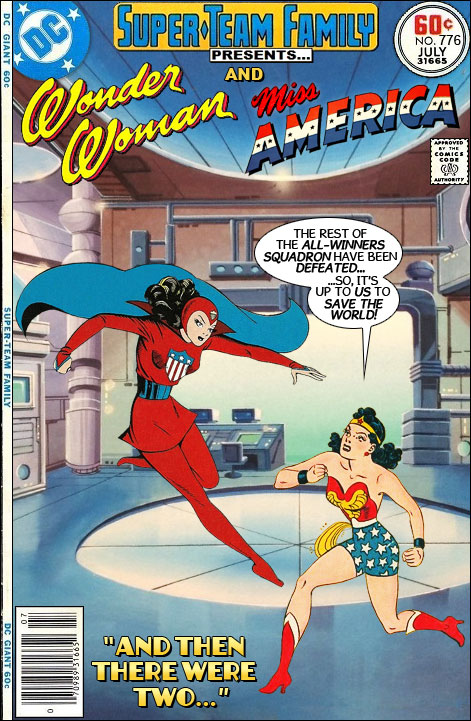
Wonder Woman and Miss America:

776

Something I’ve suggested is Wonder Woman vs Bob Hope- there was a Bob Hope comic book that ran from 1950 to 1968 that depicted Hope as a serial sexual harasser, so the cover would show Wonder Woman holding him in the Lasso of Truth and sternly forcing him to admit the wickedness of his lecherous ways. Guess I’ll have to draw that one myself…

Star Trek and Duck Dodgers:

546

It’s good to see the often-forgotten animated Star Trek series used in these covers.

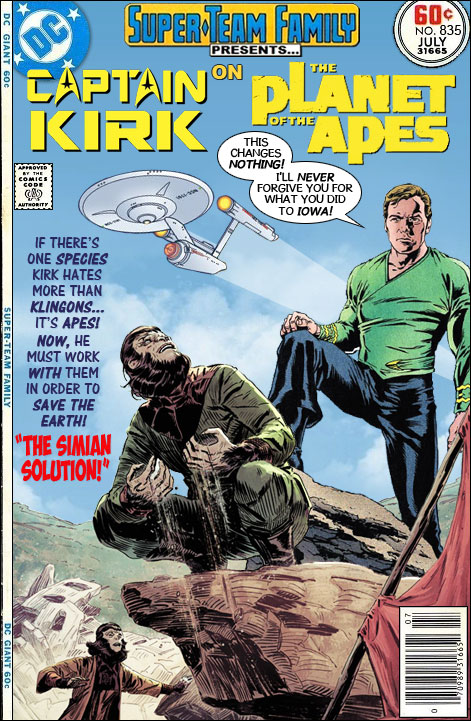
Captain Kirk on the Planet of the Apes:

835

I’ve always loved Star Trek and liked Planet of the Apes, so this pairing makes me smile.


Who will pick up the pieces of the Republican Party after Trump’s defeat?

It seems pretty obvious to me, at this point, that Donald Trump is going to be the Republican presidential nominee and that each of the other candidates is trying to position himself to be the man who leads the Republican Party out of the wilderness that will follow the defeat Mr Trump will suffer at the hands of Hillary Clinton.

I’ve been tweeting at various people about this.  For example:

and:

and:

and:

Ted Cruz hasn’t done significantly better so far than did Rick Santorum in 2012 or any better than Mike Huckabee in 2008, neither of whom emerged as the heir apparent for the next cycle. So his continued presence represents a hope that Republican voters will be slower to coalesce around Mr Trump than they were to coalesce around Mitt Romney in 2012, John McCain in 2008, George W Bush in 2000, Bob Dole in 1996, or George H. W. Bush in 1988, and that he will be able to win some of the states that won’t vote for him. That seems a forlorn hope, since Mr Cruz has drawn almost all of his support from evangelicals, and in no remaining state are there enough of them to put him over the top. His current standing would not seem likely to entrench Mr Cruz even as leader of the far-right counter-establishment, let alone as nominee-in-waiting for the 2020 election.

John Kasich also has to hope that states keep voting against Mr Trump, and if they do he can plausibly hope to be the beneficiary of that opposition. But, there is really no reason to suppose that Mr Trump’s support on the remaining primaries and caucuses will spike any less dramatically than did Mr Romney’s in 2012. If Mr Kasich’s bid ends with him having lost every state but the one where he is governor, he’ll be a punchline, then a trivia question, then a lecturer at the Kennedy School.

Many diehard anti-Trump Republicans have been touting House speaker Paul Ryan as a potential nominee if the Republican convention does not produce a first-ballot winner. Unlikely as that scenario is, a couple of weeks of discussion of it may be enough to qualify Mr Ryan as this cycle’s runner-up, and therefore as the de facto leader of the opposition to the Hillary Clinton administration.

How party loyalty undermines the power of party elites

I think this piece on Politico about the failure of the John E. Bush presidential campaign and the challenges facing the Hillary R. Clinton presidential campaign is pretty good, but it misses one key point.

In the USA, people by and large are much more likely today than they were in the past to consider their allegiance to the Democratic or Republican Party an important feature of their social identity. US presidents symbolize their parties. Therefore, when pollsters ask prospective voters their opinion of the person their party most recently elected as US president, the first reflex for many of them will be to express a very high opinion of that person.

It should be no surprise, then, that in 2013 and 2014 polls indicated that most supporters of the Republican Party expressed a high opinion of the Bush-Cheney administration. Leading figures in and around that party decided at that time to coalesce around John E. Bush as the party’s next presidential candidate.  If Republican voters liked George W. Bush so much, why not give them his brother as their next standard-bearer? When the party’s rank-and-file greeted John Bush’s entry into the race with an uncomfortable shifting in the seats and the sound of crickets was heard, party elites cast about for another candidate who could address the putative demand for a return to the Bush-Cheney years. Eventually they settled on Florida senator Marco Rubio, whose policy positions are identical to those of the Bush-Cheney administration. Four states in to the nomination contest, Mr Rubio has yet to win anywhere, and polls indicate that the states where he once seemed to have a chance are now moving out of his reach. His campaign and indeed his political career, will likely end with a humiliating defeat in his home state on 15 March.

What the elites who rallied first around John Bush and then around Mr Rubio missed is that the reflex which leads partisans to tell pollsters that they have a high opinion of the person whom they still see as their party’s leader is largely about those partisans’ reaction to a stranger asking them whether they are loyal members of their party. That reaction doesn’t necessarily predict much about the process of selecting a new leader. So when loudmouth landlord Don-John Trump rejects George W. Bush’s relaxationist stand on immigration and says that George W. Bush lied in making the case for the 2003 invasion of Iraq, party elites are genuinely surprised that Mr Trump’s support among Republican primary voters seems to go up afterward. Why wouldn’t they be surprised, those voters are the very people who for years told pollsters that George W. Bush had been a good president.

Except among party elites and ideological purists, support for Mr Trump is not likely to mark anyone as a disloyal Republican. Mr Trump’s image as a not-particularly-ethical businessperson who is wont to make racist and sexist remarks fits a stereotype of Republicans; that’s why he is so unpopular outside the Republican Party, but it’s also why his deviations from the party’s familiar line are so acceptable to its traditional supporters. He gives them a way to acknowledge that their party’s leaders have betrayed their interests and ill-served their country without surrendering to Democrats or radicals or foreigners or anyone else outside their ranks.

On the Democratic side, we have a two person race in which one candidate has the support of every major donor, every major media organization, and virtually every elected official, while the other is an elderly Jewish socialist who joined the Democratic Party for the first time last summer. In the first four contests, the elderly Jewish socialist first fought the establishment favorite to a tie, then won by a handy margin, and finally came within four points of winning a second victory before heading into territory where he had not had time to build a campaign.

Coupled with the fact that the same establishment favorite actually lost the Democratic nomination in 2008, Mr Sanders’ early success confirms that the Democrats are going through something similar to what the Republicans have experienced with the failures of the party elite to sell either John Bush or Marco Rubio to their party’s rank-and-file. Going in to the 2008 election cycle, Democrats were telling pollsters of their deep and abiding love for former president William J. “Bill” Clinton. As their Republican counterparts would, eight years later, offer George W. Bush’s brother to their party, so Democratic Party elites in that cycle offered Bill Clinton’s wife as a presidential candidate.

Hillary Clinton’s backing for the Iraq War out her at odds with the Democratic Party’s base, dooming her candidacy in 2008 as John Bush’s for a relaxationist immigration policy doomed him among Republicans in 2016. As in 2016 Mr Trump’s fit with stereotyped images of Republicans enables him to hold onto the support of the party faithful while denouncing Republican leaders, so in 2008 voting for the first black US president was so much a thing one would expect Democrats to do that Ms Clinton could not make headway by casting doubt on the status of Barack Obama’s supporters as true Democrats.

That Hillary Clinton has come back is a sign, in part of the declining salience of war and peace as an issue in a Democratic Party led by a president who is currently bombing half-a-dozen countries or more, and in part of the party’s failure to replace Bill Clinton’s Finance First strategies. By Finance First, I refer not only to Bill Clinton’s campaign strategy of lining up finance before formulating policy proposals or doing anything else, but also to the economic policy that was a corollary to that, in which his administration addressed the demands of the finance sector before attending to any other concerns.

Finance First is not an approach that comes naturally to the sorts of people who tend to vote for Democrats, and is in fact anathema to most of them. In view of the distribution of wealth in today’s USA, however, and considering that neither organized labor or ethnically or religiously based political groups can any longer turn out enough volunteers to counteract the power of the money-men, it is not obvious that any approach other than Finance First can elect a president or sustain one in office. The Democratic Party’s elites, therefore, see the presidential nominee’s job as persuading the base to accept Finance First.

Though Finance First has enabled the Democrats to win five of the last six presidential elections (falling within the margin of error in 2000, when the party nominated an exceptionally maladroit candidate,*) it has not served them well overall. When Bill Clinton was first nominated in 1992, the Democrats controlled both houses of Congress, most state legislative chambers, most governorships, most elected county and municipal offices, and had for decades. A quarter century into the dominance of Finance First, the Republicans hold 70% of all elected offices in the USA. Even if Hillary Clinton defeats Don-John Trump in a landslide come November, that isn’t going to change. Indeed, since the party in the White House usually takes a drubbing in the midterm elections, by the end of the first term of the Hillary Clinton administration the Democrats will probably be in a much weaker position even than they are now.

For Mr Trump to challenge the Bush-Cheney relaxationist line on immigration is not a radical departure for his party. Restrictionists do tend to cluster in the Republican Party, and the party elite can retain its commitment to a low-wage economy even without significant relaxation of border controls. Likewise for the Democrats and an issue like the Iraq War; while militarism is a central feature of the American economic system and a challenge to it would represent a profound revolt against both major parties, one can always express reservations about a particular war without standing for a demilitarization of the US economy and society. Barack Obama’s emphasis on his early opposition to the invasion of Iraq in his 2008 campaign was, therefore, within the bounds of what the Democratic Party is capable of handling.

What Mr Sanders is doing, however, is a head-on challenge to the whole Finance First model.  Even if he had worked out a viable alternative, that would be a breathtakingly audacious undertaking. If he ends up with something like 40% of the popular vote at the end of the primary season, I think we may see a great deal of effort put into developing such an alternative between now and the next open Democratic nomination. If a hardy campaign on behalf of Mr Sanders in the primary is followed by a significant vote for Green Party candidate Jill Stein in the general election, I am confident that such an effort will have a noticeable effect on the Democratic Party’s overall direction.

*Then-US Vice President Albert Arnold Gore, Junior.  Mr Gore likes to be called “Al.”  I call him “The Tennessee Turd.”

Humanist Comic Elements in Aristophanes and the Old Testament, by Benjamin Lazarus

978-1-4632-0243-9I’m a member of the Classical Association of the Middle West and South. As such, I regularly receive book reviews in my email on recent scholarly publications dealing with the ancient Mediterranean world.
One of these recent reviews was by Ioannis Konstantakos of the National and Kapodistrian University of Athens. Professor Konstantakos discussed Humanist Comic Elements in Aristophanes and the Old Testament by Benjamin Lazarus.  The book sounds extremely interesting. Here are a couple of paragraphs from Professor Konstantakis’ review:

Jonah and the Dionysus of the Frogs exemplify another comic prototype, the “Comic Failure” (Lazarus’ term) or “comic anti-hero”, as he might be called in contrast to the heroic Aristophanic protagonists discussed by Cedric Whitman (Aristophanes and the Comic Hero, Cambridge, MA: Harvard University Press, 1964). This kind of character becomes laughable by constantly failing to live up to the expectations of his role. The buffoonish Dionysus proves unable to judge poetry correctly and even to impersonate Heracles competently, despite his celebrated associations with the theater. Jonah cannot meet the requirements of his prophetic mission and repeatedly fails to recognize the will of Yahweh. There are additional analogies in the two story patterns, as both anti-heroes experience a katabasis into the world of death (the belly of the fish in Jonah is expressly likened to Sheol), but return without real improvement. Both Dionysus and Jonah are parodies of serious models, respectively Heracles’ dark journey to Hades and Elijah’s prophetic career. Their incompetence is underlined by figures of lower status, such as Dionysus’ slave Xanthias or the Gentile Ninevites, who successfully perform the very tasks which these comic anti-heroes ridiculously mismanage. In this case, Lazarus has traced an important satirical structure, probably as old as the Margites and applicable to many other comic figures, from Master Ford to Iznogoud.
The final chapter brings together Wealth and Tobit, two works revolving around an ordinary protagonist, a “Comic Everyman”. Both works are set in a world of mundane suffering and injustice and use a domestic, down-to-earth kind of humor as a means of relief from the difficulties of life. In this connection, another line of enquiry would be worth pursuing. Tobit, a character at once ridiculous for his rigidity and sympathetic for his sufferings, and thus evoking a complex response from the audience, is closer to the personages of Menander than to Aristophanes’ Chremylus. Like Menandrian heroes, the characters of Tobit have a limited understanding of the universe, and their apparent tragedy is eventually turned into comedy by a supernatural force which approximates the workings of Menander’s Tyche. The shift towards domestic, low-key humor is common to New Comedy and Tobit, which is also, significantly, a Hellenistic product.

I’ve always thought Jonah was funny, and I’m glad to see a scholarly argument to the effect that this perception of mine does not mark me as an incorrigible heathen.

On the other hand, I find it difficult to imagine that the original audience of Tobit felt it was supposed to laugh at anything in it. Not that I don’t smile a bit at the idea of all those guys, one after another, dutifully marching off to their deaths in Sarah’s bridal chamber, and it’s true that that dog has a disconcertingly well-developed personality. Maybe the ancients smiled at those things, too. But the whole thing is paced so much like a thriller that any breaks for laughter or classification of major characters as “ridiculous” would throw it off badly.

To know what is right

Here’s a Saturday Morning Breakfast Cereal strip that I’ve been silently disagreeing with for about a week:

1454254683-20160131

The part with which I disagree is “Moral standing is assigned to other creatures based on how similar they are to average human intelligence.” I’d say that the key consideration is that social life among humans involves an intricate mixture of competition and cooperation. Because a great deal is often at stake in our competitions with one another, conflicts of interest often render our judgments regarding one another unreliable.  Because the most valuable goals for which we compete can be fully attained only among people who trust each other to act charitably toward one another, excessively aggressive behavior in competitive situations is usually counterproductive at both the individual level and for society at large.

Therefore, codes governing human conduct must begin by acknowledging that no one can be the judge in his or her our own cause.  When we deal with someone who is in competition with us for the good things in life, we cannot justly demand the power to force that person to accept our decision that we should have access to these things and s/he should not. If we are not in direct competition, then perhaps one of us might be acceptable as judge over the other.

An extreme case would be selective breeding of humans.  In various societies there have from time to time been projects to establish a central authority to decide who is allowed to reproduce and who is not.  Since reproduction is one of the principal functions towards which humans and other living beings tend to be oriented, the stakes in this sort of decision are as high as they could possibly be.  For that reason, no central authority could ever be established that would be able to make such decisions in a truly rational manner.  Kinship groups compete with each other to produce offspring and to promote the interests of their offspring in the order of society; no conceivable human being could be altogether disinterested in the implications any particular a ruling for or against sterilization, for or against fertilization, for or against pairing, would have for his or her own kinfolk.  Most judges would, consciously or unconsciously, discriminate in favor of unions that are likely to produce mates for his or her future descendants, and against unions that are likely to produce rivals for them.  A few self-loathing individuals might discriminate in the opposite direction, but in no case would an altogether fair and above-board decision-making process be possible.

Compare this with the selective breeding humans conduct of other animals and of plants. We do not compete directly with any of the creatures whose breeding we direct.  Sometimes we use them to compete with other groups of humans, as a more prosperous agricultural will gain the advantage over its neighbors and gain opportunities to drive them out of their land, and sometimes we use them to compete with other creatures that we classify as pests or weeds or pathogens.  So, if we are to interact with the natural world in a healthy way, we ought to grant some form of moral standing to those pests and weeds and pathogens, inasmuch as our competition with them blinds us to the roles they play in the earth’s ecosystems.  What that form of moral standing would be, and how it would be enforced, is of course not an easy question to answer.  Religions that make particular places and particular species of animals sacrosanct may be good at doing that, though one can hardly be expected to adopt a religion in order to meet the requirements of a single argument from ethical theory.

Intelligence is not altogether irrelevant to the question of moral standing. Of course, creatures that are radically different from humans in average intelligence could not very well make a case for their interests in a way that humans could understand.  What is more, the closer creatures are to one another in their abilities, the fiercer, and therefore the more distorting to perceptions, competition between them is likely to be.  If it is difficult to imagine how a rhinovirus could gain a fair hearing for itself in a human court, it is scarcely any easier to imagine how a human struggling to save a wooden house from a termite colony could keep a clear view of that colony’s ecological role.  Indeed, that human would likely see the corporate intelligence formed by the termite colony, not as a virtue calling for protection, but as a menace to be eradicated by any means necessary.

More guesses about how the 2016 US presidential race will turn out

img_1959202

Out of the starting gate

Since I’ve been so brilliantly successful at forecasting the progress of the US presidential campaign so far, I’ve decided to share more predictions.

At Five Thirty Eight, Nate Silver sees “Four Roads Out of Iowa for the Republicans.”  I also see four sets of outcomes for tomorrow’s Iowa caucuses, but not quite the same four Mr Silver sees.

I see four possible winners. Loudmouth landlord Don-John Trump is leading the polls among Republican voters in Iowa and most other states.  If he wins the first contest, (let’s say he has a 35% chance of doing that,) his odds of winning everywhere else likely increase.  However, it has several times happened that the winner of the Iowa caucuses has gone on to receive a smaller percentage of the vote in the next contest, the New Hampshire primary, than the New Hampshire polls had suggested before that Iowa win. George H. W. Bush in 1980, George W. Bush in 2000, and Barack Obama in 2008 can all be cited as examples of that sort of anti-momentum. A highly unconventional candidate like Mr Trump might be especially vulnerable to anti-momentum.  New Hampshire voters might be leery of giving him wins in both of the first two contests, thereby putting him in a commanding position in the rest of the primary season.  If they do desert him, the likeliest candidate to benefit would be Ohio governor John Kasich. Mr Kasich is rising in the New Hampshire polls, drawing big crowds at events in the state, and dominating the airwaves there. So if Iowa goes to Mr Trump, I would put the chances of New Hampshire also voting for him at about 70%, and of it turning to Mr Kasich at about 20%.

Texas senator Ted Cruz is also strong in the Iowa polls, and his voters do seem likelier to turn out for the caucuses. So I’d give him a 50% chance of winning Iowa. If he beats Mr Trump by a narrow margin, that shouldn’t be much of a surprise to anyone; Mr Trump’s chances of winning New Hampshire would probably be at least 70% in that case. On the other hand, if Mr Cruz wins by a wider than expected margin, that would put Mr Trump on the defensive, and again Mr Kasich comes into the picture as a possible winner in New Hampshire. Maybe his chances would rise as high as 40% in that case, with a 50% likelihood Mr Trump would win New Hampshire.

Florida senator Marco Rubio has consistently stood in third place in the Iowa polls, and is the only conventional Republican candidate making a stand there.  Mr Cruz and Mr Trump have been feuding with each other in recent weeks; Iowa caucus-goers don’t like that sort of fighting, as witness the Democratic race in 2004, when frontrunners Howard Dean and Richard Gephardt spent weeks filling Iowa television and radio with attacks on each other, then neither finished in the top two on the night.  It’s possible Mr Rubio could pull the kind of upset this year that John Kerry pulled on the Democratic side in 2004.  If that happens, Mr Rubio will eclipse Mr Kasich, New Jersey governor Chris Christie, former Florida governor John Ellis Bush, and onetime tech CEO Carly Fiorina to become the default candidate of those looking for a conventional Republican candidate. That will likely guarantee him a win in New Hampshire, and probably make him unbeatable down the road to the nomination. If he doesn’t win Iowa, Mr Rubio won’t win anywhere; he’s been static in the polls, fundraising, and organization for months and months, and simply is not very good at connecting with Republican voters.  If he does win in Iowa, though, he’s the nominee.  (Unless something embarrassing bubbles up from his past, or something else unforeseeable happens.)  On the other hand, that Iowa win, is pretty unlikely, I’d say about a 5% chance. So let’s say that translates to a 4% chance of a Rubio nomination.

Retired brain surgeon Ben Carson, briefly a frontrunner in the polls last year, is now polling at about 10% in Iowa.  However, the final polls before the 2012 Republican Iowa caucuses showed former Pennsylvania senator Richard Santorum with about that same level of support, and he won. Mr Santorum’s people were the hardcore religious conservatives, the group that is far likelier than any other to show up and take an active part in the Republican caucus meetings. Dr Carson draws his support from the same bloc, and he has been a familiar figure among them for decades. While Mr Cruz may have made sufficient inroads with the religious right that Dr Carson is unlikely to emerge tomorrow night as the big winner, it would be foolish to discount his chances altogether.  I would guess that he has about a 10% chance of winning Iowa. If he manages that, Mr Trump and Mr Cruz will both be seriously damaged, and Mr Kasich is virtually certain to win New Hampshire.

If Mr Trump comes out of Iowa and New Hampshire looking like winner, he’ll have to knock all of his opponents out of the race quickly, lest his poverty choke his campaign before he can clinch the nomination. If he wins Iowa, Dr Carson will probably back out of the race; if he wins it by a wide margin, Mr Cruz may see his candidacy collapse.  If he wins New Hampshire, he’ll knock Mr Kasich, Mr Christie, Mr Rubio, Ms Fiorina, and Kentucky senator Randall “Rand” Paul out of the race.  Mr Bush has enough money in the bank and enough institutional support that he can continue his campaign indefinitely.  He will likely spend many millions of dollars trying to win the primary in South Carolina regardless of the results of the first two contests. If Mr Cruz is still in contention at that point, as it seems virtually certain he will be, then the outcome of the South Carolina primary will be quite unpredictable.

If Mr Kasich wins the New Hampshire primary, he may slip through the Trump/ Cruz/ Bush scrum to win South Carolina as well.  Even if he doesn’t manage that feat, a win in New Hampshire would give him the mainstream default candidate status Mr Rubio could gain by winning Iowa.  That in turn would take him to March 15, when the first states hold primaries in which the winner takes all of that state’s convention delegates, instead of giving each candidate a share of delegates proportional to his or her percentage of the vote. The two biggest of these states are Ohio, which Mr Kasich will certainly win if he is a viable candidate, and Florida, which is also likely to favor a candidate more conventional than Mr Trump or Mr Cruz. If he wins those two states, Mr Kasich will be all but unbeatable in the later stages of the nomination contest.  But he has to win New Hampshire; he stands so low in the polls nationally and has so little organization or institutional support that anything less than a first-place finish there will force him out of the race.

Of all the Republican candidates, Mr Kasich sounds the most like a president; no less an an observer than the late Richard M. Nixon has declared that he is his party’s most, and indeed only, electable candidate.  I would rather not see a Republican elected president, so I suppose I should hope they nominate Dr Carson or Mr Bush or Mr Cruz, each of whom, for his own particular reasons, would probably drive well over 50% of the electorate to oppose him unalterably.


I say something about politics and something about religion. No sex or money, though.

I’ve recently been participating in two discussion threads at The American Conservative. In a thread on Noah Millman’s blog, I’ve been laying out a theory that Florida Senator Marco Rubio will either win virtually every state in the Republican Party’s presidential nominating contest, or he won’t win any states at all. It all hinges on whether he can pull an upset win in the Iowa caucuses. My comments are here, here, and here.

In a thread on Rod Dreher’s blog, I’ve been talking about how the request by the “Primates” of the Anglican Communion that the leaders of the Episcopal Church scale back their participation in the Anglican Communion’s policy-making structures raises questions about how we can tell whether formal organizational bonds are helping or harming efforts to unify Christians, and if we decide that a particular structure is doing more harm than good, how we can dissolve it without making matters even worse.  My comments are here and here.

I’m not going to vote for a Republican for president in any case, and I think Mr Rubio would do an especially bad job in the White House.  The fact that I have worked up a theory about his prospects, therefore, just goes to show what a political junkie I am.  The other topic is of more direct personal interest to me, since I am a member of the Episcopal Church, and I find some value in the “Anglican” label.  Still, I discuss that topic also in terms of political strategy.

The other white guilt

Here are a couple of tweets I just put up:

This was in response to a bit on Quartz about a study of suicide among older white men, titled “Masculinity and Privilege are Killing Older White Men- No, Really.”