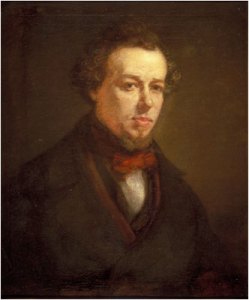
- Benjamin Disraeli as a Young Man
A review of Adam Kirsch’s biography of Benjamin Disraeli focuses on Kirsch’s idea that because Disraeli realized he could not stop his fellow nineteenth-century Englishmen from thinking of him primarily in terms of his Jewish ancestry, he “did not attempt to disguise his Jewish background. He embellished it.” Disraeli purported to be far more deeply involved with that side of his ancestry than he in fact was, even explaining his active membership in the Church of England as an example of his fealty to “the only Jewish institution that remains… the visible means which embalms the race.” Meanwhile, the Jewish characters and themes in Disraeli’s novels appall modern sensibilities. Sidonia, a character in the Young England trilogy (Coningsby, Sybil, and Tancred,) “looks like nothing so much as an anti-Semitic hate figure. It is amazing, in fact, how Disraeli manages to combine in this one character every malicious slander and paranoid fear that the anti-Semitic imagination can breed.” Disraeli’s manipulation of the label his fellows had imposed upon him enabled him to become prime minister of the United Kingdom. Disraeli’s ability to “outline [an] agenda of radical change to be achieved conservatively, a political program that allowed him to reinvent himself as the representative not only of the wealthy and the working class but of the Tory Party, too” has inspired rightist politicians like Richard Nixon and the neocons.
If Kirsch is right, Disraeli knotted his contemporaries’ perceptions of him around their image of “the Jew,” using their prejudices to transform himself from a marginal figure unlikely to make a mark in politics into a figure of England’s national mythology. Another complex of ideas twists around another such image in Brendan O’Neill’s analysis of the thoughts of some of Israel’s more fervent defenders in the West. O’Neill argues that the individuals he cites are less interested in Israel as an actual place inhabited by living people than they are in using a particular idea of Israel as a symbol for the values of the Enlightenment. “In effect, Israel is cynically, and lazily, being turned into a proxy army for a faction in the Western Culture Wars that has lost the ability to defend Enlightenment values on their own terms or even to define and face up to the central problem of anti-Enlightenment tendencies today.” This use of Israel as a pawn in cultural struggles centered elsewhere shades into philosemitism. “[A]s Richard S. Levy writes in his book Anti-Semitism: A Historical Encyclopedia of Prejudice and Persecution, simple philosemitism, like anti-Semitism, also treats the Jews as ‘radically different or exceptional’… Where anti-Semites project their frustrations with the world and their naked prejudices onto the Jews, and frequently onto Israel, too, the new philosemites project their desperation for political answers, for some clarity, for a return to Enlightenment values onto Israel and the Jews. Neither is a burden the Jewish people can, or should be expected to, bear.”
(more…)
Posted by acilius on March 4, 2009
https://losthunderlads.com/2009/03/04/the-american-conservative-9-march-2009/


 acilius
 believer1
 lefalcon
 losthunderlads
 vthunderlad
 Panther Red