Church Going, by Philip Larkin

poem for Christmas.

Once I am sure there’s nothing going on
I step inside, letting the door thud shut.
Another church: matting, seats, and stone,
And little books; sprawlings of flowers, cut
For Sunday, brownish now; some brass and stuff
Up at the holy end; the small neat organ;
And a tense, musty, unignorable silence,
Brewed God knows how long. Hatless, I take off
My cycle-clips in awkward reverence,

Move forward, run my hand around the font.
From where I stand, the roof looks almost new-
Cleaned or restored? Someone would know: I don’t.
Mounting the lectern, I peruse a few
Hectoring large-scale verses, and pronounce
“Here endeth” much more loudly than I’d meant.
The echoes snigger briefly. Back at the door
I sign the book, donate an Irish sixpence,
Reflect the place was not worth stopping for.

Yet stop I did: in fact I often do,
And always end much at a loss like this,
Wondering what to look for; wondering, too,
When churches fall completely out of use
What we shall turn them into, if we shall keep
A few cathedrals chronically on show,
Their parchment, plate, and pyx in locked cases,
And let the rest rent-free to rain and sheep.
Shall we avoid them as unlucky places?

Or, after dark, will dubious women come
To make their children touch a particular stone;
Pick simples for a cancer; or on some
Advised night see walking a dead one?
Power of some sort or other will go on
In games, in riddles, seemingly at random;
But superstition, like belief, must die,
And what remains when disbelief has gone?
Grass, weedy pavement, brambles, buttress, sky,

A shape less recognizable each week,
A purpose more obscure. I wonder who
Will be the last, the very last, to seek
This place for what it was; one of the crew
That tap and jot and know what rood-lofts were?
Some ruin-bibber, randy for antique,
Or Christmas-addict, counting on a whiff
Of gown-and-bands and organ-pipes and myrrh?
Or will he be my representative,

Bored, uninformed, knowing the ghostly silt
Dispersed, yet tending to this cross of ground
Through suburb scrub because it held unspilt
So long and equably what since is found
Only in separation – marriage, and birth,
And death, and thoughts of these – for whom was built
This special shell? For, though I’ve no idea
What this accoutred frowsty barn is worth,
It pleases me to stand in silence here;

A serious house on serious earth it is,
In whose blent air all our compulsions meet,
Are recognised, and robed as destinies.
And that much never can be obsolete,
Since someone will forever be surprising
A hunger in himself to be more serious,
And gravitating with it to this ground,
Which, he once heard, was proper to grow wise in,
If only that so many dead lie round.

Philip Larkin

White Christmas, theremin-style

Christmas Art from Plan59

As we head into the Christmas season, here are some brightly colored images from the 1950s and 1960s. 

Christmas 1960

Christmas 1960

That’s quite a deep horizon above.

Beer Ad

Beer Ad

Beer for Christmas?  It must have sounded like a good idea in 1948.

(more…)

UOGB’s latest

aaaorangehowfi_m

Teamwork

Last month, I mentioned that  the Ukulele Orchestra of Great Britain was releasing two new albums.  Our copies arrived last week, and Mrs Acilius and I can give them enthusiastically positive reviews. 

fidicula-inter-angelosThe Christmas album, referred to on their website as “Christmas with the Ukulele Orchestra of Great Britain” but labeled as Fiducula inter Angelos (“Miniature Lyres among the Angels,”)  does not after all include the performances they issued last year as a virtual album called “Never Mind the Reindeer.”  Those performances are still available on iTunes.   I do miss the rendition of “The Holly and the Ivy” from last year, but new tracks like the “Wenceslas Canticle” and a vocalese version of  “Winter Wonderland” more than make up for its absence.  Their “Jingle Bells Canticle” gets us (Mr & Mrs Acilius and the dogs) dancing every time we hear it.  Here’s ukulelehunt‘s review of the album. 

live-in-londonIn a comment on last month’s post, ukulelehunt’s proprietor Al Wood, a.k.a. Woodshed, gave it as his opinion that Live in London #1 is the UOGB’s best album yet.   I agree, though Mrs Acilius still leans toward Precious Little.  She plans to walk down the aisle to that album’s recording of “Finlandia” when we make the “Mrs” part official in May, so it has a sentimental importance to her.  Though when we listened to Live in London #1 and heard Hester Goodman’s rendering of “Teenage Dirtbag” as a ballad of adolescent lesbian angst, Mrs Acilius was so enthusiastic I wondered if she was about to suggest using that instead.  She assured me that her enthusiasm was strictly political, stemming from a conviction that sexual minorities need representation in music.  That she has a crush on Hester is purely by the way.  Here is an unflattering picture of Hester sitting next to George Hinchliffe that I could look at if I were in a jealous mood, which of course I never am.    

(more…)

Chronicles, December 2008

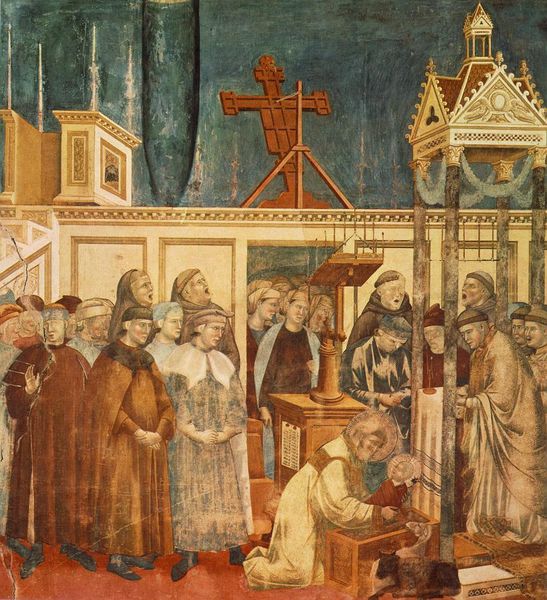
Giotto painting reproduced on the cover of this issue


Giotto painting reproduced on the cover of this issue

(image)

Three articles about Christmas in this issue of Chronicles.  Editor Thomas Fleming, who I seem to recall occasionally describes himself as having been raised an atheist, then converted to arch-traditional Roman Catholicism, describes in the third person the attitudes of an unnamed man who was raised anatheist, then converted to arch-traditional Roman Catholicism.  As a boy, this anonymous person disliked Christmas.  The months-long buildup, the morning moments unwrapping toys that could never live up to the expectations that buildup engendered, the endless anticlimax of the day as of adult relatives hung on and bored him with their chatter.  Far better Halloween, an ordinary day that ended with a burst of total anarchy.  As he grew, he preferred the moral atmosphere of Halloween to that of Christmas.  The Christians he knew pretended that death was nothing to be afraid of and embedded that pretense into the holiday, while Halloween began by taking the cold terror of death and everything touching death for granted.  Evidently this preference remains with him in his religious phase, as the terror of death gives Easter its power.

Contributor Thomas Piatak defends Christmas, not against the severe theology of Fleming, but against opponents of public piety at Christmastime.  Apparently it was Piatak who coined the phrase “The War Against Christmas.”  While Fleming inveighs against a religious Christmas that soft-pedals or denies the hard truths of lifeand thus denatures Christianity, Piatak fears a secular Xmas that is “devoid of religious or cultural significance or indeed of beauty, with nothing left but multiculturalist pap and tawdry sentimentalism.”  As examples of this creeping insipidity, Piatak cites a case in Columbus, Ohio in 2003, when the school district banned a performance of Handel’s Messiah unless equal time were given to “Frosty the Snowman” and “Jingle Bells.” 

Columnist Aaron D. Wolf has little use for the idea of a secular “War Against Christmas,” though he does agree that such a thing exists.  He tells us of wishing a store clerk “Merry Christmas.”  “She looks directly at me, smiling, eyes narrowed, and nods.  “Yes.  Merry CHRISTMAS!”… It wasn’t a bright, elven (sic) “Yes!  Merry Christmas!”  She spoke with a knowing, in your face, liberal America air of defiance.”  Later: “That Merry Christmas seemed more like a countercultural protest statement, that kind that says, yeah, you’re one of us, or yeah, I’m one of you.  One of you… what?  Believers in Christ Jesus?  … Or perhaps it was one of you proud white Americans.”  Wolf’s suspicion that many of those most exercised about the “War Against Christmas” are in fact not very much devoted to Christ at all, but are only interested in sticking it to educated secularists, gains verisimilitude from the high December sales of mugs bearing the slogan “Don’t be a Pinhead.”  

(more…)

A Thanksgiving Song

Happy belated Thanksgiving and thanks to ukulelehunt for this song that proves the jumping flea’s ability to make any subject matter sound cheerful.  The artist calls herself “Ukebucket.”

President-Elect Obama

It’s appropriate that Election Day should come so shortly after Halloween.  As the ghosts and ghouls vanish into their occult places when day breaks, so the bogeymen and superstars of the campaign season pass out of view once the election is over.  It’s back to Alaska with Sarah Palin, back to work for “Joe the Plumber,” back to the political science textbooks with the Bradley Effect, back to a museum of the 60s with the Weather Underground.  Four years from now another set of entertainments will rise from some unknown quarter and haunt us for a season. 

The candidates themselves do not go anywhere; they cease to exist.  The winning candidate is replaced by the office holder, the losing candidates are replaced by somewhat older, somewhat sadder versions of the people they were before they ran.  That’s why there’s a richer vein of literature about losing contenders for power than about winners.  Try to dramatize the winner and the best you can do is hint at what Shakespearean actors call “the man inside the king.”  The king is a symbol, he is power, he is majesty, he is order, and he is empty.  Art and literature can focus on the king only when the symbol fails and the human being emerges.  I think the Horace illustrates that process in his Ode 1.37.  As long as she is a contender for power, Cleopatra is at best a monster.  Defeated, she is one of us. 

Here’s Cedric Whitman’s translation of that poem.  Robert Frost defined poetry as “that which is lost in translation”; I’m afraid Whitman does not manage to defeat that definition.  But it does show the major gestures in Horace’s original, and unlike some other versions it is possible to read Whitman’s aloud.  I’ve appended Edward Wickham’s edition (from his Oxford Classical Text) of the original below. 

Drink, comrades, drum the ground, now it is time

for freedom’s dance; and call on all the gods

to come, lay out their gorgeous couches,

and let them recline at the feast of Mars.

It had been crime till now to pour good wine

from the crypts of our forefathers, while ruin poised

over the Capitol, and fevered madness

was winding cerecloth round our realm-

Dreams of the queen of half-men, girt by her crew

of sickly shame, and drunk with delirious hopes

grown fat and reckless on easy fortune!

But all that glare of frenzy waned

When scarce one vessel of her fleet sailed home

unscorched by flame; her mind, long tranced and dazed

on heady Egypt’s wine, now waking

to terror’s truth, found Caesar’s oars

hard pressing on her flight from Italy,

swift hawk on downy dove, hunter on hare

in snowy fields of Thrace, and ready

to fling her into chains, a beast

of ominous wonder.  But she had loftier thoughts,

to find out death; blades could not make her cheek

blanch like a girl’s, or drive her flying

with huddled sails to lurking shores. 

Her courage soared; with placid face she scanned

her fallen palace, and valorously reached

her hands to rasping snakes, sucking

their venom’s blackness through her limbs.

Once death was fixed, the fiercer grew her mind:

Indeed, she scorned his cruel galleys, and men

who would have had her walk uncrowned,

no spiritless woman, in triumph’s pride. 

(more…)

Monster Mash

HAPPY HALLOWEEN!

Girly Man

Scary Halloween video!

The Nation (five issues)

The Democratic primaries dominate the issues of 25 February, 3 March, 10 March, 17 March, and 24 March.  Interesting bits do slip in, though.  What are these bits?

 25 February: A long review of a biography of Joschka Fischer and Stuart Klawans’ review of the Romanian illegal-abortion drama 4 Months, 3 Weeks, and 2 Days

3 March: Alexander Cockburn declares that diverting Social Security taxes to Wall Street “was never a job for the Republicans, any more than was welfare ‘reform.’  Eradication of the social safety net is a job for the Democratic Party,” a job Bill Clinton would have completed had God not sent Monica Lewinsky to rescue us.  Kathryn Joyce writes on the New Natalists, right-leaning types who worry that too few white babies are being born.  Joyce identifies historian Allen Carlson as the intellectual godfather of this group.  I’ve read some of Carlson’s books and can attest that he is at once an excellent historian whose works anyone can benefit from reading and a far-right crackpot whose triumph in the realm of public policy would be catastrophic.  Jochen Hellbeck reviews two books on Stalin, tracing the development of Utopian plans into hellish institutions.  Ronald Grigor Suny reviews two other books about Bolshevism.  And from Charles Bernstein, a nifty little love poem called “All the Whiskey in Heaven,” which ended up in my Valentine’s Day package to Mrs Acilius.

10 March: Tom Hayden revisits Vietnam and is very uncomfortable with what he finds there; Daniel Wilkinson reviews four books on Hugo Chavez’ Venezuela and reaches far less rosy conclusions than have previous issues of The Nation.

17 March: Jeremy Scahill reports on Barack Obama’s stated willingness to continue using mercenary firms like Blackwater; and Daniel Lazare reviews two books on religious conflicts in early Modern Europe, arguing that secularism is older than the Enlightenment and defending it as the one tried-and-true means of overcoming religious conflict. 

24 March: Mark Mazower wrings his hands about the implications of the Kosovo’s “independence”; Neve Gordon reviews work on Palestinians who collaborate with Zionism; and Stuart Klawans reviews Chop Shop, a film which he identifies as part of “a small but fascinating group of Iranian-flavored movies made in New York City.”