

- policecorps.org
All posts in category Violence
Bush Truth Commission
Posted by CMStewart on March 24, 2009
https://losthunderlads.com/2009/03/24/bush-truth-commission/
The Nation, 6 April 2009
 Lorna Fox Scott reviews the new Library of America volume True Crime: An American Anthology, edited by Harold Schechter. She quotes Americans who have tried to explain acts of extreme violence that their countrymen have committed. Cotton Mather could say that acts of violence were symptoms of irreligion. But what would Mather have made of a case like this?
Farmer Yates, who in 1781, as he tells his examiners in what reads like an uncensored transcript, is suddenly commanded by an unidentified “Spirit” to slaughter his beloved family for being “idols”? Vividly reliving the inner struggle of human love with mystic duty, in between enthusiastic pursuits of the victims through the snow, this text stands out as the only perpetrator’s narrative in the collection; its anonymous presenter cannot in the end decide whether Yates was stricken by “the effect of insanity” or “a strong delusion of Satan.” The old certainties are fraying.
Ambrose Bierce was less interested in explaining why people commit acts of extreme violence then in pointing out the glee with which the public receives accounts of those acts:
His “Criminal Market Review” from the late 1860s is unusual for its admission that crime is not so much a deviation as the very image of the national economy: “Robberies are looking up; Assaults, active; Forgeries, dull.” Taking a swipe at the veiled Californian relish in violence–“Our joy at the mutilation of old Hulton has been deeply unspeakable; our lively interest in the shooting and hacking of and by the Dudleys, Ingham and Miller, has been testified in a novel and interesting manner by a private scalp dance at our own apartments”–Bierce links this to the war. “It pleasantly reminds us of the time when we were a soldier.” Then, like Twain satirizing the social worship of “blackguards”: “Yosemite is a conceded fiction, and the Big Trees a screaming joke…. But we are handy with the pistol and wield a butcher-knife as deftly as an Indian or anybody.”
Twentieth century writing has shown new forms of self-consciousness. Edna Ferber’s comments on the trial of Richard Bruno Hauptmann include not only scorn for the gawking crowd but sympathy for the accused murderer; Zora Neale Hurston’s reports on the trial of Ruby McCollum, a black woman accused of shooting a white physician, show the defendant and the crime lost to public awareness as black and white act out the rituals of race.
Fox quotes a haunting conversation that occurred in 1949. A man had gunned down a dozen people on the street in his New Jersey neighborhood, then gone home. The phone rang. He answered it. Calling was a reporter from The Camden Evening Courier.
Mr. Buxton asked how many persons Unruh had killed.
The veteran answered. “I don’t know. I haven’t counted. Looks like a pretty good score.”
“Why are you killing people?”
“I don’t know,” came the frank answer. “I can’t answer that yet. I’ll have to talk to you later. I’m too busy now.”
Posted by acilius on March 20, 2009
https://losthunderlads.com/2009/03/20/the-nation-6-april-2009/
Shoot-‘Em-Up Video Games Aren’t Sadistic Enough to Entertain Little Boys?

skateestate.com
Posted by CMStewart on March 12, 2009
https://losthunderlads.com/2009/03/12/shoot-em-up-video-games-arent-sadistic-enough-to-entertain-little-boys/
Mental Illness and Criminal Responsibility

Posted by CMStewart on March 6, 2009
https://losthunderlads.com/2009/03/06/mental-illness-and-criminal-responsibility/
The American Conservative, 9 March 2009
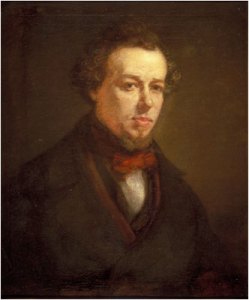
- Benjamin Disraeli as a Young Man
A review of Adam Kirsch’s biography of Benjamin Disraeli focuses on Kirsch’s idea that because Disraeli realized he could not stop his fellow nineteenth-century Englishmen from thinking of him primarily in terms of his Jewish ancestry, he “did not attempt to disguise his Jewish background. He embellished it.” Disraeli purported to be far more deeply involved with that side of his ancestry than he in fact was, even explaining his active membership in the Church of England as an example of his fealty to “the only Jewish institution that remains… the visible means which embalms the race.” Meanwhile, the Jewish characters and themes in Disraeli’s novels appall modern sensibilities. Sidonia, a character in the Young England trilogy (Coningsby, Sybil, and Tancred,) “looks like nothing so much as an anti-Semitic hate figure. It is amazing, in fact, how Disraeli manages to combine in this one character every malicious slander and paranoid fear that the anti-Semitic imagination can breed.” Disraeli’s manipulation of the label his fellows had imposed upon him enabled him to become prime minister of the United Kingdom. Disraeli’s ability to “outline [an] agenda of radical change to be achieved conservatively, a political program that allowed him to reinvent himself as the representative not only of the wealthy and the working class but of the Tory Party, too” has inspired rightist politicians like Richard Nixon and the neocons.
If Kirsch is right, Disraeli knotted his contemporaries’ perceptions of him around their image of “the Jew,” using their prejudices to transform himself from a marginal figure unlikely to make a mark in politics into a figure of England’s national mythology. Another complex of ideas twists around another such image in Brendan O’Neill’s analysis of the thoughts of some of Israel’s more fervent defenders in the West. O’Neill argues that the individuals he cites are less interested in Israel as an actual place inhabited by living people than they are in using a particular idea of Israel as a symbol for the values of the Enlightenment. “In effect, Israel is cynically, and lazily, being turned into a proxy army for a faction in the Western Culture Wars that has lost the ability to defend Enlightenment values on their own terms or even to define and face up to the central problem of anti-Enlightenment tendencies today.” This use of Israel as a pawn in cultural struggles centered elsewhere shades into philosemitism. “[A]s Richard S. Levy writes in his book Anti-Semitism: A Historical Encyclopedia of Prejudice and Persecution, simple philosemitism, like anti-Semitism, also treats the Jews as ‘radically different or exceptional’… Where anti-Semites project their frustrations with the world and their naked prejudices onto the Jews, and frequently onto Israel, too, the new philosemites project their desperation for political answers, for some clarity, for a return to Enlightenment values onto Israel and the Jews. Neither is a burden the Jewish people can, or should be expected to, bear.”
Posted by acilius on March 4, 2009
https://losthunderlads.com/2009/03/04/the-american-conservative-9-march-2009/
Thailand’s anti-pornography campaign
Here‘s a public service announcement against pornography currently running on TV in Thailand.
Posted by acilius on February 27, 2009
https://losthunderlads.com/2009/02/27/thailands-anti-pornography-campaign/
Latest out of Iraq Plan

Obama won’t be getting s out as soon as some of us thought.
Posted by believer1 on February 27, 2009
https://losthunderlads.com/2009/02/27/latest-out-of-iraq-plan/
Harry Nicolaides speaks
 After the jump, two brief newspaper articles based on interviews Harry Nicolaides has granted since his release. Most interesting to me is this paragraph from the first article:
Harry admits that an article by him published in Eureka Street, a Melbourne based publication, alleging that Thai police turned a blind eye to the importation of child pornography from Burma, may have impacted on his situation, “It may have put me on the radar, I knew I was always provocative but at worst if anything at all happened I thought I would be deported, never jailed.”
Posted by acilius on February 25, 2009
https://losthunderlads.com/2009/02/25/harry-nicolaides-speaks/
He’s free!

Reunited with his father
Posted by acilius on February 23, 2009
https://losthunderlads.com/2009/02/23/hes-free/
The Nation, 9 March 2009
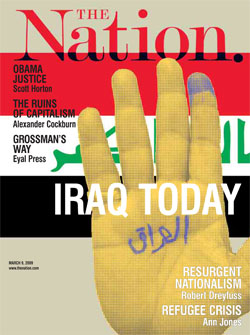 Robert Dreyfuss looks at the regional elections held in Iraq on 31 January and finds good news. A new alliance of Shi’a and Sunni groups is beginning to operate in Iraqi politics. Soon, Dreyfuss hopes, this alliance will be strong enough to present itself as a genuinely nationalist bloc and to insist on an end to the US occupation.
No such development is in sight in Afghanistan. An editorial expresses the fear that the Obama plan to send more US troops to that country will make “Bush’s War” into Mr O’s very own.
Katha Pollitt speaks up for free speech. On the twentieth anniversary of the Ayatollah Khomeini’s fatwah against Salman Rushdie, she finds fault with fellow leftists whose only response to violent behavior by Muslims who have taken offense at speech labeled anti-Islamic is to “see these incidents as gratuitous provocations by insensitive Westerners” and to support restrictions on speech that amount to blasphemy laws. She grants that many of the incidents that have generated violent responses in the Muslim world have indeed been gratuitous provocations by insensitive Westerners, and is happy to list extremists from other religious groups whose conduct has been every bit as deplorable as the worst we have seen from Khomeini and his coreligionists. But:
Appeals to the hurt feelings of religious people are just a dodge to protect the antidemocratic and retrograde policies of religious states and organizations. We’re all adults; we have to live with unwelcome expression every day. What’s so special about religion that it should be uniquely cocooned? After all, nobody at the UN is suggesting that atheists should be protected from offense–let alone women, gays, leftists or other targets popular with the faithful. What about our feelings? How can it be logical to say that women can’t point out sexism in the Bible or the Koran but clerics can use those texts to declare women inferior, unclean and in need of male control? And what about all the abuses religions heap on one another as an integral part of their “faith”?
An essay about Israeli novelist David Grossman of course concerns itself chiefly with Grossman’s insights into the Israeli/ Palestinian conflict. What sticks with me from the essay is this quote from Grossman about writing:
[Y]ears ago, reflecting on a story he was writing that featured a bitter, emotionally unstable protagonist, he described his desire to have the tale surprise him. “More than that, I want it to actually betray me,” he wrote.
To drag me by the hair, absolutely against my will, into the places that are most dangerous and most frightening for me. I want it to destabilize and dissolve all the comfortable defenses of my life. It must deconstruct me, my relations with my children, my wife, and my parents; with my country, with the society I live in, with my language.
Posted by acilius on February 22, 2009
https://losthunderlads.com/2009/02/22/the-nation-9-march-2009/
Who writes this?
 acilius
 believer1
 lefalcon
 losthunderlads
 vthunderlad
 Panther Red