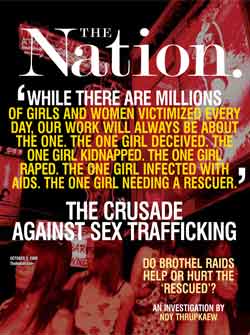
The Nation, 5 October 2009

nation 5 october 2009We take sexual violence seriously here at Los Thunderlads, and so welcome the first installment of The Nation‘s investigation of sex trafficking and of what’s being done in the name of stopping it.  The first part looks at some projects that don’t seem to be helping; the second part will look at other approaches that might represent an improvement.

At the opening of this first part, Noy Thrupkaew interviews Gary Haugen and Patrick Stayton of International Justice Mission, an evangelical Christian group that stages vigilante raids on brothels in southeast Asia; Thrupkaew then talks with other people who have tried to help the women and girls IJM has “freed,” finding that many of them wind up returning to sex work, if anything finding themselves more helpless after the raid than they had been before.  Not only did IJM dump their “rescuees” with other NGOs, simply assuming that those organizations would somehow take care of them, they made no effort to differentiate between, on the one hand, women who had chosen sex work as the least worst option available to them and, on the other, women and girls who had been forced or deceived into it.  Nor did they choose their allies intelligently; IJM’s strategy of working closely with the Cambodian police seems rather dubious when we read one Cambodian policeman’s confession of the nightly rapes he and his colleagues perpetrated against the sex workers in their district, and when we read reports that many Cambodian policemen are active in sex trafficking rings.  Thrupkaew closes this first part of the series with the voices of two other women who are on the ground in Cambodia trying to help victims of sex trafficking there:

(more…)

The Wickersham Report on Lawlessness in Law Enforcement

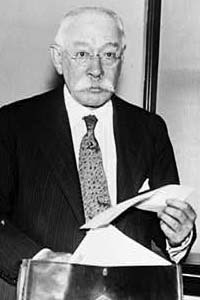
George Wickersham, 1930

George Wickersham, 1930

I’ve been meaning to post a “Periodicals Note” about the July issue of Counterpunch, in which “Peter Lee” wrote about the report that a commission headed by one George Wickersham submitted to US President Herbert Hoover on 7 January 1931.  The Wickersham Commission had investigated charges that US law enforcement agencies were using torture to enforce the prohibition of alcohol that was then in effect across the United States.  The commission’s staff was led by a civil liberties lawyer named Zechariah Chafee, and Chafee turned up evidence that made the Wickersham report impossible to ignore.  Lee gives considerable detail from the report, and points out that all of the “enhanced interrogation” techniques that CIA and military interrogators have been accused of using against captives in the “war on terror” were familiar to Prohibition agents in the 1920s.  Those methods disgusted the American public then, and the exposure of them did a good deal to spur the movement that ended Prohibition.  The difference in the outraged public reaction of 1930 and the muted public reaction to the exposure of the same methods in the last five years cannot be attributed to the difference between accused bootleggers and accused terrorists; Lee points out that torture is not in fact a very effective way of thwarting terrorists.  What has changed is us.  The headline above Lee’s piece is “When America Said No!”  His implication is that the American people have lost the moral compass that once enabled them to say no to torture.   

(more…)

The American Conservative, October 2009

american conservative october 2009

The cover may suggest an alarmist piece about Pakistan.  The article actually in the issue, though, is precisely the opposite.  Granting that Pakistan is an important country that has very serious problems, it asserts that there is no chance that it will break up, fall into the hands of Osama bin Laden, or launch a nuclear attack.  If the USA sobers up and pursues a more realistic policy in Afghanistan, Pakistan might even make progress on its real problems.

Elsewhere in the issue, Andrew Bacevich quotes Cold Warrior Richard Pipes’ 1979 declaration to the effect that since Afghanistan is a place of no strategic importance, the Soviet invasion of that country must have been a step towards a goal elsewhere.  Bacevich agrees that Afghanistan was without strategic importance when Pipes said that, and says that it continues to be so.  Where he disagrees with Pipes is in his assessment of the rationality of the Soviet leadership of the 1979-1989 period, and indeed of the US leadership of today.  He claims that the Soviets invaded Afghanistan because they believed that showing power there would shore up their empire; in fact, the Soviet occupation of Afghanistan was a significant factor in the eventual collapse of the USSR.  Likewise, America’s leaders want to persist in Afghanistan, not because of they have made any rational calculation indicating that they should, but because they are dare not make a calculation that might indicate that they should not.

This issue includes a piece by always-intriguing, highly eccentric writer Eve Tushnet.  Tushnet has a gift for the lapidary; she describes growing up in Washington, DC as one of very few white children in her neighborhood, albeit one “weird enough that my skin color was not one of the obvious targets of teasing.”  Recounting her childhood Halloweens, she writes that “A mask is above all an attempt to communicate, to create and reshape meaning over the silence of skin.”  Quite a provocative phrase, “the silence of skin.”  On a par with her line from 2008, “by religion, I mean an understanding of the nature of love.”

(more…)

The American Conservative, September 2009

american conservative september 2009One of the traits of this magazine is a tendency to grandiose theoretical explanations.  That’s one of the things I like about it; I’m into grandiose theoretial explanations myself.  It isn’t scholarly publication, and few of its authors have academic reputations to defend, so that tendency is not always restrained by the standards that keep theorizing under control in academic journals.  Sometimes that means that the magazine runs a provocative, bold idea that might not have survived heavier editing; sometimes it means that it runs something that’s just plain cheesy quality.  Again, I’m a pretty cheesy guy, so that’s okay with me. 

For example, this month Ted Galen Carpenter points out that Americans by and large are quick to view political disputes in foreign countries in a romantic light, seeing the ghost of Thomas Jefferson in all sorts of unlikely figures.  The next piece, by John Laughland, picks up on this same theme, explaining this American tendency as a sign of the influence of the philosophy of the Enlightenment.  Laughland writes that “the key to understanding the West’s love of revolutions” is Westerners’ characteristic desire to believe that “politics can and should be a story with a happy ending.”  This desire has run rampant in the West ever since the thinkers of the Enlightenment undermined the traditional Christian belief that the cosmos was ordered in a hierarchy, that justice was to be found in that hierarchy, and that the ruler’s power should be limited because the ruler was subordinate to God.  Laughland identifies Immanuel Kant as “the greatest of all Enlightenment philosophers,” and summarizes Kant’s theory as a belief that ordinary reality is unknowable, but that the highest reality is “the categorical imperative- an abstract universally valid proposition that becomes real when it is willed.”  Proceeding from these rather drastic simplifications, Laughland declares that:

The attraction of Enlightenment liberalism, therefore, is the result of a deep emotional need for a philosophical sytem that enables man to create a reality in a universe he does not understand and thereby to escape from the difficulties of the world by believing that everything will turn out all right in the end.  Lacking a real belief in the afterlife, it also holds that the drama of human salvation is played out in this world, in history and politics. 

Again, this is a severe oversimplification, but it has a certain plausibility.  Where Laughland really goes off the rails is in his closing section, in which he argues that Enlightenment liberalism has an “objective ally” in Islam:

[B]ecause it has no priesthood, Islam, and especially Shi’ism, is fundamentally a “democratic” religion comparable to Puritanism and other forms of Presbyterianism.  There is no established hierarchy; the Koran must be read equally by all.  Of course Allah is supreme and Islam demands absolute submission to Him; on the face of it, this seems the opposite of the liberal model in which the individual is subjected only to himself.  But this very submission is egalitarian, creating a mass of individuals who are equal in their abstractness.  Moreover, God’s will is [merely] will, it has no correlation with natural law as in the Christian or Jewish traditions.  Islam is therefore a profoundly voluntarist religion.  Because Allah is absolutely transcendent and unknowable, he is like the Kantian thing-in-itself: mere command. 

(more…)

The Nation, 3 August 2009

nation 3 august 2009Jonathan Schell’s remembrance of former Defense Secretary Robert Strange McNamara begins with the story of Schell’s meeting with McNamara in 1967, at which he, then a young reporter for The New Yorker, briefed the secretary on what he had seen American forces doing in Vietnam.  Schell would not hear from McNamara after that meeting, but declassified documents would subsequently reveal that the secretary had responded to it by attempting to discredit Schell’s story and block its publication.  Schell mentions McNamara’s subsequent contrition for his Vietnam policies, stressing that the remorse he suffered was quite trivial compared with the what the people of Vietnam suffered during the war McNamara did so much to design.  Still, Schell points out, McNamara was unique among high-level US policymakers of recent decades in publicly admitting error.  The piece ends with Schell’s line “If there is a statue made of McNamara, as there probably will not be, let it show him weeping.  It was the best of him.” 

(more…)

The USA and Pakistan’s nuclear arsenal

Dr Abdul Qadeer Khan

Dr Abdul Qadeer Khan

The 16-30 June issue of Counterpunch carries a brief article by Andrew Cockburn about US government backing for Pakistan’s nuclear weapons program.  In view of the concerns top American officials have expressed about the possibility that Pakistani nukes might fall into the hands of Bin Ladenite extremists, and of the fact that Dr. A. Q. Khan sold Pakistani nuclear material on an international black market, it is sobering to learn of the extent to which Washington has been involved in the development of Pakistan’s arsenal.  When CIA analyst Richard Barlow tried to blow the whistle on the US government’s complicity in helping Pakistan acquire nuclear weapons in the 1980s, his career was ruined.  Even the Khan affair doesn’t seem to have changed the CIA’s attitude; indeed, Khan’s shipping manager was a CIA agent.  The article lists an impressive array of malefactors involved in the business of promoting Pakistan’s nuclear ambitions.  Some of them, such as an unnamed group of “Israeli arms merchants,” are accustomed to bad press; others, such as the Dalai Lama, usually get friendlier publicity.

Warbots

wired.com

wired.com

There are no robots in foxholes.

Gay Teen Undergoes Christian “Therapy”

3 times, at his request.

Fake Suicides Spark Chinese Riot

Chinese government is accused of drug and murder corruption.

The swing vote in Iran

persicos odi puer apparatusAt Language Log, Mark Liberman notes that a protest song young Iranians are singing these days has the same opening as “Bei mir bist du shayn,” a klezmer tune partly translated out of Yiddish that was a hit in the USA about 70 years ago.  This rather surprising connection in turn leads Professor Liberman to quote one of Horace’s Odes and to compare that ode with a couple of English poems composed in tribute to it.