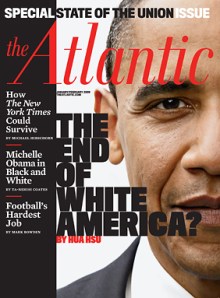
The Atlantic Monthly, January/ February 2009

atlantic-janfeb09

Garrett Epps declares the creation of the presidency to have been “The Founders’ Great Mistake.”  You’d think the history of the last 85 years would have made that clear to everyone, but evidently it has not.  Epps does not propose abolishing the presidency.  Instead, he outlines a plan that would keep the office in existence, but make the president dependent on the support of a majority in Congress.  In effect, Epps would replicate a parliamentary system.  That would be, if anything, worse than what we have now.  At least now the president and Congress can fight each other to a standstill.  Under Epps’ system, there would never be an opposing force to block the worst ideas that came out of the leadership of the ruling party. 

Mark Ambinder’s piece on the way the Obama campaign handled race as an issue contains an interesting line:

Even during the 2008 primaries, a discomfiting pattern had emerged: Barack Obama did his best overall in the states with the largest or the smallest percentages of African American voters—think of South Carolina, where blacks made up 55 percent of the Democratic-primary vote, and Vermont, where they made up less than 2 percent. Obama won in states where black Democrats had already attained a measure of political power, or where whites had never competed with blacks.

Ambinder seems close here to an idea that has been rattling around on the far right for some time.  Some writers, such as Steve Sailer, have claimed that “white guilt” is in fact a sign of disengagement from African Americans.  Whites who support policies that might put other whites at a disadvantage to African Americans do so in order to show their superiority over other whites.  On this view, “white guilt” is not a sign of belief in the equality of African Americans.  Quite the contrary, it rests on a belief that African Americans will never be able to compete at the highest levels of achievement.  Those who declare themselves racked by white guilt do so in order to show that they themselves are able to do so, and look down on those whites who have to worry about African American competitors.  I don’t know if I believe that idea, but I do think it deserves wider discussion than it has received.  Certainly it shouldn’t be relegated to Sailer’s blog and similarly confined venues.  

Mark Bowden profiles Bob Fishman, who directs CBS’ television broadcasts of NFL games.  The sheer number of decisions Fishman must make in the course of a minute of airtime staggers the mind.  Cognitive psychologists should study the guy.

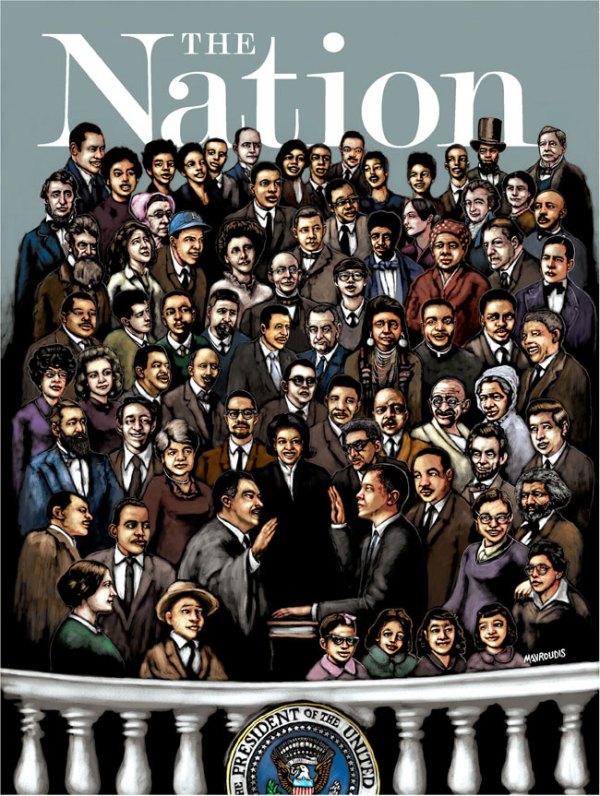
The Nation, 2 February 2009

Click on the image to see who's who

Click on the image to see who's who

Several articles about Barack Obama and what he should do, now that all the historical figures pictured on the cover are watching him. 

A review of a new biography of George Plimpton makes me want not only to look at that book, but also to read some of Plimpton’s own writings, notably Shadow Box, Paper Lion, and Edie

The preacher who delivered the invocation at Mr O’s inauguration, Rick Warren, represented a disappointment to those advocates of the rights of sexual minorities who had done so much to support Mr O when he was seeking the nomination.  Jon Wiener points out that Warren’s clout is so far reaching that the US Senate in 2002 voted unanimously for a bill to relieve him of the necessity to pay federal income tax.  The bill was specifically craftedto nullify an ongoing suit against Warren for tax evasion.  The key parts of the bill appear to apply to Warren, and only to Warren.  If Rick Warren has that kind of power, no wonder  Mr O thought he could gain by favoring him over some of his most important supporters. 

On a happier note, we read about Julius Genachowski, an old friend whom Mr O has named to head the Federal Communications Commission.  John Nichols assures us that Genachowski sees the main question in media policy as the question of democracy.  Committed to the promotion of “openness, free speech, competition, innovation, access, economic growth, and consumer welfare,” Genachowski will be in a position to strengthen America’s democratic institutions.

A letter to various officials

On Saturday, 24 January, I sent letters to President Obama and my other elected representatives in Washington about the case of Harry Nicolaides.   Below is the text of the letter to Mr. O.  I sent slightly modified versions of the same letter to the other officials.   

Dear Mr. President:


Several weeks ago, I read a magazine article by Australian writer Harry Nicolaides.  Mr. Nicolaides reported from Tachilek, a town in Burma located only about 50 meters from the Thai border.  Originally published in an Australian magazine called Eureka on 29 July 2008, the article claimed that child pornography was openly sold in Tachilek.  Mr. Nicolaides claimed to have evidence of videos sold there depicting the binding, rape, and torture of thousands of children aged 4-12 years, most of them apparently produced in Europe or North America, the rest in Cambodia and other Asian countries.  Mr. Nicolaides claims that men from Europe and North America cross the border freely, never searched by Thai or Burmese police.  The article is available online at: http://www.eurekastreet.com.au/article.aspx?aeid=8264.  


I saw Mr. Nicolaides’ name in the news again today.  Thai authorities arrested him late in August, four weeks after the publication of his article about Tachilek.  The charge against him was that a novel he had published in 2005 contained a paragraph that might be construed to refer to Thailand’s Crown Prince and to constitute lese-majeste.  This past Monday, a Thai court sentenced Mr. Nicolaides to three years in prison. 


It strikes me that Mr. Nicolaides’ article about Tachilek, if true, constitutes a valuable service.  One might hope that the Thai authorities would be grateful to be alerted to the existence of this trade and for the opportunity to stamp it out.  Certainly the citizens of the countries where the videos are produced owe Mr. Nicolaides a debt of gratitude.   Perhaps the court that sentenced Mr. Nicolaides was not at liberty to take this service into account.  In view of the international dimension of the Tachilek question, might the Thai ambassador to the United States have occasion to put in a word with the king? 


Thank you for your kind attention to this matter. 


Yours truly,

No Touchdown, No Fumble

baltimoresun.com

baltimoresun.com

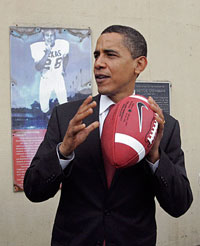
Obama’s Nuclear Football

Gigapan Inauguration

Thanks to Alison Bechdel for linking to this Gigapan photo of Mr O giving his inaugural address.  She asks you to look for Yo Yo Ma taking a picture with his cellphone- I’ll ask you to look for Clarence Thomas taking a nap.  To be honest, I’d never heard of Gigapan before- it’s fascinating.

Obama Has Only 4 Years to Save the World

greencampus.harvard.edu

greencampus.harvard.edu

Tall Order for Mr. O

Obama imagery

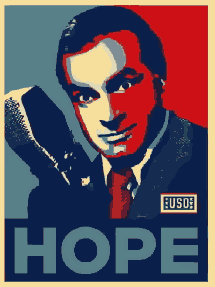
obama_poster_bob_hope

One recent post showed a photo of President Obama tying a bow tie; another discussed the intense fascination with his physical person that seems to have gripped so many people.   That led some of us to compare our favorite pictures of Mr O. 

The original

The iconic image of Mr O so far is probably Shepard Fairey‘s “Hope” poster.  In October, Fairey himself contacted boingboing.net with a link to a collection of spoofs of his poster.  A few I can’t resist copying appear after the jump. (more…)

Mr O

Photoshop at its finest

Photoshop at its finest

From a friend of the blog:

I’ve been reflecting on how, in these very early days of the Obama administration, there is such relentless focus upon the person of Barack Obama himself, as if the man constitutes the real locus of substantiality in this situation.  Ironically, the case is tending so much to the diametric opposite:  Obama is a virtual spectre, a wraith, an empty place-holder.  He is, top-to-bottom, configured by the present complex of circumstances facing the country and earth (although world conditions have chillingly small bearing on the highly-inward gaze which is the hallmark of US political perspective) … This complex of circumstances, the range of plausible methods to engage it, and the particular types of public reaction that these methods will inexorably evoke:  all of this amounts to an essential structure of near-fatalism:  A pine cone will not fall up; water will not freeze at boiling temperature.  In the same way, the deep-rooted urge to ogle Das Leader, whatever it’s all about, certainly is linked to a voracious need to place the mask of a human face upon a disconcerting, and highly impersonal, black vortex of historical forces.  We believe that, because we can see Obama physically upon the TV screen, therefore we can truly see him.  What’s even more frightening than the realization that Das Leader is, at bottom, a social construction, is the uneasy suspicion that that social construction is being – cunningly, indefatigably – moulded and tweaked for public consumption by the mind-nexus of power-wealth.  Consider the recent news that a US “remote unit” in a border region of Pakistan has killed twenty-two people.  Das Leader has not been in power for one week, and he’s already handed down orders to kill people:  no evidence required, no judicial process.  Pharaoh has put them to death, for he is Pharaoh.  And since they (a) were almost certainly not US citizens, and (b) may have satisfied a definition of “terrorist,” they are in consequence right-less subhumans on both counts.  The fact that the sarcastic final clause of my prior sentence would meet with a thoroughly above-board “yeah” of acknowledgment from vast legions of Americans, with no ensuing deeper rumination, is a sobering index of where we are.”

From Acilius’ reply:

“good points about Mr O.  one of the reasons i like to call him “Mr O” is that the letter O does suggest the “empty place-holder” 0.  he is a vacant space which the spectator can fill with any image s/he may wish.  his accession to the presidency invites us to construct in our minds any narrative that may help us to live with “a disconcerting, and highly impersonal, black vortex of historical forces.”  (america’s 44th, and first black, vortex of historical forces.)  that narrative may concern a redeemer prince who embodies our highest hopes or a leering tyrant who confirms our deepest fears.  in either case, we can feel that the processes in which we are enmeshed are familiar, intelligible, human.  it isn’t too different from what we were talking about before.  those of us who don’t understand theoretical physics can listen to an explanation of the big bang, visualize eggs hatching, and tell ourselves that the familiar image we have thereby produced is the way it really happened.  it then seems to us that the physical world isn’t so puzzling after all.  if we can understand ordinary eggs, how much harder could it be to make sense of a cosmic egg?  the social world might also seem less mystifying if we can reduce its larger scale processes to personal narratives.  and not the personal narratives of actual, complex human beings, but the personal narratives of archetypal figures familiar in legends as old as the stone age and as fresh as the movies.” 

Let me clarify my remarks here.  These remarks are from an email discussion that had, the week before, centered on what goes in the minds of scientific illiterates such as myself when we hear experts try to explain the Big Bang theory.  My idea was that as we listen, we tend to draw on the same kind of nature imagery that people have been using since prehistoric times to devise myths that would help make the confusing, dangerous, frustrating aspects of reality seem familiar and comprehensible.  So whatever the physicists on the History Channel’s The Universe may be trying to say, what I and people like me end up believing we heard is a Cosmic Egg creation story that could have been told around any Neolithic campfire.  

In my reply above, I suggest that the fixation on Mr O may be part of a similar phenomenon.  I do not mean to suggest that my correspondent is trying to cast Mr O as a “leering tyrant” and thereby to make his own myth about him.  This last point would likely have been clear in the original context, since my correspondent voted for Mr O and has in the past supported other politicians whom no one would regard as incapable of the “Pharaonic” behavior he laments.  Nor do I mean to deny that there may be situations in which an individual can take an action that will change the course of history.    

Inaugural ties

On the big day

On the big day

Day 1 in Office!

I am glad to see that President Obama has already started working on keeping promises.  Maybe an elected official can tell the true. 

“Obama’s new lobbying rules will not only ban aides from trying to influence the administration when they leave his staff. Those already hired will be banned from working on matters they have previously lobbied on, or to approach agencies that they once targeted.

The rules also ban lobbyists from giving gifts of any size to any member of his administration. It wasn’t immediately clear whether the ban would include the traditional “previous relationships” clause, allowing gifts from friends or associates with which an employee comes in with strong ties.

The new rules also require that anyone who leaves his administration is not allowed to try to influence former friends and colleagues for at least two years. Obama is requiring all staff to attend to an ethics briefing like one he said he attended last week.”