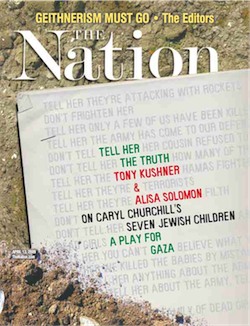
The Nation, 13 April 2009

nation-13-april-09Tony Kushner and Alisa Solomon review Caryl Churchill‘s new play, Tell Her the Truth, which tells the history of the Arab-Israeli conflict in ten minutes.  “Why is the play so short?  Probably because Churchill means to slap us out of our rehearsed arguments to look at the immediate human crisis.”  Churchill cares about what human beings are doing to each other and how they justify what they have done to themselves and to each other, especially in the justifications parents give their children.  Tell Her the Truth consists of a series of lines giving the parents of seven unseen Jewish children advice as to what they should tell those children about various historical acts of violence, some committed against Jews in the name of antisemitism, some committed by Jews in the name of Zionism. 

Tell Her the Truth, like every publication critical of Israeli policy, has attracted charges of antisemitism; much of the case against it apparently hinges on a line that does not appear in the play.  Some have claimed that the play raises the spectre of “blood libel,” the old idea that Jews ritually murder Gentile children.  “Those who level the blood-libel accusation insist that Churchill has written “tell her I’m happy when I see their children covered in blood.””  What she actually wrote was quite different: “tell her I look at one of their children covered in blood and what do I feel? tell her all I feel is happy it’s not her.”  Kushner and Solomon interpret the real line thusly: “The last line of the monologue is clearly a warning: you can’t protect your children by being indifferent to the children of others.”

(more…)

More on the Destruction of ViewMaster

a-viewmaster

It did not die a natural death

In November, I posted here news that had come to me in a mass email from Las Vegas’ 3Dstereo Store, a report that Mattel would no longer produce ViewMaster reels that might appeal to adults.  Today, another mass mailing from the same source brings more bad news:

Since the the end of last year, the news from the world of View-Master has been earth shaking, but then hasn’t all the news been earth shaking.

Scenic and Custom Divisions Close:
Late last year, Fisher-Price notified all its dealers that the Custom Division which encompassed the Scenic Division was closing permanently. All of its products, every scenic title of View-Master, and the Model L viewers will be discontinued. Custom and commercial reels will never again be made. The factory in Mexico where everything from Beaverton, Oregon was moved, will close. And the remaining View-Master products (children’s View-Master) will only be produced in China at the location that produced the poisoned Mattel/Fisher-Price toys which brought Mattel to the edge of destruction in the first place.

The economy can be blamed for a lot of changes in this world, but the demise of View-Master came unassisted at the hands of Mattel/Fisher-Price executives.

But one thing that Mattel/Fisher-Price will never kill is the joy that tens of thousands of View-Master collectors will always possess in the fascinating product that thrilled the world for 70 years. 

(more…)

Bush Truth Commission

policecorps.org
policecorps.org

Why a commission?

Petition to Investigate Bush/Cheney

The Nation, 6 April 2009

nation-6-april-2009Lorna Fox Scott reviews the new Library of America volume True Crime: An American Anthology, edited by Harold Schechter.  She quotes Americans who have tried to explain acts of extreme violence that their countrymen have committed.  Cotton Mather could say that acts of violence were symptoms of irreligion.  But what would Mather have made of a case like this?

Farmer Yates, who in 1781, as he tells his examiners in what reads like an uncensored transcript, is suddenly commanded by an unidentified “Spirit” to slaughter his beloved family for being “idols”? Vividly reliving the inner struggle of human love with mystic duty, in between enthusiastic pursuits of the victims through the snow, this text stands out as the only perpetrator’s narrative in the collection; its anonymous presenter cannot in the end decide whether Yates was stricken by “the effect of insanity” or “a strong delusion of Satan.” The old certainties are fraying.

Ambrose Bierce was less interested in explaining why people commit acts of extreme violence then in pointing out the glee with which the public receives accounts of those acts:

His “Criminal Market Review” from the late 1860s is unusual for its admission that crime is not so much a deviation as the very image of the national economy: “Robberies are looking up; Assaults, active; Forgeries, dull.” Taking a swipe at the veiled Californian relish in violence–“Our joy at the mutilation of old Hulton has been deeply unspeakable; our lively interest in the shooting and hacking of and by the Dudleys, Ingham and Miller, has been testified in a novel and interesting manner by a private scalp dance at our own apartments”–Bierce links this to the war. “It pleasantly reminds us of the time when we were a soldier.” Then, like Twain satirizing the social worship of “blackguards”: “Yosemite is a conceded fiction, and the Big Trees a screaming joke…. But we are handy with the pistol and wield a butcher-knife as deftly as an Indian or anybody.”

Twentieth century writing has shown new forms of self-consciousness.  Edna Ferber’s comments on the trial of Richard Bruno Hauptmann include not only scorn for the gawking crowd but sympathy for the accused murderer; Zora Neale Hurston’s reports on the trial of Ruby McCollum, a black woman accused of shooting a white physician, show the defendant and the crime lost to public awareness as black and white act out the rituals of race. 

Fox quotes a haunting conversation that occurred in 1949.  A man had gunned down a dozen people on the street in his New Jersey neighborhood, then gone home.  The phone rang.  He answered it.  Calling was a reporter from The Camden Evening Courier

Mr. Buxton asked how many persons Unruh had killed.
 The veteran answered. “I don’t know. I haven’t counted. Looks like a pretty good score.”
  “Why are you killing people?”
  “I don’t know,” came the frank answer. “I can’t answer that yet. I’ll have to talk to you later. I’m too busy now.”

(more…)

Shoot-‘Em-Up Video Games Aren’t Sadistic Enough to Entertain Little Boys?

skateestate.com

skateestate.com

How about Rape-the-Women games for the future psychopaths?

Mental Illness and Criminal Responsibility

gretchenbatcheller.com

gretchenbatcheller.com

Threshold of a Crime

The American Conservative, 9 March 2009

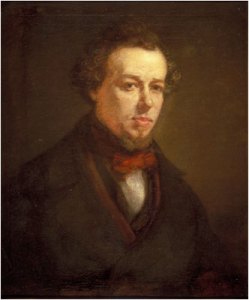
Benjamin Disraeli as a Young Man

A review of Adam Kirsch’s biography of Benjamin Disraeli focuses on Kirsch’s idea that because Disraeli realized he could not stop his fellow nineteenth-century Englishmen from thinking of him primarily in terms of his Jewish ancestry, he “did not attempt to disguise his Jewish background.  He embellished it.”   Disraeli purported to be far more deeply involved with that side of his ancestry than he in fact was, even explaining his active membership in the Church of England as an example of his fealty to “the only Jewish institution that remains… the visible means which embalms the race.”  Meanwhile, the Jewish characters and themes in Disraeli’s novels appall modern sensibilities.  Sidonia, a character in the Young England trilogy (Coningsby, Sybil, and Tancred,) “looks like nothing so much as an anti-Semitic hate figure.  It is amazing, in fact, how Disraeli manages to combine in this one character every malicious slander and paranoid fear that the anti-Semitic imagination can breed.”  Disraeli’s manipulation of the label his fellows had imposed upon him enabled him to become prime minister of the United Kingdom.  Disraeli’s ability to “outline [an] agenda of radical change to be achieved conservatively, a political program that allowed him to reinvent himself as the representative not only of the wealthy and the working class but of the Tory Party, too” has inspired rightist politicians like Richard Nixon and the neocons.      

If Kirsch is right, Disraeli knotted his contemporaries’ perceptions of him around their image of “the Jew,” using their prejudices to transform  himself from a marginal figure unlikely to make a mark in politics into a figure of England’s national mythology.  Another complex of ideas twists around another such image in Brendan O’Neill’s  analysis of the thoughts of some of Israel’s more fervent defenders in the West.  O’Neill argues that the individuals he cites are less interested in Israel as an actual place inhabited by living people than they are in using a particular idea of Israel as a symbol for the values of the Enlightenment.  “In effect, Israel is cynically, and lazily, being turned into a proxy army for a faction in the Western Culture Wars that has lost the ability to defend Enlightenment values on their own terms or even to define and face up to the central problem of anti-Enlightenment tendencies today.”  This use of Israel as a pawn in cultural struggles centered elsewhere shades into philosemitism.  “[A]s Richard S. Levy writes in his book Anti-Semitism: A Historical Encyclopedia of Prejudice and Persecution, simple philosemitism, like anti-Semitism, also treats the Jews as ‘radically different or exceptional’…  Where anti-Semites project their frustrations with the world and their naked prejudices onto the Jews, and frequently onto Israel, too, the new philosemites project their desperation for political answers, for some clarity, for a return to Enlightenment values onto Israel and the Jews.  Neither is a burden the Jewish people can, or should be expected to, bear.”    

(more…)

The American Conservative, 23 February 2009

Woodrow Wilson

Woodrow Wilson

Daniel McCarthy chronicles the American Right’s shift from the skepticism about the office of US President that fueled the principled critique of excessive presidential power that thinkers like James Burnham and Willmoore Kendall sustained in the middle decades of the twentieth century to the abject presidentialism of the Bush/ Cheney Republicans.  McCarthy does not suggest an agenda for curbing the power of the presidency; still less does he express agreement with my favorite idea, abolishing the office.  He does not even hope for a return to the arrangement of the nineteenth century, when the Congress was the senior partner in the leadership of the federal government.  The wish he does express is that conservatives will once more express a wish for a return to those days.   

Richard N. Gamble, author of the magnificent book The War for Righteousness: Progressive Christianity The Great War, and the Rise of the Messianic Nation and of a neat article about Irving Babbitt’s view of Abraham Lincoln, reviews several  recent books about Woodrow Wilson’s foreign policy.  Most interesting to me were Gamble’s remarks about What the World Should Be: Woodrow Wilson and the Crafting of a Faith-Based Foreign Policy, by Malcolm D. Magee.  The key paragraph is this:

Magee gets Wilson largely right, but one further refinement of his analysis would have been helpful in connecting American Christianity and the “faith-based foreign policy” of the subtitle. It is not enough to say that Wilson was a Calvinist or a Presbyterian. Wilson, as Magee’s evidence makes clear, was a particular kind of Calvinist and Presbyterian. He adhered to a branch of Calvinism that tried to reorder every institution by bringing it under Christ’s dominion. Magee refers to “the Presbyterian tradition,” but it is doubtful there ever has been anything so unified in American history. Wilson owed his view of the church and the world not to confessional Presbyterianism but to the transformationist strand of evangelicalism that came to dominate mainstream Presbyterianism in the late 19th century. Wilson imbibed an activist faith that in many ways distorted historic Presbyterianism. He rejected creedal, confessional Presbyterianism. In order to understand his foreign policy, then, we must understand not his Presbyterian roots in general, but the fact that he emerged from a branch of Protestantism that had more in common with low-church, sentimental, meliorist evangelicalism than with historically Reformed Christianity. Magee fills in an important dimension of Wilson’s thought and personality, but finding the precise faith on which Wilson based his foreign policy requires that the story of American Christianity be told a bit differently.

Kirkpatrick Sale reviews a novel by Carolyn Chute, The School on Heart’s Content Road.  In a fictional town in a rural Maine, a commune full of aging hippies form an unlikely alliance with the local underemployed rednecks.  Forming a militia, they decide that the only way for Mainers to reclaim their freedoms is to secede from the USA.  Since Chute is herself a member of the real-life 2nd Maine Militia and an advocate of the dissolution of the USA, it is perhaps surprising that the militiamen are an unimpressive bunch whose revolt peters out into drunkenness and random fornication.  But not so surprising that she promises a series of four sequels. 

Bill Kauffman goes to his favorite gun show and reports that the American Left is missing a fertile recruiting ground there.  The attendees are “working and rural citizens who are pro-Bill of Rights, anti-corporatist, and open to radical alternatives.”

It’s official!!!!!!!!!!!!!!!!!!!!!!!!!!!!!!!!!!!!!!

http://www.cnn.com/2009/POLITICS/02/27/gop.poll/  The 2012 presidential campaign is under-way.  I, for one, just don’t want to hear about it.  I’d much rather hear about Ayn Rand’s Objectivism, and that’s saying a lot.

Thailand’s anti-pornography campaign

Here‘s a public service announcement against pornography currently running on TV in Thailand.