Full circle

In the 1920s and early 1930s, so many people took up the ukulele that it was a staple of popular culture to complain about the annoyance of bad amateur ukers.  Reyalp Eleluku, the Backward Ukulele Player, often posts reports of anti-ukulele sentiment from that period.  Nowadays the uke is back in fashion, and with that fashion has come more complaining about people who play badly in public.

In the same years, the comic strip Blondie debuted in US newspapers.  Blondie has kept going ever since; it has never changed the Art Deco-inspired drawing style that made it so hip back then.

Today’s Blondie might have appeared in the strip’s first year of publication, 1930:


What are political parties for?

Click on the image below to see Keith Knight’s latest K Chronicles in readable form.

This suggests a different view of US politics than did one of his recent (th)ink comics:

The whole premise of the first comic that the Republicans and Democrats in official Washington might be expected to “solve America’s problems.”  I see no evidence that either party is interested in doing anything that could meet this description.  On a whole range of issues, the two parties are much closer to each other than either is to the mainstream of US public opinion.  In regard to trade policy, tax policy, health care, foreign policy, labor law, immigration, etc, the two parties represent a coordinated program to subsidize capital ownership and penalize wage labor.

The premise of the second comic is that the Republicans’ main goal is to attack the Democrats and that there is no point in the Democrats’ attempts to work with them.   If this is true, and if it is also true that the Democrats represent something good, then a Democratic leader who said that his or her party’s chief goal was to rid Washington of Republicans  would not be neglecting “America’s problems,” but tackling one of America’s biggest problems.   I don’t doubt that Knight sincerely believes that that Republicans are hopelessly bad, and that the Democrats are far better.  I am surprised that he doesn’t accept that Senator McConnell and his supporters are equally sincere in the contrary belief.

Acyrologia in the news

Yesterday, Language Log posted this cartoon.  Click on the image to see it in full size on the cartoonist’s site:

The poster, Professor Arnold Zwicky, at first remarked that he hadn’t seen the word “acyrologiaphobia” before; he then updated the post with the cartoonist’s explanation that “Acyrologia… seems be more or less synonymous with malapropism.”  So I googled “acyrologia,” and found this nifty little page explaining the word and its uses.  The page is part of Silvae Rhetoricae, an online reference for students of rhetoric maintained by Professor Gideon Burton of the Brigham Young University.

More ghosts

On Halloween, I posted about Ambrose Bierce’s idea of ghosts as beings who come from nowhere, go nowhere, and are powerless to play a direct role in human life.  I suggested that Bierce might have been expected to come up with an idea like this, given that his religious background was a self-conscious Protestantism that made a point of renouncing notions like Purgatory and intercessory prayer.  Bierce grew up hearing that at the moment of death, a soul passes either to Heaven or to Hell.  With that belief as the starting-point for his thoughts about the afterlife, how could Bierce have crafted a drama of any substance for the dead to enact?  How could he have attributed to them the power to influence our lives?

Similar thoughts seem to have been working lately in the mind of cartoonist David Malki.  The four most recent installments of his Wondermark have dealt with ghosts.  Here’s one from earlier this week:

Bierce has his ghost explain that the spirits of the dead are “invisible even to ourselves, and to one another”; on rare occasions, she says, “we are seen by those whom we would warn, console, or punish. What form we seem to them to bear we know not; we know only that we terrify even those whom we most wish to comfort, and from whom we most crave tenderness and sympathy.”  Perhaps the ghost in this comic is under the impression that she is communicating with the medium, who does not really hear her at all but is deceiving her and his clients; or perhaps the medium does hear her and is  faithfully reporting what he hears, which is distorted in the way that Bierce’s ghost had complained her attempts to communicate with the living had been distorted.

“The economic argument”

Last week there was an xkcd strip that bothered me for three reasons.  Here’s the strip:

Two of the three things that bothered me about it were raised in this comment in the forum, more forcefully than I likely would have done.  So I’ll take the liberty of quoting “woodrobin”:

1. Dowsing is used by oil prospectors, as well as people looking for places to dig water wells. Less often these days, but it’s still used. Does that mean it works? No. Does people not using it mean it doesn’t work? No. Very few people use horses to pull plows, except the Amish and people in developing countries. Does that mean that horses can’t pull plows?

2. Health care cost reduction. That was funnier, taken seriously, than the original joke. When was the last time you ran into a doctor, hospital or insurance company that was interested in cost reduction through treatment? Any treatment, scientific or otherwise? Doctors and hospitals want to make money, and insurance companies have figured out it’s easier to save money by denying coverage for treatment, either in whole by canceling coverage, or in part by excluding anything “experimental” or “unproven.” In other words, it’s cheaper to exclude entire types of health care than to consider or cover them, whether or not they’re quackery notwithstanding.

“woodrobin” goes on to make two more points, about irrational practices that are in fact quite common in financial planning and military operations.

I would add one thing to woodrobin’s point 1, that people who defend dowsing usually claim only that it is a good way of finding water that is near the surface.  Most oil prospecting these days is concerned with deposits that are deep underground, so no method of shallow surveying is going to “make a killing” for anyone in that area.

My third objection hinges on the word “eventually” in the caption.  In the long run, the caption seems to say, market competition tends to eliminate irrational practices.  That may well be true.  However, that long run can be very long indeed, and in the interval those irrational practices can be reinforced by any of a wide variety of social forces.

Moreover, the rationality that competitive markets enforce is not the rationality Plato talked about in The Republic, not a single process that must culminate in a vision of unmixed truth and untainted justice.  Rather, it is the rationality Max Weber had in mind when he said that modern society traps its members in an “iron cage of rationality.”  Economic agents respond to the incentives of the market and develop ever more efficient ways of meeting the demands of other economic agents who have purchasing power.  Whether those demands accord with the sort of truth and justice Plato hoped to discover has nothing to do with it.  The mouseover text on this strip reads “Not to be confused with ‘selling this stuff to OTHER people who think it works,’ which corporate accountants and actuaries have zero problems with.”  The distinction between making a killing selling financial advice based on astrology to suckers who think astrology works and making a killing selling financial advice based on astrology because astrology really works may have made perfect sense to Plato, but it seems awfully tenuous from the viewpoint of someone like Weber.

(more…)

Pretty in pink?

Yesterday, many US comic strips were loaded with pink in a campaign to raise awareness of breast cancer.  For examples, see the Comics Curmudgeon.  When I read the paper yesterday morning, what all that pink in fact reminded me of was the Financial Times:

Maybe the FT has been on a campaign to raise awareness of breast cancer for all these years, and it has just neglected to tell anyone about it.

What we’ve posted on the Tumblr site

Since our most recent substantive post here, we’ve posted all of this stuff on our Tumblr site:

-a recent Jem Cooke video

– a picture of a funny sign

-a link to the announcement of a new comic book a friend of ours made

-a video of classical ukuleleist Valèry Sauvage playing Ken Middleton’s arrangement of a traditional Irish tune

-a little joke about a political controversy that’s been raging in the USA

-a one-panel comic about Botticelli’s Birth of Venus

-a video of ukuleleist The Bradlands playing Mrs Brown You’ve Got a Lovely Daughter, accompanied by a link to Phranc’s ukulele version of the same song

-a video of Bosko and Honey performing with The Uke Box

-an animated short, made in 1973 and narrated by Orson Welles, dramatizing Plato’s allegory of the Cave

We haven’t moved from this site to that one.  It’s just that we’ve all been a bit busy, and it’s been easier to find a couple of minutes to slap a video or a link on Tumblr than to do the sort of writing we usually produce for this site.  We’ll post more stuff here soon.

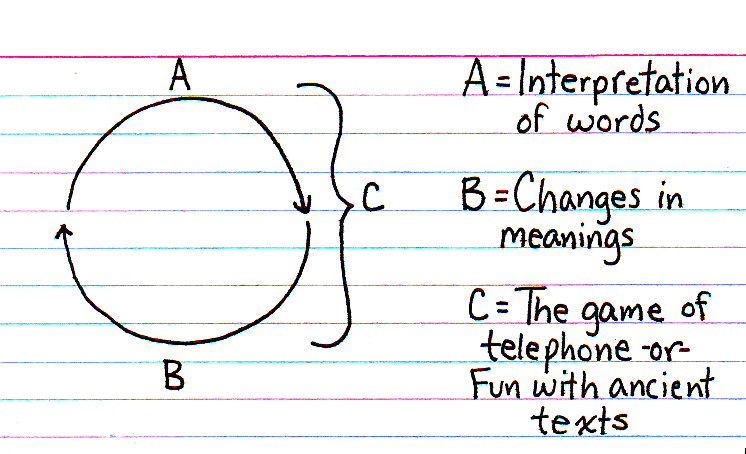
Popular web comic mentions “Ancient Texts”

Classical scholars take note!  Jessica Hagy of Indexed may be aware of your existence.

Remarkable coincidence

Here’s a comment I just had occasion to post on Alison Bechdel’s site:

This morning, I was teaching a class about English words derived from Latin and Greek. One of the exercises required them to write definitions of English words and illustrate their definitions with examples of the words in use.

I wanted to show them how they could use Lexis-Nexis* to find example sentences. So I projected the computer onto the screen in front of the classroom and opened the Lexis-Nexis search window. I asked the class which word they wanted me to look for in my demonstration. From a list of several dozen words, someone picked “neurosis.” So I typed “neurosis” into the search window. Up came hundreds of results. Looking these over, we could see not only potential definitions, but a good deal about the usage of the word. For example, finding it in hundreds of daily newspapers but only one medical journal we formed the hypothesis that it is a word that is no longer in technical use, an hypothesis which that one journal reference** explicitly confirmed.

Then I wanted to show them that you can narrow the search so that it only brings up items posted today. When I did that, paragraphs six through eight of this article appeared on the screen***:

http://www.guardian.co.uk/books/2010/jul/18/comics-grow-up-graphic-novels-harvey-pekar

You could have knocked me over with a feather. I gave a little eulogy for Harvey Pekar and said something like, “Hey, Alison Bechdel! She’s great!”****  Then it was back to lexicography.

*Here’s a link to Lexis-Nexis.  My students and I have access to their “Academic” service

**It was the 2 May 2009 edition of The Lancet, in case you’re curious; “Twisted Science, Regulation, and Molecules,” by Peter Tyrer, Pg. 1513 Vol. 373 No. 9674, wherein appear the sentences “The condition from which my patient suffers used to be called depressive neurosis. It was not a very good diagnostic label, and its boundaries were unclear, but it did allow anxiety and depression to coexist without the need for splitting them into interminable subgroups that, when they were subsequently found together in one person, were pompously described as “comorbidity.”” 

***The portion that appears on screen starts with the search term you used to find the article.  The first appearance of “neurosis” was near the top of paragraph six, and the screen I was using had room for that paragraph and the next two. 

**** Come to think of it, it may have been closer to “Whoa, there’s Alison Bechdel!”  Or maybe “Whaa–!  Alison Bechdel!”  It may even have been “Alison Bechdel!  Golly!”  I taught another class right after that one, so I can’t be certain of my exact phrasing.

Tom Tomorrow, Today

A quote from General David Petraeus, commander of US forces in Afghanistan.  As always, click on the picture to go to the original site: