The American Conservative, 16 June 2008 and 30 June 2008

16 June– William Lind writes about the “New Urbanism,” arguing that the right should embrace this movement‘s defense of neighborhoods and face-to-face human interaction.  A profile of Rep. Walter Jones (R-NC) “shows that antiwar conservatives can win- for now.” 

Gerald Russello reviews a collection of essays by philosopher Michael Walzer.  As a marxisant leftist associated with the hawkish Journal Dissent, Walzer would seem like the last person one would expect to see praised in this journal of the antiwar right, yet Russello finds much to admire in Walzer’s exploration of the tensions between the claims of community and the right of the individual to self-directed development. 

30 JuneLocalvores beware!  TAC agrees with you!  At least one of their contributors, John Schwenkler, does; he calls for a new economy of food to be built on a small scale, on the impeccably conservative grounds that “Heavily concentrated industries demand expensive and centralized government.”  Scale agriculture down from world-feeding corporate behemoths to neighborhood-feeding family farms and community gardens, and you can both restore the human scale to life and cut taxes. 

Philip Weiss, of the mondoweiss blog, visits the American Israeli Public Affairs Committee‘s annual conference.  Readers of mondoweiss will wonder why they let him in, but they did, and he had a wonderful time.  “Even a sharp critic like myself of what AIPAC is doing to American policy in the Middle East was frequently moved by the pure loving feeling that surrounds you at every moment.”  Surrounds you, because AIPAC is a lobby that has nothing to do with desire for money: “the AIPACers didn’t come for selfish reasons.  They are devoutly concerned with the lives of people they don’t know, very far away.  Yes, perople with whom they feel tribal kinship.” 

US Senator James Webb (D-VA) documents his opposition to the more bellicose aspects of American foreign policy in the Middle East over the last 25 years.  He quotes a memo he wrote on 7 August 1987 while serving as Ronald Reagan’s navy secretary.  In that memo, he expressed his opposition to the administration’s policy of flying the American flag over Kuwaiti oil tankers, a policy that would lead directly to the first US/ Iraq war three years later.

Michael Fernandes, Banana Artist

I should have mentioned this in my notes on the latest issue of Funny Times, since I learned about it there.  Anyway, here’s the report from Chuck Shepherd’s News of the Weird:

Great Art!

Artist Michael Fernandes’ exhibit in Halifax, Nova Scotia, in June caused a commotion because it was merely a banana on a gallery’s window sill, and Fernandes had it priced at $2,500 (Cdn) (down from his original thought, $15,000). Actually, Fernandes changed bananas every day (eating the old one), placing progressively greener ones out to demonstrate the banana’s transitoriness. “We (humans) are also temporal, but we live as if we are not,” he wrote. Despite the steep price, two collectors placed holds on the “work,” requiring the gallery’s co-owner, Victoria Page, to get assurance from callers. “It’s a banana; you understand that it’s a banana?” [Globe and Mail (Toronto), 7-2-08]

The installation was the target of a crime when a “prankster” broke into the gallery and replaced the banana with an apple and a handwritten note.  Here‘s the gallery’s site devoted to the exhibition.  In 1992, Fernandes gave this interview and published it in a book of his.

I like bananas

The song says “I like bananas because they have no bones.”  That’s one of the reasons I like bananas.  I also like the Hoosier Hotshots, though apparently they did have bones.  

The Belgian National Colors

Via BBC

If Vietnam Were Now

Via haha.nu

Obama, McCain Prepare for Debate

One of Jodie Foster’s Early Roles

I posted a link to this a year or so ago, here’s an embed. 

The Funny Times, October 2008

This month, Dave Barry goes to the Olympics, where he finds American reporters and tourists eating things like fried scorpions and sheep-penis-on-a-stick.  Meanwhile, every actual Chinese he sees is eating fresh fruit and roast lamb.  Curmudgeon quotes witty remarks about gossip, including my favorite, Alice Roosevelt Longworth’s first rule of socializing: “If you haven’t got anything nice to say about anyone, sit right here by me.”  News of the Weird describes accomodations High Point University in North Carolina offers its undergrads, accomodations so luxurious (hot tubs, concierge service, etc) that the school has come to be known as “Club Ed.”  Garrison Keillor recommends that all our leaders do as he has done and undergo Japanese spa treatments, so that they will learn that as wet naked people they are essentially indistinguishable from the rest of the world’s wet naked people.  Planet Proctor quotes an oldie-but-goodie:

We’ll begin with box, and the plural is boxes,

But the plural of ox becomes oxen, not oxes.

One fowl is a goose, but two are called geese,

Yet the plural of moose should never be meese.

You may find a lone mouse or a nest full of mice,

Yet the plural of house is houses, not hice.

If the plural of man is always called men,

Why shouldn’t the plural of pan be called pen?

If I speak of my foot and show you my feet,

And I give you a boot, would a pair be called beet?

If one is a tooth and a whole set are teeth,

Why shouldn’t the plural of booth be called beeth?

Then one may be that, and three would be those,

Yet hat in the plural would never be hose

And the plural of cat is cats, not cose.

We speak of brother and also of brethren,

But though we say mother, we never say methren.

Then the masculine pronouns are he, his, and him,

But imagine the feminine: she, shis, and shim?

The American Conservative, 22 Sept 2008

In this issue. John Laughland describes the Saakashvili regime in Georgia, quoting along the way gushing praise that various Western media outlets have lavished on that grubby little dictatorship.  Faced with the contrast, Laughland provides an intriguing psychological theory to explain why media and policy elites in the USA and the states ranged with it so often form passionate attachments to unappealing foreign states and leaders:

The Georgian president has indeed achieved extraordinary success in presenting his fiefdom as a Jeffersonian paradise.  This is partly due to Georgia’s use of operatives in Washington, such as John McCain’s foreign-policy advisor Randy Sheunemann, and a PR firm in Brussels.  But more importantly, it is the result of a virulent form of Western self-delusion.  Faced with seemingly intractable domestic problems, in which different political actors have to be balanced, Western states like to indulge in occasional but dangerous flights of foreign-policy escapism.  We imagine that we can free subject peoples with our bombs.  The image of a victim nation has now become an easy psychological trigger that can be applied indiscriminately to Bosnian Muslims, Iraqis, and now Georgians.  These unknown peoples and nations are but a blank screen on which we project our fantasies.  Our image of them says much more about us than it does about reality.    

Tony Smith analyzes the foreign policy teams and statements the presidential candidates have made and concludes that neither is likely to conduct a significantly less warlike administration than the current one.  Both candidates are committed to the major tenets of the interventionist consensus: democratic peace theory, the notion that states governed by democratic institutions are unlikely to make war on each other (Smith mentions thinkers Bruce Russett, Andrew Moravcsik, and John Rawls as advocates of this theory); democratic transition theory, the idea that liberal democracy could be established in any of an extremely wide variety of social contexts (here Smith cites Larry Diamond); and “R2P,” the notion that a state forfeits its sovereignty unless it meets its “responsibility to protect” its population (Smith cites Thomas Franck and Anna-Marie Slaughter.)  “With these three concepts, a witches’ brew has been concocted.”  America’s wars against Serbia in 1999 and against Iraq since 2003 have bubbled up from this unholy concoction. 

Septimus Waugh reviews Gerard deGroot’s The Sixties Unplugged: A Kaleidoscopic History of a Disorderly Decade.  Waugh mentions an article deGroot wrote for The Journal of Mundane Behavior, wherein he argued “that the writing of history is too influenced by what is interesting and newsworthy to be a true reflection of the past, which is made up of the boring and humdrum events of survival.  By concentrating on extraordinary events, historians, he complained, were pandering to myth, though to tell the true tale of the past would be boring.”  So Waugh sets out to explode the myth of the 60’s as a time of extreme behavior, letting people into his story who spent the decade minding their own business.

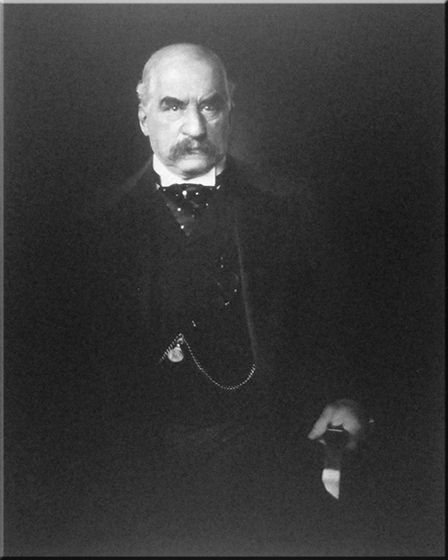
J. P. Morgan, photographed by Edward Steichen