
If you have a Facebook account, you should log in right away. A new video of Victoria Vox’ “Bird Song” is up. It’s animation produced by Arketype, Inc. Look for Victoria’s Hitchcock-like cameo.
All posts by acilius
New Victoria Vox Video on Facebook
Posted by acilius on September 18, 2009
https://losthunderlads.com/2009/09/18/new-victoria-vox-video-on-facebook/
The Atlantic, September 2009
 David Goldhill’s piece about health policy identifies the main problem with the current US system as health insurance. Not the fact that so many people lack health insurance, or the way health insurers operate, or any of the usual complaints, but in the sheer fact that Americans pay for health care primarily by means of health insurance. Goldhill argues that this payment system strips patients of the ability to make informed decisions about their own care, subjects health care providers to a regime of incentives that are unrelated to the rationality of the marketplace, and inflates the costs of health care to unsustainable levels. Goldhill proposes a far-reaching plan to replace this system.
Under Goldhill’s plan, the government would operate an insurance plan that would provide coverage to every American who faced catastrophic health care expenses; that plan would, in time, “ultimately replace Medicare, Medicaid, and private insurance.” It would pay only for genuinely catastrophic expenses. Goldhill acknowledges that it would be difficult to define the limit of “catastrophic,” and discusses various dollar amounts that might be used as a cutoff. Perhaps a percentage of national median income would be a better determinant than any absolute number of dollars, but Goldhill doesn’t bring that up.
The second part of Goldhill’s plan are Health Savings Accounts. Already in existence, these tax-sheltered accounts would under Goldhill’s plan be mandatory for all Americans, and would be the source from which virtually all health care would be paid. Goldhill proposes that the government should subsidize low-income Americans with direct payments to their Health Savings Accounts, so that everyone would have at least as much money in his or her Health Savings Account as any patient would likely be able to claim from Medicare or Medicaid today. The difference is that under Goldhill’s system, the patients themselves would be the ones writing the checks to health care providers. The providers would then have to compete for patients. That competition would take the mystery out of health care prices, and would give health care providers an economic incentive to keep prices down and quality of service up.
Goldhill’s system would also give health-care providers an incentive to adopt best practices, breaking down resistance from entrenched stakeholders. As an example of such resistance, Goldhill opens the piece with the story of his father’s death from a hospital-borne infection in 2007. Remarking that about 100,000 Americans die of hospital-borne infections annually, Goldhill brings up Dr. Peter Pronovost, who has developed a checklist of simple disinfection procedures. Hospitals which have adopted Dr Pronovost’s checklist have seen deaths by hospital-borne infection decline by about 2/3. Yet most hospitals have refused to adopt the checklist, backing down in the face of doctors who are offended that anyone would suggest they need to be reminded to keep clean. Goldhill closes the piece by asking us:
Imagine my father’s hospital had to present the bill for his “care” not to a government bureaucracy, but to my grieving mother. Do you really believe that the hospital—forced to face the victim of its poor-quality service, forced to collect the bill from the real customer—wouldn’t have figured out how to make its doctors wash their hands?
Posted by acilius on September 15, 2009
https://losthunderlads.com/2009/09/15/the-atlantic-september-2009/
Neuron communication according to “Publius”
Here’s a press release on Science Daily with the whimsical headline “Neurons found to be similar to US Electoral College.” The key paragraph, both in summarizing the research and in explaining the analogy, is this:
In this model, each dendritic branch of a neuron receives and integrates thousands of electrical inputs, deciding on just one signal to send to the axon. The axon then receives signals from all the dendrites, much like electoral votes coming in from state elections, and a final decision is made. The result could be an output in the form of an impulse, or action potential, or no action at all.
Posted by acilius on September 15, 2009
https://losthunderlads.com/2009/09/15/neuron-communication-according-to-publius/
New UOGB Album
 The Ukulele Orchestra of Great Britain has released a new album, available for sale at their website. Mrs Acilius and I have ordered our copy; it should be arriving in two or three weeks. The band’s latest email to fans promises that they will be putting out DVDs in the future of their show “Ukulelescope” and their mass-uking session at the BBC Proms last month. No word yet on when “Dreamspiel,” their opera about Germany in the 1930s, will be available for home viewing.
Posted by acilius on September 14, 2009
https://losthunderlads.com/2009/09/14/new-uogb-album/
Liberty and Bureaucracy
The Rebecca Solnit piece linked below, together with some recent conversations I’ve had with LeFalcon and VThunderlad, have got me thinking about what we twenty-first century types mean when we use words like “freedom” and “liberty.” I’m wondering if we can’t update Isaiah Berlin’s “Two Concepts of Liberty” a bit. Perhaps when we moderns talk about freedom, we are talking about how individuals relate to bureaucracies. This sets us apart from the ancient Greeks and Romans. Bureaucracy in the modern sense scarcely existed in ancient times; nor was the individual the basic unit of society. It was the household which was the locus of rights and responsibilities. Challenges which a single household could not meet were met by groupings of households, either traditional groupings based on kinship relations or more-or-less temporary, informal relations based on physical propinquity. In the absence of bureaucracies that could define their clients and members as parts of a community, it was the ability to form cooperative groupings that made a community. The ancients, therefore, tended to see freedom as a property, not of individuals in isolation, but of independent households, of men acting as representatives of those households, and of concerted efforts made by collections of households.
If on the other hand we define freedom as the individual’s relationship to bureaucracy, what do we mean when we say that we want to be free? Sometimes we mean that we want to rebel against bureaucracy, to escape from the infantilizing effects of dependence on bureaucracy. This can lead to absurd extremes; if we do not have a concept of community apart from the bureaucratic organizations that bear the community’s name, this anti-bureaucratic idea of freedom could keep us from calling anyone free but a solitary creature like the Cyclops. And many among us do not seem to have such a concept of community; the attempt to build a communitarian movement that got so much publicity back in the early 1990s seems to have foundered on the difficulty of talking to modern people about community and eliciting a response that is about anything other than bureaucracies. Many libertarians seem to be numbered among those who lack a concept of community as something other than bureaucracy. Libertarians often make penetrating remarks about the dangers of state bureaucracy, but then go on to talk as if corporate bureaucracies were not fraught with the same dangers. Indeed, if the forces of the market make the bureaucracies that are subject to them more efficient at meeting the needs of their clients than are bureaucracis that don’t compete for clients, then we would expect market-generated bureaucracies to reduce their clients to dependence, and thus to infantilize them, more rapidly and more thoroughly than do state monopolies.
Other times we say that we want freedom, and we mean that we want some benefit that a bureaucracy can give us. So in the 1940s when Franklin Roosevelt spoke of the “Four Freedoms“- freedom of speech, freedom of religion, freedom from fear, and freedom from want- he clearly thought of these as the products of bureaucratic efficiency. An effective anti-poverty bureaucracy would ensure freedom from want; an effective national-security bureaucracy would ensure freedom from fear; an effective judicial bureaucracy would ensure freedom of religion and of speech, freedoms which in turn would allow people to express themselves by creating denominational bureaucracies for their religious groups and partisan bureaucracies for those who shared their political views. When Americans today call for a public-sector guarantee of health care for all, they are asking for this kind of freedom. When other Americans oppose such a guarantee, some are motivated by a concept of freedom as rebellion against bureaucracy, but others are motivated by a belief that the private sector bureaucracies of insurance companies offer a more efficient way of providing freedom from the fear of illness and freedom from the want that often follows illness.
Still other times when we say that we want freedom, we mean that we want to play a particular role within a bureaucratic organization. Academic freedom is an obvious example of this concept of liberty. Professors are free to use their own judgment in teaching their courses and in delivering opinions about topics within their fields of expertise. Which courses they will teach, what field of expertise is theirs, and what topics lie within each field of expertise are all questions that are answered by continuous bureaucratic activity. The idea that freedom is a category of roles within bureaucracies can be found also at the heart of the labor movement. What rules a union sets for the workforce of its shop is a less vital concern than the fact that there are rules in the shop which came from the union. What deal emerges from collective bargaining is less important than the fact that management is obligated to sit down with the representatives of labor and come to consensus with them.
Perhaps the concept of liberty as a way of operating within a bureaucracy has been very influential in making the modern world. When there was a live controversy about whether women should go out of the household to work in bureaucratic organizations, the women’s movement put a great deal of emphasis on the freedom women would gain by participating in the workforce. This would have been unintelligible in the ancient world, where work in the household was appropriate to free people, while work for wages was proper only to slaves. In the modern world, by contrast, going out of the household and into wage labor is a sign of freedom, if that wage labor means an opportunity to have an impact on the operations of a bureaucracy.
The antislavery movement may be another case of liberty conceived as something found within bureaucracy. Abolitionism was at once a movement against slavery and a movement in support of wage labor. While the ancient Greeks and Romans might have seen that as a contradiction, it did not seem so by that time. The ancients would have understood the slogan “forty acres and a mule.” A grant of land and the means to support a household by farming it would open the way to the creation of a self-sufficient agricultural household. That would have chartered the kind of freedom they could appreciate. The freedom merely to leave the master’s household, to venture out as an isolated individual and to enter the world of bureaucracy, whether as a job-seeker or as a client needing services, would not have seemed to them to be freedom at all. We moderns, on the other hand, find the purest promise of freedom in the African American elected officials and government employees of the Reconstruction era, and the most natural support of freedom in the operations of the Freedmen’s Bureau.
Posted by acilius on September 12, 2009
https://losthunderlads.com/2009/09/12/liberty-and-bureaucracy/
The triumph of civil society
Rebecca Solnit on “How 9/11 should be remembered.” Some key paragraphs:
New Yorkers triumphed on that day eight years ago. They triumphed in calm, in strength, in generosity, in improvisation, in kindness. Nor was this something specific to that time or place: San Franciscans during the great earthquake of 1906, Londoners during the Blitz in World War II, the great majority of New Orleanians after Hurricane Katrina hit, in fact most people in most disasters in most places have behaved with just this sort of grace and dignity.
And:
Hollywood movies and too many government pandemic plans still presume that most of us are cowards or brutes, that we panic, trample each other, rampage, or freeze helplessly in moments of crisis and chaos. Most of us believe this, even though it is a slander against the species, an obliteration of what actually happens, and a crippling blow to our ability to prepare for disasters.
Hollywood likes this view because it paves the way for movies starring Will Smith and hordes of stampeding, screaming extras. Without stupid, helpless people to save, heroes become unnecessary. Or rather, without them, it turns out that we are all heroes, even if distinctly unstereotypical ones like that elderly woman who got Fichtel back on his feet. Governments like the grim view for a similar reason: it justifies their existence as repressive, controlling, hostile forces, rather than collaborators with brave and powerful citizenries.
Posted by acilius on September 11, 2009
https://losthunderlads.com/2009/09/11/the-triumph-of-civil-society/
Eight years of one day
 Eight years ago today some Tom Waits songs started running through my head. “Yesterday is Here” seemed very timely; “today’s grey skies, tomorrow is tears,/ you’ll have to wait til yesterday is here.” That song is on the album Frank’s Wild Years; several times in those days I set my CD player to play two cuts from Frank’s Wild Years, “Yesterday is Here” and “Cold Cold Ground.”
Another Waits tune that seemed to fit the day very well was “The Fall of Troy” from the Dead Man Walking soundtrack. It’s about a boy who watched helplessly while his brother Troy was shot to death in a robbery. The whole song is full of extremely apt lines. “It’s hard to say grace and to sit in the place,/ of someone missing at the table./ Mom’s hair’s sprayed tight and her face in her hands/ Watching TV for answers to me/ After all, she’s only human/ and she’ll have to find her own way home.”
“The Fall of Troy” would usually get me crying, back then. If crying felt good, I’d turn to Heartattack and Vine and listen to “Jersey Girl.” That would get me sobbing. Waits said that before he wrote that song he never thought he’d use “sha-la-la” in lyrics; eight years and one day ago, I never thought “sha-la-la” would elicit tears from me.
Posted by acilius on September 11, 2009
https://losthunderlads.com/2009/09/11/eight-years-of-one-day/
The inexpressible slowness of the express lane
 Years ago I read a study somewhere about which lane moves fastest in the supermarket. Apparently a supermarket viewed from overhead more often than not looks like a normal curve, with the longest lines in the middle lanes and the shortest on the outer ends. So ever since I’ve been going to the outer lanes in supermarkets. I very much doubt this has saved me any time, but I always tell myself “Remember that study” when I pick a lane. And of course Apu on The Simpsons explained further refinements long ago.
Now, Jason Kottke points to a note explaining one reason why the express lane is often slower than other lanes.
Posted by acilius on September 10, 2009
https://losthunderlads.com/2009/09/10/the-inexpressible-slowness-of-the-express-lane/
The Nation, 28 September 2009
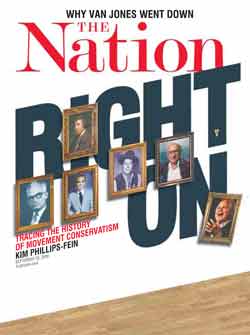 In this issue, Kim Phillips-Fein looks at a topic we spend a significant amount of time on here at Los Thunderlads, the political label “conservative” and the odd collections of people and ideas that have been grouped under it over the years. Phillips-Fein faces an impossible task; her 3-page piece is packaged as a review essay on 12 books, and as she goes she is constrained to mention several more books and articles. What she has written would be a fine introduction to a bibliography on recent scholarship about the American Right. There is one snippet in the piece I’d like to quote. Describing the attempt by New York Times writers David Brooks and Sam Tanenhaus to enshrine a traditionalist conservatism of the sort that writers like Irving Babbitt, Russell Kirk, and George Nash found in the writings of Edmund Burke, Phillips-Fein expresses skepticism that such a conservatism is likely to flourish in America. “That Brooks and Tanenhaus find the motif of Burke appealing is largely a sign of their longing to revive a serious, sophisticated and mature conservatism, and their sense that, thanks to the radicals, the right is in desperate straits and has entered a period of decline.”
I don’t know whether Tanenhaus and Brooks believe that the American Right is in decline as a political force. I for my part find it hard to escape the conclusion that it is in a very bad way as an intellectual tradition. Readers of this blog will have noticed that I spend a lot of time reading magazines like The American Conservative and Chronicles; so it shouldn’t be surprising that I sympathize with their desire to provide America with a conservatism worth arguing against.
A column about Harvard Medical School’s vague conflict-of-interest policy mentions the fact that some researchers at that institutions have received over $1 million dollars from companies they are supposed to be observing disinterestedly. Its dean “wants to increase, not decrease, the school’s connections with industry.”
Posted by acilius on September 10, 2009
https://losthunderlads.com/2009/09/10/the-nation-28-september-2009/
Cigar Box Guitar
The finished product has five strings, which is one string more than we’re used to seeing at Los Thunderlads, but it’s still interesting to watch Renee Stokley of Romulus, Michigan make a cigar box guitar.
UPDATE: Here’s her webpage.
Posted by acilius on September 10, 2009
https://losthunderlads.com/2009/09/10/cigar-box-guitar/
Who writes this?
 acilius
 believer1
 lefalcon
 losthunderlads
 vthunderlad
 Panther Red