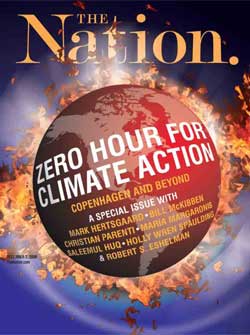
The Nation, lately

Here are the first two paragraphs of Stuart Klawans’ review of Richard Linklater’s docudrama, Me and Orson Welles:

 The story of an omelet told from an eggshell’s point of view, Me and Orson Welles relates the events of one week in November 1937, when a fictional high school student named Richard happens upon some actors goofing off on New York’s Forty-first Street and gets cast in a show that just might open: the Mercury Theatre’s soon-to-be-legendary Caesar. A day-tripping kid from the suburbs will accidentally participate in greatness. As the Mercury’s office manager and all-purpose sweetheart puts it, he will get to sit at the feet of Orson Welles and be showered with his spittle.

As swift and stripped-down as its title, the Caesar into which Richard has wandered will thrillingly transform Shakespeare’s Roman general into a present-day dictator in jackboots and black shirt, provided the director and star ever lets the play get out of rehearsals. Welles is a dictator too, you see, though without any ideal of military discipline, and evidently can’t bear to set an opening date, because then the chaos would end and he could no longer go on bullying and seducing and making everyone in the company wait on his every whim. “Can you play the ukulele?” Welles demands of Richard upon seeing him on the sidewalk, as if it were the first question that would pop into anyone’s mind. Without asking why, Richard looks Welles in the eye, lies and says yes. Welles stares back, recognizes the lie and hires him anyway, telling him he’s now Lucius. It seems the dictator has found a new underling, one with just enough spirit to make him temporarily interesting to break.

“Can you play the ukulele?” is a fine greeting so far as I’m concerned… 

That’s from the 21 December issue, as is Lori Wallach’s piece about the World Trade Organization.  Wallach has done yeoman work over the years publicizing the fact that the World Trade Organization is not just about “trade,” but takes a wide variety of issues out of the democratic process in its member states and subjects them to cloistered bureaucracies that respond only to major corporate interests.   
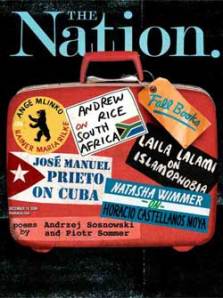
The main thing I want to remember from the 14 December issue is a piece about the killing of Fred Hampton.  Fred Hampton was the chairman of the Black Panther Party in Chicago when police shot him to death at his home, 2337 West Monroe Street, on 4 December 1969.  The official story from the Chicago Police Department at the time was that Hampton fired first; crime scene photos showing that most of the blood Hampton lost drained into his mattress suggested that he was in bed throughout the gun battle.  Hampton must have been very tired indeed to have remained in bed while waging a firefight against the police.    

The author of the piece is Jeffrey Haas.  Here is Haas’ summary of his own role in the response to Hampton’s death:

I was the first person to interview the survivors in the police lockup, where Hampton’s crying and pregnant fiancée told me that after she was pulled from the room, police came in and fired two shots into Hampton and said, “He’s good and dead now.” The autopsy showed he had been shot twice in the head at point-blank range. My colleagues went to the raid scene, examined the bullet holes and found that the trajectory of all the bullets except one was from the direction of the police toward the Panthers. Later, an FBI firearms expert testified that more than eighty shots were fired by the police at the Panthers, with only one coming from a Panther. That one shot was fired in a vertical direction by a falling Mark Clark after he had been fatally wounded.

Two years after the murder, antiwar activists raided the FBI office in Media, Pennsylvania, and found and distributed documents that demonstrated that FBI chief J. Edgar Hoover was conducting a secret war on the left–the Counterintelligence Program, or Cointelpro. Its most aggressive and lethal tactics were used against the black movement, and the Panthers in particular. Cointelpro mandated FBI agents in cities with Panther chapters to “cripple,” “disrupt” and “destroy” the Panthers and their breakfast program and to prevent the rise of a “messiah” who could unify and electrify the black masses.

In 1969 I was a young, newly radicalized lawyer, one of the founders of a collective called the People’s Law Office, which represented the Panthers. After successfully defending the survivors of the raid against bogus criminal charges, we filed a civil rights suit against the police and the prosecutor, and later the FBI. My book The Assassination of Fred Hampton chronicles our long legal and political struggle to uncover the truth about the FBI’s role in the killing. After thirteen years of litigation, we proved that the raid was a Cointelpro operation. FBI agents in Chicago gave Hanrahan and the Chicago police a floor plan of Hampton’s apartment, which included the location of the bed where Hampton would be sleeping. They urged Hanrahan to conduct the raid and later took credit for it in internal documents. The FBI informant who provided the floor plan was given a bonus because his information was deemed to be of “tremendous value” to what one agent referred to as the “success” of the raid.

Noam Chomsky has called the murder of Fred Hampton “the gravest domestic crime of the Nixon Administration.” It is hard to imagine a more serious abuse by a government than the deliberate assassination of a citizen for his political beliefs and activity. But though we were finally able to reveal that Hampton’s death had been an assassination, it has never gotten the attention it deserves. The government’s cover-up and stonewalling basically worked.

(more…)

Should the USA adopt a value-added tax?

Most countries in the world collect a border-adjusted value added tax; the USA does not.  In this document, posted on his blog, former US Senator Ernest F Hollings succinctly points out a problem this creates for American manufacturers: 

Our tax laws force off-shoring. You can manufacture a computer in Chicago, which requires an average corporate income tax of 27%. Exporting that computer to China, when it reaches Hong Kong, China adds another 17% value added tax. But if you manufacture a computer in China, the 17% VAT is rebated or cancelled as it leaves Hong Kong for Chicago. And when it reaches Chicago, there is no 27% add-on, making for a 44% penalty to produce in Chicago. Imagine a country where you can’t produce for a profit. Well, that’s Obama’s United States today.

Hollings is the last person you would expect to find online, but his blog is terrific.

Hanukkah “Phranc Talk”

Everybody’s favorite all-American Jewish lesbian folk singer, Phranc, has posted a new installment of her YouTube variety show Phranc Talk.  Since tonight is the first night of Hanukkah and there’s nothing more appropriate to an all-American Jew than a Hannukah celebration, that’s what she and Pickles have.  Of course she plays the ukulele. 

The rise of the machines

and

Hanukkah songs written by US Senators from Utah

What with Hanukkah getting underway and all, I thought it was time to honor this song by US Senator and Mormon bishop Orrin Hatch.  The lead singer, by the way, is Rasheeda Azar, a Syrian-American originally from Terre Haute, Indiana. 

Copernicium

In a comment on the post below, I referred to “Cp” as the chemical symbol of the element #112.  It was by reading reports like this one and this one that I got this idea.   It turns out that the symbol is actually “Cn.”  By way of correction, here’s a YouTube from “The Periodic Table of Videos” about the name “Copernicium.”  

And their earlier post about the element and its name:

Words that can be spelled using chemical symbols

Fans of National Public Radio’s Sunday Puzzle segment will remember occasional challenges (for example, the one described here) to spell English words using chemical symbols.  So, you could spell the word “iron” using the symbols for iridium, oxygen, and nitrogen (IrON.)  The example should make it clear that this has nothing to do with chemistry; iridium, nitrogen, and neon cannot form a compound, and if they could it wouldn’t be notated in that sequence.  It is just a matter of treating the symbols as if they were Scrabble tiles. 

I’ve been thinking about this, not only because I listen to the NPR Sunday Puzzle, but also because I teach in a classroom decorated with a big poster showing the periodic table.  When the students are taking a test or quiz, there are always at least a couple of minutes when I have nothing to do but look at that poster.  So I try to form words from the symbols. 

Here’s an exhaustive list of all the English words in the tenth edition of Merriam Webster’s dictionary that can be formed in this way.  It not only lists 26,811 words (with a total of 56,407 spellings,) but also includes word squares and word ladders.

Victoria Vox on the Jay Leno Show

All honor to Al Wood’s Ukulele Hunt for posting a link to this video of Victoria Vox on the Jay Leno Show.  I missed Victoria’s blog posting announcing that she would be on, and of course I never watch the Jay Leno Show, so I wouldn’t have known about it but for Al. 

There’s a higher quality video on Facebook.

 Here, Victoria explains the mouth trumpet:

And here’s “Peeping Tomette,” a.k.a. “Chameleon,” which features one of Victoria’s best mouth trumpet solos:

“Chameleon” is the title track of Victoria’s terrific second album, which you can buy at her website.

Virtue Engendered; or, Big States Breed Small Souls

I found two highlights in this issue: a review of Michael Sandel’s Justice: What’s the Right Thing to Do? and a review of David Finkel’s The Good Soldiers

Harvard philosopher Michael Sandel is a major figure in the revival of “virtue ethics,” the school of thought pioneered by Aristotle.   As its name suggests, virtue ethics tends to emphasize the importance of developing particular character traits.  Virtue ethics was out of fashion among academic philosophers for quite a long time, but now it seems to be on an equal footing with the two other leading schools of ethical thought, utilitarianism and deontology. Utilitarianism is a set of approaches that take their cue from Jeremy Bentham’s definition of the Good as that which brings the greatest amount of pleasure to the greatest number of people; deontology first crystallized in the work of Immanuel Kant, defender of the idea that moral duty and rational understanding are inseparable one from another.  So, an advocate of utilitarianism might argue that we should sustain friendships because societies composed of people who like each other tend to have lots of healthy and cheerful citizens, and an advocate of deontological ethics might argue that we should sustain friendships because the universe only makes sense to people who recognize a duty to grow close to each other.  An advocate of virtue ethics, on the other hand, might argue that being a friend means developing traits of character that are valuable in themselves and that can be attained in no other way.     

Sandel, like other virtue ethicists, is associated with a tendency in political theory called “communitarianism.”  Communitarians criticize classical liberalism for its image of the individual human being as a self-contained unit.  As The Nation‘s reviewer puts it:

Nearly thirty years ago, in his massively influential debut in political theory, Sandel argued that communal belonging precedes individual freedom–that, in his language, the self is “encumbered” and therefore not altogether prior to the ends it chooses. An intrepid technical dissection of his colleague [John] Rawls’s epoch-making A Theory of Justice (1971), Liberalism and the Limits of Justice made Sandel’s name as a “communitarian.” Sandel demonstrated that for Rawls, the freedom of individual choice alone is the morally relevant starting point for inquiry into justice, an assumption that renders things like family ties, religious belief, group loyalty and historical identity irrelevant, except as a secondary extra. Communitarians like Sandel, Charles Taylor (with whom Sandel studied as a Rhodes scholar at Oxford) and Michael Walzer responded that most people, even in liberal societies, prize those things at least as much as personal autonomy. The most attractive part of Sandel’s criticism was his contention that relationships, rather than being the result of previous choices, are the sphere in which identity is possible at all. (To put it in more technical terms, there is no individual subject not intersubjectively constituted from the first.) Ever since making these claims, even as political theory has substantially evolved, Sandel has continued to argue for the priority of the communal good in an account of justice, even as he recognizes its risks for liberty.

Because a person’s virtues are part of his or her identity, communitarianism and virtue ethics inevitably go hand in hand.    

The same review discusses a book by Amartya Sen that prompts the reviewer to mention that many philosophers were dismayed when political theorist John Rawls declared that the nation-state was “the natural forum for justice.”  Otherwise dedicated Rawlsians rebelled against this pronouncement, arguing that justice requires a worldwide framework.  I value Sandel and the communitarians because their position points to a different response to Rawls.  I haven’t studied Rawls’ work deeply, but what I have read suggests to me that his theory does indeed presuppose the nation-state as the standard of community.  The communitarians, on the other hand, have the intellectual resources to challenge that standard, not by arguing that the nation-state is too small to be just, but that it is too big.  The nation-state, especially in the form of continental behemoths like the USA or the former USSR or China or India or the European Union, is bloated beyond any capacity to nurture healthy relationships.  The only connection citizens of such enormous empires can achieve with each other is the one they feel when they cheer their rulers on and rejoice as their warriors smash the Enemy, whoever that Enemy may be at the moment.  The qualities of character that we develop when we do those things are hardly to be called virtues. 

That big states breed small souls is supported by material cited from David Finkel’s reports from Iraq.  The American public is separated from the perspective of the American soldier by official censorship, and so has a distorted view of what is being done in its name in Iraq.  Senior American commanders, too, have a distorted view, in their case because sycophantic briefing officers tell them what they want to hear rather than what their subordinates on the ground are actually seeing and doing.  The reviewer describes a scene in which Finkel reports on a briefing given to the celebrated General David Petraeus.  Finkel attended the briefing, and had been an eyewitness of the firefights deascribed in the briefing.  He makes it clear that what the general heard had little or no relationship to the events Finkel saw.  Even ground troops themselves see an ever smaller portion of what they are doing; “the Pentagon’s continued dependence on unmanned Predator drone attacks in Afghanistan and Pakistan means that even soldiers aren’t seeing the full contours of the global battlefield,” as the reviewer points out.  Of course, it’s long been an axiom of military history that a researcher should ask a participant in a battle for eyewitness accounts only of events that took place within a meter of that participant’s face, and shouldn’t expect extreme clarity even in those accounts.  But these added degrees of separation certainly don’t improve our ability to take responsibility for what is done in our name.  Finkel apparently pulls out the emotional stops in an attempt to protest against this separation:

The chasm between over here and over there is central to another heartbreaking sequence, when the wife of a severely wounded soldier transferred from Iraq to the National Naval Medical Center in Bethesda, Maryland, remembers a visit from President Bush. Finkel recounts not only what the soldier’s wife said to the president–“Thank you for coming”–and not only what she wished she had said to him–“He doesn’t know how it feels”–but why she hadn’t said it: “Because I felt it would not have made any difference.” Communication is fruitless, because if Bush can’t see the problem staring at him from that hospital bed, he’s already living on too remote a planet.

(more…)

Disability Visibility, again

From The New York Times, 30 November 2009:

The fashion world may be the last bastion of prejudice, a field that overtly discriminates against people because of their looks. So there is something both bold and troubling about “Britain’s Missing Top Model,” a reality show that begins on Tuesday on BBC America that pits disabled women against one another to compete for a photo spread in the U.K. edition of Marie Claire magazine.

One thing never changes in the beauty industry, however: an ounce of fat is a greater hurdle than a missing limb. “Rebecca’s disability didn’t cause me any problems,” a photographer says after shooting Rebecca, 27, a stunning brunette who was born with a deformed hip and wears a prosthetic leg. “It was just the fact she’s not really in shape. Most models are pretty toned, slimmer, more agile.”

In other words, this is pretty much like any season of “America’s Next Top Model,” except when it’s not. This series comes with a paradoxical premise: it’s a contest designed to raise the profile and confidence of disabled women but makes a spectacle of their hunger for acceptance. “Missing Top Model” tries to bolster self-esteem yet revels in the piquancy of physically imperfect women competing in a profession that demands physical perfection, which one judge defines this way: “It’s what 99 percent of the population do not have and never will.”

The show wants to enlighten viewers and also keep them amused; it tries to be considerate, yet reality shows are by definition cruel.

These conflicts pop up in almost every scene, and are captured best not by the judges or the aspiring models, but by two passers-by in London who stare through a lingerie store’s window at a disabled model posing in a lacy bra and thong. A young man in a fleece cap says he is impressed that she is not scared to show her stump, “because she’s beautiful at the same time, so she’s got nothing to hide.” A middle-aged woman agrees, but worries about using amputees to appeal to prurient tastes. “Personally I think it should be emphasized,” she says. “But if it’s to sell something like lingerie I think people are going to be troubled.”

The women themselves, though, are delighted by the exposure. “I don’t know if people were really looking only at my arm,” Debbie, a 22-year-old who lost an arm in a bus crash, says, noting jubilantly that everyone was looking at her breasts instead.

I find it creepy when people have a fetish for amputees, and I suspect that many amputees find it creepy as well.  But if the premise of the project is that it’s empowering to be a model and stimulate men’s prurient interests (“everyone was looking at her breasts”,) how can you justify excluding amputees from lingerie ads?