Great Moments in the History of the US Vice Presidency

Vice President Nelson Rockefeller greets US Senators, 1976

Say what you will about the men who have served as Vice President of the United States, they’ve been a lively bunch.  Just look at how incumbent Joseph Biden behaved at the single most important ceremonial occasion of his term in office so far, yesterday’s signing of the health-care reform measure:

Biden was only doing his bit to continue a fine tradition.  Biden’s immediate predecessor, that Dick Cheney, during his time in office not only responded to questions from a senior senator by telling him to “go f*ck” himself, but also shot a man in the face.  Cheney’s adventures in gunplay recall Vice President Aaron Burr, who in 1804  shot and killed former Treasury Secretary Alexander Hamilton in a duel.
Other Vice Presidents have also done their bit to amuse the Republic.  For example, Andrew Johnson was drunk when he was inaugurated as vice president in 1865.  Perhaps more disturbingly, Spiro Agnew was apparently sober when he publicly referred to a prominent Japanese-American as a “fat Jap” and when he explained his refusal to visit the Watts section of Los Angeles by saying that “When you’ve seen one city slum, you’ve seen them all.”   J. Danforth Quayle sometimes seemed to be on a mission to make life easy for standup comics; how else can one explain remarks such as “It’s time for the human race to enter the solar system”; “I believe we are on an irreversible trend toward more freedom and democracy – but that could change”; “I love California, I practically grew up in Phoenix”*; “If you give a person a fish, they’ll fish for a day. But if you train a person to fish, they’ll fish for a lifetime”; and “It isn’t pollution that’s harming the environment. It’s the impurities in our air and water that are doing it.”
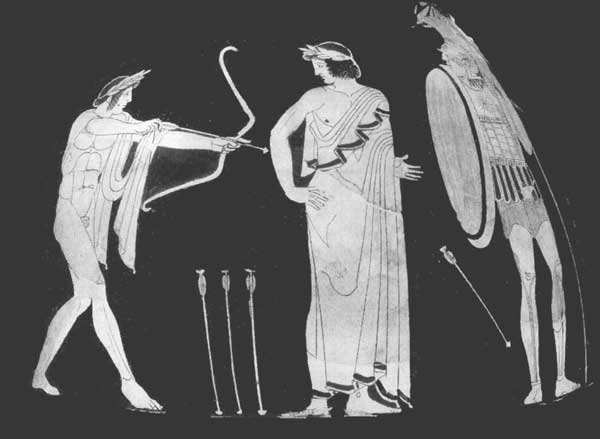
Not all vice presidents have been merely ridiculous.  Some have combined ridiculousness with signs of true dignity.  Richard Mentor Johnson, no relation to Andrew, served as vice president from 1837-1841, when Martin Van Buren was US president.  Richard Johnson’s great qualification for public office was his claim to have fired the bullet that killed the Shawnee chief Tecumseh at the battle of Tippecanoe.    The slogan “Rumpsey-Dumpsey, Rumpsey-Dumpsey, Colonel Johnson killed Tecums-ee” gave more credit for a single lucky shot than any marksman had received since Paris planted an arrow in Achilles’ heel.
So much for the ridiculous part of Johnson’s life.  His personal life was where the dignity crept in.  In the words of the US Senate’s official history:
Johnson was reelected to a full Senate term in 1822 but in 1828 lost his reelection bid because Kentucky Democrats feared that controversy over his domestic life would jeopardize Jackson’s chances in the national election. Johnson never married. Family tradition recounts that he ended an early romance, vowing revenge for his mother’s interference, after Jemima Johnson pronounced his intended bride unworthy of the family. He later lived openly with Julia Chinn, a mulatto slave raised by his mother and inherited from his father, until her death from cholera in 1833. Johnson freely acknowledged the relationship, as well as the two daughters born to the union, and entrusted Julia with full authority over his business affairs during his absences from Blue Spring Farm.
This relationship was not without cost for Johnson.  To quote the official Senate history again, this time with reference to the reaction presidential candidate Martin Van Buren met when he chose Johnson as his running mate:
Van Buren’s ally Albert Balch had previously warned Jackson that “I do not think from what I hear daily that the nomination of Johnson for the Vice Presidency will be popular in any of the slave holding states except Ky. on account of his former domestic relations,” and a Van Buren correspondent later predicted that “Col. Johnson’s . . .  weight would absolutely sink the whole party in Virginia.” Tennessee Supreme Court Chief Justice John Catron warned Jackson that Johnson was “not only positively unpopular in Tennessee . . .  but affirmatively odious” and begged the president “to assure our friends that the humblest of us do not believe that a lucky random shot, even if it did hit Tecumseh, qualifies a man for the Vice Presidency.” He predicted that “the very moment Col. J. is announced, the newspapers will open upon him with facts, that he had endeavored often to force his daughters into society, that the mother in her life time, and they now, rode in carriages, and claimed equality.”
Van Buren’s friend may have been right about Virginia; that state’s electors refused to vote for Johnson, throwing the 1836 vice presidential election into the Senate.
*Phoenix, Arizona, that is

The Nation and the metropolis

A review of Frances Stonor Saunders’ book about Violet Gibson, the Englishwoman who shot Benito Mussolini in 1926, includes this passage:

[A]ccording to the British ambassador to Italy, Mussolini was “like any other gentleman.” The King of England decorated him with the Order of the Bath, and Austen Chamberlain, the British foreign secretary (whose half brother was Neville, future prime minister and champion of the Munich accord), considered Mussolini a sincere, charming patriot, and certainly preferable to any other “Italian.” Sure he was a dictator, the foreign secretary admitted, but one simply could not “apply British standards to un-British conditions.” As Saunders acidly comments, Chamberlain’s remark “contained all the narrowness and smugness of an imperial conceit.”

I’ll grant that saying one cannot “apply British standards to un-British conditions” may have been an imperial conceit when it was used to keep agents of the British Empire from being held to account for actions they took in Britain’s colonies.  I would not agree that such a remark is also an imperial conceit when it is said in the course of an argument to the effect that the UK should not pursue a policy of confrontation with another state.  Indeed, to call on one state to take an interest in the internal affairs of another state is to meet any definition of imperialism.  Many have said the the function of ideology is to enable a person to hold two contradictory ideas simultaneously; that Saunders can say, in evident sincerity and to the approbation of The Nation‘s reviewer, that to defer to the sovereignty of a foreign state is to be an imperialist, shows the ideological power of liberal internationalism.   Certainly Mussolini’s regime was unjust; perhaps there might be a case to make that Britain and other world powers should have embarked on an adventure in the 1920s to coerce Italy into good behavior.  Not too long ago, neoconservatives like William Kristol openly described the US invasion of Iraq as an imperial project, a project which they claimed was justified because Saddam Hussein was so wicked a tyrant.  Kristol would likely have endorsed the idea of an international campaign to bring Mussolini in line as well.  Harsh as Kristol’s words may have been, at least they had some recognizable meaning.  One could rebut Kristol by arguing against imperialism.   Saunders and liberal interventionists like her are worse than Kristol, in that their ideology has drained words of all meaning and rational argument of all purpose.   

There’s a review essay about Jane Jacobs.  Unless you’re familiar with Jacobs’ work, skip it.  It seems to be an attempt to counterbalance the usual portrayal of Jacobs as a critic of urban gigantism and an advocate of self-sufficient neighborhoods by summarizing her view of the advantages big cities offer their residents.  That’s fine up to a point, but the essay goes so far with it as to leave the impression that Jacobs was an uncritical booster of the big city.

Jo Ann Wypiewski’s been thinking about the dilemmas facing same-sexers who would like to live openly in places where that isn’t easy:

“For the longest time, the gay movement told people in rural areas, Just move to the city and come out,” Joe said afterward. He was raised in Oil City, and one sister still won’t talk to him. “That’s not an answer if you’re connected to your family, your job, your town. And you can’t expect oppressed individuals to take the whole burden of coming out on themselves.”

A friend of ours, a man in late middle age, spent much of the 1960s in Berkeley, California.  He often fondly recalls the evening he spent in the city jail with Mario Savio’s cousin.  When someone of the “Baby Boom” generation tells a story about an adventure s/he had in The Turbulent Sixties, I tend to react with a reflexive scepticism.  That’s why I cherish that story.  If he had claimed to have spent a night in jail with Mario Savio, I would find it impossible to believe him.  If he had claimed to have spent a night in jail with  Abbie Hoffman’s cousin, I would have found it impossible to believe him.  But Mario Savio’s cousin– who would make that up?  Mario Savio is a name that will impress too few people these days to figure obliquely in any fictional boast.  Only a direct encounter with the man himself could win anyone any points for a brush with celebrity, and then only if the audience were rather well informed about the fine details of the New Left. 

So I smiled warmly while I read a review essay about Savio.  It doesn’t mention Savio’s cousin, but you can’t have everything. 

The “teabaggers” are a group of right-leaning Americans who have been making headlines for the last year or so by sending teabags to their elected officials as a symbol of political protest.  The teabags are supposed to be reminders of the revolutionary spirit of the 1773 Boston Tea Party.  They didn’t have teabags in 1773, but then cloth sacks filled with tea would cost a lot in postage, so I suppose it’s all right.  One Bostonian, perhaps trying to bring matters full circle, claimed to see the Virgin Mary in a teabag.  The teabaggers have also made news by disrupting public appearances by members of Congress.  Most left-of-center Americans have been unhappy with the rise of the teabaggers.  Alexander Cockburn, however, sees much to admire in their movement.  He sees an anarchistic side to it, and sympathizes with its petit-bourgeois members:

The lower middle class is what we’re focusing on here, the people who own auto repair shops, bakeries, bicycle shops, plant stores, dry cleaners, fish stores and all the other small businesses across America–in sum, the “petite bourgeoisie,” stomped by regulators and bureaucrats while the big fry get zoning variances and special clause exemptions. The left always hated the petite bourgeoisie because it wasn’t the urban proletariat and thus the designated agent of revolutionary change. Today’s left no longer believes in revolutionary change but despises the petite bourgeoisie out of inherited political disposition and class outlook. Ninety-five percent of all the firms in America hire fewer than ten people. There’s your petite bourgeoisie for you: not frightening, not terrifying and in fact quite indispensable.

And the petit bourgeois are legitimately pissed off. Whatever backwash they got from the stimulus often wasn’t readily apparent. They can’t afford health plans for themselves or their employees. They’re three or four payrolls away from the edge of the cliff, and when they read about trillions in handouts for bankers, trillions in impending deficits, blueprints for green energy regs that will put them out of business, what they hear is the ocean surge pounding away at the bottom of that same cliff.

The conventional parties have nothing to offer them. The left disdains them. But here comes the tea party.

Cockburn likes some weird things, but maybe he’s onto something here.  If New York Times pundit David Brooks is afraid of the teabaggers, they must be doing something right.     

A straw poll at the Conservative Political Action Committee shows that while grassroots Republicans don’t like the Obama administration, they sure don’t want to go back to the Bush-Cheney days.  They oppose many of the same things lefties oppose.  One suspects that a genuinely populist American Left might be able to make common cause with them on issues from antimilitarism, to monetary reform, to civil liberties. 

I make my living teaching ancient history, so I take notice when I hear that historians are under fire.  Jon Wiener’s article about historians who have come into contact with the tobacco industry thus came to me as something sobering.  Over the years, many historians have been intimidated into silence by the industry and its lawyers.  Many others have been corrupted by tobacco money, making misleading statements in the  press and in the courts and then benefiting from tobacco-linked donations. 

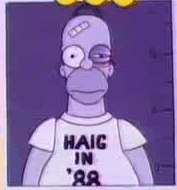
General Alexander Haig died earlier this year, a fact that occasions some doggerel from Calvin Trillin.  I remember when Haig ran for president in 1988; Haig’s name had long been familiar, but neither I nor any of my political-junkie friends ever imagined he would run for president.  As a top-level army staff officer, later as Richard Nixon’s top aide, then NATO’s Supreme Commander, and finally as US Secretary of State, Haig was a symbol of the Washington elite, but not a leader who had a following outside the capital.  We weren’t alone in laughing at Haig; his whole campaign turned into a bit of a joke.  A joke that could still garner laughs years later, as this still from The Simpsons shows:

Listen to the soundtrack in the last two seconds

For the last couple of weeks I’ve been trying to find a video of this that was viewable in the states, only to discover that a link to this one was posted on UOGBFans all along.  I suppose that’s what I get for looking everywhere but the obvious place:  

Where Volkswagens Come From

Via Weirdomatic:

Yin and Yang

Terrible Freedom

Yesterday’s Ferd’nand strip:

Ferd'nand, 16 March 2010

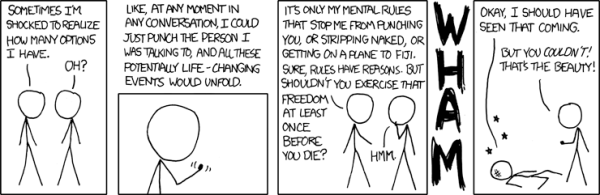
I wrote something here several weeks ago remarking on a tendency I’ve observed in myself.  I’ve often thought that the reason I’m more relaxed outdoors in a natural setting than inside my apartment or my office is that when I’m in a space that belongs to me, my eye constantly lights on things I might control, or that I have controlled, or that I should control.  There’s the computer; I might control that, and do any number of things.  There’s a bookcase; I bought those books and put them into order on the shelves.  There’s a pile of papers; I should file them in an orderly way.  Outdoors, I see the trees, the soil, the sky; they get along quite all right without my control.  I’m glad to see I’m not the only one who is bothered by an urge to take control of my environment, to put things in order.   

Here’s an xkcd from a couple of weeks ago:

xkcd 706

This also reminds me of something I’ve observed in my own psychology.  Many years ago, I was in the dentist’s chair, having a cavity filled.  They didn’t give me one of those contour pillows that usually cradles your neck at the dentist’s.  I became aware that I could, if I wished, turn my head abruptly to one side or the other and cause myself great pain.  Not that I wanted to do that, of course, but the sensation of freedom, the realization that nothing was stopping me from doing that, was quite unsettling.  Back in 2007, Keith Knight did a whole cartoon about just this point:

Click for full size

One of our first posts on Los Thunderlads was a link to this strip.  That post is titled “The Imp of the Perverse,” a nod to Edgar Allan Poe’s story of the same name.  Poe’s story includes these paragraphs:

We have a task before us which must be speedily performed.  We know that it will be ruinous to make delay.  The most important crisis of our life calls, trumpet-tongued, for immediate energy and action.  We glow, we are consumed with eagerness to commence the work, with the anticipation of whose glorious result our whole souls are on fire.  It must, it shall be undertaken to-day, and yet we put it off until to-morrow; and why?  There is no answer, except that we feel perverse, using the word with no comprehension of the principle.  To-morrow arrives, and with it a more impatient anxiety to do our duty, but with this very increase of anxiety arrives, also, a nameless, a positively fearful, because unfathomable, craving for delay.  This craving gathers strength as the moments fly.  The last hour for action is at hand.  We tremble with the violence of the conflict within us, – of the definite with the indefinite – of the substance with the shadow.  But, if the contest has proceeded thus far, it is the shadow which prevails, – we struggle in vain.  The clock strikes, and is the knell of our welfare.  At the same time, it is the chanticleer-note to the ghost that has so long over-awed us.  It flies – it disappears – we are free.  The old energy returns.  We will labour now.  Alas, it is too late!

We stand upon the brink of a precipice.  We peer into the abyss – we grow sick and dizzy.  Our first impulse is to shrink from the danger.  Unaccountably we remain.  By slow degrees our sickness, and dizziness, and horror, become merged in a cloud of unnameable feeling.  By gradations, still more imperceptible, this cloud assumes shape, as did the vapor from the bottle out of which arose the genius in the Arabian Nights.  But out of this our cloud upon the precipice’s edge, there grows into palpability, a shape, far more terrible than any genius, or any demon of a tale, and yet it is but a thought, although a fearful one, and one which chills the very marrow of our bones with the fierceness of the delight of its horror.  It is merely the idea of what would be our sensations during the sweeping precipitancy of a fall from such a height.  And this fall – this rushing annihilation – for the very reason that it involves that one most ghastly and loathsome of all the most ghastly and loathsome images of death and suffering which have ever presented themselves to our imagination – for this very cause do we now the most vividly desire it.  And because our reason violently deters us from the brink, therefore, do we the more impetuously approach it.  There is no passion in nature so demoniacally impatient, as that of him, who shuddering upon the edge of a precipice, thus meditates a plunge.  To indulge for a moment, in any attempt at thought, is to be inevitably lost; for reflection but urges us to forbear, and therefore it is, I say, that we cannot.  If there be no friendly arm to check us, or if we fail in a sudden effort to prostrate ourselves backward from the abyss, we plunge, and are destroyed.

Examine these and similar actions as we will, we shall find them resulting solely from the spirit of the Perverse.  We perpetrate them merely because we feel that we should not.  Beyond or behind this, there is no intelligible principle.  And we might, indeed, deem this perverseness a direct instigation of the Arch-Fiend, were it not occasionally known to operate in furtherance of good.

I’m no psychologist, but I wonder if there is a connection between the urge to take control of our environment that makes Ferd’nand unable to rest if he can see his unmowed grass and untrimmed hedge-row and the impulses Knight, Poe, and xkcd’s stick figures who enjoy math describe.  Seized by the imp of the perverse, we might find ourselves doing any of an endless list of things.  If we act “merely because we feel that we should not,” there is no telling what we might do.  Likewise, at the first moment we are seized by the urge to take control of our environment our subsequent behavior is highly unpredictable.   If we act merely because we feel that we should, we confront a list of possible actions that is just as endless as the list of things we should not do. 

Not only do the imp of the perverse and the urge to take control of our environment resemble each other in that we become unpredictable when we first succumb to either; they resemble each other also in their characteristic outcome, which is that we accomplish nothing.  Occasionally the imp of the perverse may lead us all the way off the precipice, all the way to punch the other person, all the way to scream from the audience during the stage play; but far more often we simply shift in our seat, uncomfortable to recognize such an urge in ourselves.  And occasionally the urge to take control of our environment will lead us to complete one task after another and put a space into good order; more often, I would say, it distracts us from each task, preventing us from completing anything satisfactorily.

The American Conservative, April 2010

Pluto, no other label needed

My favorite read from the antiwar Right has undergone quite a few changes since it began in 2002.  Founding editors Pat Buchanan and Taki Theodoracopulos are long gone from The American Conservative, and the hard line those men have taken against immigration from poor countries to rich ones is no longer the magazine’s editorial policy.  Last year, the magazine scaled its publication schedule back from biweekly to monthly.  This issue suggests that some further changes are underway. 

For one thing, the editors seem to want short pieces to end with pungent epigrams.  So Stuart Reid’s column about Peter Hitchens’ less interesting brother praises him for the the fine satires he directed at self-important British Conservatives in the 1970s (Reid ruefully admits that he himself met Peter Hitchens’ brother’s sardonic descriptions perfectly at the time) and praises him also for a 1986 piece arguing that the word “terrorism” should be discarded as worse than useless.  Reid laments that Peter Hitchens’ brother has now become an angry voice calling for endless war and jeering at advocates of peace.  The pungent epigram at the end is this:

Some people say that Hitchens himself is now a conservative.  That is absurd.  But he might one day make a great police chief.

Eve Tushnet’s column about the contrast between “Washington the dateline,” where the US government is headquartered, and “DC the hometown,” where she grew up and lives today, also ends with a pungent epigram: “Official Washington can disappoint you, but only home can break your heart.” 

Not only is the magazine’s style changing; there are signs of further shifts on poitical issues.  A review of a new book by former Texas Republican Party leader Tom Pauken notes Pauken’s case for replacing many federal taxes with a border-adjusted Value Added Tax, a proposal that the magazine has looked on warmly in many pieces in previous issues.  This time around, the response is much cooler, even dismissive: “Would the harm to consumers be offset by the benefits to producers?  Even if so, it’s hard to imagine the consuming many making that sacrifice on behalf of the producing few.”  Perhaps it is hard to imagine, but I would join Pauken in saying that something like it must happen if the “producing few” are not to go on becoming fewer and fewer.   

Not everything about the magazine has changed, however.  Bill Kauffman’s column closes with his characteristic assertion that “small really is beautiful.”  The smallness he discusses is that of the planet Pluto and the resources available to its discoverer, the unlettered 24 year old farm boy Clyde Tombaugh.  Tombaugh’s formal education had ended, apparently forever, when he graduated from high school; there was no money to send him on to college.  Toiling in his family’s pasture, he built his own telescope and spent nights drawing freehand sketches of Mars and Jupiter.  On a whim, Tombaugh sent these sketches to Lowell Observatory in Flagstaff, Arizona.  The observatory operated on a shoestring budget; when its director saw Tombaugh’s sketches, he seized the opportunity to hire someone who might be capable of the drudgery involved in searching for a hypothetical “Planet X” beyond the orbit of Neptune.  After Tombaugh spotted Pluto on a series of photographic plates, he was awarded a scholrship to the University of Kansas, and began a distinguished academic career.   Kauffman points out that in a properly funded observatory today, “a 21st century Clyde Tombaugh would be wearing a hairnet and ladling mac and cheese in the cafeteria.”   I suspect that a 21st century Tombaugh would likely have qualified for a scholarship to the University of Kansas without having to discover a planet first, but Kauffman does have a point.  The bureaucratization of science, like bureaucratization generally, may be the road to efficiency, but there’s something to be said for the independent, uncredentialled researcher. 

I can’t resist mentioning that the Believer (aka Mrs Acilius) takes a keen personal interest in Pluto.  I read this piece to her; when I got to the bit where Kauffman says that the officials of the International Astronomical Union who in 2008 decided to reclassify Pluto as a dwarf planet were a group of “costive bastards,” she let out a war whoop that would have done her Cherokee forebears proud.  She was not satisfied with Kauffman’s conclusion that the label “dwarf planet” might “be okay” because “small really is beautiful,” however.  She wants it back on the list of full-fledged planets. 

The theme that “small is beautiful” comes up in another piece, Patrick Dineen’s “Counterfeiting Conservatism.”  Dineen traces many evils back to the introduction of primary elections in the USA in the early decades of the 2oth century.  While primaries were supposed to break the grip of political elites on the nominating process, in fact they merely replaced the old elite of local party bosses with a new elite of political professionals who operate on  a national scale.  This development has in turn led to the nationalization of elections, the rise of partisan ideology, and a new concept of patriotism.  Where a 19th century American might have thought of patriotism in terms of loyalty to a particular state and reverence for particular historical figures, the nationalized politics of the 2oth century pushed Americans to identify patriotism with enthusiasm for the nation-state and its expansion. 

I should also note a report on current US politics.  There’s an antiwar candidate running for US Senator from Indiana.  That isn’t the likely Democratic nominee, Congressman Brad Ellsworth of Evansville, but his predecessor in the US House, Republican John Hostettler.  Hostettler opposed the Iraq War from the beginning, and even wrote an antiwar book.  If Hostettler wins his party’s nomination, Indiana will see a conservative, prowar Democrat squaring off against an even more conservative, antiwar Republican in November.  I wonder how the Indiana contingent of Thunderlads will react to that choice.

The strong do what they will, and the weak suffer what they must

Thucydides wouldn't have been surprised


The February 16-February 28 issue of Counterpunch looked at various statements about international law that have come from offices of the Israeli Defense Forces in the last few years and found in them a systematic disregard for the concept of international law.  These statements, the author of the piece argues, are part of a campaign to render international law irrelevant to the conflicts in Israel/Palestine, and as such represent a threat to the entire project of international law.  The blub on the front of the newsletter asks us to “Imagine an entire world unprotected against occupation, invasions, exploitation, and warehousing, a global Gaza!” 

I would suggest that such a feat of imagination might be rather easy to achieve.  The whole history of mankind, from the earliest records to the present moment, offers us the spectacle of precisely such a world.  International law no more protects the weak against the depredations of the powerful today than appeals to justice protected the Melians against Athens in 416 BC.  

Thucydides’ story of the Peloponnesian Wars summarizes my habitual view of “international law,” in his day and ours.  Writing of the events that had led to the outbreak of war between Athens and Sparta in 431 BC, Thucydides concluded that the main cause of the war was the rising power of Athens and the fear with which the other Greeks viewed that power.  After ten years of desperate struggle, the Spartans and their allies brought Athenian power to a standstill.  A series of negotiations concluded in 421 BC brought the first phase of the war to an end.  Thucydides devotes much of Book 5 of his History to the detailed legalistic language of the treaties of this year known under the name “The Peace of Nicias.”  Thucydides’ decision to devote so much of his text to these documents puts a heavy emphasis on the treaties and their legalism.

Had the History ended there, one might have imagined it to tell a story of the triumph of law in human affairs.  What in fact follows, however, shows that nothing of the kind happened.  The Peace of Nicias was not at all satisfactory, involving frequent confrontations between proxies of Athens and Sparta and occasional battles between Athenian and Spartan forces.  When, five years into that period of  tension, the people of Melos tried to break their alliance with Athens, the Athenians sent envoys to hear the Melians’ case.  The Melians appealed to justice and to the legal principles encoded in the treaties of the Peace of Nicias.  The Athenians responded that “The strong do what they will and the weak suffer what they must.”  When the Melians appealed to notions of legality, the Athenians responded that these obtain among equals, while in cases where one party is far stronger, the other must submit and make the best of submission.  The law that prevails among states is not the sort of law agitated in courts, but a law of nature.  “Of the gods we believe, and of men we know, that by a necessary law of their nature they rule wherever they can. And it is not as if we were the first to make this law, or to act upon it when made: we found it existing before us, and shall leave it to exist for ever after us; all we do is to make use of it, knowing that you and everybody else, having the same power as we have, would do the same as we do” (Rex Warner’s Penguin Classics translation.)     

The Athenians would destroy Melos, killing its men and selling the women and children as slaves.  Thucydides leaves us to find justice for the Melians in another sort of natural law.  The next topic he turns to is Athens’ invasion of Sicily, a military adventure that would cost Athens tens of thousands of men, virtually its entire fleet, and its hopes of winning the second phase of the Peloponnesian Wars.  By 404 BC, the Athenians would be defeated, as abjectly at the mercy of Sparta as the Melians had been at their own mercy 12 years before.  The ancients Greeks believed that power bred arrogance, that arrogance bred folly, and that folly brought the mighty low. 

The Greeks tended to describe this process in mythological terms, attributing it to the jealousy of the gods.  By laying out a narrative in that traditional form without  dwelling on the gods in his own voice, Thucydides was able to gain a reputation as the first scientific historian.  Whether science can discern in history a pattern of power leading to arrogance leading to folly leading to downfall, the idea of such a pattern is at least as likely to be comforting to the victims of power as are any of the lawyerly fairy tales told at the Hague and in the headquarters of the United Nations. 

As for the case of Israel/ Palestine, the idea of international law may at times have had a gentling effect on the Israeli state.  On the one hand, it may have given the Israeli leadership a set of criteria they had to meet if they were to be assured of a smooth flow of operations in their relations with the outside world.  And now and then, some Israelis may have seen in the promise of international law something they could rally around, something to soften the harsher angles of Zionism.  So whatever limitations there might be in the prospects for international law as an actual force  that could protect the weak “against occupation, invasions, exploitation, and warehousing,” and however much the spectacles that we now call “international law” might disgust us, still we might wish that it will go on.

The Religious Case Against Belief

James P Carse

I like book catalogs, so it’s always one of the high points of the month for me when Edward Hamilton Bargain Books shows up in the mailbox.  Lately I’ve been intrigued by a 2008 title, The Religious Case Against Belief, by James P. Carse.  When I say I was intrigued by the title, I mean precisely that.  There are several ideas that might go under that label, so I wanted to know what it was Carse was saying.  So I looked the book up online and came upon this interview Carse gave to Salon when the book came out.   Here’s a bit that seems to sum up his big idea:

In your book, you say the only defining characteristic of religion is its longevity. It has to be around for a very long time to qualify as a religion.

Exactly. That’s a very interesting contrast with belief systems. Belief systems have virtually no longevity. Think of Marxism. As a serious political policy, it lasted only about 70 or 80 years. Nazism only went 12 years. And they were intense, complete, comprehensive, passionately held beliefs. But they ran out very quickly. The reason the great religions don’t run out as quickly is that they’re able to maintain within themselves a deeper sense of the mystery, of the unknowable, of the unsayable, that keeps the religion alive and guarantees its vitality.

Carse seems to be saying that the main thing that’s praiseworthy about religion is that it binds one generation of people to other generations.  Belief systems can’t do that, at least not beyond a few generations and certainly not without a great risk that the militant ignorance needed to sustain the system will do less to bring people together than to drive them apart and to bring in elements of intimidation that will poison such relationships as they do maintain.  So Carse’s case seems to rest on an appeal to use rituals, stories, and a sense of awe to lower the barriers that separate one person from another. 

Carse was for 30 years a professor of religious studies at New York University; his case sounds like the sort of plea a kindly old scholar might make to the world at the end of such a career.  He maintains a fine blog, and is an accomplished photographer.  I hope to be a kindly old scholar myself someday, I blog, and I appreciate photography.  So I admire Carse and wish him well. 

Another idea that I thought a book called The Religious Case Against Belief might put forward is one that’s been on my mind as I’ve tagged along with Mrs Acilius to her Quaker meeting every Sunday.  Many Quakers, like other mystics, distrust language and say that they seek a knowledge that cannot be confined to the words of human speech.  So Quakers have historically resisted the formulation of creeds and litanies.  Dogmatic theology has little place in the history of Quakerism.  Quakers might quote Thomas á Kempis with approval, when he wrote in the Imitation of Christ that he was grateful for his education because it had freed him from a multitude of opinions.  It would seem logical for a mystic of the Quaker stamp to take Thomas a step further, and to define religion, not as a set of beliefs, but as a set of practices that free a person from the power that beliefs formulated in language might have over his or her mind.

How rumors get started, nowadays

Here is a fascinating account of how a group of people shut up in a room together managed, within 26 minutes, to start a rumor that made national news.

The “Academic We” again

From a brief interview with Martha Nussbaum on The Nation‘s website.  Speaking of various things people say when they are trying to come up with arguments against same-sex marriage, Nussbaum says:

Then there’s finally the argument that legalizing same-sex marriage will degrade or defile straight marriage. What’s that about? It looks something like the claim that admitting all these baseball players who use steroids to the Hall of Fame would degrade the achievements of the genuine competitors. It taints the achievement. But what can that be about? We don’t think that heterosexuals who are flaky, silly or awful, Britney Spears marrying on a whim and then divorcing almost immediately, we don’t think that that taints the institution of heterosexual marriage.

I share Nussbaum’s puzzlement that opponents of same-sex marriage have offered such a poor array of arguments to defend their stand.  You’d think that with all the financial and political resources on their side they might have come up with something that at least took some work to disprove, yet what they’ve come up with is simply preposterous.  My quarrel is not with Nussbaum’s position on this issue, but with the last sentence of the section I’ve quoted. 

That sentence here features what I like to call “the Academic We.”  I suppose everyone is familiar with the Royal “We“, first-person plural pronouns monarchs use to refer to themselves when they are speaking in their official capacity.  And there is the Editorial “We,”  which editorialists use when expressing the official position of their publications.  In a case of the Academic “We,” a college professor uses first person plural pronouns when characterizing the current state of knowledge or opinion among some unspecified group of people. 

Who exactly is in Nussbaum’s “we”?  Nussbaum gives so little detail about Britney Spears and her marriage that it is clear she expects the reader to know who Britney Spears is and to know the story of her marriage.  Moreover, her flat conjunction of  the words “silly, flaky, or awful” with her reference to Spears shows that she does not expect to hear from anyone who approves of what Spears did.  If everyone can be expected to know a story and no one can be expected to defend the behavior of one figure in it, clearly that story must have some moral force in the community where it is told.  To me, it would seem that the likeliest moral for a story in which a person who takes marriage lightly is represented as “silly, flaky, or awful” is that taking marriage lightly is an abuse of a valuable institution. 

Nussbaum says that when we hear arguments about institutions being debased, “We can’t understand what’s being said without going back to some kind of magical idea about stigma or taint.”  While the antigay statements Nussbaum is considering may well be examples of magical thinking, no such thinking is on display in the debate about whether to include steroid users and other notorious cheaters in the  Baseball Hall of Fame.   To people who respect baseball and who see their values reflected in its rules, excellence in baseball can be a point of pride or a source of legends.  To those for whom baseball is a foolish activity and who find its rules alien to their culture, excellence in baseball will count for nothing.  Therefore, to admit known juicers to the Hall of Fame is to cheapen the achievements of clean players. 

Baseball is a very strange example for Nussbaum to choose to illustrate her point.  One might say that there are actions that have value in themselves, apart from any particular social institution.  Perhaps the creation of a monogamous sexual relationship between people who share property and a common social identity may be such an action.  Maybe there’s something inherent in the nature of things that ordains such relationships as a telos of human virtue.  In that case, even if the people who enact such a relationship are entirely isolated from any broader community, a self-sufficient entity called “honor” might still inhere in it.  Hey, for all I know, that could be true. 

But I do know that no action performed in a baseball game is of any value apart from the rules, traditions, and social standing of baseball.  The honor that baseball players earn is solely a function of baseball as an institution.   A swing of the bat that sends a ball to one side of the foul line may be an achievement; a swing that sends it to the other side is not.  Had the institution of baseball evolved to draw the line in a different place, swings that now mean nothing would become the stuff of legend, while swings that made history would have passed unnoticed.  Indeed, the idea that honor could inhere in the achievements of Satchel Paige or Babe Ruth even in a society where the institution of baseball had lost its moral salience is a pure example of magical thinking.