

orfe.princeton.edu
orfe.princeton.edu
Posted by CMStewart on March 11, 2009
https://losthunderlads.com/2009/03/11/earth-calling-earth/
http://www.hartfordadvocate.com/article.cfm?aid=3873 The title of this article is pretty funny. In this age of “anything goes,” there are still some true-blue, bona fide perverts out there. That’s what this article is about: people with a big damn problem: perverts. I didn’t read the article carefully. Once I realized what these people were into, I surfed away. Hey, they’re perverts, and that’s their “right.” (Uh, that last bit was for A’s enjoyment.)(Hmm, I wonder if anybody will take my bait and try to defend the perverts??)
Posted by lefalcon on March 10, 2009
https://losthunderlads.com/2009/03/10/hell-hath-no-furries/
Photographer Walker Evans collected picture postcards, and the Metropolitan Museum of Art is exhibiting them. Here’s one:

Evidently Calvin Trillin reads Los Thunderlads. Here’s the first half of this week’s doggerel:
Republicans had hoped they might rekindle
Their party’s prospects through one Bobby Jindal.
But Jindal proved an easy man to mock
(He’s like the dorky page on 30 Rock).
Below find an excerpt from an article headlined “America is #… 15?” by Dalton Conley.  The article is about the Human Development Index, or HDI, a statistic that has since 1990 been used to gauge the relative well-being of people in various countries. The American HDI was released for the first time last year. As the article puts it, “The score consists of three dimensions: health, as measured by life expectancy at birth; access to knowledge, captured by educational enrollment and attainment; and income, as reflected by median earnings for the working-age population.” The HDI was first developed by Pakistani economist Mahbub ul Haq to enable humanitarian aid groups and development economists to gauge the relative well-being of people in poor countries. “With some slight adjustments, the index was retrofitted to work for rich countries,” and the results for the USA are quite disturbing.
Posted by acilius on March 9, 2009
https://losthunderlads.com/2009/03/09/the-nation-23-march-2009/

An empty church
Today the new American Religious Identification Survey is to be released.
Below are two newspaper pieces about the survey. The first article appeared in today’s Washington Post and went out over the AP. The byline was Michelle Boorstein. I think the key sentence is “The only group that grew in every U.S. state since the 2001 survey was people saying they had “no” religion; the survey says this group is now 15 percent of the population”:
The percentage of Americans who call themselves Christians has dropped dramatically over the past two decades, and those who do are increasingly identifying themselves without traditional denomination labels, according to a major study of U.S. religion being released today.
The survey of more than 54,000 people conducted between February and November of last year showed that the percentage of Americans identifying as Christians has dropped to 76 percent of the population, down from 86 percent in 1990. Those who do call themselves Christian are more frequently describing themselves as “nondenominational” “evangelical” or “born again,” according to the American Religious Identification Survey.
The survey is conducted by researchers at Trinity College in Hartford, Conn., and funded by the Lilly Endowment and the Posen Foundation. Conducted in 1990, 2001 and last year, it is one of the nation’s largest major surveys of religion.
The increase in people labeling themselves in more generic Christian terms corresponds strongly with the decline in people identifying themselves as Protestant, the survey found. People calling themselves mainline Protestants, including Methodists and Lutherans, have dropped to 13 percent of the population, down from 19 percent in 1990. The number of people who describe themselves as generically “Protestant” went from approximately 17 million in 1990 to 5 million.
Meanwhile, the number of people who use nondenominational terms has gone from 194,000 in 1990 to more than 8 million.
“There is now this shift in the non-Catholic population — and maybe among American Christians in general — into a sort of generic, soft evangelicalism,” said Mark Silk, who directs Trinity’s Program on Public Values and helped supervise the survey.
The survey substantiated several general trends already identified by sociologists: the slipping importance of denomination in America, the growing number of people who say they have “no” religion and the increase in religious minorities including Muslims, Mormons and such movements as Wicca and paganism.
The only group that grew in every U.S. state since the 2001 survey was people saying they had “no” religion; the survey says this group is now 15 percent of the population. Silk said this group is likely responsible for the shrinking percentage of Christians in the United States.
Posted by acilius on March 9, 2009
https://losthunderlads.com/2009/03/09/fewer-americans-identify-with-established-religious-groups/

Tim Edwards
Posted by CMStewart on March 9, 2009
https://losthunderlads.com/2009/03/09/pimp-thi-bum/
Posted by CMStewart on March 6, 2009
https://losthunderlads.com/2009/03/06/mental-illness-and-criminal-responsibility/
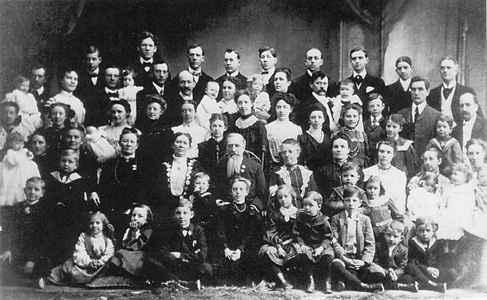
A quiet evening at home
In a comment thread elsewhere on the blog, Cymast, LeFalcon, and I have had a thought-provoking discussion about the concept of extended family. So I decided to post these remarks Kurt Vonnegut, Jr made in his commencement address at Agnes Scott College in Georgia in 1999. You may recognize the passage; it has been widely quoted. It’s still one of the first things I think about when the topic of extended family comes up, so here it is.
OK, now let’s have some fun. Let’s talk about sex. Let’s talk about women. Freud said he didn’t know what women wanted. I know what women want. They want a whole lot of people to talk to. What do they want to talk about? They want to talk about everything.
What do men want? They want a lot of pals, and they wish people wouldn’t get so mad at them.
Why are so many people getting divorced today? It’s because most of us don’t have extended families any more. It used to be that when a man and women got married, the bride got a lot more people to talk to about everything. The groom got a lot more pals to tell dumb jokes to.
A few Americans, but very few, still have extended families. The Navahos. The Kennedys.
But most of us, if we get married nowadays, are just one more person for the other person. The groom gets one more pal, but it’s a woman. The woman gets one more person to talk to about everything, but it’s a man.
When a couple has an argument nowadays, they may think it’s about money or power or sex, not how to raise the kids, or whatever. What they’re really saying to each other, though, without realizing it, is this:
”You are not enough people!”
I met a man in Nigeria one time, an Ibo who had six hundred relatives he knew quite well. His wife had just had a baby, the best possible news in any extended family.
They were going to take it to meet all its relatives, Ibos of all ages and sizes and shapes. It would even meet other babies, cousins not much older than it was. Everybody who was big enough and steady enough was going to get to hold it, cuddle it, gurgle to it, and say how pretty is was, or handsome.
Wouldn’t you have loved to be that baby?
I sure wish I could wave a wand, and give every one of you an extended family – make you an Ibo or a Navaho – or a Kennedy.
Posted by acilius on March 5, 2009
https://losthunderlads.com/2009/03/05/kurt-vonnegut-jr-on-extended-families/
Posted by CMStewart on March 5, 2009
https://losthunderlads.com/2009/03/05/vulcanic-martians/
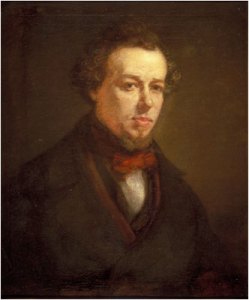
A review of Adam Kirsch’s biography of Benjamin Disraeli focuses on Kirsch’s idea that because Disraeli realized he could not stop his fellow nineteenth-century Englishmen from thinking of him primarily in terms of his Jewish ancestry, he “did not attempt to disguise his Jewish background. He embellished it.” Disraeli purported to be far more deeply involved with that side of his ancestry than he in fact was, even explaining his active membership in the Church of England as an example of his fealty to “the only Jewish institution that remains… the visible means which embalms the race.” Meanwhile, the Jewish characters and themes in Disraeli’s novels appall modern sensibilities. Sidonia, a character in the Young England trilogy (Coningsby, Sybil, and Tancred,) “looks like nothing so much as an anti-Semitic hate figure. It is amazing, in fact, how Disraeli manages to combine in this one character every malicious slander and paranoid fear that the anti-Semitic imagination can breed.” Disraeli’s manipulation of the label his fellows had imposed upon him enabled him to become prime minister of the United Kingdom. Disraeli’s ability to “outline [an] agenda of radical change to be achieved conservatively, a political program that allowed him to reinvent himself as the representative not only of the wealthy and the working class but of the Tory Party, too” has inspired rightist politicians like Richard Nixon and the neocons.
If Kirsch is right, Disraeli knotted his contemporaries’ perceptions of him around their image of “the Jew,” using their prejudices to transform himself from a marginal figure unlikely to make a mark in politics into a figure of England’s national mythology. Another complex of ideas twists around another such image in Brendan O’Neill’s analysis of the thoughts of some of Israel’s more fervent defenders in the West. O’Neill argues that the individuals he cites are less interested in Israel as an actual place inhabited by living people than they are in using a particular idea of Israel as a symbol for the values of the Enlightenment. “In effect, Israel is cynically, and lazily, being turned into a proxy army for a faction in the Western Culture Wars that has lost the ability to defend Enlightenment values on their own terms or even to define and face up to the central problem of anti-Enlightenment tendencies today.” This use of Israel as a pawn in cultural struggles centered elsewhere shades into philosemitism. “[A]s Richard S. Levy writes in his book Anti-Semitism: A Historical Encyclopedia of Prejudice and Persecution, simple philosemitism, like anti-Semitism, also treats the Jews as ‘radically different or exceptional’… Where anti-Semites project their frustrations with the world and their naked prejudices onto the Jews, and frequently onto Israel, too, the new philosemites project their desperation for political answers, for some clarity, for a return to Enlightenment values onto Israel and the Jews. Neither is a burden the Jewish people can, or should be expected to, bear.”
Posted by acilius on March 4, 2009
https://losthunderlads.com/2009/03/04/the-american-conservative-9-march-2009/
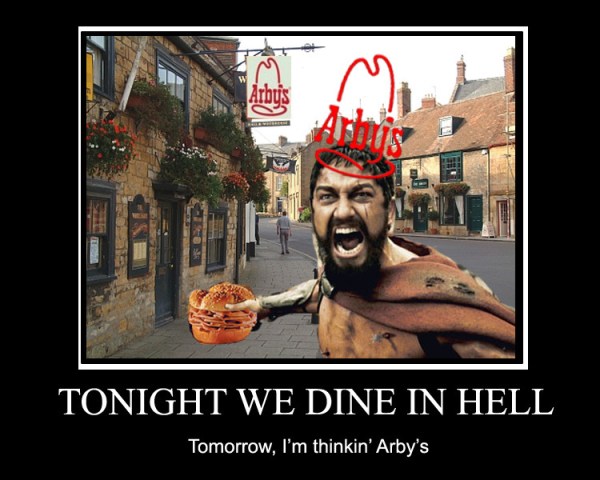
doesn’t make much sense: why’s he holding that sandwich if he’s planning on Arby tomorrow ??
Posted by lefalcon on March 1, 2009
https://losthunderlads.com/2009/03/01/2475/


 acilius
 believer1
 lefalcon
 losthunderlads
 vthunderlad
 Panther Red