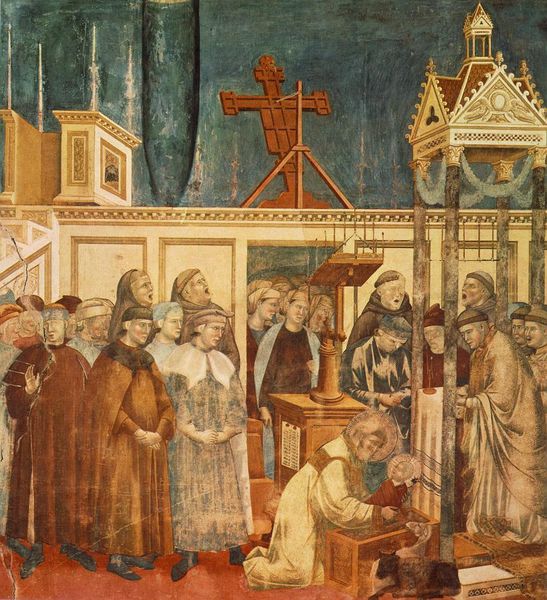
Giotto painting reproduced on the cover of this issue
(image)
Three articles about Christmas in this issue of Chronicles. Editor Thomas Fleming, who I seem to recall occasionally describes himself as having been raised an atheist, then converted to arch-traditional Roman Catholicism, describes in the third person the attitudes of an unnamed man who was raised anatheist, then converted to arch-traditional Roman Catholicism. As a boy, this anonymous person disliked Christmas. The months-long buildup, the morning moments unwrapping toys that could never live up to the expectations that buildup engendered, the endless anticlimax of the day as of adult relatives hung on and bored him with their chatter. Far better Halloween, an ordinary day that ended with a burst of total anarchy. As he grew, he preferred the moral atmosphere of Halloween to that of Christmas. The Christians he knew pretended that death was nothing to be afraid of and embedded that pretense into the holiday, while Halloween began by taking the cold terror of death and everything touching death for granted. Evidently this preference remains with him in his religious phase, as the terror of death gives Easter its power.
Contributor Thomas Piatak defends Christmas, not against the severe theology of Fleming, but against opponents of public piety at Christmastime. Apparently it was Piatak who coined the phrase “The War Against Christmas.” While Fleming inveighs against a religious Christmas that soft-pedals or denies the hard truths of lifeand thus denatures Christianity, Piatak fears a secular Xmas that is “devoid of religious or cultural significance or indeed of beauty, with nothing left but multiculturalist pap and tawdry sentimentalism.” As examples of this creeping insipidity, Piatak cites a case in Columbus, Ohio in 2003, when the school district banned a performance of Handel’s Messiah unless equal time were given to “Frosty the Snowman” and “Jingle Bells.”
Columnist Aaron D. Wolf has little use for the idea of a secular “War Against Christmas,” though he does agree that such a thing exists. He tells us of wishing a store clerk “Merry Christmas.” “She looks directly at me, smiling, eyes narrowed, and nods. “Yes. Merry CHRISTMAS!”… It wasn’t a bright, elven (sic) “Yes! Merry Christmas!” She spoke with a knowing, in your face, liberal America air of defiance.” Later: “That Merry Christmas seemed more like a countercultural protest statement, that kind that says, yeah, you’re one of us, or yeah, I’m one of you. One of you… what? Believers in Christ Jesus? … Or perhaps it was one of you proud white Americans.” Wolf’s suspicion that many of those most exercised about the “War Against Christmas” are in fact not very much devoted to Christ at all, but are only interested in sticking it to educated secularists, gains verisimilitude from the high December sales of mugs bearing the slogan “Don’t be a Pinhead.”

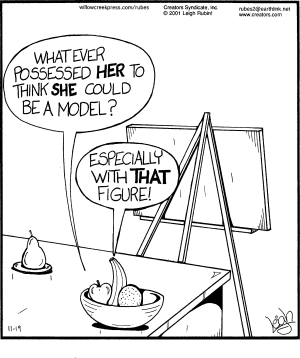
 I’ve never objected to corny jokes, and



 acilius
 believer1
 lefalcon
 losthunderlads
 vthunderlad
 Panther Red