 I’ve been reading an article about a school of Islamic mystical philosophy called “unity of existence.” Their position on the nature of existence is neither entirely monist nor entirely dualist, but rather something in-between.
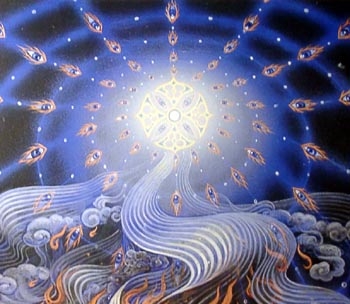
The starting point of their position is that, in our conventional perception of reality, we tend to see lots and lots of discrete things or forms, i.e. multiplicity. Metaphorically speaking, we are seeing the images of things in the mirror of the Absolute.
However, it’s possible for someone to have a mystical experience wherein their ego-consciousness is completely annihilated. Upon returning from this experience, their perception has become the reverse of the conventional perception, i.e. they see the image of the Absolute in the mirror of the multiplicity of forms.
In the first case, things obscure the Absolute. In the second case, the Absolute obscures the multiplicity of things.
Finally, the person with deepest insight – a true metaphysician worthy of the name – is capable of experiencing both forms of awareness simultaneously, i.e. they can perceive the multitude of forms as articulations of the Absolute, *and* they can perceive the Absolute as reflected in the diverse forms of the world.
Also, this school maintains that the Absolute is real, and the world of forms is not real. But, at the same time, the situation is not quite that simple. The forms are real in a conditional or dependent way, inasmuch as they are manifestations or crystallizations of the Absolute.
Writers of this school are fond of using metaphors to describe the situation. For example, an individual person is like a drop of water that had always viewed itself as a discrete drop of water. Then one day, the drop suddenly discovers that it’s part of the ocean.
Another relevant metaphor is waves on the surface of the ocean: People become fascinated by the waves, i.e. the phenomenal world, and attach all kinds of importance to the waves, without it ever occurring to them that the waves themselves are just articulations of the vast, underlying ocean.
In other words, the world around us is essentially a dream or a mirage. Nevertheless, at the same time, it still possesses some shadow-like realness.
To add a further wrinkle, it is only when the Absolute comes into juxtaposition to the phenomenal world that it makes sense to talk about Allah or God. Now, to say that God is somehow contingent seems surprising. However, we can think of the word “God” here as a relational concept: “God” is what the Absolute becomes as soon as the Absolute is set off in relation to the created world. Without the world, all that exists is the all-embracing, all-inclusive Absolute, i.e. the ocean of existence.
For this reason, Islamic mystical tradition understands God to have explained His motivation for creating the world by saying (paraphrase): “I was a hidden treasure and wished to be known.”












 acilius
 believer1
 lefalcon
 losthunderlads
 vthunderlad
 Panther Red