
An original ukulele song by Honor Finnegan calls for us to observe Martin Luther King’s birthday by giving him the gift he always wanted.
“King of Hope,” by Honor Finnegan
Posted by acilius on January 17, 2011
https://losthunderlads.com/2011/01/17/king-of-hope-by-honor-finnegan/
Martin Luther King on the disturbing power of love
In the aftermath of the Tucson massacre, many Americans (including the president) have quoted Martin Luther King’s remark, made in the aftermath of the assassination of Malcolm X, that we must learn “to disagree without being disagreeable.”
Today the USA observes a national holiday honoring Dr King. It strikes me that the great man had more to say about Malcolm X than that one phrase. In this video clip, Martin Luther King answers critics such as Malcolm X who claimed that his nonviolent resistance to white supremacy brought comfort to the oppressors:
Posted by acilius on January 17, 2011
https://losthunderlads.com/2011/01/17/martin-luther-king-on-the-disturbing-power-of-love/
The Higher Cannibalism
On 16 December 2010, Swiss Senator Dick Marty presented to the Council of Europe a report that he had been commissioned to make. Senator Marty demonstrated that the government of Kosovo, led by Prime Minister Hashim Thaci, operates a network of “clinics” in which ethnic Serbs and other political prisoners are routinely killed. Their organs are removed and sold on an international black market.
The Marty Report has barely been noticed in US media. News outlets that in 1999 were flooded with tales of atrocities that Serbs were supposed to be committing against ethnic Albanians in Kosovo have been entirely silent. If it weren’t for notices of the Marty Report in Alexander Cockburn’s column in The Nation, in Cockburn’s newsletter Counterpunch, and on Antiwar.com, even so devoted a reader of news as your humble correspondent would have missed the story completely.
Posted by acilius on January 15, 2011
https://losthunderlads.com/2011/01/15/the-higher-cannibalism/
Full circle
In the 1920s and early 1930s, so many people took up the ukulele that it was a staple of popular culture to complain about the annoyance of bad amateur ukers. Reyalp Eleluku, the Backward Ukulele Player, often posts reports of anti-ukulele sentiment from that period. Nowadays the uke is back in fashion, and with that fashion has come more complaining about people who play badly in public.
In the same years, the comic strip Blondie debuted in US newspapers. Blondie has kept going ever since; it has never changed the Art Deco-inspired drawing style that made it so hip back then.
Today’s Blondie might have appeared in the strip’s first year of publication, 1930:

Posted by acilius on January 15, 2011
https://losthunderlads.com/2011/01/15/full-circle/
Three videos from The Biscuit-Eyed Lady
Leisa Rea (of Adams & Rea fame) calls this affecting vignette “my new lesbian film”:
In this one, the narrator (who may be Leisa Rea, or may be the Biscuit-Eyed Lady, or may be someone else altogether) calls Phil Collins a gorilla, then admits to liking him:
Here, the narrator tries motivational speaking:
I recommend all of the Biscuit-Eyed Lady’s videos.
Posted by acilius on January 14, 2011
https://losthunderlads.com/2011/01/14/three-videos-from-the-biscuit-eyed-lady/
Buckeye Candy

Follow this link to see who wrote the recipe and for helpful reviews.
Ingredients
- 1 1/2 cups peanut butter
- 1 cup butter, softened
- 1/2 teaspoon vanilla extract
- 6 cups confectioners’ sugar
- 4 cups semisweet chocolate chips
Directions
1. In a large bowl, mix together the peanut butter, butter, vanilla and confectioners’ sugar. The dough will look dry. Roll into 1 inch balls and place on a waxed paper-lined cookie sheet.
2. Press a toothpick into the top of each ball (to be used later as the handle for dipping) and chill in freezer until firm, about 30 minutes.
3. Melt chocolate chips in a double boiler or in a bowl set over a pan of barely simmering water. Stir frequently until smooth.
4. Dip frozen peanut butter balls in chocolate holding onto the toothpick. Leave a small portion of peanut butter showing at the top to make them look like Buckeyes. Put back on the cookie sheet and refrigerate until serving.
Amount Per Serving Calories: 331 | Total Fat: 19.4g | Cholesterol: 16m
Posted by believer1 on January 13, 2011
https://losthunderlads.com/2011/01/13/5765/
Hope in a Bad Situation
“‘My dad wants to see her, it will help him to see her. I believe they are arranging that. He asks about her everyday,’ Douglas said”
The above quote came from an article about two of the people who were shot during the recent Arizona shooting. This article truly shows that these two people are GREAT people. Their concern for the congresswoman is indescribably heartwarming.
Posted by believer1 on January 12, 2011
https://losthunderlads.com/2011/01/12/hope-in-a-bad-situation/
Taste
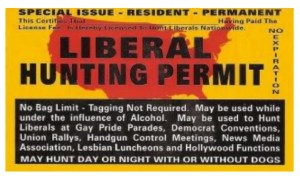 For some time, violent imagery has characterized much American political discussion. For example, two weeks ago Mrs Acilius and I watched the 1996 documentary A Perfect Candidate, a chronicle of a US Senate race in Virginia; the Republican candidate goes hunting with some supporters, one of whom brings a small boy along. The boy, wielding a rifle, is asked what he’s hunting. “Hares,” he says. Then he adds, “Hares and Democrats.” The adults laugh, the camera zooms in on the boy’s face. He seems a bit baffled by their reaction, unsure what it is that’s supposed to be funny.
Saturday’s shooting of 20 people in Tucson, Arizona, among them Congresswoman Gabrielle Giffords, prompted many to decry this violent imagery. In particular, former Alaska Governor Sarah Palin’s habit of using firearms-related graphics and figures of speech when calling for the defeat of her political opponents, Representative Giffords among them, has occasioned much complaint.
Governor Palin has refused to apologize for her remarks, calling herself the victim of a “blood libel.” By this she apparently means that her critics have accused her of causing the massacre. This stand might make sense in a court proceeding, where apologies count as admissions of legal responsibility. If the governor were a defendant in such a proceeding, then her defiant attitude and the fear of censorship that many on the Right have raised would be understandable. Yet no such proceedings are even remotely likely, and her refusal to apologize is certainly not winning her any fans. She seems to be trapped in a self-defeating pattern of behavior.
In a comment elsewhere, I’ve suggested that the USA might be a better place if the ethical concept of “taste” were revived. If we still had the idea that there are such things as “good taste” and “bad taste,” then someone in Governor Palin’s position might have options that are currently not available to her. She could recognize that it is in bad taste to talk about shooting people, apologize for that bad taste, and resolve to show good taste in the future. This would not imply a damaging admission; everyone on earth has at some point or other flown off the handle and acted like a jerk. Therefore, everyone should be prepared to accept such an apology.
If, on the other hand, the governor believes that the political situation in the USA is so bad that it is necessary to disregard the canons of taste and to continue using the violent imagery that has become her trademark, then a society in which the concept of taste still had ethical force would take that belief of hers seriously. Good taste is not the highest of the virtues, and it can be disregarded in crises. By continuing to use violent imagery after the massacre in Tucson had reminded everyone that it is in extremely bad taste, therefore, the governor would be making it clear that she regards the political situation in the USA as a crisis. She could then defend this view, and potential voters could assess the soundness of her judgment based on that defense.
Posted by acilius on January 12, 2011
https://losthunderlads.com/2011/01/12/taste/
The Tucson Massacre
Saturday, some guy shot 20 people in Tucson, Arizona. The first person he targeted was U.S. Representative Gabrielle Giffords.
In the days since, the American media has been flooded with speculation as to the shooter’s motives. Many people, such as this cartoonist, have focused on the fact that Giffords is a member of the Democratic Party, and a great deal of very heated rhetoric has been directed against that party. Quite a few have focused on a map former Alaska Governor Sarah Palin posted on Facebook with a symbol of crosshairs on Giffords’ district. Others have brought up the fact that Giffords is the first Jewish person elected to Congress from Arizona and speculated that the shooter might have been anti-semitic. Still others have brought up the debate about immigration currently raging in Arizona and have suggested that it somehow made Giffords a target.
I suggest we look at the victims and ask at which of them the shooter aimed his gun. His first shot was discharged point-blank into the congresswoman’s head. He also targeted Mavanell Stoddard, hitting her with 3 rounds before her husband, Dorwan, made his way in front of her and gave his life to save hers. Dorthy Morris was apparently also a target; her husband, George, also threw himself on his wife during the shooting, though he was too late to save her life. Did the shooter think Mrs Stoddard and Mrs Morris were likelier to be Democrats their husbands? Or that they were likelier to be Jewish? Or that they were likelier to share Giffords complex and nuanced views on immigration? Maybe! Perhaps they were wearing T-shirts decorated with a donkey, a Star of David, and the slogan “Honk if you love to spend hours discussing immigration policy.” Or maybe they had something else in common.
To my knowledge, no detailed forensic reconstruction of the shooting has yet been published. However, what has come out suggests that most of the women and girls who were shot were standing closer to the shooter and were in his line of sight, while the men were either too far away to have been deliberately targeted (for example, Judge John Roll), or gave their lives in deliberate acts of heroism like those of Mr Stoddard and Mr Morris. The Feminist Peace Network has made the point that the shooter seems to have targeted women; I haven’t seen that point elsewhere yet.
Posted by acilius on January 11, 2011
https://losthunderlads.com/2011/01/11/the-tucson-massacre/
Baby Don’t Stop, by POLYUSOs
These guys have real promise, I hope to see a lot more from them. Their YouTube channel is called POLYUSOs, I suppose that’s the name of their act.
Posted by acilius on January 9, 2011
https://losthunderlads.com/2011/01/09/baby-dont-stop-by-polyusos/
Who writes this?
 acilius
 believer1
 lefalcon
 losthunderlads
 vthunderlad
 Panther Red


