Deep in the brain

An article about brain parasites that breed in cats and spread to creatures, possibly including humans, that then become unreasonably attracted to cats appeared in the March 2012 issue of The Atlantic.  The article triggered vast amounts of comment around the web; I’ll just mention that it appeared at about the same time Gregory Cochran argued on his “West Hunter” blog that the likeliest biological basis for homosexuality is a brain parasite.  If this strikes you as an obnoxious point to make, you are well on your way to grasping the nature of Dr Cochran’s mission.

The late Christopher Hitchens often irritated me, though not in the way that Dr Cochran sets out to irritate people.  I read his column in The Nation for many years, and always wondered what percentage of their working day that magazine’s widely praised fact-checkers spent correcting his misstatements, exaggerations, and outright falsehoods.  A few always slipped through; my personal favorite was this, from his column of 22 October 2001:

There are others who mourn September 11 because it was on that day in 1683 that the hitherto unstoppable armies of Islam were defeated by a Polish general outside the gates of Vienna. The date marks the closest that proselytizing Islam ever came to making itself a superpower by military conquest. From then on, the Muslim civilization, which once had so much to teach the Christian West, went into a protracted eclipse. I cannot of course be certain, but I think it is highly probable that this is the date that certain antimodernist forces want us to remember as painfully as they do. And if I am right, then it’s not even facile or superficial to connect the recent aggression against American civil society with any current “human rights issue.”

I agree that it is foolish to regard the attacks of 11 September 2001 as an act of political protest, but that is not because Hitchens was right in his suspicion that their perpetrators chose the date 11 September from an obsession with the events of the seventeenth century.  A correction appeared in the following issue pointing out that the Ottoman forces actually suffered their defeat on 12 September 1683, not 11 September.  Hitchens, in his next column, dug his heels in and argued that because the battle began the previous day, he shouldn’t have to give up his point.  In defense of this apparently preposterous stance, he quoted a remark in which Hilaire Belloc put the battle on 11 September, then said that Belloc’s “awful ‘Crusader’ style is just the sort of thing to get him noticed by resentful Islamists.”

The same column in which Hitchens tried to salvage his theory that 9/11 was a reprisal for Hilaire Belloc’s prose style includes a quote from G. K. Chesterton.  Chesterton and Belloc were so closely associated that in their day they were often referred to as “Chesterbelloc.”  This issue of The Atlantic includes an essay by Hitchens about Chesterton, who was apparently one of his favorite authors.  I didn’t think of it in 2001, but it explains a great deal about Hitchens to think of him as a follower of Chesterton and Belloc.  Like those men, he was a prolific writer who prided himself on a fluent style, showed significant erudition in a wide range of fields, and did not particularly trouble himself about questions of fact.  Also like Chesterton and Belloc, he was an insistent and grossly unfair apologist for his religious ideas.  Chesterton and Belloc defended the Roman Catholic church by presenting every other faith tradition in an absurdly negative light; Hitchens simply added one item to their catalogue of strawmen when he set up shop as a professional atheist.  The essay in this issue raises the possibility that Hitchens imitated at least some aspects of Chesterton and Belloc’s work deliberately, as well as exhibiting an influence that stemmed from his early and long exposure to them.

Sandra Tsing Loh describes the difficulties she faces adjusting to the idea that her father, Eugene Loh, is in a long, terminal decline, and that she is his caregiver. The article’s hook is “Why caring for my aging father has me wishing he would die.”  I shouldn’t think that would require much explanation.  It is difficult to watch a loved one suffer irretrievable losses, stressful to take care of another person, and natural to resent unfamiliar responsibilities.

I suspect that everyone who has ever occupied Ms Tsing Loh’s current position has at least momentarily wondered how much nicer things would be if the other person would just hurry up and die already.  If Ms Tsing Loh had written a short story about a fictional character in her position who couldn’t shake that thought, she would have explored a facet of the human experience* that needs acknowledgement.  By choosing to forgo the distancing mechanism of fiction and write a first person account, complete with photographs of Mr Loh, she is performing an entirely different sort of speech act.  She is not only confessing to this wholly predictable, probably well-nigh universal human response; she is also confronting her father and everyone else who loves him with a demand that they discard pretenses that have become conventional because they often make life more comfortable for people in their situation.  That demand, if met, would create a new kind of social situation, one which would be “honest” in the sense that it leaves raw emotions unconcealed.  However, that very honesty is another form of role playing, in which the members of the group play roles that might be appropriate in a therapeutic setting, though not necessarily so in the setting of a family group that is supposed to survive for many generations.  To keep people together for that long under all the stresses that come with family life, it’s necessary to develop a shared understanding of boundaries and to define ways to renegotiate boundaries.  Without those understandings, it’s impossible to predict each others behavior, which means that it is impossible to communicate without leaving the impression that one is saying more than one intends.  If Mr Loh were to recover the ability to read, I can hardly that he would not flinch when he realized that he was the theme of sentences like “if, while howling like a banshee, I tore my 91 year old father limb from limb with my own hands in the town square, I believe no jury of my peers would convict me.  Indeed, if they knew all the facts, I believe any group of sane, sensible individuals would actually roll up their shirtsleeves and pitch in.”  He might laugh, but I’m sure he would flinch.

*I’m familiar with the arguments against the phrase “the human experience”, and I still like to use it.  If you rehearse those arguments in the comments, be prepared to read long discussions of the thought of Irving Babbitt in response.

Star Pilot #7

Jules Jupiter, from Star Pilot #1

I’m glad to say that I’ve received an advance copy of Star Pilot #7, the latest installment of our favorite photocopied comic book. In this one, Jules Jupiter, super-intelligent simian who sometimes flies among the stars and sometimes acts as a roving sleuth here on earth, travels to a fictional country where a dictator has spent 30 years or more trying to erase all awareness of history from the minds of his compatriots.  Jules meets an old man who tells him of a legendary pop star from the 1970s whose music might restore freedom.  In an apparent nod to Star Wars, the old man reveals himself to be this pop star.  As in that venerable film Old Ben Kenobi resumed the name Obi Wan and took up the light sabre again after he revealed his true identity to R2D2 and company, so Julio Clemente resumes the name JuCle and takes up his electric guitar again after he has told Jules Jupiter his story.  The story reimagines this pop culture classic in a nonviolent form.  There are no explosions, no shootings, no sword fights,only music and the prospect of a negotiated settlement.  That fits with the peace-minded ethos of the previous issues, but is still a surprise in the ultra-violent world of comics.  Check Jules Jupiter’s online store to see when it will be available for purchase.  Issues 1-6 are there now, at the amazingly low price of $1 apiece.

Car Insurance vs Health Insurance

Earlier this evening, I posted a long comment on a post at Secular Right.  In the post, blogger Heather MacDonald said that she was, in principle, a supporter of the idea that the law should require people to buy health insurance.  In support of this view, she pointed out that motorists are required to buy car insurance.  My reply:

“I see little difference between mandated car insurance and mandated health insurance—in most places, having a car is virtually a necessity of life” Car insurance and health insurance have a couple of things in common. The chief of these is that both categories of products are called “insurance.” The rest of the similarities, such as the fact that the some of the same companies sell them and some of the same agencies regulate them, stem from this point of vocabulary.

The similarities between car insurance and health insurance, however, are dwarfed by the differences between them. You choose an auto dealer, choose a car, negotiate a price for that car, arrange financing for it, pay that price, buy the fuel of your choice for it, decide which routine maintenance tasks you will perform on it yourself and which you will entrust to a mechanic, choose the mechanic who will perform those tasks, and pay that mechanic for those routine tasks, all without input from your insurer. If car insurance were the same thing as health insurance, you would be dependent on the insurer to make all of these payments and all of these decisions for you. To use mandates for car insurance as an analogy to justify mandates for health insurance, then, is like saying that because lightning rods protect your house from lightning, they should also protect your garden from lightning bugs.

If the USA’s political leaders were serious about controlling the cost of health care, in fact, they would move to make health insurance more like car insurance- not by making it mandatory, but by removing the tax incentives that reward employers for redirecting money from employee’s paychecks to health insurance premiums. Under our current system, a substantial percentage of the compensation US employers pay to keep their employees on staff goes, not to them in the form of money they can spend as they see fit, but to insurers to form funds from which employees can draw only in the form of medical expenses. Therefore, when those employees become consumers of health care they have no incentive to keep the cost of their health care down. Health care providers obviously have no such incentive. Even employers and insurance companies have only a very weak incentive to keep costs down, since employers are paying premiums with money that would otherwise go to the corporate income tax or to some other tax shelter. That’s why the cost of health care has for many consecutive years grown at a rate well in excess of the general rate of inflation, something which is not true of cars, car insurance, or any of the services car insurance usually covers.

If the corporate income tax were abolished, it would be possible for health insurance to become like car insurance. Consumers could choose and pay for their own routine health care, and pay also for insurance to cover catastrophic health expenses, as consumers now buy car insurance to cover catastrophic auto expenses. Doubtless, the modern world being what it is, there would be a political demand for substantial public sector subsidies for low-income people who have need of health care. So long as these subsidies were in the form of direct transfers of money to these potential consumers, they might leave the recipients with as much incentive to negotiate for lower prices as they have when considering the purchase of other goods and services that money could gain them. Not being as far to the right (or as secular) as most people who hang around here at Secular Right, I would be eager to support a generous program of subsidies along these lines.

Walking in Roman Culture

For years I’ve had it in the back of my mind to prepare a study called Posture and Gait in Classical Antiquity.  We have a variety of sources that could help us reach conclusions about how various types of people tended to stand and move in ancient times.  There are literary descriptions of posture and gait, visual artworks depicting people standing and walking, clothes that required a particular posture and gait if they were to stay on the wearer’s body, shoes that exhibit particular patterns of wear, buildings with entryways that accommodate some strides better than others.  Were such a study completed, it could open the door to investigations in topics ranging from dance to infantry operations to architecture to the status of the disabled and the expression of social class in antiquity.

I’ve never got around to beginning such a study, and now I find that someone has had a similar idea.  Timothy M. O’Sullivan of Trinity University has written a book called Walking in Roman Culture.  According to a review by Alana Lukes that circulated on an email list of members of the Classical Association of the Middle West and South, a professional organization of American classicists, Professor O’Sullivan’s book presents “a compilation of citations from ancient sources which mention the physical activity of walking by the ancient Romans,” and does not go into depth on any other sort of evidence.  Still, that’s quite enough material for one book.  The magnum opus I have occasionally toyed with the idea of creating would be the work of decades, and Professor O’Sullivan appears to be  quite a young fellow.  So perhaps he’ll end up writing such a thing.

Unkept Republics

I named my online persona after Gaius Acilius, a man who lived in 155 BC, in part because the history Acilius wrote of Rome seems to have reflected some of the concerns that would define what scholars like Quentin Skinner call the “Republican Tradition” in political thought.  Professor Skinner has labeled such thinkers as Hobbes, Machiavelli, and Thomas More “neo-Roman” because of their preoccupation with themes that Romans like Acilius developed.  For example, all of these thinkers ask how a person can be called free when that person is dependent on the favor of others, and all of them answer with various schemes for creating compartments of social life within which people can be independent.  A couple of years ago, I suggested in this space that a way of developing this idea in a highly bureaucratized world like that of the twenty-first century might be to develop three conceptions of liberty in tandem with each other, as freedom from bureaucracy, freedom within bureaucracy, and freedom as a product of bureaucracy.  I called this suggestion “The Three Freedoms.”  So far as I can see, it is an idea which has had no influence on anyone.  I shouldn’t be surprised; I haven’t been trying very hard to draw anyone’s attention to it.  Gaius Acilius would probably be disappointed in me.

What brings all this to mind is a piece in the current issue of The Nation magazineYascha Mounk reviews Maurizio Viroli‘s The Liberty of Servants: Berlusconi’s Italy.  According to Mr Mounk, Professor Viroli accounts for Silvio Berlusconi’s long tenure at the forefront of affairs in Italy by arguing that “Berlusconi was able to stay in power because he transformed Italy from a republic into a kind of royal court.”  Not simply a monarchy, but a court.  Mr Mounk explains Professor Viroli’s terminology thus:

For him, a court system, far from being defined by the traditional trappings of royalty, is any arrangement of power whereby “one man is placed above and at the center of a relatively large number of individuals—his courtiers—who depend on him to gain and preserve wealth, status, and reputation.” Viroli calls the person at the center of the court system the signore. Even if it weren’t for the uncanny association with the droit du seigneur, it is clear why the label fits Berlusconi. Viroli is hardly exaggerating when he states that over the past few decades, “all of Italy’s political life has rotated around Silvio Berlusconi: all eyes turn to him, all thoughts, hopes, and fears.” He quickly became such a polarizing figure that the gulf between Italy’s left and right, which had been huge and vicious during much of Italy’s postwar history, has shrunk. What mattered most for Italians during his reign was whether one was for or against Berlusconi. In the summer of 2010, for example, several politicians on the left were prepared to fawn over Gianfranco Fini, a longtime fascist with center-right views, simply because he had broken with Berlusconi and spoken in public about his opposition to the prime minister.

Berlusconi not only made himself the Sun King of Italian politics; he acted like a Mafia don. At his word, pretty teenage girls became TV presenters, TV presenters ascended to the rank of government ministers and government ministers were offered lucrative jobs in various industries once they left office.

Mr Mounk goes on the explain the relationship between Professor Viroli’s views and those of the school associated with Professor Skinner:

For Viroli, Berlusconiland was more than a corrupt court. Drawing on republicanism, a long-neglected tradition of political thought that has recently been revived by intellectual historians and political theorists like John Pocock, Quentin Skinner and Philip Pettit, Viroli argues that Berlusconi’s corrosive influence has deprived Italians of their liberty. On Viroli’s account, philosophers who stand in the liberal tradition worry only about actual interference with a person’s actions. “A Free-Man,” wrote Thomas Hobbes with his characteristic crispness, “is he that, in those things, which by his strength and wit he is able to do, is not hindered to doe what he has a will to.” The subjects of a benevolent despot remain perfectly free so long as he does not inhibit their actions. Viroli argues that according to such a liberal conception of freedom, Berlusconi’s Italy remained a free country: “If we can rightly point to violations of liberty only in cases where fundamental civil and political rights are suppressed by force, then we Italians are, generally speaking, a free people.”

Yet for Viroli, the liberal definition of freedom, with its exclusive emphasis on freedom from interference, is too anemic. He worries that a ruler with vast, arbitrary power would have a chilling effect on the freedoms of his subjects even if he never chose to exercise his power. To emphasize this point, republicans such as Viroli like to cite the example of Tranio, the protagonist of a comedy by the Roman playwright Plautus. Tranio is a slave. But because his master is often absent, and because he is so wily, no one ever interferes with his actions. As long as he continues to flatter and manipulate his master, he is free to do as he pleases. And yet, the republicans point out, a slave is surely the very opposite of a “free man.”

While slavery is now officially banned throughout the world, Viroli argues that the most salient characteristic of slavery—the relation of domination and dependence between master and slave—persists in a milder form in our societies. “Citizens who can be tossed into prison arbitrarily by the police,” for example, stand in just such a relation of dependence to an oppressive, dominating power. Even if, for now, they nominally remain at liberty, they lack real freedom. In the case of Italy, though Berlusconi never used his vast power to interfere with the lives of Italian citizens, they knew that he could, at any moment, choose to do so. This lack of real freedom, Viroli argues, limited the things Italians dared to do as well as the words they dared to say.

Mr Mounk suspects that Professor Viroli’s model takes him at once too far and not far enough in his assessment of the damage that Mr Berlusconi did to Italy:

Viroli’s account of the theory of republican liberty is attractive, but his argument that Italians were, in his own sense, unfree is not convincing. Some Italians did find themselves in a true position of dependence on Berlusconi’s whims. Journalists at the networks and newspapers he controlled knew that one honest sentence could make the difference between a lucrative job and the dole. In a country where even many junior positions in business, government and academia have long been reserved for insiders and their children, many young people knew that their career prospects depended as much on their willingness to flatter Berlusconi or his cronies as on their ability to get the job done.

Nevertheless, even on a republican conception of liberty, most Italians remained free during Berlusconi’s rule. The reason is not just that Berlusconi never chose to interfere with the lives of his adversaries by, say, throwing a member of the opposition in jail for a rude op-ed; it’s that Italians knew perfectly well that Berlusconi had no more power to do such a thing than does Barack Obama. The price that opponents of Berlusconi were afraid of paying was not, as Viroli thinks, that Berlusconi might decide to interfere in their lives in an arbitrary manner but rather that he would choose not to tempt them with favors. For all the signore’s power and influence, ordinary Italians hardly lived in fear of his wrath.

One wonders exactly when these paragraphs were written; on 31 December 2011, Barack Obama signed into law a bill which grants him the power to throw anyone in jail on any grounds whatever.  So he is a rather poorly chosen example of an official with limited power to interfere with the lives of his adversaries.  Nonetheless, no such law seems to be on the books in Italy, and no Italian leader since Mussolini has behaved as if one did.

As Mr Mounk thinks that Professor Viroli’s model drives him too far when it implies that Italians have been reduced to slavery, so he claims that it prevents him going far enough in his analysis of aspects of the Berlusconi regime that liberalism also indicts:

The weakness of Viroli’s central assumption, that only the language of liberty can adequately express the horrors of Berlusconi’s rule, may explain why his account of Berlusconiland is not fully persuasive. Other critics of Berlusconi have written damning accounts of his reign, but instead of going so far as to claim that Berlusconi made Italians unfree, they have demonstrated that his government violated the equal treatment of citizens before the law, neglected the government’s duties to further the economic interests of its citizens and condoned corruption (failings that liberals as well as republicans condemn). In The Sack of Rome (2006), for example, Alexander Stille explains that Berlusconi’s business empire was, from its first days, built on political favors and rent-seeking. A true modernization of Italy’s economy would have given his companies unwanted competition and deprived them of crucial state subsidies. Berlusconi chose instead to preserve arcane rules and bureaucratic roadblocks, or even to create new ones, to protect his business interests. He sacrificed the country’s economic well-being for his own.

Berlusconi’s influence on the judicial system was equally disastrous. Whereas in many countries the statute of limitations cannot expire after a defendant has been indicted, in Italy defendants go free if the highest court of appeals has not upheld their convictions within the allotted time. Knowing this, Berlusconi’s attorneys, whom, in a rare instance of efficiency, he made members of Parliament, shortened the statute of limitations for the most troublesome white-collar crimes and devised rules to strengthen legal tactics for delaying trials. This change had the desired effect of aiding Berlusconi’s defense in his trials for false accounting and embezzlement. It also had the unintended effect of making it more difficult to jail members of the Mafia.

Even with these strictures, Mr Mounk’s final assessment of Professor Viroli’s book is strongly favorable:

Stille and others have described the disastrous economic and legal fallout of Berlusconi’s rule in much greater detail than Viroli. But Viroli, in his own way, paints an even more memorable portrait of Italy’s new ruling class. His description of Berlusconi as a signore is on the money. And while the servility of Berlusconi’s hangers-on may have been self-imposed, it still raises the central paradox of Berlusconiland. Absolute monarchs are able to cow their courtiers into submission by wielding the implicit threat of pain, imprisonment or execution. Berlusconi never had such tyrannical powers. Even so, his underlings acted as if they were mere courtiers—apparently, the hope of getting rich was quite enough to keep them in line. This makes the Italian case all the more relevant at a time when the superrich and their political enablers seek to wield ever more influence over democracies in a climate of austerity. It seems that to achieve their purposes, our would-be masters need not impede our rights or liberties: the promise of a farthing of their vast riches might be quite enough to turn many of us into docile servants.

Elsewhere in the issue, David Sarasohn contributes a piece with the resoundingly neo-Roman title “The Treason of the Senate,” in which he looks back to a series of essays published in 1906 and concludes that all the forms of corruption that marked the US Senate in the Gilded Age have reemerged and been joined by new evils.  Sarah Wildman’s “Israel’s New Left Goes Online” promoted a webzine called +972, which presents itself above all else as independent of ideological and institutional constraints characteristic of the Israel/ Palestine conflict.  Someone like old Gaius Acilius would certainly have been alarmed at a process that empowers extremist minorities and reduces citizens to dependence on increasingly professionalized security forces, so he likely would have understood +972s goals, whatever conclusion he might ultimately have reached regarding their politics.  Chris Savage writes of “The Scandal of Michigan’s Emergency Managers,” officials appointed by that state’s governor to replace elected municipal governments of whom he disapproves.  I think that someone in the republican tradition would say that the true scandal of this system is that there is no citizenry jealous of its rights that rises up in revolt when the governor pulls this stunt.  That same governor, incidentally, is the topic of Patricia J. Williams’ column in this issue; though he is a member of something called the Republican Party, he could hardly be called an heir of the republican tradition.

I’ll mention just one other piece, a review essay by Paula Findlen called “Galileo’s Credo.”  At various points in the development of the republican tradition, Galileo has been a powerful symbol of the autonomous individual maintaining his honor by refusing to knuckle under to the overweening power of a court.  Professor Findlen notes that as a young man, Galileo and his friends laughed at literal-minded neo-Romans who favored Latin over the vernacular and went about wearing togas.  Yet in his resistance to the demands of the Vatican, surely Galileo lived as the stubbornly independent noblemen of the old Res Publica would have recommended.

John S Wilkins’ “Evolving Thoughts”

A year and a half ago, in September 2010, blogger John S. Wilkins posted something I meant to remark on here.  A response to the public discussion going on at the time about Stephen Hawking’s book The Grand Design, it was titled “Stephen Hawking and the Creation of the Universe.”  Mr Wilkins’ point was that, while some presented Professor Hawking’s book as presenting an argument against the existence of God, the argument Professor Hawking actually presents tells only against a theology that was discredited in the nineteenth century.  Once mathematicians demonstrated that simple processes could yield complex and stable systems, the Enlightenment theory of the universe as a grand machine and of God as the grand machinist, a view expressed in, among other movements, deism, lost its logical warrant.  Mr Wilkins closing paragraphs read thus:

Can we come up with a deist god that is consistent with the modern physics? One way is called “block universe” theory, and I have discussed this before. Any deity that is not themselves bounded by ordinary causal relations and time is able to set up a universe that does things causally even if that universe is unpredictable within spacetime. But this is rather more like the traditional theist God, only without all the intervention. In losing the Laplacean deist god we find ourselves back with the Augustinian-Thomist deity. If you think it matters. I’m a block theorist for other reasons than theology, but the option is there if you need it.

A universe that can “create” itself is a state of affairs that is actualised, and may very well be actualised by a deity that desired it. The notion of cause has been so stretched and modified that it is almost unrecognisable, but there is nothing I can see that is self-contradictory about it, and so I conclude that Hawking, if he’s being reported correctly, has disproven a view of God that had currency solely among scientists and philosophers who were still Enlightenment thinkers.

Now somebody will tell me that the book is more subtle and interesting than that. Which is what these posts are for…

I bring this up now because Mr Wilkins has announced that both his blog and his Twitter account are likely to be dormant for a time, since he’s out of work and short of funds.  If you have profited from his temperate and learned posts on biology, the philosophy of science, and the case for agnosticism, you might consider donating money to him.  If you haven’t read him and are interested in the natural world, philosophy, science, or religion, or if you simply enjoy hearing a calm and rational voice, you should have a look.  Even if you don’t decide to help him financially, I’m sure your reading of his blog would bring both satisfaction to him and fresh intellectual stimulation to you.

The American Conservative, March 2012

The table of contents of the March issue of The American Conservative seems to have a problem.  I haven’t seen the print edition yet, but the page numbers in the online edition’s table of contents  don’t match the pages numbers in the magazine. There was a similar, though smaller-scale, problem with last month’s issue.

In the cover story, Peter Hitchens argues that, while the snarling rage Margaret Thatcher continues to evoke in her opponents does go to show that she was a figure of great historical consequence, conservatives are quite wrong to adopt her as a model of political success.  Rather, her true significance is a tragic one, embodying the final collapse of a social ideal and of an approach to governance.  The reverence Lady Thatcher continues to enjoy on the Right in both the UK and the United States suggests to Mr Hitchens that her partisans in those countries have not come to terms with this collapse, and that their ability to formulate and direct national policy is handicapped by their attachment to these outworn notions.

Rod Dreher, the original “crunchy con,” takes a more optimistic view of another eminent Briton.  He gives a glowing writeup to Prince Charles, of all people.  Evidently Mr Dreher sees in His Royal Highness the prophet of a “revolutionary anti-modernism.”  I suppose it is a sign of my shortcomings that I can never keep an entirely straight face when the topic of the British Royal Family comes up; not being British, it would certainly be inappropriate of me to say that grown-up countries don’t have kings and queens.  But I will say that my favorite aspect of the British monarchy has always been the expectation that the various princes and princesses would keep their opinions to themselves.

Gary Johnson, who from 1995 to 2003 represented the Republican Party as governor of the state of New Mexico, has left that party and declared his candidacy for president as a member of the Libertarian Party.  W. James Antle gives sympathetic attention to the freedom-loving Mr Johnson and his quixotic campaign.  Mr Johnson and his fellow Libertarians oppose many things which I think are eminently worth opposing.  If they were the only ones speaking out against the crony capitalism, the wars of aggression, and the burgeoning police state that the Democrats and Republicans have combined to foist upon the USA, I would certainly vote for them.  Fortunately, however, former Salt Lake City mayor Rocky Anderson is running for president as a left-of-center candidate.   Mr Anderson stands against all the evils that the Libertarians would fight, and at the same time supports measures to ensure fair play for all to and restrain the excesses of the market.  Mr Anderson may not have much to offer the authors and editors of something called “The American Conservative,” but most of them are just as much opposed to Libertarianism as they are to the 1980s-style liberalism that Mr Anderson represents.

Our favorite Eve Tushnet returns to the magazine with an argument to the effect that the fear of divorce has spawned a social movement that has, paradoxically, weakened marriage in the USA.  Here’s one paragraph that’s too good not to quote:

Possibly in response to divorce scripts like “We just fell out of love,” or “It just happened,” which emphasize powerlessness, the contemporary delayed-marriage script attempts to crack the code, figure out the formula, and do it right.  The fact that marriage, like parenting, is mostly about acceptance, forgiveness, and flexibility in the face of change and trauma gets suppressed.

It’s hard to believe that a celibate like Ms Tushnet wrote such an insightful remark about the nature of marriage.   On the other hand, I don’t suppose Pythagoras was a triangle, and he came up with something useful to say about them.  Be that as it may, there’s some more great stuff in Ms Tushnet’s article.  For example:

A culture of love can’t be built on a foundation of rejection.  The path forward doesn’t include further stigmatizing divorce, or bringing back stigma against unmarried childbearing… What young people need is hope: a sense that marriages can last, not because the spouses were smart enough on the front end but because they were gentle and flexible enough in the long years after the wedding.

Samuel Goldman undertakes to explain “what sets conservatives apart from authoritarians and fascists,” a task prompted by a recent book that lumped together many writers who were in one way or another connected to the word “conservative” (in some cases by their own adoption of that label as a description of their ideological stands, in other cases by their affiliation with a political party with the word “Conservative” in its name, and in still other cases only by the fact that some self-described conservatives have spoken highly of them) and declared them all to be enemies of freedom.  Why so unimpressive a work should occasion an essay by anyone of Mr Goldman’s talent may seem mysterious, but the mystery lessens when one realizes that the author of the book actually occupies a chair of political philosophy at a well-known university.  When it first appeared, some critics noticed the author’s credentials and wondered if it was a parody of crude efforts by right-wingers to smear the word “liberalism” with tar from an equally injudicious brush, but that individual has insisted that he regards his production as a genuine contribution to scholarship.

Mr Goldman’s little essay is remarkable for the courtesy and patience which it shows towards this book and its author.  Not for Mr Goldman such words as “charlatan,” “impostor,” or “fraud.”  Nor does he engage even in subtle and urbane ridicule of his subject.  Instead, he takes it as an occasion for a concise exposition of major themes in the works of Edmund Burke and Joseph de Maistre.  Mr Goldman’s even temper, as much as his demonstration of the absurdity of the book’s characterization of those thinkers, exposes the depths of its author’s corruption far more effectively than could the most blistering polemic.

Weirdomatic goes bananas

Over at Weirdomatic, fotb Irina Alexandra has posted a gallery of banana-shaped household products.  I found these especially charming:

Banana Vases

JFK, George Quintana, and tumblr

Our tumblr page is called “Thunderlads After Hours.”  If you are a tumblr user, you will be familiar with the service’s “Dashboard” feature.  All the posts on all the tumblr pages you follow appear before you in a constant stream. We follow lots of people, so we see lots of images when we log on there.  Below are a few we’ve seen there.

This is the avatar for a page we follow that goes by the name “Jack Ruby Tuesday“:

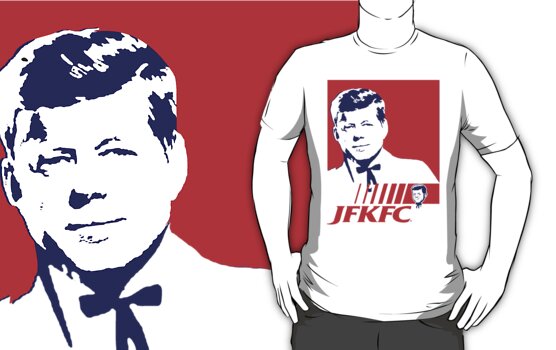
President John F. Kennedy projected a public image that was in many ways the opposite of the image Colonel Harlan Sanders projected.  They both came to international prominence in the 1960s and have remained familiar ever since, and each is strongly associated with a three-letter abbreviation.  So I think this image is worth a chuckle.  Because it simply replaces Colonel Sanders’ three-letter trademark “KFC” with Mr Kennedy’s familiar “JFK,” I think it is much funnier than the image on this T-shirt.

Also, this image caught my eye a few days ago:

I’d say this picture is sensational in more than one sense of the word.  The artist worked under the name George Quintana, though his given name was George Quaintance.

Atheism is no excuse for skipping church

In a recent review of Alain de Botton‘s Religion for Atheists: A Non-Believer’s Guide to the Uses of Religion, John Gray writes:

Rarely mentioned in the debates of recent years is that atheism has been linked with all kinds of positions in ethics, politics and philosophy. More particularly, there is no necessary connection – either as a matter of logic or in the longer history of atheist thinking – between atheism and the rejection of religion.

Atheist thinkers have rejected and at times supported religion for many different reasons. The 19th-century anarchist Max Stirner rejected religion as a fetter on individual self-assertion. Bakunin, Marx and Lenin rejected it because it obstructed socialist solidarity, while Nietzsche hated religion (specifically, Christianity) because he believed that it had led to ideologies of solidarity such as socialism. Auguste Comte, an atheist and virulent anti-liberal, attempted to create a new church of humanity based on science.

In contrast, the French atheist and proto-fascist Charles Maurras, an admirer of both Comte and Nietzsche, was an impassioned defender of the Catholic Church. John Stuart Mill – not exactly an atheist but not far off – tried to fuse Comte’s new religion with liberalism. In marrying atheism with very different ethical and political positions, none of these thinkers was confused or inconsistent. Atheism can go with practically anything, since in itself it amounts to very little.

Certainly a dictionary definition such as “the doctrine that there are no gods” amounts to very little.  Professor Gray champions such a definition:  “Rightly understood, atheism is a purely negative position: an atheist is anyone who has no use for the doctrines and concepts of theism.”  For my part, I am reflexively skeptical of any very simple, purely abstract definition of an ideological label.  I doubt that anyone adopts such a label as a self-description or responds powerfully to it as a description of a participant in a debate unless it suggests a rather substantial narrative.   “Atheist” is a label that millions of people wear with fierce pride, and that raises equally fierce anger and fear in hundreds of millions of others.  The strength of those reactions proves that the word has connotations for these people that go far beyond the tidy little abstractions of the dictionary, and their predictability shows that these connotations are much the same from person to person.   Therefore, I am not convinced that anyone anywhere is an atheist simply in the dictionary sense of the word.  There are people who reject particular religious beliefs that involve the existence of gods, and there are people who accept particular beliefs that exclude the existence of gods.  The key thing about each of these people is their relationship to those particular beliefs, to the people they know who espouse those beliefs, and to the institutions in their social worlds that are associated with those beliefs.  A label such as “atheist,” in the dictionary sense, would sort a pious Confucian, an orthodox Communist, and a militant freethinker together.  Certainly no category that includes three such disparate people could be a very important part of our understanding of the world.

As I am skeptical of the dictionary version of the word “atheism,” so too am I skeptical of the word “theism.”  The Oxford English Dictionary gives four definitions for “theism.”  (Not counting another, unrelated, word spelled the same way, which means “illness as the result of drinking tea.”)  These definitions are: “belief in a deity or deities; as opposed to atheism”; “belief in one god, as opposed to polytheism or pantheism”; “belief in the existence of god, with denial of revelation”; “belief in the existence of god, without denial of revelation.”  n the first of these senses, the word appears to be a back formation created by taking the prefix off of “atheism.”  The word is obsolete in the second sense, having been replaced by “monotheism.”  The third sense has been replaced by “deism”; where deism is a live option, its opponents still use the word “theism” to describe themselves.  In view of the word’s history, then, it would be as true to say that “theism” names a “purely negative position” as it is to say that “atheism” names a “purely negative position.”  A theist is someone who rejects the labels “atheist” and “deist” and will not play the social roles that come with those labels.

Again, no one does only this.  Those who call themselves “theists” are adherents of particular religions.  Surely, no one believes in “a personal god”; billions of people believe in the God their favorite preacher describes.  Mere theism is as unreal as C. S. Lewis’ “Mere Christianity.”  Indeed, the labels that name world religions cover so many people and so many cultures of faith that anyone can see the point the late Edward Said made when he proposed scrapping the term “Islam” on the grounds that such a word “imputes a unified and monolithic religious and cultural system” to what is in fact an infinitely diverse range of experiences lived by over a billion people scattered all over the globe.  How much worse then is a label that encompasses not only that range, but also the ranges of experience grouped under “Christianity,” “Judiasm,” Sikhism,” “Hinduism,” etc.

Professor Gray does recover a bit as the review goes on.  So:

Most people think that atheists are bound to reject religion because religion and atheism consist of incompatible beliefs. De Botton accepts this assumption throughout his argument, which amounts to the claim that religion is humanly valuable even if religious beliefs are untrue. He shows how much in our way of life comes from and still depends on religion – communities, education, art and architecture and certain kinds of kindness, among other things. I would add the practice of toleration, the origins of which lie in dissenting religion, and sceptical doubt, which very often coexists with faith.

Today’s atheists will insist that these goods can be achieved without religion. In many instances this may be so but it is a question that cannot be answered by fulminating about religion as if it were intrinsically evil. Religion has caused a lot of harm but so has science. Practically everything of value in human life can be harmful. To insist that religion is peculiarly malignant is fanaticism, or mere stupidity.

De Botton has done us a service by showing why atheists should be friendly to religion. Where he could have dug deeper is the tangled relations between religion and belief. If you ask people in modern western societies whether they are religious, they tend to answer by telling you what they believe (or don’t believe). When you examine religion as a universal human phenomenon, however, its connections with belief are far more tenuous.

The fixation on belief is most prominent in western Christianity, where it results mainly from the distorting influence of Greek philosophy. Continuing this obsession, modern atheists have created an evangelical cult of unbelief. Yet the core of most of the world’s religions has always been holding to a way of life rather than subscribing to a list of doctrines. In Eastern Orthodoxy and some currents of Hinduism and Buddhism, there are highly developed traditions that deny that spiritual realities can be expressed in terms of beliefs at all. Though not often recognised, there are parallels between this sort of negative theology and a rigorous version of atheism.

A couple of years ago, we noticed James P. Carse’s The Religious Case Against Belief, a book which argues not only that its beliefs are not the things which make a religious tradition most valuable, but that an excessive emphasis on beliefs is the surest way to drain a religious tradition of its value.  Professor Gray seems to be approaching Professor Carse’s views here.  He goes on to write paragraphs that will make any admirer of Irving Babbitt wince:

The present clamour against religion comes from confusing atheism with humanism, which in its modern forms is an offshoot of Christianity.

Unfortunately, de Botton falls into this confusion when he endorses Comte’s scheme for a humanist church. “Regrettably,” he writes, “Comte’s unusual, complex, sometimes deranged but always thought-provoking project was derailed by practical obstacles.” It is true that in accepting the need for religion Comte was more reasonable than the current breed of atheists. But it is one thing to point out why atheists should be friendly to religion and another to propose that a new religion should be invented for atheists.

The church of humanity is a prototypical modern example of atheism turned into a cult of collective self-worship. If this ersatz faith came to nothing, it was not because of practical difficulties. Religions are human creations. When they are consciously designed to be useful, they are normally short-lived. The ones that survive are those that have evolved to serve enduring human needs – especially the need for self-transcendence. That is why we can be sure the world’s traditional religions will be alive and well when evangelical atheism is dead and long forgotten.

I mention Irving Babbitt because of the episode that briefly made him a celebrity.  In 1930, Babbitt was 65 years old, and had for over 30 years taught French and Comparative Literature at Harvard University.  In those decades, he and his friend Paul Elmer More had assembled a school of learned followers who labeled themselves “the New Humanists.”  1930 was the year the New Humanists chose to make their debut as a movement.  A book featuring essays by Babbitt, More, and many of their followers (including Babbitt’s pupil T. S. Eliot) appeared under the title Humanism and America: Essays on the Outlook of Modern Civilization; Babbitt himself gave a lecture at Carnegie Hall, drawing an audience of 3000.  Much to the dismay of Babbitt and company, a circle around philosopher John Dewey also chose 1930 to launch a project under the name “the New Humanism.”  While Babbitt traced the criticism that he and his school practiced back to Erasmus and the other the Christian humanists of the Renaissance and claimed that it offered a way even for irreligious people such a himself to recognize the value of religion, the Deweyans were hostile to traditional religion and favored views quite similar to those Professor Gray describes above.  The extent of the Deweyans’ triumph in the battle for the word “humanist” can be measured not only by remarks like Professor Gray’s but also by the prosperity of the American Humanist Association, which had its origins in the Dewey group’s 1930 activities and which stands today as the USA’s foremost institutional champion of atheism.  Needless to say, the American Humanist Association’s successive “Humanist Manifestoes” make no reference to Babbitt and More, and certainly take no notice of Erasmus or any other Christian humanists.

Babbitt’s “humanism” suffered from many weaknesses, not least the fact that it was at least as sweeping a collection of diverse beliefs and experiences as would be sorted under the label “theism.”  Indeed, at the height of the “Humanist” controversy Paul Shorey slashed away at the New Humanists precisely because they made the term “humanism” bear an impossible burden.  Even as the dictionary versions of “theism” and “atheism” elide the whole world of religious experience, so too Babbitt’s conflation of all the sages, philosophers, and prophets of the past is, in Shorey’s words, “exposed to misunderstandings and misapplications, and Professor Babbitt wishes to deduce from it precisely his own ideals in religion, ethics, culture, philosophy, politics, and education.”  By contrast, Shorey declared himself  “content to take the word in a loose, fluid, literary way and in the traditional Renaissance sense of devotion to the Greek and Latin classics and to the cultural and ethical ideals that naturally result from an educational system in which they hold a considerable place.”  Babbitt would likely have claimed that he and his school used the word in the same way, but that they, unlike Shorey, had thought through the question of what “cultural and ethical ideals” can be expected to “naturally result” from various educational systems in which the Greek and Latin classics hold various places that might be called considerable.  In other words, what Shorey was doing with the word “humanism” may be very much like what Professor Gray is doing by invoking the dictionary definition of “atheism.”  In each case, the critic is trying to avoid a controversy by associating himself with a version of a word that is artificially drained of its connotations and narrative content and confined to a purely formal significance.  In each case, however, the word has associations that cannot be suppressed.  By trying to hide those associations behind the dictionary, the critic puts himself in a weak position.  If Shorey wished to escape from Babbitt’s attempt to overstuff the word “humanism” with all the wisdom in the world and to ground in it all of his preferred ideas, he would have been better advised to consider the particular uses of the word as evidenced by identifiable people in specific situations than to express a preference for a use of the word that differs from Babbitt’s chiefly in its greater vagueness.

Philosopher that he is, Professor Gray was never likely to declare that a term and the prejudices it expresses are best left unexamined.  His refuge in the dictionary, however, leaves him in a very awkward position.  For example:

“Religion,” writes Alain de Botton, “is above all a symbol of what exceeds us and an education in the advantages of recognising our paltriness.” It is a thought reminiscent of Blaise Pascal. One of the creators of modern probability theory, the 17th-century thinker invented an early calculating machine, the Pascaline, along with a version of the syringe and a hydraulic press. He made major contributions to geometry and helped shape the future development of mathematics. He also designed the first urban mass transit system.

Pascal was one of the founders of the modern world. Yet the author of the Pensées – an apology for Christianity begun after his conversion to Catholicism – was also convinced of the paltriness of the human mind. By any standards a scientific genius and one of the most intelligent human beings that may ever have lived, Pascal never supposed that humankind’s problems could be solved if only people were smarter.

The paradox of an immensely powerful mind mistrusting the intellect is not new. Pascal needed intellectual humility because he had so many reasons to be proud of his intelligence. It is only the illiteracy of the current generation of atheists that leads them to think religious practitioners must be stupid or thoughtless. Were Augustine, Maimonides and al-Ghazali – to mention only religious thinkers in monotheist traditions – lacking in intellectual vitality? The question is absurd but the fact it can be asked at all might be thought to pose a difficulty for de Botton. His spirited and refreshingly humane book aims to show that religion serves needs that an entirely secular life cannot satisfy. He will not persuade those for whom atheism is a militant creed. Such people are best left with their certainties, however childish.

I would be the last to deny that Pascal was a great mind, but neither would I say that atheism, even of the militant variety, has confined its appeal to people who can be dismissed as “best left with their certainties, however childish.”  As Professor Gray says, a bare denial of the existence of gods, considered in the abstract, doesn’t “amount to much.”  Yet there is something in the label “atheist” and the roles that atheists play in society that has a powerful attraction even to people who could have matched wits with Pascal.  Like Paul Shorey before him, Professor Gray has not followed his own lead.  As he is willing to break the “fixation on belief” in discussing religion, so too should he break the same fixation when discussing irreligion.