A possible etymology of the name “Acilius”

I’ve long used “Acilius” as my screen-name, in tribute to Gaius Acilius, a Roman historian who was alive and doing interesting things in 155 BC.  It never occurred to me that anyone would know the etymology of the name “Acilius”; it was quite an old name among the Romans, and they did not really keep track of that sort of thing in those days.

A couple of months ago, I happened onto a post on the blog “Paleoglot” which led me to wonder if there might not be a way to explore the question of where the gens Acilia found its name.  Blogger Glen Gordon analyzes various occurrences of a stem acil- in Etruscan.  In his conclusion, Mr Gordon offers these definitions to cover the occurrences he has discussed:

I think we could define the English translations of the whole word family much better as part of a grander morphological design:

*aχ (v.) = ‘to do, to make, to cause’
> acas (v.) = ‘to craft, to make’
> acil (n.) = ‘thing, act; rite, holy service’ (> acil (v.) = ‘to do rites, to worship’)

The implied underlying verb here, *aχ, reminds me very much of the Indo-European *h₂eǵ-, as if borrowed from Latin agere ‘to drive, lead, conduct, impel’.

This intrigues me very much.  If the Etruscans borrowed such a word from Latin, that would suggest that the usual story about the relationship between Etruscan religion and Roman religion is misleading.  Rather than a situation in which the Etruscans molded the religious practices and ideas of their subjects, the early Romans, the presence of a Latinate word in Etruscan religious vocabulary would suggest a reciprocal relationship between the hegemonic Etruscans and their vassals.

On the other hand, if the similarity between acil- and agere is a mere coincidence, another possibility presents itself.  This is where the Acilii come to mind.  Perhaps the name “Acilius” is a combination of the Etruscan root acil-, with its sense of performing holy service, and the Latinate suffix -ius.  A fairly exact equivalent could be suggested, as chance would have it, in the English name “Priestley,” where the borrowed word priest is combined with the indigenous suffix -ley.  So perhaps all these years I’ve been unwittingly associating myself with such distinguished polymaths as Joseph Priestley and J. B. Priestley.

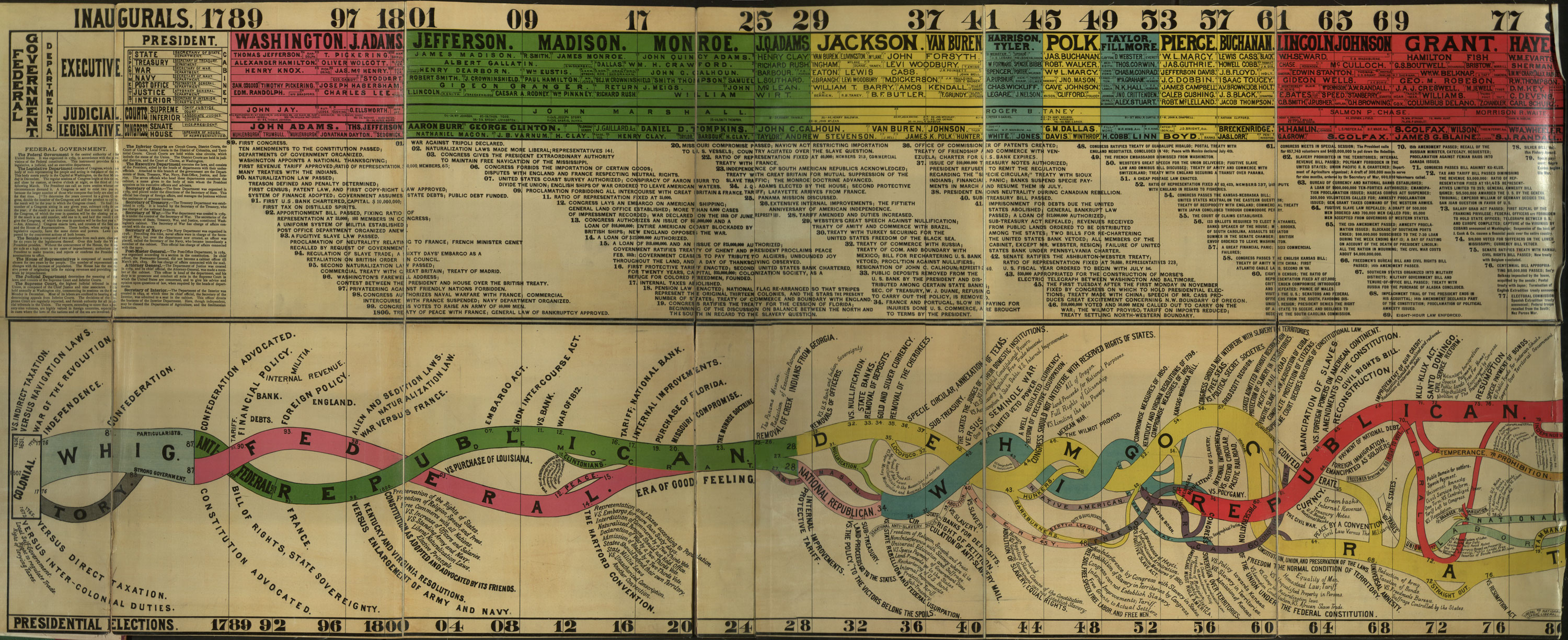
The political history of the USA in two charts

This chart was published in 1880, in a book called Conspectus of the History of Political Parties, by Walter R. Houghton.  In July, Susan Schulten put it on her blog, Andrew Sullivan mentioned it on his, and I put it up on Tumblr.  Here it is full-size.

This was today’s xkcd comic.  Click on it for a zoomable version.

I think the chart from the Houghton book is more elegant, but this one is nice also.


Is the Republican Party strong enough to survive a Romney presidency?

The other day,Jack Balkin of Yale Law School posted an item on The Atlantic‘s website in which he argued that, if former Massachusetts governor Willard M. “Mitt” Romney is elected president of the United States a week from Tuesday, his administration will likely come with great cost to the Republican Party which he nominally leads.  Professor Balkin links to the Amazon listings for two books by political scientist Stephen Skowronek (The Politics Presidents Make and Presidential Leadership in Political Time.)  Professor Skowronek classifies US presidents by the relationship they and their parties have to each other and to what Professor Balkin summarizes as the “interests, assumptions, and ideologies that dominate public discussion.”  Together, these interests, assumptions, and ideologies set the boundaries of the political “regime” of the period.  Professor Skowronek asks two questions about each of the US presidents*: “Skowronek’s key insight is that a president’s ability to establish his political legitimacy depends on where he sits in “political time”: Is he allied with the dominant regime or opposed to it, and is the regime itself powerful or in decline?”  Presidents who lead strong parties that oppose declining regimes can sweep those regimes away and implement sweeping new policies.  Professor Skowronek’s label for the few presidents who have held and capitalized in this enviable position is “reconstructive president.”  If the regime that takes shape under the administration of a reconstructive president continues to thrive after his time in office, his successors can be either “affiliated presidents,” who support the  regime and try to extend it, or “preemptive presidents,” who oppose the regime and try to modify it.  When the regime goes into terminal decline, affiliated presidents go down to political defeat, as “disjunctive presidents,” while preemptive presidents can attempt to join the list of reconstructive presidents.

Professor Balkin argues that the current regime in the USA emerged when the Reagan-Bush administration cut personal income taxes and increased defense spending on big-ticket weapons systems.  These measures were intended to solve certain problems the USA faced at the beginning of the 1980s; the tax cuts did in fact precede an end to the “stagflation” that had plagued the 1970s, and the military buildup did in fact worry the Soviet Union.  These measures, apparently successful as solutions to those particular problems, have been the foundation stones of national policy for nearly a third of a century.  Thus, Professor Balkin classifies Ronald Reagan as a reconstructive president, the two George Bushes as affiliated presidents, and Bill Clinton and Barack Obama as preemptive presidents.  Like observers well to his right, Professor Balkin has come to the conclusion that lower taxes and higher spending on big-ticket weapons systems have run their course.  Our current economic woes are not an example of stagflation, and even if they were it is by no means certain that in an age of global capital further reductions in personal income tax could relieve them.  Nor does the Soviet Union, or any other potential adversary against which the weapons systems that eat up most of our military budget would be useful, exists at present.  Tied to a party that has become increasingly doctrinaire in its attachment to these anachronistic policies, a President Romney would be doomed to join the ranks of the disjunctive presidents.  He might be comfortable in their company; the last two disjunctive presidents were Herbert Hoover and Jimmy Carter, like Mr Romney businessmen who campaigned on their abilities as technocratic managers.  Professor Balkin goes so far as to declare that “The next Jimmy Carter will be a Republican president — a Republican who, due to circumstances beyond his control, unwittingly presides over the dissolution of the Reagan coalition.”

I’m not altogether convinced that a Romney administration would necessarily end as the Hoover and Carter administrations ended, with a landslide defeat for the president after one term and a new American regime created by his successor.  I suppose if I were a Democratic politician considering a bid for the presidency in 2016, I would find the idea irresistible, but it strikes me that an incumbent president does have some influence over his party.  If it is so obvious that the policies that carried Ronald Reagan to reelection in 1984 are no longer applicable to the problems of our day, then a President Romney might not only see this himself, but might well be able to find powerful forces in the Republican Party that will support him in an effort to reorient the party towards some new agenda.  He, not a Democratic successor of his, might then emerge as a reconstructive president who creates a new regime.

If Mr Romney is elected and rises to his historical moment in this way, I would suggest a parallel to the presidencies of William McKinley (1897-1901) and Theodore Roosevelt (1901-1909.)  Those presidents together enacted an agenda of territorial expansion, commercial regulation, and political centralization that marked a significant departure from main line of post-Civil War politics, and established the regime that Herbert Hoover was trying to preserve thirty years later.  Surely we ought to would classify them as reconstructive presidents.  Yet the regime they replaced had been created during the Civil War, when their fellow Republican Abraham Lincoln had played the role of reconstructive president.  By this reckoning Democrat Grover Cleveland was at once a preemptive president ( 1885-1889 and 1893-1897) and a disjunctive president, opposing typical postbellum Republican policies of high tariffs and military pensions, and a disjunctive president, being the last to govern within the bounds set by the old regime.  Barack Obama might follow President Cleveland in this regard, with such measures as his health insurance reform and his moderate stand on social issues qualifying him as a preemptive president while his warmaking and support for Republican-devised subsidies to the financial firms would place him in the line of post-Reagan presidents.

I should add that I am not at all optimistic that a new political regime founded by Mr Romney and his associates would be desirable.  Given his platform, his background, and his associates, I suspect it would be pretty nearly intolerable, with taxes paid directly to the moneyed elite, frequent wars, and an end to civil liberties.  In these ways, such a regime could fairly be labeled fascist.  However, Professor Skowronek’s system focuses, not on what is desirable or undesirable, but on what is sustainable or unsustainable in a particular period of history.  And I suspect that fascism of that sort might very well be sustainable for quite some time.

*No, not about how they would do in a mass knife fight to the death, unfortunately.

Time and cartoons

In the comic books, Superman is quitting his day job as a newspaperman.  The company that publishes the Superman titles, DC Comics, explains that, as part of an effort to make the character more relevant to “the 21st century,” he will become- a blogger!  Evidently the part of the 21st century they want him to be relevant to is the part that ended about 6 years ago.

Nina Paley summarizes the history of the Levant in 3 minutes and 32 seconds of animation.

Despite what you’d expect from a webcomic with its name, Doghouse Diaries rarely deals with dogs.  Yesterday’s strip is therefore in rare company.

Neither Zach Weiner nor Randall Munroe is at all impressed with the level of statistical discourse in mass media.


George McGovern

Former US Senator George McGovern, the Democratic Party’s 1972 presidential nominee, died the other day.  Since 1972, it has often been possible to argue that one major party’s presidential candidate was a lesser evil than the other party’s offering; I thought Barack Obama was a demonstrably lesser evil than John McCain in 2008, for example.  But Senator McGovern was not at all evil.  He was quite admirable and thoroughly sane.  Of course he lost by one of the biggest landslides in history, to Richard Nixon.

Four years ago, I posted a link to a commercial the McGovern campaign put on television in 1972.  Here’s another link to the same commercial, the only political ad I’ve ever seen that is 100% free of bullshit.  The senator talks with a group of veterans just returned from Vietnam with newly acquired disabilities; it’s as uncomfortable to watch as you’d suppose it would be, and that seems to have been the intention.

Wasted votes

In a couple of weeks, voters in the USA will go to the polls to fill a number of offices, including the electors who will either return Barack Obama to the White House for another four years as the country’s president or replace him with former Massachusetts governor Willard M. “Mitt” Romney.  To be more precise, that is when the last voters will cast their ballots; millions of of Americans, Mrs Acilius and I among them, have already cast absentee ballots.

The missus and I did not, as it happens, vote for either Mr O or his leading opponent.  We had planned to vote for Ross “Rocky” Anderson, former mayor of Salt Lake City, Utah, whose independent bid focuses, first, on opposition to the wars the USA is currently waging or underwriting in Afghanistan, Pakistan, Syria, Libya, Mali, Mauretania, and heaven knows how many other countries; second, on opposition to “anti-terrorism” policies that have compromised the rule of law so drastically that Mr O openly boasts of murders he has ordered and plans to order in the future;  third, on support for investigation and prosecution of any and all war crimes that recent US presidents have sponsored.  But Mr Anderson did not gain sufficient support to be certified as a candidate in our state.  So we voted instead for Green Party nominee Jill Stein.  Dr Stein agrees with Mr Anderson on all of those points, but focuses her campaign on environmental policy and poverty issues.

Many people like to say that, because Mr O and Mr Romney are the only candidates with any chance of winning next month’s election, votes for any other candidate are “wasted.”  On its face, this expression is nonsensical.  It isn’t as if the polling places were casinos where the machines pay out if voters cast a ballot for a winner.  I have often asked people what they meant they say that votes for candidates unlikely to win are “wasted,” and have read many internet comment threads where people have been asked to explain what they mean by it.  The response is invariably a repetition of the claim that some candidate or other is unlikely to win, usually accompanied by a lot of bluster asserting that it is a sign of some moral deficiency to vote for anyone other than a likely winner.

Incoherent as these responses are, they seem to reflect a distinction that political scientists make between two kinds of voting behavior.  They talk about “instrumental voting” and “expressive voting.”  Instrumental voting, in its most basic form, represents a voter’s hope that s/he will cast the decisive ballot; expressive voting represents the voter’s attempt to make his or her policy preferences clear.

Political scientists sometimes go to great lengths to defend the rationality of instrumental voting.  Yet a moment’s reflection should suffice to show that in any election where the electorate is more than 600 or 700 people, the likelihood that there will be a single decisive ballot is quite small.  In a race like that for US president, where over one hundred million ballots will be cast and the electoral process is indirect, the probability that the outcome will be decided by a single ballot is effectively nil.  Meanwhile, if it is generally expected that the same electorate will vote again in the future and that such voting will be comparable in importance to the present election, political actors will analyze the results of the election as they formulate their plans for governing and campaigning.  The more votes a losing candidate receives, the more likely the policies associated with that candidate are to receive serious consideration in the interval before the next election.  Nowadays, the methods of analysis that parties, advocacy groups, candidates, and other political actors apply to election returns are so sensitive that even tiny numbers of votes can provide elected officials with information that they may profitably use in forming their approach to governing and campaigning.  Therefore, it is not too much to say that expressive voting is in fact the only rational form of voting behavior wherever the electorate is larger than a few hundred people.

What brought all this to my mind were three pieces I recently read dealing with the 2012 campaign.  Two of them were from lefties exasperated with Democrats telling them that any vote not cast for Mr O is effectively an endorsement of Mr Romney’s worst proposals; these were from Ted Rall and M. G. Piety of Counterpunch.  Another was from a right-wingers exasperated with Republicans telling him that any vote not cast for Mr Romney is effectively an endorsement of the misdeeds of the Obama administration; this was from Mark P. Shea.  In particular, Mr Rall’s arguments, and even his presentation of them as a series of replies to Frequently-Asked-Questions, are remarkably similar to Mr Shea’s.  Of course, the two are poles apart on most issues, but do unite in opposition to the idea of voting for either Mr O or his Republican counterpart.

Without a net

I’ve written long comments recently on two blogs, Secular Right and Kenan Malik’s Pandaemonium.  Both of these blogs are written by and for secular-minded people who value freedom of speech.  As its name would indicate, Secular Right usually favors a conservative political agenda; Mr Malik is a man of the center-left in politics.

A week ago, Mr Malik posted this “Jesus and Mo” strip at Pandaemonium.  Mr Malik said that the strip said in fewer than 50 words what he took more than 4000 words to say in this talk earlier last year:

I for one preferred Mr Malik’s talk, and explained why in this long comment:

I think you and Plato, in the talk to which you link, do a better job of handling this particular question than Jesus and Mo do. The greatest advantage religious codes of conduct have over the philosophical study of ethics is that they are slower to collapse into debates about contrived hypothetical scenarios.

I should explain that in his talk, delivered to theology students at the University of Bristol, Mr Malik had discussed Plato’s dialogue Euthyphro, in which Socrates asks a man named Euthyphro* if it is the will of the gods that makes an act good, or if it is the goodness of an act that makes the gods will it.  Euthyphro tries to answer, and like most of the amateur philosophers Socrates encounters in Plato’s dialogues quickly gets lost in a tangle of abstractions and finds himself making absurd, self-contradictory remarks.  Mr Malik suggests that a rephrasing of the central dilemma in which Euthyphro finds himself would be “Is God good because to be good is to be whatever God is; or is God good because He has all the properties of goodness? If it is the former, then we find once more that goodness is arbitrary, since it would be whatever God happened to be. If, on the other hand, God is good because he has all the properties of goodness, then it means that such  properties can be specified independently of God.”  In the first case, belief in God or in any other kind of supernatural order would not be sufficient to provide a rational basis for morality; in the latter case, such belief would not be necessary to provide that basis.  So the point I was making in this opening paragraph was that Euthyphro has a bigger problem even than that, and that it is one which a believer might be able to escape.

Unlike the cartoon Jesus and Mo, actually existing Christians and Muslims can refer to bodies of law and traditions of practice that have steadily been growing in tandem with conditions of daily life among vast populations for centuries. So they can answer questions like these with “It depends,” and avail themselves of a tremendous amount of material on which the answer might depend.

Someone setting out to create a philosophical system, by contrast, occupies the position in which Socrates found Euthyphro. With only abstractions as building material, such a person cannot distinguish between extreme situations in which moral reasoning is unlikely to produce useful conclusions and normative situations in which we can be expected to achieve moral clarity, Still less can such a person establish a hierarchy of cases and rules that will define some cases as analogous to others, therefore usable as precedents to decide right action in those other cases. That is so even in the case of someone like Euthyphro, whose kit of abstractions includes theological abstractions.

In other words, Euthyphro’s problem is not that he is approaching morality in terms of the wrong abstractions, but that he is approaching it in abstract terms at all.  The occasion of the dialogue is that Euthyphro is prosecuting his own father on a charge of murder.  Socrates wants to know how anyone could have so little filial piety.  In his questioning of Euthyphro, he finds that the man’s devotion to his abstract, and as it happens ill-thought-out, notions of justice has deadened him to family feeling and made him into a sort of monster.  At the close of his talk, Mr Malik seems to have such monsters in mind when he writes “The human condition is that of possessing no moral safety net. No God, no belief in God, no amount of ethical concrete, can protect us from the dangers of falling off that moral tightrope that is to be human. That can be a highly disconcerting prospect. Or it can be a highly exhilarating one. Being human, the choice is ours.”  This follows a discussion of Albert Camus, whose thought Mr Malik seems to recommend we use to help keep our balance as we walk this tightrope.

I value Albert Camus’ works highly, but I think the path to sanity runs not through books, but through human relationships.  As we try to hold onto each other, as we imitate each other, as we take up work that earlier generations began before we were born and that later generations will continue after we die, as we draw on past experience to find analogies that will help us resolve present difficulties, we connect with each other and with the world around us.  It is in those activities and the striving for the immediate that underpins them that we avoid the fate of Euthyphro.  What we need is not the “ethical concrete” Mr Malik disparages, but a concrete ethics of actual experience and loving relationships with people who are close enough to us that it would hurt if they didn’t love us back.

If theological abstractions drift about unmoored to codes of conduct and myth and ceremonial, they are little different from other abstractions. So if instead of Jesus and Muhammad, the cartoon showed Sam Harris declaring that moral questions should somehow be reduced to neurological questions, it would be just as easy to show the cartoon version of Mr Harris presented with some lifeboat scenario, and to conclude with him scratching his head as he tried to resolve that scenario by looking at an fMRI scan as it is to show Jesus and Muhammad stymied in an attempt to find a similar solution in their holy books. That would be no more cutting against Mr Harris than the present cartoon is against Jesus and Muhammad, since his appeal, like theirs, is not to any particular document, but to a deep and rich tradition of shared practice and mutual understanding. In his case, that appeal is to science, in theirs, to religion. At the end of the day, none of these appeals is more convincing to me than it is to you, but they are far more powerful than the sorts of arguments Euthyphro and his heirs make.

In his talk, Mr Malik had mentioned his disagreement with Sam Harris about the role of science in ethical debates.  He claims that there is a dividing line between himself on one side, and Mr Harris and Euthyphro on the other: “Sam Harris, one of the so-called New Atheists, and perhaps the most strident of contemporary critics of faith, in his book The Moral Landscape, attacks both religion and moral relativism, arguing that moral values are in reality moral facts and as facts they can be scientifically understood by studying brain and behaviour. ‘The wellbeing of humans and animals must depend on states of the world and on states of their brains’, he writes, ‘and science represents our most systematic means of understanding these states’.   Science, and neuroscience, do not simply explain why we might respond in particular ways to equality or to torture but also whether equality is a good, and torture morally acceptable. A Christian might look to the Bible to help distinguish right and wrong, good and evil. Harris would look in an fMRI scanner.”  Mr Malik links to a detailed critique of Mr Harris’ views that he offered last year.

I made very similar points in an even longer comment I posted on Secular Right in September.  In a post called “What is it like to be a theist?,” John Derbyshire mentioned this review of a book in which philosopher Alvin Plantinga defends belief in God as defined by the Reformed tradition in Christianity.  I haven’t read that book, but I am familiar with Professor Plantinga’s other works, and so I made some remarks about them.  That brought a friendly response from “Steve Cardon,” which was all I needed to prompt me to post this:

@Steve Cardon: Thanks for the kind words, and for several very interesting ideas.

I’m going off to think more about what you’ve written. All I know I want to say now is this:

“I can make up a story far more sophisticated and satisfying than those that have gone before. The idea that relatively backwards cultures can provide us with the ultimate answers to the universe is patently ridiculous.”

That may well be so, but the stories are only one part, usually a rather small part, of what religions offer their followers. Myths, doctrines, ritual, ceremonial, etc, all work together to help bind generation to generation and create a community with a sense of shared purpose.

Likewise with “the ultimate answers to the universe.” Religions, including ancient religions, can give you some questions about the universe, an expectation that the universe is set up to answer those questions, and a sense that it is urgent to find those answers, but the particular answers people offer are never as important as they seem at the time. So in debates about science or sexuality or economic systems or environmental policy or what have you, believers proclaim opinions in the firm conviction that they are speaking with the voice of the ancients. There we see believers feeling that their generation is bound to generations before and that they represent a project that will continue into generations yet unborn, and in some cases repeating language that they inherited from old texts.

Yet their ideas, however antique the language in which they are expressed, are about topics no one had ever heard of until recent decades. What would Moses have thought of the theory of evolution, or relativity, or the heliocentric model of the Solar System? Probably nothing- these ideas all answer questions he never asked and rely on concepts no one in the time of the Pharaohs had ever imagined. What would Paul have thought of the people in the contemporary West who want to marry members of the same sex? Again, probably nothing, certainly nothing useful. Family structure and sex roles in our time are so radically different from anything known in the Roman Empire that neither side of the debate would have been intelligible to him. Yet there are believers who find it necessary, and evidently find it gratifying, to try to square the findings of science with the earliest Hebrew scriptures and to analyze twenty-first century family formation in accord with formulas drawn from Paul’s writings. Their ideas are not ancient ideas, but their words may be ancient words. That alone seems to suffice to give them assurance of continuity.

*When I was in college, one of my Greek professors pointed out that the name “Euthyphro” is formed from Greek words meaning “broad-browed” or “wide-headed.”  So, when students translated the dialogue in class, he insisted that they call Euthyphro “Meathead.”   That was long enough ago that all of remembered this guy, and we laughed at the image of him as Socrates’ respondent.

The respectable voice

The Nation magazine has a pretty clear line about US policy towards Israel; it is whatever the Israeli Left, especially the Meretz Party, is calling for at any given moment.  Any number of influential groups in the USA are willing to speak up for whatever position the Israeli Right, especially the Likud, might take, so it’s useful to have a nationally circulated weekly with an impressive list of writers and editors that will provide that view to an American audience.  The magazine has a far less clear view about US policy towards the Arab states.  In fact, sometimes they are just muddled, as for example in this recent editorial about the violence that has been perpetrated ostensibly as an objection to some video a guy in California posted on YouTube.  There are some good remarks in it, like these:

While it is true that freedom of expression has not been as firmly established, either culturally or constitutionally, in the Muslim world as it has in the West, this is far from a clash of civilizations, and there’s much more behind the demonstrations than rage at one bigoted YouTube clip. For one thing, the video was first widely disseminated by Salafi media outlets, which called for the first protests at the US embassy in Cairo. And the Salafis, who preach a fundamentalist strain of Islam, are motivated as much by domestic politics as by US policy or obscure videos (for more, see Sharif Abdel Kouddous’s report “What’s Behind the US Embassy Protests in Egypt”). Among the many seismic reverberations set off by the more democratized politics of the Arab Awakening are fierce contests between Salafis and more moderate Islamists, notably the Muslim Brotherhood, to define political Islam. For the Salafis, the video was useful both to rally followers and as a wedge issue against Egypt’s vulnerable Brotherhood, which is torn between the desire to placate Washington and the IMF—which hold the purse strings to billions in desperately needed aid—and a domestic constituency fed up with decades of imperial manipulation and support for autocrats.

So far, so good.  The video may be obnoxious and stupid, but so are millions of other videos, including thousands that insult Muhammad and Islam.  No one can explain what quality this particular specimen of idiocy exhibits that elevates it above the general run of ignorant garbage that fills the internet.  It is patently the case that individuals engaged in power struggles within predominantly Muslim countries chose it at random as a tool with which to provoke a confrontation in which they would be able to present themselves as the defenders of Islam.  I think Kenan Malik put it more forcefully on his blog than The Nation puts it here:

It is true that Innocence of Muslims is a risibly crude, bigoted diatribe against Islam. But the idea that this obscure film that barely anyone had seen till this month is the source of worldwide violence is equally risible. As in the Rushdie affair, what we are seeing is a political power struggle cloaked in religious garb. In Libya, Egypt and elsewhere, the crisis is being fostered by hardline Islamists in an attempt to gain the political initiative. In recent elections hardline Islamists lost out to more mainstream factions. Just as the Ayatollah Khomeini tried to use the fatwa to turn the tables on his opponents, so the hardliners are today trying to do the same by orchestrating the violence over Innocence of Muslims, tapping into the deep well of anti-Western sentiment that exists in many of these countries. The film is almost incidental to this.

Of course, that “deep well of anti-Western sentiment” is fed from the groundwater of imperial ventures like the recent war on Libya that brought down the Gadhafi regime and created a power vacuum that many groups are now jockeying to fill.  In Egypt also, the US has long been a violently intrusive presence in the country’s internal affairs.  As the Egyptian army’s 60-year grip on power weakens, a political space therefore opens in which anti-Western voices are likely to be heard.  And, as it is unclear who will emerge as Libya’s new leaders, so it is unclear who will rise to the head of affairs in Egypt.  One hears much about the Muslim Brotherhood, but of course the Brotherhood is not organized along lines of command and control like an army or the Communist Parties of the century gone by.  So even we knew that the Muslim Brotherhood would provide Egypt’s leadership, we would be very far from knowing who the members of that leadership would be or how they would relate to each other, to the population at large, or to Egypt’s neighbors abroad.  There is therefore much to play for in the politics of these countries, and it is hardly surprising that many political actors there are eager to establish themselves as the defenders of Islam.

The Nation‘s editors seem to agree with that assessment in the paragraph above, about the “Salafi media outlets” that were the first to pick the video up and publicize it.  Things get a little bit shaky in the next paragraph, however:

Indeed, the deepest wellsprings of resentment lie in US policy on the region. From backing dictatorships, to the strangulation by sanctions and eventual evisceration of Iraq, to drone strikes across the Muslim world, to steadfast support for Israel’s occupation of Palestine, now in its fifth decade—the list of grievances is long (see Adam Baron, “Yemen Inflamed,” for insight into the roots of the latest protests in one country). And Muslims are well aware of the Islamophobia permeating American society and government (for more, see our special issue “Islamophobia: Anatomy of an American Panic,” July 2/9). The video is just one particularly nasty example of a bigotry that has become pervasive throughout the Western world. Mitt Romney’s attack on President Obama for “sympathizing” with those who attacked the US consulate in Benghazi was, of course, a grossly opportunistic slander. But [Mr. Romney’s] ridicule of those who would “apologize” for America reflected an all-too-common cultural insensitivity toward Muslims—a bigotry many would not tolerate if leveled against Christians or Jews.

The first sentences here are pretty good, if oddly selective- the most violent episodes have occurred in Egypt and Libya, so why not mention US interference in Egypt’s internal affairs and the recent war on Libya?  Why only mention specific US actions in Iraq, Palestine, and Yemen, waving a hand at every other country, including the two countries most affected, with general remarks about “backing dictatorships” and “drone strikes across the Muslim world”?  Surely the more information one provides about the harm that US policy has done to these countries under administrations past and present, the clearer it becomes that “the Islamophobia permeating American society and government” is a clear and present danger to the well-being of their inhabitants.   In that way, anti-Islamic sentiment in the USA is at present in a different category than “bigotry” that might from time to time be “leveled against Christians or Jews”; the USA is not, at least at the moment, waging war in multiple countries where the majority is associated with these religions.  The comparison at the end of the paragraph is therefore another example of odd selection of material.

Meanwhile, the president who has ordered the vast majority of the drone strikes the US has committed in majority-Muslim countries, who was the author of the war on Libya, and who has made clear time and again that he will continue all of the other policies that the paragraph opens by condemning figures in it only as the victim of a “grossly opportunistic slander” emitted by his chief opponent in the upcoming election.  I would say that this presentation of Mr O as a poor maligned statesman explains the other oddities of the paragraph.  The Nation is edited, written, underwritten, and read by people most of whom would very much like to support Mr O for a second term as president.  At the same time, the magazine’s whole purpose is to denounce unjust policies pursued by the US government and powerful interests associated with it.  This creates a bit of tension.  How can one be simultaneously an uncompromising opponent of US policy and a vigorous supporter of the US’ chief policymaker?  One way is to be loudest about expressing one’s opposition to policies that had run their course before he took office.  So, note the emphasis on the 1990-2003 sanctions against Iraq, sanctions that were imposed when Mr O was still in law school and that dissolved in an invasion staged when he was a not-very-senior member of the Illinois state legislature.  Another is to dilate on those aspects of policy that had been in place for decades when he took office and to leave out the fact that he has done nothing to change them.  So, “backing dictatorships,” “steadfast support for Israel’s occupation of Palestine,” etc, appear by themselves, not as verbs with subjects or agents, but as abstract noun constructions untethered to the action of any person.

There is also a weasel word in the last sentence of the paragraph.  That word is “many.”  Mr Romney is judged guilty of “a bigotry many would not tolerate if leveled against Christians or Jews.”  Who are these “many,” and what form would their intolerance take?  That vagueness becomes the more troubling as we turn to the next paragraph:

Washington’s support for the Arab Spring was too inconsistent and came too late to outweigh America’s troubled history in the region. The collapse of longstanding dictatorships has allowed antipathy against the United States to surface more visibly; it has also left weapons and money in the hands of Islamist radicals, many of them funded by the Persian Gulf monarchies. Indeed, Washington must finally confront the fact that our oldest regional ally, Saudi Arabia, happens to be controlled by Wahhabi fundamentalists who have spent billions spreading their ideology throughout the Muslim world. We should hardly be surprised when it blows back in our face.

This is the sort of thing one sees on the editorial page of The New York Times, or would see there if one were sufficiently masochistic to read the editorial page of The New York Times.  As in those columns, logical consistency is thrown to the winds and the empty slogans familiar in the corridors of power take the place of facts.  “Washington’s support for the Arab Spring” was too little and too late, apparently; yet “the collapse of longstanding dictatorships” which was the point of the Arab Spring “allowed antipathy against the United States to surface more visibly” and “left weapons and money in the hands of Islamist radicals.”  What possible Washington government could regret its tardiness to promote these outcomes?  Also, note the change of direction- earlier, the piece had explained that groups which it designates by the labels “Salafis” and “the Brotherhood” (a ridiculously simplistic taxonomy to be sure, but come on, they’re trying) are jockeying with each other for power and that their positions on the controversy regarding this preposterous YouTube clip are to some extent the product of this jockeying.  In the quote I gave from Mr Malik, I saw this same point taken much further.  Now, however, it seems that the “Islamist radicals” were already there, already in their present condition and posture, with nothing added except weapons and money.  Finally, notice the complaint about Saudi Arabia’s promotion of the ideology of “Wahhabi fundamentalists” abroad.  Given the fact that the paragraph starts with a lament that “Washington” (presumably not meaning President George Washington, whose administration ended in 1797, but his current successor, whatever his name might be) was not fast or aggressive about supporting the Arab Spring,* I can only assume that their preferred response to Saudi promotion of Wahhabist ideology is not learning from the example of that policy’s bad effects and refraining from official promotion of ideologies, but a contest in which the USA, led by the president who must not be named, will try to outdo the Saudis in the promotion abroad of an official US ideology.  What this ideology might be is too depressing to contemplate, given the dismal state of intellectual life and the political system in the United States.  I can’t stifle a suspicion that such a thing, were it ever announced, might make even Wahhabism look appealing by contrast.

The conclusion of the editorial is as follows:

The United States needs a radically new Middle East policy, based on respect for the democratic aspirations of Arabs and Muslims, with economic assistance focusing on jobs and justice, and an end to military solutions that seek control rather than cooperation. If we want a change in attitudes, we need a change in policy.

How about a radically new Middle East policy based on the fact that the USA is on the other side of the world from the Middle East, has a culture that is deeply discontinuous with the predominant cultures of most Middle Eastern societies, and has no business telling Middle Easterners what sort of “aspirations” they are allowed to have, or what economic policies “justice” permits them to adopt?  How about we start minding our own business and letting the rest of the people in the world mind theirs, in other words?  Don’t look for that proposal in this piece.  It sounds good to call for “an end to military solutions,” but to qualify that call with “that seek control rather than cooperation”- who’s kidding whom?  “Military solutions” is a euphemism for war.  As the saying goes, “War means fighting and fighting means killing.”  Replace “military solutions” with “killing,” and the editorial is calling for “an end to killing that seeks control rather than [killing that seeks] cooperation,” and you see what nonsense that expression is.  Killers can use the fear of death to control a population, but they can hardly expect cooperation.  In that nonsense, as in the rest of the New York Times editorial page-style sloganeering that crops up so often when Americans try to sound respectable, one finds a wish to be simultaneously known as a peacemaker and to be received respectfully among warmakers.  Before we can change the policies that sow such fear and anger in the Muslim world, the idea that these two wishes are compatible is the first attitude we must stamp out.

Elsewhere in the issue,  Eric Alterman notices that nobody with many interesting things to say is appearing on television in support of Mr Romney’s presidential campaign.  Apparently Mr Alterman takes this to mean that there are, really, no conservative intellectuals.  Indeed, the title of his column is “The Problem of Conservative ‘Intellectuals,'” and every time he mentions supporters of Mr Romney he calls them “conservative ‘intellectuals,'” with quotation marks suggesting that these two terms don’t go together.  Readers of this site know that I am continually reading and talking about conservative intellectuals; magazines like Chronicles and The American Conservative are written and edited by thinkers who are highly intellectual and, with some exceptions, very, very conservative.  Mr Alterman’s focus on Campaign 2012 may have misled him, as none of these intellectuals is at all enthusiastic about Mr Romney.  More contributors to The American Conservative will probably vote for third party candidates than for Mr Romney, and several contributors to Chronicles might demand that their states to secede from the Union if either he or the president wins in November.

Akiva Gottlieb reports from the Whitney Biennial’s 2012 exhibition of American cinema, and puts forth a sobering hypothesis: “from now until the final reel of celluloid is shot and projected, every film’s primary subject will be film itself.”  Arid as this prospect is, it gets worse.  Apparently film’s primary subject will be low-quality film stock, as Kodachrome and other excellent brands of film are no longer in production and projection equipment suited to them will soon be hard to find.  For some reason, the only film that can be produced during this period when digital is rising is film that is in no way way superior to digital.

*May I put scare quotes around the phrase “the Arab Spring”?  I would very much like to put scare quotes around the phrase “the Arab Spring.”  It is precisely the sort of phrase for which scare quotes were invented.

Random words

The other day, Bruce Schneier posted a note about “Recent Developments in Password Cracking.”  At the end, he mentioned: “Finally, there are two basic schemes for choosing secure passwords: the Schneier scheme and the XKCD scheme.”  The xkcd scheme, as some of you will recall, is laid out in this cartoon:

Much of the discussion on Bruce Schneier’s blog has included expressions of doubt that many users of the xkcd scheme are actually choosing the words randomly.

I use the xkcd scheme sometimes.  Here’s how I try to ensure that I’m picking the words randomly.  I have a telephone directory; fortunately, they still print those where I live.  I go to Wordcount.org, a site which indexes the 86,800 most common words in the British National Corpus in numerical order by frequency.  I close my eyes, open the telephone directory, and put my finger down on the page.  I open my eyes and see the last four digits of the number nearest my finger.  I put that number into Wordcount’s “by rank” search box and find the corresponding word.  I repeat the process to come up with four random words.

So, for example, the number sequence 6841, 1131, 4508, 1967, yields this word sequence in Wordcount:

hatred interested lecture beneath

Say the word “hatred” makes me uncomfortable.  Sometimes you will come up with a word you dislike, such as a curse word or an ethnic slur, or with a word that is too long, or one that is difficult to remember.  Well, there are more numbers on the telephone directory; repeating the process, I come up with 4300.  The 4300th most common word in the British National Corpus is “bench.”  So, the password can be either:

bench interested lecture beneath

or

interested lecture beneath bench

My usual practice when one of the first four words is problematic in some way is to put its replacement at the end, but since “interested lecture beneath bench” sounds like a series of words that might possibly appear in some bit of writing somewhere, I would choose “benchinterestedlecturebeneath.”

There are other ways to have fun with Wordcount.org.  You can look for little bits of unintended poetry in the sequencing.  One of my favorites is the sequence of words from #5595 to #5598, “touching shallow charming fuck.”  That tells the whole story of a bittersweet romance.  Or #44631 to #44634, “uneaten reticulum, oxidative fungicide.”  I can’t say that sounds like an appealing meal. Or #5844 to #5848, “publish solar petitions hurried Gabriel.”  Or #50 through #56, “so no said who more about up.”  Punctuate it as “‘So, no,’ said who?  More about up!”  A familiar story is told succinctly from #85 to #88: “See first!  Well, after.”  Punctuation can make a great deal of #100 through #164: “Got much?  Think, work- between go years; er- many, being those before right, because through- yeah?  Good- three make us such.  Still, year must last, even take own, too.  Off here come both- does say ‘Oh, used, going “‘Erm- use government day, man!'”  Might same, under ‘yes,’ however, put world another want?  Thought, while life again, against Never, need old look home.  Something, Mr Long.”  I grant you, it doesn’t make sense, but it keeps sounding like it is about to mean something.  And several of the sub-sequences in there sound so good that it really is a shame they are gibberish.

Cartoon etymology

Thanks to Stan Carey, who introduced those of us who read his site to “Mysteries of Vernacular.”  “Mysteries of Vernacular” is a series of animated shorts exploring the etymology of a few English words.  Here’s the one for hearse.  I like the interactive graphic that they give you to browse the videos:


The other day, Zach Weiner’s Saturday Morning Breakfast Cereal featured an explanation of the origin of the phrase “vanilla sex.”  The explanation:

The VAN- part comes from the Spanish “Vaina” from the Latin “Vagina.”  The -ILLA part is diminutive.  So, etymologically, “Vanilla Sex” refers to a little vaginal sex.

Each of the etymological claims in the explanation is basically true,* but the conclusion they allegedly support is ludicrous.  Which I’m sure is the point, the etymological information represents a pun of an unusual and elaborate form.

*Basically.  So Spanish vaina does come from the Latin vagina, but so does Spanish vagina.  In Latin, vagina meant either “vagina” or “sheath”; in Spanish, vagina means “vagina” and vaina means “sheath.”  So, etymologically, “vanilla” means “little sheath,” not “little vagina.”  If the people who coined the phrase “vanilla sex” were thinking about the etymology behind the word “vanilla,” the etymological meaning of the phrase would be “little sheath sex.” In that case, we would expect the first appearances of the phrase to have some association with condoms.  Perhaps with little condoms.  Though perhaps not; sometimes the Romans used diminutive endings the way we use them in English, as terms of endearment or as ways of sounding cutesy (like the -sy on the end of “cutesy,” or the -y on the end of “thingy.”)  So maybe “condom-y sex,” or “condomish sex” might be a more accurate rendering than “little condom sex” if the original formation of “vanilla” were in fact part of the history of the expression.