In the aftermath of the Tucson massacre, many Americans (including the president) have quoted Martin Luther King’s remark, made in the aftermath of the assassination of Malcolm X, that we must learn “to disagree without being disagreeable.”
Today the USA observes a national holiday honoring Dr King. It strikes me that the great man had more to say about Malcolm X than that one phrase. In this video clip, Martin Luther King answers critics such as Malcolm X who claimed that his nonviolent resistance to white supremacy brought comfort to the oppressors:
One of Ambrose Bierce’s most famous stories is “The Moonlit Road.” Three narrators describe the same killing. The third narrator is the victim, speaking through a medium. Two of the victim’s remarks suggests that Bierce had worked out some sort of a theory about what it’s like to be a ghost:
Fear has no brains; it is an idiot. The dismal witness that it bears and the cowardly counsel that it whispers are unrelated. We know this well, we who have passed into the Realm of Terror, who skulk in eternal dusk among the scenes of our former lives, invisible even to ourselves, and one another, yet hiding forlorn in lonely places; yearning for speech with our loved ones, yet dumb, and as fearful of them as they of us. Sometimes the disability is removed, the law suspended: by the deathless power of love or hate we break the spell — we are seen by those whom we would warn, console, or punish. What form we seem to them to bear we know not; we know only that we terrify even those whom we most wish to comfort, and from whom we most crave tenderness and sympathy.
A bit later, she elaborates on this:
You think that we are of another world. No, we have knowledge of no world but yours, though for us it holds no sunlight, no warmth, no music, no laughter, no song of birds, nor any companionship. O God! what a thing it is to be a ghost, cowering and shivering in an altered world, a prey to apprehension and despair.
While I’m at it, I should mention John Zmirak’s recent Halloween essay. Who likes Halloween? Radical traditionalist Catholics, that’s who likes Halloween. Zmirak expresses a measure of sympathy for anti-Halloween Protestants:
Some homeschooling friends of mine confessed to me that they felt torn over whether or not to let their son dress up and go trick-or-treating; their Protestant friends kept telling them that this holiday was pagan or even Satanic. And given their theology, you can see their point: The souls of the dead are either in Heaven — in which case they’re not walking the earth and need not be appeased, represented, mocked, or even commemorated, depending on which reading you give to the way we Catholics appropriated old pagan customs that marked this time of year– or else they’re in Hell, and not worth remembering.
Only if you believe in Purgatory, Zmirak argues, can you fit earth-haunting ghosts into the world of Christian imagination. Zmirak gladly claims the Addams family as rad-trad Catholics. “Indeed, I think I may have spotted several Addamses at the indult parish in New York City…” He urges devout parents not to dress their little trick-or-treaters as saints, but to give them costumes that display the eerie and frightening parts of life that Halloween is meant to confront. He does draw the line somewhere, though:
Now, I’m very much in agreement that two-year-old children should not be dressed as Satan. For one thing, it’s a little bit too realistic. Indeed, the fallenness of children, which Augustine bemoaned in his Confessions, is so evident to everyone that garbing the little tykes in the robes of absolute evil seems to overstress the point. Nor do we wish to trivialize the serious, deadly purpose of our infernal enemy — dragging each of us screaming to Hell. If you’re feeling puckish, it’s in much better taste to dress up your kids as Osama bin Laden, Annibale Bugnini, or some other of the Evil One’s lesser minions. If you must dress your boys as saints, choose military martyrs, canonized crusaders, or patriarchs from the Old Testament. One suggestion I made as editor of the Feasts and Seasons section of Faith & Family magazine was this: Dress up your daughters as early Roman martyrs, like Agnes and Agatha, and your sons as the Roman soldiers, gladiators, and lions that sent them to heaven. Stock up on lots of fake blood for the girls’ machine-washable tunics, and let the games begin! (Alas, this idea never saw print.)
Bierce grew up in Ohio in the 1840s and 1850s; his family and neighbors were staunch Calvinists. One of his sisters was so committed to that faith that she went to Africa as a missionary. She was never heard from again; many Ohioans thought that she had been eaten by cannibals. Perhaps she was an inspiration for the cartoons magazines used to run showing pith-helmeted figures in great pots of boiling water. Bierce himself was alienated from religion; at times he made a show of atheism, at other times he cultivated a reputation for the Satanic. The God in whom Bierce did not believe was the God of Calvin. When he turned his imagination to the supernatural, Calvinism would have been his starting point. Perhaps the isolated, helpless, misunderstood ghosts of Ambrose Bierce and Lila Burns represent a stage in the decay of Calvinist theology, even as the Addams family and other products Zmirak endorses represent the current stage of rad-trad Catholicism.
I have been wondering. Why is it that our society has labeled birthday celebrations as something only for the young? I hear people say things like “I’m too old to celebrate my birthday,” or “It’s just another day”. I disagree, and I think God would agree with me. Isaiah Chapter 43 verse 1 says, “But now, O Israel, the Lord who created you says, ‘do not be afraid, for I have ransomed you. I have called you by name; you are mine.” The Lord knows all 6 billion plus of us by name, and we are his. He loves each of us dearly, and wants us to love ourselves. He wants us to celebrate the very life that he has given us. What better time to do that than on your birthday. Birthdays are a kind of personal New Year. They are a chance to reflect, and to reconnect with people and with God.
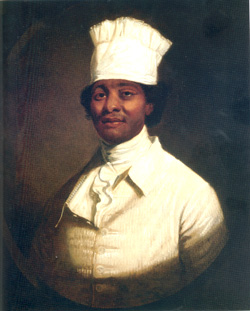
A painting sometimes identified as a portrait of Hercules the chef and attributed to Gilbert Stuart
George Washington may have been in some ways uniquely admirable as a political leader, but as a slaveholder he was no better than he found it convenient to be. Today’s Philadelphia Inquirer reports on recently discovered documents that show how brutally Washington could treat even his most favored household slaves.
When Washington went to Philadelphia to head the federal government there, he took his chef Hercules with him to the President’s Mansion. Hercules’ talent as a gourmet cook made him famous shortly after his arrival in the reestablished capital, and the president acknowledged his skill by allowing him unheard-of privileges, for example allowing him to earn income by selling leftovers from the kitchen, and to use this income to dress himself in a style that gained him a reputation as one of Philadelphia’s foremost dandies.
In the spring of 1787, Prince Louis-Philippe of France visited Mount Vernon. He reports that the Washingtons were upset that Hercules had escaped. Any thought that Washington might have been a benevolent master loved by his slaves should be dispelled by a conversation his manservant had with Hercules’ six year old daughter. The servant asked the little girl if she was sad that she might never see her father again. “Oh! Sir, I am very glad, because he is free now.” What could she have seen that would have made a little girl happy that her father had gone away, never to return?
For many years, it was assumed that Hercules had escaped while in Philadelphia. The Quaker city was after all the world’s foremost center of abolitionism; it might have been relatively easy for a skilled man who had collected some savings to find his way to freedom there. Perhaps Hercules had seen freedom ready at hand, and simply taken it.
With a recently uncovered farm report and a cache of letters it makes intelligible, we now learn a far darker story. In the spring of 1796, a year before the end of Washington’s second term as president, a woman named Oney Judge, who was Martha Washington’s personal maid, disappeared from the President’s Mansion. Washington would employ detectives to hunt for Oney Judge, eventually running her to ground in Portsmouth, New Hampshire. Oney Judge may have been trying to make her way to Nova Scotia, where several fugitives from Washington’s plantation at Mount Vernon had already made homes. The Washingtons then decided that it was too dangerous to try to keep slaves in Philadelphia. When they went to Mount Vernon that summer, they took the whole establishment with them. When they returned to Philadelphia, they returned alone.
With the president and his lady 130 miles away in Philadelphia, there was no need for a gourmet chef at Mount Vernon. Hercules and his sons were sent to the fields. Evidently the demotion came as a shock to Hercules’ son Richmond, who was soon caught stealing money. Informed of this theft, President Washington saw a plot to escape, and surmised that it might be a father-son enterprise. He ordered Hercules and Richmond sent to the clay pits, the hardest and most degraded task given to slaves at Mount Vernon. On 22 February 1797, as George Washington celebrated his 65th birthday, Hercules disappeared from the plantation. President Washington’s term was due to expire 10 days later, when John Adams was inaugurated as president on 4 March. One might imagine that Hercules was afraid of what might happen when Washington came home. Afraid, perhaps, that his capricious master might find new ways of humiliating him; afraid, perhaps, that he would be unable to restrain his own anger at the thoughtless and unjust treatment he had received, so that if he stayed he might do something that would lead the Washingtons to make life even worse for his children than they would make it in response to his escape.
He saw his shadow. BOO HOO. I never knew exactly where the tradition comes from. Here it is.
“German tradition holds that if a hibernating animal sees its shadow on Feb. 2 — the Christian holiday of Candlemas — winter will last another six weeks. If no shadow is seen, legend says spring will come early”.
No moving picture, but extremely moving words. A 1967 speech doesn’t have any business being so relevant to the events of 2010. The “demonic destruction tool” Dr King describes from about the 5 minute mark on is still operating quite smoothly.




 acilius
 believer1
 lefalcon
 losthunderlads
 vthunderlad
 Panther Red