In response to the Believer’s post below, I’ve added the World Values Survey to our page of “Reference” links.
All posts in category Responses
Posts replying to remarks that have appeared elsewhere on the blog
World Values Survey, II
Posted by acilius on April 30, 2010
https://losthunderlads.com/2010/04/30/world-values-survey-ii/
The Cat That Is Not There
 Ron Aharoni, professor of mathematics at the Israeli Institute of Technology and the subject of the post below, writes us at losthunderlads @ gmail. com to let us know that his book The Cat That Is Not There has been published. The book is only out in Hebrew so far, but Ron was kind enough to send along an English language summary that begins below. You can find the whole thing after the “More” tag, including his proposed definition of “philosophy”: “Philosophy studies human thinking, while assuming that the conceptual system studied is identical with the one used for the study. ”
A definition of “philosophy”
Introduction
This article suggests a definition for the term “philosophy”. It is a summary of a book, “The Cat That is Not There”, published by Magnes Publishing House (Hebrew University Press), 2010. The title comes from a dictum attributed to William James: “A philosopher is a blind man searching in a dark room for a black cat that isn’t there.”
Why define “philosophy”?
It is clear why philosophers are interested in the definition of “philosophy”, but why should a layman care? Here is one reason: philosophy is the only field in which you can find problems 2500 years old that are still open, and that despite tremendous efforts no tangible progress has been made towards their solution. You may find this as motivation to try your own luck against the problems. But a more reasonable approach is to try to understand what in the nature of philosophy makes the existence of such problems possible.
People regard philosophy with a mixture of awe and suspicion. Awe because its problems look deep, suspicion because no concrete insights emerge from philosophical discussions. But nobody, including philosophers, is sure what precisely philosophy is. What is its subject matter? And is it the topic that makes a discussion philosophical, or the way the topic is studied? Philosophy is concerned with human thinking, but human thinking is part of the world – why should its study be different from that of any other subject? The object of a philosophical discussion is always a fata morgana, that disappears when you get closer. If it becomes tangible, it no longer belongs to the realm of philosophy. There is undoubtedly something unique about philosophy, setting it apart from all other branches of knowledge.
Beyond all this, the definition of “philosophy” is interesting because it bears on the philosophical problems themselves. At least, the definition given in this article does.
Peculiarities
- Why is the philosophical discussion meaningful, if it destroys everything great, interesting and important? Because what we destroy is nothing but a tower of cards. (Wittgenstein)
The touchstone of any definition of philosophy should be the ability to explain its many peculiarities. For example, the fact mentioned above, that two and a half millennia of research have not brought any progress on the main problems. As Wittgenstein put it, “Today’s philosophers are not any nearer to understanding reality than Plato. Isn’t it amazing how far Plato advanced?” In other fields robust edifices of knowledge are constructed, one solid layer upon another. Nothing of the sort exists in philosophy. As Wittgenstein’s remark cited above testifies, every construction is accompanied by just as much destruction. Nothing is agreed upon, and the general spirit is that of constant debate. “There is undoubtedly confusion, absurdity and puzzlement in philosophy” (Peter Strawson). More than in any other field, philosophical study usually relates to the sayings of previous researchers rather than to the object of study. All these puzzling characteristics must have a common origin, and more likely than not, one that can be sharply defined.
What kind of problem is “what is philosophy”?
Let me start by expropriating the problem of “what is philosophy” from the possession of philosophers. It is not a philosophical problem at all. The last statement may sound circular, because it depends on the definition of “philosophy”, but one property of philosophy that is agreed upon by all is that it is not empirical. A problem answerable by observation cannot be philosophical. However, the definition of “philosophy” (like all other definitions) is empirical. Finding it means identifying the conceptual structure that people recognize as “philosophy”. This should be done by scrutinizing philosophical writings, to find their common underlying structure.
The ease and confidence with which people recognize philosophical problems testify to the sharpness of this structure. This is not to mean that it is easy to discover: the fact that a mechanism (in this case, that of recognizing philosophical discussions) operates well in our minds does not mean we necessarily know how it operates. In this respect, mental mechanisms are not different from physical ones: having a well functioning digestive system does not mean its owner knows how it works.
Posted by acilius on April 4, 2010
https://losthunderlads.com/2010/04/04/the-cat-that-is-not-there/
Some thoughts about race and sports

These guys are Navajos, not Nazis
The three original Thunderlads- Acilius, LeFalcon, and VThunderlad- have exchanged some emails in recent days in which we’ve been talking about race and sports. The discussion has gotten on to some pretty interesting questions, I think, about politics, economics, culture, etc.
This started when blog founder VThunderlad sent us a link to a news item about “The All-American Basketball Association,” a proposed professional basketball league that will be restricted to players who were born in the USA to two parents “of the Caucasian race.” I blogged about that story a few days ago, explaining my suspicions as to what the promoters are really up to.
In response to VThunderlad’s email, LeFalcon mocked the AABA’s promoters’ claim that African-American players had corrupted the NBA:
There actually is something interesting about
the reasons they give for forming the league:
They’re suggesting that African-Americans have corrupted the sport.
How so?
The white players are grounded in “fundamentals”
(= honest, hard-working).
Black players violate these “fundamentals,” supposedly gaining an unfair advantage from doing so.
It seems to be implied that black players, in a seeming paradox, are both superior players
AND intrinsically lazy.
Question: If opportunism wins the day,
can’t white players similarly “cheat”?
“Both superior players AND intrinsically lazy”- that’s exactly the kind of logical absurdity racism makes it possible for people to accept blithely. VThunderlad expressed surprise about one point:
“”natural born citizens of TWO (2) Caucasian parents” (they seem to have left out a definition of parents being a man and a woman, as one might expect, but perhaps they don’t mind homo-ball, just negro-ball.”
I responded with the theory I laid out in my “Gametime for Hitler” post. Then the conversation started to turn away from the sarcastic tone above (“riddim,” “negro-ball,” etc) and toward a more serious discussion of the underlying issues of race and sport. From LeFalcon:
Posted by acilius on January 24, 2010
https://losthunderlads.com/2010/01/24/some-thoughts-about-race-and-sports/
The Tank Chair
Thanks to “Hairball of Hope,” a regular commenter at Alison Bechdel’s “Dykes to Watch Out For” blog, for calling my attention to the “Tank Chair,” an all-terrain wheelchair.

Posted by acilius on January 11, 2010
https://losthunderlads.com/2010/01/11/the-tank-chair/
Language extinction
In a recent email to me and Le Falcon, blog founder VThunderlad included this link:
VThunderlad commented on the way the link includes an abstract of the article.
Le Falcon replied:
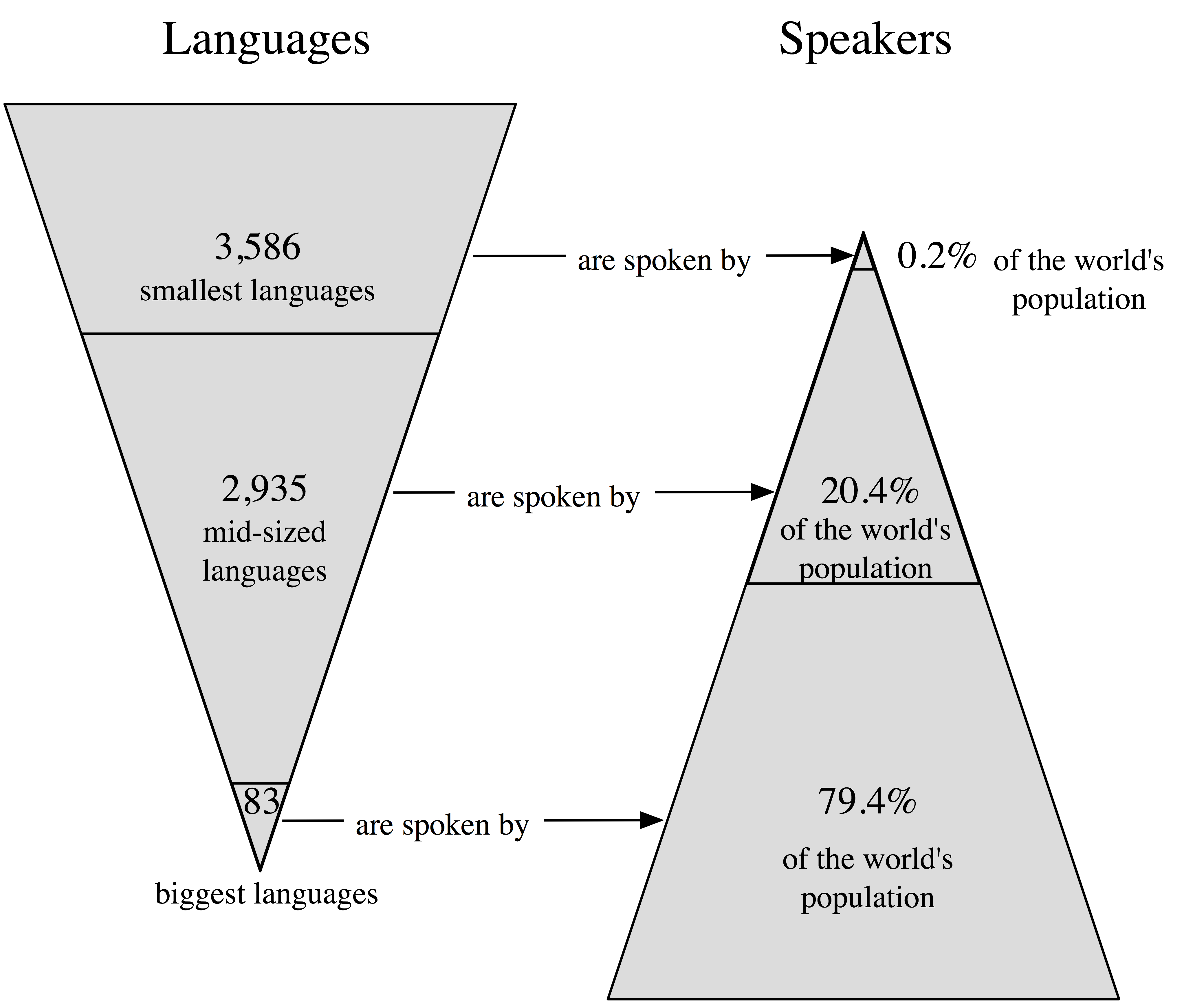
I saw a diagram (along these lines) of two triangles.
One has the point up; the other has the point down.
The first represents world population;
the second represents world languages.It was a striking graphic depiction of this inverse
relation : how most
languages on Earth have very small speech communities;
while a small handful have enormous speech communities.
Here’s an example of such a diagram. I’d have embedded it here, but it’s a bitmap file, which this site does not support.
VThunderlad went on to wonder whether it really makes sense to see the fact that so many languages are faced with extinction as a moral issue in and of itself. I replied that I thought it does. When a language goes extinct, it becomes that much more difficult for a community to understand its ancestors. A break in communication between one generation and another may sometimes be necessary, but is never costless. Language extinction is the result of political and economic policies that people can either support or oppose; therefore, when we decide what our stand will be on those policies, their likely impact on endangered languages should be one of the considerations we take into account.
Posted by acilius on December 13, 2009
https://losthunderlads.com/2009/12/13/language-extinction/
Copernicium
In a comment on the post below, I referred to “Cp” as the chemical symbol of the element #112. It was by reading reports like this one and this one that I got this idea. It turns out that the symbol is actually “Cn.” By way of correction, here’s a YouTube from “The Periodic Table of Videos” about the name “Copernicium.”
And their earlier post about the element and its name:
Posted by acilius on December 11, 2009
https://losthunderlads.com/2009/12/11/copernicium/
Looking for Angels- Skillet
Christian Music
sans Jesus/being a sinner
Posted by CMStewart on April 20, 2009
https://losthunderlads.com/2009/04/20/looking-for-angels-skillet/
Kurt Vonnegut, Jr, on extended families
A quiet evening at home
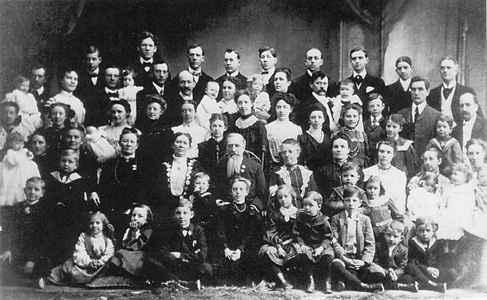
In a comment thread elsewhere on the blog, Cymast, LeFalcon, and I have had a thought-provoking discussion about the concept of extended family. So I decided to post these remarks Kurt Vonnegut, Jr made in his commencement address at Agnes Scott College in Georgia in 1999. You may recognize the passage; it has been widely quoted. It’s still one of the first things I think about when the topic of extended family comes up, so here it is.
OK, now let’s have some fun. Let’s talk about sex. Let’s talk about women. Freud said he didn’t know what women wanted. I know what women want. They want a whole lot of people to talk to. What do they want to talk about? They want to talk about everything.
What do men want? They want a lot of pals, and they wish people wouldn’t get so mad at them.
Why are so many people getting divorced today? It’s because most of us don’t have extended families any more. It used to be that when a man and women got married, the bride got a lot more people to talk to about everything. The groom got a lot more pals to tell dumb jokes to.
A few Americans, but very few, still have extended families. The Navahos. The Kennedys.
But most of us, if we get married nowadays, are just one more person for the other person. The groom gets one more pal, but it’s a woman. The woman gets one more person to talk to about everything, but it’s a man.
When a couple has an argument nowadays, they may think it’s about money or power or sex, not how to raise the kids, or whatever. What they’re really saying to each other, though, without realizing it, is this:
”You are not enough people!”
I met a man in Nigeria one time, an Ibo who had six hundred relatives he knew quite well. His wife had just had a baby, the best possible news in any extended family.
They were going to take it to meet all its relatives, Ibos of all ages and sizes and shapes. It would even meet other babies, cousins not much older than it was. Everybody who was big enough and steady enough was going to get to hold it, cuddle it, gurgle to it, and say how pretty is was, or handsome.
Wouldn’t you have loved to be that baby?
I sure wish I could wave a wand, and give every one of you an extended family – make you an Ibo or a Navaho – or a Kennedy.
Posted by acilius on March 5, 2009
https://losthunderlads.com/2009/03/05/kurt-vonnegut-jr-on-extended-families/
Misheard lyrics
On Monday, Language Log posted about this video:
Today, cymast and I had an exchange in the comments on one of her posts about something similar.
So, here are three links.
A very ambitious collection, where visitors vote to rank mishearings by comic value and submitters include stories to show that they did sincerely mishear the lyrics, that they are not making up parodies; another collection, almost equally ambitious in the number of mishearings recorded and keys by which they are indexed, but without the same means to filter out parodies; and an explanation of why misheard lyrics are known as “Mondegreens,” from snopes.
Posted by acilius on February 18, 2009
https://losthunderlads.com/2009/02/18/misheard-lyrics/
How not to write a blog post
Here Mencius Moldbug provides an example of what I try to avoid doing when I write a post.
1. It’s very long, 32 screens of text.
2. It starts with a series of acronyms that are neither generally familiar to the public nor explained anywhere in the text.
3. It deals with a wide range of topics. The terms “Right” and “Left” as applied to politics, the advantages of royalism over democracy, Carlyle’s theory of the state, the ongoing financial crisis, the relationship of money to value, the evils of John Maynard Keynes, the supreme importance of a strong state, the virtues of corporate CEOs, the mental illnesses of Hitler and Stalin, the evils of separation of powers, and the impossibility of changing anything for the better.
4. It contains strong claims about many matters which the author does not appear to understand. Making an analogy between political systems and stellar evolution, he say that “Betelgeuse, of course, will end in supernova”; a commenter points out that Betelgeuse is not massive enough to end this way. He lumps all proposals to respond to economic difficulties by loosening the fiscal policy of the government under the label “Keynesian,” then attacks John Maynard Keynes for them, regardless of what Keynes actually said or what theories the proposals in question may actually reflect. He claims that all systems which divide of powers within the state violate the Roman strictures against imperium in imperio, ignoring the rest of Roman political thought and the whole practice of the Roman Republic.
These four flaws all point to the same thing: the author of this post needs an editor. An editor would have assigned him a maximum length; would have blue-penciled the acronyms; would have insisted on a coherent arc of development; and would asked the author for the basis of his factual claims. It’s a shame this person blogs instead of submitting his work to an editor, because the piece contains several interesting points as well.
Posted by acilius on February 8, 2009
https://losthunderlads.com/2009/02/08/how-not-to-write-a-blog-post/
Who writes this?
 acilius
 believer1
 lefalcon
 losthunderlads
 vthunderlad
 Panther Red