The Nation, 23 March 2009

Photographer Walker Evans collected picture postcards, and the Metropolitan Museum of Art is exhibiting them.  Here’s one:

walkerevans_12_el

Evidently Calvin Trillin reads Los Thunderlads.  Here’s the first half of this week’s doggerel:

Republicans had hoped they might rekindle
Their party’s prospects through one Bobby Jindal.
But Jindal proved an easy man to mock
(He’s like the dorky page on 30 Rock).

Below find an excerpt from an article headlined “America is #… 15?” by Dalton Conley.  23-march-2009-nationThe article is about the Human Development Index, or HDI, a statistic that has since 1990 been used to gauge the relative well-being of people in various countries.  The American HDI was released for the first time last year.  As the article puts it, “The score consists of three dimensions: health, as measured by life expectancy at birth; access to knowledge, captured by educational enrollment and attainment; and income, as reflected by median earnings for the working-age population.”  The HDI was first developed by Pakistani economist Mahbub ul Haq to enable humanitarian aid groups and development economists to gauge the relative well-being of people in poor countries.  “With some slight adjustments, the index was retrofitted to work for rich countries,” and the results for the USA are quite disturbing. 
(more…)

The American Conservative, 9 March 2009

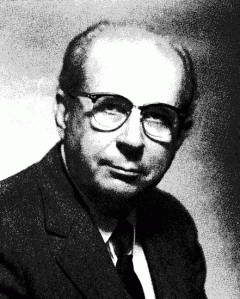
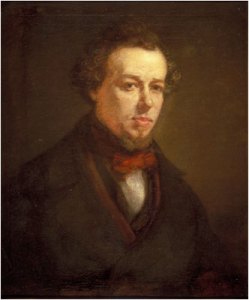
Benjamin Disraeli as a Young Man

A review of Adam Kirsch’s biography of Benjamin Disraeli focuses on Kirsch’s idea that because Disraeli realized he could not stop his fellow nineteenth-century Englishmen from thinking of him primarily in terms of his Jewish ancestry, he “did not attempt to disguise his Jewish background.  He embellished it.”   Disraeli purported to be far more deeply involved with that side of his ancestry than he in fact was, even explaining his active membership in the Church of England as an example of his fealty to “the only Jewish institution that remains… the visible means which embalms the race.”  Meanwhile, the Jewish characters and themes in Disraeli’s novels appall modern sensibilities.  Sidonia, a character in the Young England trilogy (Coningsby, Sybil, and Tancred,) “looks like nothing so much as an anti-Semitic hate figure.  It is amazing, in fact, how Disraeli manages to combine in this one character every malicious slander and paranoid fear that the anti-Semitic imagination can breed.”  Disraeli’s manipulation of the label his fellows had imposed upon him enabled him to become prime minister of the United Kingdom.  Disraeli’s ability to “outline [an] agenda of radical change to be achieved conservatively, a political program that allowed him to reinvent himself as the representative not only of the wealthy and the working class but of the Tory Party, too” has inspired rightist politicians like Richard Nixon and the neocons.      

If Kirsch is right, Disraeli knotted his contemporaries’ perceptions of him around their image of “the Jew,” using their prejudices to transform  himself from a marginal figure unlikely to make a mark in politics into a figure of England’s national mythology.  Another complex of ideas twists around another such image in Brendan O’Neill’s  analysis of the thoughts of some of Israel’s more fervent defenders in the West.  O’Neill argues that the individuals he cites are less interested in Israel as an actual place inhabited by living people than they are in using a particular idea of Israel as a symbol for the values of the Enlightenment.  “In effect, Israel is cynically, and lazily, being turned into a proxy army for a faction in the Western Culture Wars that has lost the ability to defend Enlightenment values on their own terms or even to define and face up to the central problem of anti-Enlightenment tendencies today.”  This use of Israel as a pawn in cultural struggles centered elsewhere shades into philosemitism.  “[A]s Richard S. Levy writes in his book Anti-Semitism: A Historical Encyclopedia of Prejudice and Persecution, simple philosemitism, like anti-Semitism, also treats the Jews as ‘radically different or exceptional’…  Where anti-Semites project their frustrations with the world and their naked prejudices onto the Jews, and frequently onto Israel, too, the new philosemites project their desperation for political answers, for some clarity, for a return to Enlightenment values onto Israel and the Jews.  Neither is a burden the Jewish people can, or should be expected to, bear.”    

(more…)

The Nation, 16 March 2009

nation-16-marchFrances Richard reviews recent books about the nature of photography, citing along the way several not-so-recent but extremely interesting titles.  Among these is Downcast Eyes by Martin Jay, a study of twentieth century French thinkers who have argued that vision is overrated.  Also, Michael Fried’s 1967 essay “Art and Objecthood,” in which he introduced the idea that he’s been working on ever since, that we change people and situations when we make them objects of vision and that it is dishonest of us to pretend that our making images and looking at them is an innocent activity that has no effect on anyone or anything else.   

A review of Steven Shapin’s The Scientific Life: A Moral History of a Late Modern Vocation focuses on the influence of corporate money on scientific research.  The reviewer holds that this is the most important question Shapin ought to have addressed in his history of the last few decades of science, and that it is a question he takes far too lightly. 

Gary Younge argues that only an energized Left can turn the populist impulses that the current global economic crisis has spawned into something constructive.   “The last time things looked this bad globally, we ended up with Nazism, fascism and war,” Younge points out, claiming that today’s right-wing populists are little better than their counterparts of the period after the Great War.  The most memorable part of Younge’s column for me was the story at the beginning:

When I was a student in the Soviet Union, during Gorbachev’s final months, my landlady used to take the dog out for a walk at the same time every night. Since it was winter and I am no dog lover, I decided not to join her. But when the weather cleared up I once accompanied her and found that she met several other local dog owners at exactly the same time. The timing, it turned out, was no coincidence. They called it Dog Hour–the moment when the state-sponsored news program RUSSIA-VOTEVremya came on, and they therefore left the house.


Following the news over the past few months, I have felt like taking a quick walk around the block myself. Watching global capitalism disintegrate in real time is a dizzying experience.

Chronicles, March 2009

same-sex-weddingI first became aware of the political question of same-sex marriage in 1980.  I was in fifth grade and we were supposed to conduct debates in class about issues of the day.  I was assigned to the group opposing this proposition: “The Equal Rights Amendment should be passed.”  Researching for my part in the debate, I found an argument that the plain wording of the proposed amendment (“Equality of rights under the law shall not be denied or abridged by the United States or by any State on account of sex”) would grant men the right to marry other men and women the right to marry other women.  This was in the context of an article opposing the amendment. 

At first I was excited to find this claim.  Up to that point all that I had been able to find were dry legal arguments that would never capture the attention of my classmates.  Here at last was a point that would grab the imaginations of everyone in the room and hold them for as long as I needed. 

But as I thought it over, I realized that there was an obvious question that would stump me if anyone asked it.  Why shouldn’t same sex couples be free to marry?  The only argument in the article was that same sex couples couldn’t reproduce.  My immediate response to that was to think of my grandmother.  When my grandfather died, she was in her fifties, most assuredly past childbearing.  Yet she remarried, and no one thought to object.  So why was the sterility of same sex couples a reason why they should not be allowed to marry? 

In the decades since, I’ve kept an eye on the debate.  I’ve found some very sensible arguments supporting the right of same sex couples to marry, and some intriguing arguments to the effect that no one should marry.  But what I have not found are many substantive arguments in favor of reserving marriage for heterosexual couples.  This is quite surprising.  One would assume that by now someone would have come up with a worthwhile argument  in favor of the status quo

In this issue of Chronicles, Thomas Fleming explains why he is opposed to same sex marriage.  (more…)

A full world

Nicholas Georgescu-Roegen

Nicholas Georgescu-Roegen

The 1-15 February issue of Counterpunch carries the third of three short articles in which Paul Craig Roberts surveys the academic discipline of economics.  On the 15th, I noted the first two parts, in which he defended supply-side theory and attacked the theory of comparative advantage.  This third part concludes with Roberts declaration that “If economics is to be of any use to humanity, it must cease being absurd.” 

Roberts points out that the world mainstream economists describe is one empty of things humans have made.  In this “empty world,” the only limits on production are the limits of human productive activity.  “Nature has no role in the game.”  In the real world, by contrast, nature is full of things humans have made.  The limited availability of natural resources, of “natural capital,” imposes sharp, sometimes terrifying limits on production.  Roberts calls for economics to be reinvented to give a realistic description of this “full world.”     

Roberts takes up the banner of mathematical economist Nicholas Georgescu-Roegen, who proposed that the discipline of economics essentially start over.  Georgescu-Roegen attacked the “Solow-Stiglitz production function,” which, according to Roberts, “assumes that man-made capital ias a substitute for nature’s capital.  Therefore, as long as man-made capital can be reproduced, there are no limits to growth.”  Roberts asserts that Georgescu-Roegen “destroyed the Solow-Stiglitz production function,” but mainstream economists cling to it “because it is a mathematical way of saying that ecological limits on economic growth do not exist.”  Georgescu-Roegen proposed replacing the Solow-Stiglitz function and the body of economic theory that depends on it with a new understanding of production.  “In contrast to the Solow-Stiglitz absurdity, Georgescu-Roegen made it clear that production is the transformation of resources into useful products and waste products.  Labor and man-made capital are agents of transformation, while natural resources are what is transformed into useful products and waste products.  Man-made capital and natural capital are complements, not substitutes.”  Nicholas Georgescu-Roegen died in 1994; the most notable living exponent of his ideas is economist Herman Daly.  Roberts particularly recommends Daly’s 2007 book Ecological Economics and Sustainable Development.

The American Conservative, 23 February 2009

Woodrow Wilson

Woodrow Wilson

Daniel McCarthy chronicles the American Right’s shift from the skepticism about the office of US President that fueled the principled critique of excessive presidential power that thinkers like James Burnham and Willmoore Kendall sustained in the middle decades of the twentieth century to the abject presidentialism of the Bush/ Cheney Republicans.  McCarthy does not suggest an agenda for curbing the power of the presidency; still less does he express agreement with my favorite idea, abolishing the office.  He does not even hope for a return to the arrangement of the nineteenth century, when the Congress was the senior partner in the leadership of the federal government.  The wish he does express is that conservatives will once more express a wish for a return to those days.   

Richard N. Gamble, author of the magnificent book The War for Righteousness: Progressive Christianity The Great War, and the Rise of the Messianic Nation and of a neat article about Irving Babbitt’s view of Abraham Lincoln, reviews several  recent books about Woodrow Wilson’s foreign policy.  Most interesting to me were Gamble’s remarks about What the World Should Be: Woodrow Wilson and the Crafting of a Faith-Based Foreign Policy, by Malcolm D. Magee.  The key paragraph is this:

Magee gets Wilson largely right, but one further refinement of his analysis would have been helpful in connecting American Christianity and the “faith-based foreign policy” of the subtitle. It is not enough to say that Wilson was a Calvinist or a Presbyterian. Wilson, as Magee’s evidence makes clear, was a particular kind of Calvinist and Presbyterian. He adhered to a branch of Calvinism that tried to reorder every institution by bringing it under Christ’s dominion. Magee refers to “the Presbyterian tradition,” but it is doubtful there ever has been anything so unified in American history. Wilson owed his view of the church and the world not to confessional Presbyterianism but to the transformationist strand of evangelicalism that came to dominate mainstream Presbyterianism in the late 19th century. Wilson imbibed an activist faith that in many ways distorted historic Presbyterianism. He rejected creedal, confessional Presbyterianism. In order to understand his foreign policy, then, we must understand not his Presbyterian roots in general, but the fact that he emerged from a branch of Protestantism that had more in common with low-church, sentimental, meliorist evangelicalism than with historically Reformed Christianity. Magee fills in an important dimension of Wilson’s thought and personality, but finding the precise faith on which Wilson based his foreign policy requires that the story of American Christianity be told a bit differently.

Kirkpatrick Sale reviews a novel by Carolyn Chute, The School on Heart’s Content Road.  In a fictional town in a rural Maine, a commune full of aging hippies form an unlikely alliance with the local underemployed rednecks.  Forming a militia, they decide that the only way for Mainers to reclaim their freedoms is to secede from the USA.  Since Chute is herself a member of the real-life 2nd Maine Militia and an advocate of the dissolution of the USA, it is perhaps surprising that the militiamen are an unimpressive bunch whose revolt peters out into drunkenness and random fornication.  But not so surprising that she promises a series of four sequels. 

Bill Kauffman goes to his favorite gun show and reports that the American Left is missing a fertile recruiting ground there.  The attendees are “working and rural citizens who are pro-Bill of Rights, anti-corporatist, and open to radical alternatives.”

Primate Shame

mc.maricopa.edu

mc.maricopa.edu

Can’t we all just be primates?

The Nation, 9 March 2009

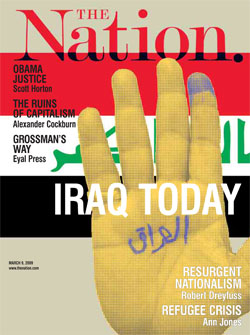
nation-9-march-2009Robert Dreyfuss looks at the regional elections held in Iraq on 31 January and finds good news.  A new alliance of Shi’a and Sunni groups is beginning to operate in Iraqi politics.  Soon, Dreyfuss hopes, this alliance will be strong enough to present itself as a genuinely nationalist bloc and to insist on an end to the US occupation. 

No such development is in sight in Afghanistan.  An editorial expresses the fear that the Obama plan to send more US troops to that country will make “Bush’s War” into Mr O’s very own. 

Katha Pollitt speaks up for free speech.   On the twentieth anniversary of the Ayatollah Khomeini’s fatwah against Salman Rushdie, she finds fault with fellow leftists whose only response to violent behavior by Muslims who have taken offense at speech labeled anti-Islamic is to “see these incidents as gratuitous provocations by insensitive Westerners” and to support restrictions on speech that amount to blasphemy laws.  She grants that many of the incidents that have generated violent responses in the Muslim world have indeed been gratuitous provocations by insensitive Westerners, and is happy to list extremists from other religious groups whose conduct has been every bit as deplorable as the worst we have seen from Khomeini and his coreligionists.  But:

Appeals to the hurt feelings of religious people are just a dodge to protect the antidemocratic and retrograde policies of religious states and organizations. We’re all adults; we have to live with unwelcome expression every day. What’s so special about religion that it should be uniquely cocooned? After all, nobody at the UN is suggesting that atheists should be protected from offense–let alone women, gays, leftists or other targets popular with the faithful. What about our feelings? How can it be logical to say that women can’t point out sexism in the Bible or the Koran but clerics can use those texts to declare women inferior, unclean and in need of male control? And what about all the abuses religions heap on one another as an integral part of their “faith”?

An essay about Israeli novelist David Grossman of course concerns itself chiefly with Grossman’s insights into the Israeli/ Palestinian conflict.  What sticks with me from the essay is this quote from Grossman about writing:

[Y]ears ago, reflecting on a story he was writing that featured a bitter, emotionally unstable protagonist, he described his desire to have the tale surprise him. “More than that, I want it to actually betray me,” he wrote.

To drag me by the hair, absolutely against my will, into the places that are most dangerous and most frightening for me. I want it to destabilize and dissolve all the comfortable defenses of my life. It must deconstruct me, my relations with my children, my wife, and my parents; with my country, with the society I live in, with my language.

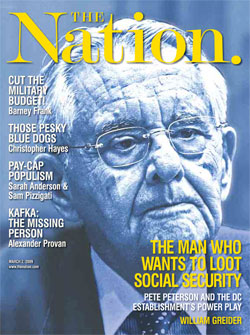
The Nation, 2 March 2009

nation-2-march-09A review of several new books from and about Iran mentions the thinker Jalal Al-e Ahmad and his concept of gharbzadegi, or “intoxication with all things western”  The reviewer assures us that this concept represents “one of the most influential critiques of the West.”  In fact, he takes issue with some of the books under review for failing to presuming to discuss twentieth-century Iranian intellectual life, yet failing to mention the presence in that life of so towering a figure as Al-e-Ahmad.  Since I’d never heard of Al-e-Ahmad or gharbzadegi, I thought I’d better make a note of this.  So here are links to the Wikipedia articles about Al-e-Ahmad and gharbzadegi

An interview with astrophysicist Adam Frank focuses on Frank’s religious ideas.  Frank’s big idea seems to be that religious systems give us a way of processing and talking about emotions like awe and wonder that come upon us when we notice the scope and orderliness of natural phenomena.  Frank shows his Astronomy 101 class a TV documentary about the origin of the universe, then asks them what they think of the music.  His point is that the documentarians are packaging the Big Bang as a creation myth.  Frank does not mean this as a condemnation of the show- on the contrary, he embraces this myth-making.  Frank’s attitude reminds me of an idea I mentioned here a few days ago.  I’ve long thought there was a great deal to be said about the relationship of scientific theories about the origin of the universe to traditional creation myths.

The Atlantic Monthly, March 2009

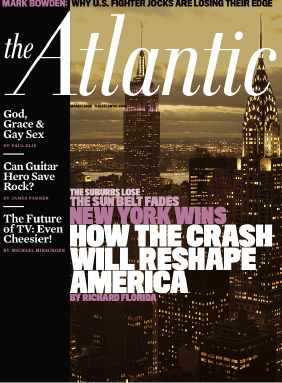
atlantic-march-2009A profile of Rowan Williams, the archbishop of Canterbury, focuses on this gifted theologian’s attempts to lead the Anglican communion in its effort to make up its mind about homosexuality.  Williams himself has many friends who are gay and took a consistently liberal line on gay issues before 2002, when he became the nominal leader of Christianity’s third most popular tradition.  In 1989 Williams gave a speech to the Lesbian and Gay Christian Movement called “The Body’s Grace,” in which he argued that a Christian understanding of grace requires us to understand that persons need to be seen in particular ways.  Sexual relationships provide one of these ways of being seen that are key to the development of the human person.  Christians must therefore find value, not only in persons who are inclined to engage in  homosexual acts, but in those acts and the relationships of which they are part.  The essay is, from one point of view, quite conservative- Williams claims that the kind of being seen that deserves this value is a kind that must be developed over time and that only one person may do the seeing.  He thus sets his face against sexual liberationists who would resist the imposition of couplehood as the one appropriate form of human sexuality, and aligns himself with those who would merely extend that imposition to same sex relationships.  Compared to other Christian leaders, of course, Williams does not seem conservative at all.  Even the view that same-sexers should be allowed to imitate opposite-sex couples and to assimilate their behavior to norms that have traditionally been imposed on them is daringly progressive in the world where the Archbishop of Canterbury moves.   

Since most of the Anglican communion’s 80,000,000 members live in African countries where homosexuality is the object of extreme cultural disapproval, it has been quite difficult for Williams to hold to his liberal, assimilationist stand while at the same time meeting the first requirement of his job and keeping the communion united. 

Atlantic editor James Bennet recalls his meeting with recently assassinated Hamas leader Nizar Rayyan.  A theologian of a very different stripe from that of Rowan Williams, Rayyan’s “bigoted worldview, and his rich historical imagination, gave him a kind of serenity.”  This serenity was nothing daunted when Rayyan sent his own son on a suicide mission against an Israeli settlement and planned to send another on a similar mission.

Those of us who call for the abolition of the US presidency (what with today being Presidents’ Day and all) will thank the Atlantic for its note of “Politicians: Be Killed or Survive,” a study finding that the only political figures who face a significant risk of assassination are those who operate in systems where power is so highly centralized that assassinating one person will effect significant change in the policies of the state.

Brian Mockenhaupt reports on an effort to persuade US combat veterans that it’s okay to seek help for psychological injuries by showing them performances of Sophocles’ plays about wounded warriors, Ajax and Philoctetes.