Among the nostalgists

When I was a kid in the 1970s, I would often hear my older brothers talking with each other and with my parents about Vietnam and Watergate. I would ask them to explain what those words meant, which presented them with quite a challenge when I was three or four years old. I never gave up, though, and by the time I’d figured them out I was not only hooked on those topics but on history in general, including the political history of the USA in the decades following the Second World War. I grew up to become a classical scholar, but when I’m not professionally engaged with ancient Greek and Latin literature my mind still wanders to those matters.

I’ve been spending a bit of my free time talking about such things on Twitter lately, especially in threads growing out of posts made by commentator Richard Brookhiser. The other day, for example, Mr Brookhiser brought up an interlocutor of his who speculated that right-wing Congressman John Ashbrook’s 1972 primary challenge to Richard Nixon’s reelection campaign was an attempt to clear the field for Ronald Reagan to replace Nixon as the Republican nominee. In response, I pointed out that Reagan already faced a formidable rival for conservative support in Vice President Spiro Agnew, and that if Ashbrook had somehow knocked Nixon out of the race he would have established himself as a substantial figure in his own right, another obstacle to any attempt Reagan might have made to launch a bid of his own.

The national attention given to yesterday’s election for mayor of New York reminded me of another 1960s-1970s figure who captured my attention when I was a child, John V. Lindsay. When I was about nine years old, I was watching the old Batman show when the character of Mayor Linseed appeared. My mother was with me, and she laughed out loud. She said that the actual mayor of New York in those days was named Lindsay. “Linseed” didn’t strike me as clever enough wordplay to account for her laughter, and she said that indeed it was not why she was laughing. What struck her as funny was that while the actual Mayor Lindsay was a ridiculously handsome man, whose good looks sometimes got in the way of his political career, the makers of Batman had cast a plain-faced character actor as his fictional counterpart. Evidently they were afraid that even in their fictional universe, it would be too much to ask people to believe that the mayor of such a big city could look like a movie star. I’ve also mentioned John Lindsay on Twitter quite a few times in recent months.

What has really kept Mayor Lindsay front of mind for me lately is not so much the comparisons I’ve seen between him and Mayor-elect Mamdani, but another item I’m checking off the list of things I was curious about when I was a kid. In those days, people ten or twenty years older than me would occasionally mention the TV show Dark Shadows, a daytime soap opera that added a vampire to its cast and became a big hit. I couldn’t imagine that- to me, soaps were the dullest things imaginable, windows into the lowest cavern of Hell, the circle of ice where absolutely nothing happens. I wasn’t a great horror fan, but I knew that vampires got people moving and couldn’t imagine how one would fit into a genre that seemed to cultivate tedium for its own sake.

I stumbled on Dark Shadows when the Sci Fi Channel was running it in the 90s, and was intrigued. I didn’t have the time to keep up with it for very long, though. So when during the COVID-19 lockdowns my wife and I found that the entire series was available for free to watch on demand, I suggested we take a look. We wound up watching the whole thing in a little more than a year. In the 2022, I realized that the calendar was the same as it was in 1966. I decided to watch each episode on the 56th anniversary of its original broadcast. So I watched episode #1 on Monday, 27 June 2022. My plan was to post any thoughts I might have in the comment sections of blogs about the show, as I had done in 2020 and 2021.

I quickly found that, while some blogs were still keeping their comboxes open, no community like the one I had participated in at Danny Horn’s Dark Shadows Every Day could be found in any of them. So if I were going to write up my thoughts about the show in the way I wanted to do, I would have to post them on a blog of my own. I decided to stick with my idea about the calendar, and have each post go live on the anniversary of the episode it reviews. At first I assumed no one would read the site, and gave it a name no one would be likely to find. But people did start reading and responding to it, so I changed its name to Dark Shadows Commentary. That’s where the bulk of my online writing as “Acilius” has been since then, which is one of the reasons this site has been so quiet. Since John Lindsay was Mayor of New York the entire time Dark Shadows was being produced in that city, it’s no wonder he keeps popping into my head.

The heyday effect

I teach ancient Greek and Latin at a university in the interior of the USA. I’ve often given a course on the ancient Mediterranean world in general, a core curriculum class that draws a cross-section of the undergraduate student body. When I first taught it, I was required to use a textbook by D. Brendan Nagle, called The Ancient World: A Social and Cultural History.

Teaching from that book, I spent a good deal of time talking and thinking about things that were outside my scholarly emphasis. For example, Nagle puts heavy emphasis on Athens’ relative prosperity in the immediate aftermath of the Bronze Age and its conservatism in the centuries that followed. That led me to wonder if the two were related- perhaps the Athenians so prided themselves on the advantages they once enjoyed over their neighbors that they couldn’t imagine having anything to learn from them, and so ended up as quite an old-fashioned place before their age of reform started in the seventh century BCE.

If that was what happened, it would be an example of what I sometimes think of as “The Heyday Effect.” This effect can be seen, not only in sovereign states like ancient Athens, but any group that gives its members one of the major focal points of their identities- political parties, religious traditions, families, professions, etc. When members look back on a specific period in the past and see their group doing what they think it could and should be doing now, they will tend to attach themselves to everything associated with that period.

I say “When members look back… and see” because the Heyday Effect can operate regardless of the historical facts about the period- the heyday might not in fact have been so great, indeed it may be entirely fictional, but what governs people’s current behavior is their belief that it was real. That’s just W. I. Thomas’ “definition of the situation”- situations defined as real are real in their consequences.

I say “what they think it can and should be doing now” because I acknowledge that a Heyday Effect doesn’t pop up out of thin air- it is rooted in the material interests people currently have, in what they want to keep and what they want to gain, even as it influences the way they evaluate those interests.

I say “everything associated with that period” because a Heyday Effect is not a product of sustained rational calculation. It doesn’t apply just to the practices and institutions that actually contributed to whatever success the group had in its heyday, or that could have been expected to contribute to the successes ascribed to imaginary heydays. Everything left over that reminds people of the heyday becomes precious. If it is positively destructive of the current interests of the people who look back on the heyday, they will sooner or later let it go, but they will be so reluctant to do so that they will likely spend a great deal of time trying to convince themselves and anyone who tries to reason with them that it is somehow worth keeping.

Tweets of the Week: Swear Trek Edition

I’m often impressed at how well the captions sync with the lip movements on Swear Trek gifs derived from the original Star Trek. Especially so for the ones featuring James Doohan or DeForest Kelley, those guys just looked like great cussers.

I can hardly remember that this wasn’t the actual line:

All three of these look convincing:

There are also some good ones with Captain Kirk:

And notable guest stars have their moments as well. Here’s Number One:

And Captain Pike:

Abraham Lincoln:

And my overall favorite, Lieutenant Commander Ben Finney:

How long ago was Christmas Day 2021?

  1. Christmas Day 2021 was about a month ago, so we’re as far from that Christmas as it was from the Russian anti-satellite test that endangered the International Space Station.
  2. In its turn, that test is now about as far in the past as the US withdrawal from Afghanistan was when it took place.
  3. That withdrawal is now as far in the past as the container ship Ever Given getting stuck in the Suez canal was when it happened.
  4. The Ever Given incident is halfway in time between the present and the SpaceX Dragon 2 launch in May 2020.
  5. The SpaceX Dragon 2 launch is halfway between the present and Canada’s legalization of cannabis in October 2018.
  6. Canada’s legalization of cannabis is halfway back to July 2015, when New Horizons flew by Pluto.
  7. The New Horizons flyby is halfway back to early 2009, when Barack Obama became US President.
  8. Mr O’s inauguration is halfway back to early 1996, when Muppet Treasure Island was playing in theaters.
  9. The release of Muppet Treasure Island is halfway back to the summer of 1969, when Apollo 11 landed on the Moon.
  10. Apollo 11 is halfway back to 1916, when a million people died for absolutely nothing in the battle of the Somme.
  11. The battle of the Somme is halfway back to 1811, when the battle of Tippecanoe spelled doom for Native Americans in what would become the state of Indiana.
  12. The battle of Tippecanoe is halfway back to 1600, when they killed Giordano Bruno for having opinions.
  13. The killing of Giordano Bruno is halfway back to 1178, when five monks in Canterbury saw the meteor strike that formed the crater on the Moon that is named Giordano Bruno.
  14. The formation of the Giordano Bruno crater is halfway back to 334, when Constantine the Great was nearing the end of his time as emperor of the Romans.
  15. Constantine’s reign is halfway back to 600 BCE, when the city of Milan was founded.
  16. The founding of Milan is halfway back to the origins of the Assyrian civilization.
  17. The origins of the Assyrian civilization are halfway back to the Younger Dryas cooling event.
  18. The Younger Dryas is halfway back to the founding of the oldest permanent human settlement yet found, a group of huts where the town of Dolní Věstonice now stands in the Czech Republic.
  19. The settlement at Dolní Věstonice is halway back to the beginning of the Upper Paleolithic Age.
  20. The beginning of the Upper Paleolithic Age is halfway back to the building of the earliest surviving stone structures on Earth, which stand near Wadi Haifa in southern Egypt.
  21. The building of the Wadi Haifa structures is halfway back to the first evidence of humans in Europe (circa 210,000 years ago.)
  22. The oldest evidence for humans in Europe is halfway back to the likely date of the first bears.
  23. The first bears are halfway back to the beginning of the Cryogenian Ice Age (circa 850,000 years ago.)
  24. The beginning of the Cryogenian Ice Age is halfway back to the earliest stone tools crafted by hominins.
  25. The first stone tools crafted by hominins are halfway back to the first human ancestors who ate grasses and sedges.
  26. The first human ancestors who ate grasses and sedges are halfway back to the last common ancestors of humans and the other great apes (circa 7,000,000 years ago.)
  27. The last common ancestors of humans and the other great apes are halfway back to the Middle Miocene Climate Transition.
  28. The Middle Miocene Climate Transition is halfway back to the comet strike in the Sahara that produced all that black glass.
  29. The comet strike in the Sahara is halfway back to the Paleocene/ Eocene Thermal Maximum (circa 56,000,000 years ago.)
  30. The Paleocene/ Eocene Thermal Maximum is halfway back to the extinction of Pelorosaurus (circa 112,000,000 years ago.)
  31. The extinction of Pelorosaurus is halfway back to time of the common ancestors of mammals, the mammaliaformes.
  32. The mammaliaformes appeared halfway between the present and the Late Ordovician Event, a mass extinction that wiped out about 85% of all marine species (450,000,000 years ago.)
  33. The Late Ordovician Event is about halfway back to the appearance of the first multicellular life on Earth (circa 900,000,000 years ago.)
  34. The appearance of the first multicellular life on Earth is about halfway back to the appearance of the first eukaryotes on Earth.
  35. The appearance of the first eukaryotes on Earth is about halfway back to the formation of the oldest fossils yet found on Earth (circa 3,500,000,000 years ago.)
  36. The oldest fossils yet found date back about halfway to the formation of Arcturus (circa 6,900,000,000 years ago.)
  37. Multiply 6,900,000,000 by two, and you get 13,800,000,000. So the formation of Arcturus dates back halfway between the present and the Big Bang. Now you know how long ago Christmas really was.

David Morgan-Mar’s “Planet of Hats”

I like the original Star Trek and I like web comics, so it should be no surprise that I like David Morgan-Mar’s “Planet of Hats,” a web comic that recapitulates the original series at the rate of one episode every Wednesday afternoon.

He’s into the third and final season of the show now, and I think he’s a bit unfair to those late episodes.  For example, the one up now is “Plato’s Stepchildren.”  Mr Morgan-Mar draws that one with wax crayons, creating the most childish image possible, and explains in the notes that when he watched the episode in preparation for the strip its childishness was the aspect of it he most wanted to bring out.

I agree there is a lot of childishness in that one, but I think it’s intentional.  The story is that a group of people who devoted themselves to the study of Plato’s works and the re-creation of the material appearance of fourth-century BCE Athens have acquired the power of telekinesis.  Plato’s works are addressed to adults, the re-creation of past times is an extremely challenging project, and if we try to imagine the social system that might develop among beings who had the power of telekinesis we might be surprised at all the ways in which the need to pick things up and move them from one place to another shapes our interactions with one another.

So, when we first hear that premise, we might imagine a story in which highly intellectual people develop unfamiliar powers, try to use Plato’s philosophy to learn how to build a society that will channel those powers in constructive ways, and through those attempts learn a variety of unexpected truths, some of them showing that Plato gave the wrong answers to his questions, some of them showing that there were important questions Plato never thought to ask, and some of them showing that there were questions Plato didn’t have to ask, because everyone in his society, unlike anyone in the world of the story, already knew the answers.

That isn’t the story that the makers of Star Trek chose to tell, however.  In the episode, the Platonians developed their telekinetic powers, along with virtual immortality, thousands of years before the Enterprise came to their planet.  Whatever the difficulties of adjustment may have been in those days, they have left no trace for us to see.  All that is visible to us is the end result of centuries of boredom and decadence, a population that has long since exhausted its creativity and spirit of inquiry and uses its powers to derive easy sadistic pleasures.  Of course their behavior is crude and childish; of course our heroes, subjected to their great powers until the end of the episode, are helpless to respond to the Platonians in any but childish ways.  The contrast between the Platonians’ elegant setting and lofty intellectualism on the one hand, and their dismally crude behavior on the other, is precisely the point of the episode.

Several other episodes of Star Trek develop the theme of beings with great powers who have lost interest in any but sadistic pleasures, and so force our heroes to engage in some crude form of physical violence.  One of these is “The Gamesters of Triskelion,” which Mr Morgan-Mar describes as “like someone took all the other episodes of Star Trek, dumped them in a blender, and hit ‘high’ for 30 seconds.”  A species consisting of three creatures have evolved into nothing but brains collects beings from various parts of the galaxy and pits them against each other in fights to the death.  In an episode Mr Morgan-Mar has not yet got round to summarizing, “The Empath,” creatures with giant heads have tortured two scientists to death and proceed to torture Kirk, Spock, and McCoy nearly to death; at the end the creatures claim that they did not do this for pleasure, but as a test to see if a woman whom they were holding prisoner in the same dungeon would volunteer to undergo torture in order to save others.  Our heroes apparently accept this explanation, but what sticks with us is the fact that hyper-intellectual, super-powered creatures resort to torture as their primary means of gathering information.

I think that this theme is the result of the frustration that writers and producers of Star Trek felt with television as a medium.  Knowing all the great high-minded ways in which television could be used to educate and challenge viewers, they were confronted by the fact that the most popular programs were often the least ambitious intellectually and artistically, that a canned laugh-track or a bare-knuckle brawl would beat a probing drama or an incisive documentary in the ratings every time.  That same frustration comes out in the episodes in which the Enterprise crew, representatives of the high ambitions of the series’ creators, find themselves at the mercy of children, episodes like “Charlie X,” “Miri,” “The Squire of Gothos,” and “And the Children Shall Lead.”  The fact that the first three of those come from early in the first season suggests that the creators of the show initially felt pressure from the studio to direct the show to a preteen audience, pressure which they resented.  Certainly that kind of resentment is at work in the other great masterpiece of 1960s American science-fiction television, The Twilight Zone, most obviously in the episode “It’s a Good Life,” in which a child with telekinetic powers turns a small rural town into an extreme nightmare.  I suppose the makers of a science fiction show on TV, in an era when science was thought of primarily as kids’ stuff, would live in fear that children would change the channel and end their careers.

RIP Leonard Nimoy

Here are some links people have been sending me since Leonard Nimoy died:

1. Sugar Smack Spock

It is illogical to suppose that you can touch my Sugar Smacks and live

2. 20 Cool Things Nimoy Did Other Than Star Trek

3. Her heart belongs to Beard Spock (nsfw)

4. A Star Trek comic book that never existed:

5. Leonard Nimoy was definitely my favorite member of the original cast of In Search Of…, and here’s one of the most endearing episodes:

https://www.youtube.com/watch?v=s-b609_uaBg

My wife and I have some connections to the Episcopal Church, and one of the things that first attracted me to that institution was this In Search Of… episode about the tragic life of Bishop James Pike.  All the remarks from clerics reminiscing about the efforts they made over the years to keep their friend Jim out of trouble showed me that, whatever its faults, it was an organization in which there was an abundance of clear heads and warm hearts:

https://www.youtube.com/watch?v=1AkrMe_5yOg

5. When I was about twelve years old, my brother gave me an LP I still have.  I should say “the LP I still have,” since I haven’t had a record player for 20 years and got rid of all the others long ago.  This one is The Touch of Leonard Nimoy, and it’s a prized possession.  Here’s my favorite track:

6. There are a couple of outstanding made-for-TV-movies Leonard Nimoy was involved in that I haven’t seen mentioned in any of the tributes.  One is 1991’s Never Forget, in which he played Holocaust survivor Mel Mermelstein, who in the 1980s found a way to fight Holocaust deniers in court.  The movie makes it clear that Mermelstein is Good and the denialists are Bad, of course, but there’s a lot more complexity and humanity in the film, as it explores Mermelstein’s relationship with his family and shows how the consequences of the Holocaust continue to play out in all of their lives.

Another is 1971’s The Assault on the Wayne, where he plays the commander of a nuclear submarine against which enemy agents are hatching evil schemes.  He’s the good guy, but watching him I’m very glad I am not a sailor- it would be quite exhausting to serve under a commanding officer like that, especially in the confined world of a submarine.  His first encounter with his supply officer is terrifying:

https://www.youtube.com/watch?v=8s2AHkU_N-8&start=747

7. Many dolls of Mr Spock have been brought to market over the years, and I’ve never wanted any of them.  But I may one day be unable to resist buying this Leonard Nimoy action figure, based on his appearances in two episodes of The Simpsons (the one with the monorail, and the one that spoofed In Search Of…):

“You didn’t do anything.” “Didn’t I?”

8. And no tribute to Leonard Nimoy would be complete without a remembrance of this, the definitive dramatization of the work of J. R. R. Tolkien:

https://www.youtube.com/watch?v=AGF5ROpjRAU

And a comment thereon:

https://www.youtube.com/watch?v=WPkByAkAdZs&start=69

In which I demonstrate that I am the world’s nerdiest nerd

In a recent email exchange with the cofounders of this blog, known here as VThunderlad and Lefalcon, I shared some thoughts about Star Trek, including a synopsis of an idea for a new Star Trek movie.  Find the relevant bits below the jump.

(more…)

“A fan base primarily comprised of people who got to the store after Mad sold out”

Contrary to the cover, it is very unlikely that anything funny was going on there.

I just stumbled on the Wikipedia article for the late, unlamented Cracked magazine.  It’s hilarious, 10,000 times funnier than anything that ever appeared in Cracked magazine, on a par with the best material that appears on that magazine’s descendant, Cracked.com.  Who could fail to laugh out loud at an article that includes this sentence: “In Germany, there were three publications that included Cracked reprints. First was Kaputt, which ran from 1974 to 1983; it was followed by Stupid, which ran from 1983 to 1984, and, finally, Panic.”

Considering what happens to interesting writing on Wikipedia, it will probably be deleted and replaced with something unreadable by the end of the morning, so I’ve preserved its text here, after the jump.   (more…)

George McGovern

Former US Senator George McGovern, the Democratic Party’s 1972 presidential nominee, died the other day.  Since 1972, it has often been possible to argue that one major party’s presidential candidate was a lesser evil than the other party’s offering; I thought Barack Obama was a demonstrably lesser evil than John McCain in 2008, for example.  But Senator McGovern was not at all evil.  He was quite admirable and thoroughly sane.  Of course he lost by one of the biggest landslides in history, to Richard Nixon.

Four years ago, I posted a link to a commercial the McGovern campaign put on television in 1972.  Here’s another link to the same commercial, the only political ad I’ve ever seen that is 100% free of bullshit.  The senator talks with a group of veterans just returned from Vietnam with newly acquired disabilities; it’s as uncomfortable to watch as you’d suppose it would be, and that seems to have been the intention.

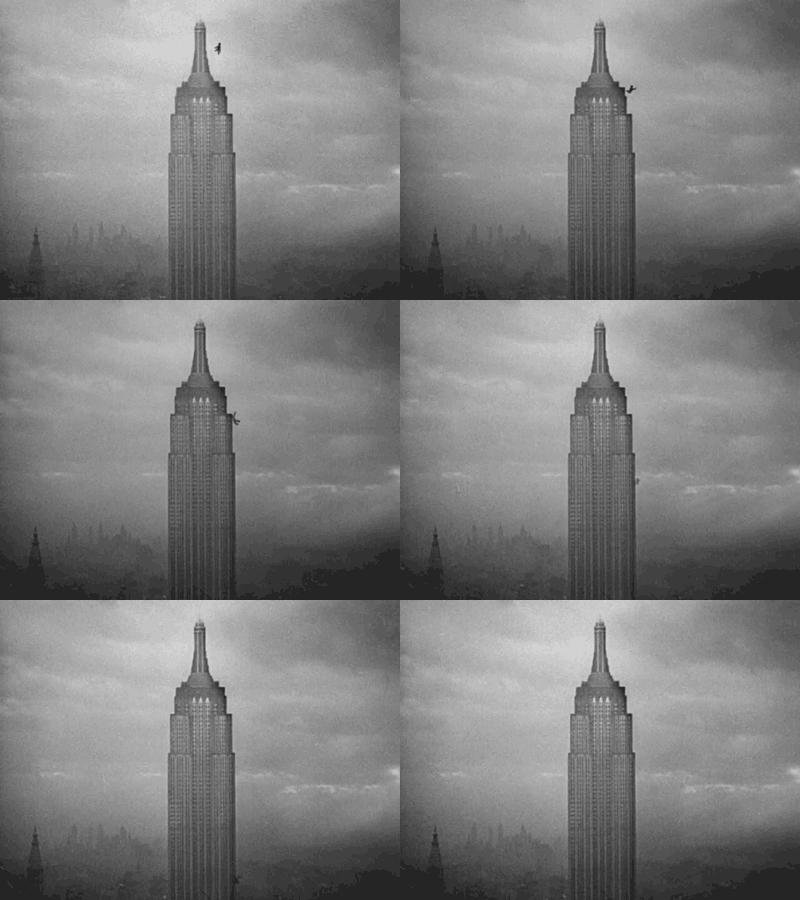
King Kong falling off the Empire State Building

This animated gif appeared in Slate some time ago, I love it: