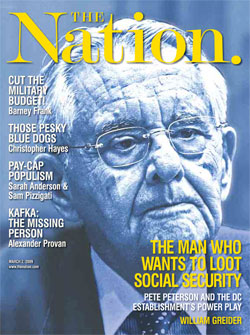
The Nation, 2 March 2009

nation-2-march-09A review of several new books from and about Iran mentions the thinker Jalal Al-e Ahmad and his concept of gharbzadegi, or “intoxication with all things western”  The reviewer assures us that this concept represents “one of the most influential critiques of the West.”  In fact, he takes issue with some of the books under review for failing to presuming to discuss twentieth-century Iranian intellectual life, yet failing to mention the presence in that life of so towering a figure as Al-e-Ahmad.  Since I’d never heard of Al-e-Ahmad or gharbzadegi, I thought I’d better make a note of this.  So here are links to the Wikipedia articles about Al-e-Ahmad and gharbzadegi

An interview with astrophysicist Adam Frank focuses on Frank’s religious ideas.  Frank’s big idea seems to be that religious systems give us a way of processing and talking about emotions like awe and wonder that come upon us when we notice the scope and orderliness of natural phenomena.  Frank shows his Astronomy 101 class a TV documentary about the origin of the universe, then asks them what they think of the music.  His point is that the documentarians are packaging the Big Bang as a creation myth.  Frank does not mean this as a condemnation of the show- on the contrary, he embraces this myth-making.  Frank’s attitude reminds me of an idea I mentioned here a few days ago.  I’ve long thought there was a great deal to be said about the relationship of scientific theories about the origin of the universe to traditional creation myths.

A letter to various officials

On Saturday, 24 January, I sent letters to President Obama and my other elected representatives in Washington about the case of Harry Nicolaides.   Below is the text of the letter to Mr. O.  I sent slightly modified versions of the same letter to the other officials.   

Dear Mr. President:


Several weeks ago, I read a magazine article by Australian writer Harry Nicolaides.  Mr. Nicolaides reported from Tachilek, a town in Burma located only about 50 meters from the Thai border.  Originally published in an Australian magazine called Eureka on 29 July 2008, the article claimed that child pornography was openly sold in Tachilek.  Mr. Nicolaides claimed to have evidence of videos sold there depicting the binding, rape, and torture of thousands of children aged 4-12 years, most of them apparently produced in Europe or North America, the rest in Cambodia and other Asian countries.  Mr. Nicolaides claims that men from Europe and North America cross the border freely, never searched by Thai or Burmese police.  The article is available online at: http://www.eurekastreet.com.au/article.aspx?aeid=8264.  


I saw Mr. Nicolaides’ name in the news again today.  Thai authorities arrested him late in August, four weeks after the publication of his article about Tachilek.  The charge against him was that a novel he had published in 2005 contained a paragraph that might be construed to refer to Thailand’s Crown Prince and to constitute lese-majeste.  This past Monday, a Thai court sentenced Mr. Nicolaides to three years in prison. 


It strikes me that Mr. Nicolaides’ article about Tachilek, if true, constitutes a valuable service.  One might hope that the Thai authorities would be grateful to be alerted to the existence of this trade and for the opportunity to stamp it out.  Certainly the citizens of the countries where the videos are produced owe Mr. Nicolaides a debt of gratitude.   Perhaps the court that sentenced Mr. Nicolaides was not at liberty to take this service into account.  In view of the international dimension of the Tachilek question, might the Thai ambassador to the United States have occasion to put in a word with the king? 


Thank you for your kind attention to this matter. 


Yours truly,

New Harry Nicolaides Site

In happier days

In happier days

And now

And now

Forde Nicolaides has launched a new website to publicize the case of his imprisoned brother Harry.  The site includes a petition, a fundraising link, and contact information for Australian officials.  I learned of it from an email sent to members of the Free Harry Nicolaides group on Facebook.  The same email included a statement from Harry Nicolaides.  What struck me about it was how much attention he paid to fellow prisoners of his who are suffering even worse deprivations than he is.  Read it, after the jump.

(more…)

Harry Nicolaides hopes for royal pardon

Waiting for His Majesty

Waiting for His Majesty

Latest newspaper report about Harry Nicolaides:

THE stress can be seen in Harry Nicolaides’ gaunt face as he leans towards the barred prison window and speaks of his hopes and fears.

“I am so jaded, so cynical,” says the Melbourne writer, hunching his shoulders. “I am placing my faith in my family, my girlfriend, the Australian Government and the reputation of the Thai king. The Australian Government is supporting a pardon for me. But I am gun-shy at the moment. It’s all so opaque.”

Sentenced on Monday to three years’ jail for writing three sentences about the Thai royal family in a novel that sold fewer than 10 copies, Nicolaides, 41, can now only hope for a pardon from Thailand’s King Bhumibol Adulyadej. There is no guarantee he will get one.

Read the rest in Australia’s The Age.

More on the Harry Nicolaides Affair

In the 29 July, 2009 edition of Eureka Street, Australian writer Harry Nicolaides reported on a market at Tachilek in eastern Burma where child pornography is openly sold.  The authorities in Burma and Thailand must know about this market; Mr Nicolaides certainly had no difficulty finding it.  Yet, Mr Nicolaides writes, “unless you are a saffron-robed monk, you will not be searched on the way back across the border into Thailand.”  Nicolaides’ report was reprinted in the December  January issue of Chronicles (which I noted here.)

The Thai police have still done nothing about the trafficking of child pornography from Tachilek through their country.  But let it not be said that they have simply been idle.  No indeed.  In August, four weeks after the publication of the report, they arrested the reporter.  Monday, he was sentenced to three years in prison.  The court did not of course say that Mr Nicolaides was being punished for exposing the Thai government’s complicity in brutal crimes against children the world over.  Instead, the authorities cited a brief passage in an extremely obscure (sold only seven copies) novel Nicolaides self-published almost four years ago, claiming that the fictional character of a Crown Prince described there reflected badly on Thailand’s actual Crown Prince and thus violated the country’s strict laws against lese-majeste

Here is an online petition asking for the release of Harry Nicolaides. 

More information about the case, including links to several sites offering downloads of the novel which the Thai authorities cited as the cause of their action against Mr Nicolaides, can be found here

On 24 September 2008, a friend of Harry Nicolaides posted a piece about Mr Nicolaides’ arrest.  On 20 January 2009, the same friend posted about Mr Nicolaides’ plea and sentence; I commented on this latter post, bringing up Mr Nicolaides’ investigation into the child pornography industry and asking his friend whether he thought the prosecution might be the Thai government’s way of hushing that issue up.

Harry Nicolaides

The man who told the truth

The man who told the truth

Recently, I posted on Australian writer Harry Nicolaides’ gut-wrenching expose of the complicity of the Thai and Burmese governments in the worldwide market for child pornography.  Now, Harry Nicolaides is in a Thai prison.  The official charge against him is that a novel he wrote and self-published in 2005, a novel which The Economist says sold “fewer than ten copies,” showed disrespect to Thailand’s Crown Prince, a man who is in fact never named in the novel.  Here’s an article on the case from Melbourne’s The Age newspaper, and here’s one from The Sydney Morning Herald about an Australian senator who is calling for action to free Nicolaides.

Gastronomic Rape

travel.webshots.com

travel.webshots.com


Celebrity “chef” Gordon Ramsay exhibits symptoms of variant Creutzfeldt-Jakob disease.

New Year, Old Right

The latest issues of my two standard “paleocon” reads, The American Conservative and Chronicles, include fewer really noteworthy articles than average.  The election of Mr O as president and a solidly Democratic Congress freed them to turn from the constant struggle to show how they differ from the Bush/ Cheney Right and toward standard-issue conservative territory, denouncing government spending, unconventional family structures, etc. 

The contest, 1972

The contest, 1972

In The American Conservative, Daniel McCarthy argues that George McGovern’s 1972 presidential campaign triggered a transformation of the Republican Party by driving Cold War liberals into its ranks.  Mary Wakefield reviews Richard Dowden’s Africa: Altered States, Ordinary Miracles, Wakefield reports that Dowden, the current director of the Royal African Society, is deeply pessimistic about western programs to aid Africa, but deeply optimistic about Africans’ ability to build a future for themselves if left alone. 

Sheldon Richman offers a succinct explanation of the Austrian school of economics’ theory of malinvestment and uses this theory to explain the current financial crisis.  David Gordon reviews a book by the most celebrated living opponent of the theory of malinvestment, Paul Krugman. 

Aung San Suu Kyi

Aung San Suu Kyi

Jim Pittaway,  licensed psychotherapist and friend of the late Michael Aris, applies his professional expertise and his personal animosity to Aris’ widow, Aung San Suu Kyi, to an analysis of western policy towards Burma.  The professional expertise part is quite illuminating.  Suggesting that we should view the Burmese regime’s relationship to its people as one of captor to hostage, he asks us to apply “the biggest rule of hostage crises: unless you can take him out right now, don’t threaten the perp.”  Since the 1990 election, the West’s dealings with Burma have consisted primarily of a series of idle threats, and the hostages have paid the price. 

(more…)

Not with a whimper

Originally posted on snotr.com in October, this video (which I found on haha.nu) may offer some consolation to those who don’t enjoy the Christmas season.

The Nation, 5 January 2009

nation-5-jan

A few things stand out in this issue.  Two pieces by A. C. Thompson, the cover story with a general focus and another about one particular case, detail acts of violence committed in the aftermath of Hurricane Katrina by groups of white homeowners who banded together to keep blacks out of their neighborhoods. 

On a happier note, Katha Pollitt offers her annual list of do-gooders who deserve our financial support.  Each of the ten she cites sounds terrific, I’d single out Iraq Veterans Against the War as the group with the most urgent agenda. 

A collection of poems by the late Jack Spicer includes some love letters Spicer wrote, an editorial decision which moves the reviewer to comment on Spicer’s views about the relationship between poetry and correspondence.  While Spicer often compared poems to personal correspondence, and “the idea or form of the letter underlies much of his published work,” in practice he always maintained a sharp distinction between the two genres.  “What Spicer recognized as poetry was always fierce and contentious and, despite the devices that feign otherwise, written to no one and for no one. ”  Indeed, Spicer’s discussion of Emily Dickinson centered on the difficulty of distinguishing between letters and poems, taking it for granted that this distinction was a needful one.

(more…)