
http://www.cnn.com/2009/POLITICS/02/27/gop.poll/ The 2012 presidential campaign is under-way. I, for one, just don’t want to hear about it. I’d much rather hear about Ayn Rand’s Objectivism, and that’s saying a lot.
All posts in category Politics
It’s official!!!!!!!!!!!!!!!!!!!!!!!!!!!!!!!!!!!!!!
Posted by lefalcon on February 28, 2009
https://losthunderlads.com/2009/02/28/its-official/
Bobby the Page
I think Boby jindal sounds just like Kenneth the page from30 Rock. See what you think.
Posted by believer1 on February 25, 2009
https://losthunderlads.com/2009/02/25/boby-the-page/
Primate Shame

mc.maricopa.edu
Posted by CMStewart on February 22, 2009
https://losthunderlads.com/2009/02/22/primate-shame/
The Fairness Doctrine
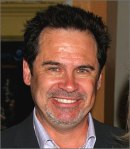
 Moron.
 Loser.
There’s been some talk going around about re-instituting the Fairness Doctrine (whatever that is!). The phrase “the Fairness Doctrine” has, I guess, been floating around for years, but I’ve never known exactly what it was. I proceeded to “conduct Internet research,” i.e. look it up on Wikipedia. Noble Wikipedia describes it thusly:
“The Fairness Doctrine was a policy of the United States Federal Communications Commission (FCC) that required the holders of broadcast licenses both to present controversial issues of public importance and to do so in a manner that was (in the Commission’s view) honest, equitable and balanced.”
Ha ha ha. Do they mean like “fair and balanced”?
The Wikipedia article includes this quote, which provides a more specific description of the doctrine:
“The Fairness Doctrine had two basic elements: It required broadcasters to devote some of their airtime to discussing controversial matters of public interest, and to air contrasting views regarding those matters. Stations were given wide latitude as to how to provide contrasting views: It could be done through news segments, public affairs shows, or editorials. The doctrine did not require equal time for opposing views but required that contrasting viewpoints be presented.”
FAUX News and other outlets would, naturally, claim that they’re already doing this. But perhaps worth pondering is: HOW are they doing it?
The format of brief, rapid, superficial debates among panelists claiming to represent the different sides of an issue, seems to have become furiously prevalent on the TV news channels. But I’ve seen countless of those little debates where one or more important perspectives on the issue simply weren’t articulated by anyone on the panel. It gives the illusion of a nice, pluralistic discussion; but in actuality, the range of possible opinions that are allowed to be expressed is severely constrained. (And the public cannot get up in arms about not being exposed to certain areas of opinion which are being kept so tightly hidden from them, they are, by consequence, not really aware those opinions even exist. Stated differently: How can you agitate for airtime for suppressed views you’re not even cognizant of?)
Alternatively, a channel like FAUX will often present the controversial or non-doctrinal viewpoint … but not in a persuasive or serious way. Rather, the guest with that viewpoint is made to look like an idiot or a nut; and essentially functions as a foil or punching-bag to which the more “level-headed” guests can construct their arguments in counter-point.
And all of this, naturally, begs the question of: Is it really even possible for a government bureau to monitor the level of “fairness” contained in media outlets’ presentations? In some absolute way: NO.
But on the other hand, if we imagine that there is something like collective, communal consensus in our society … and that this consensus reflects a conglomeration and mushing together of everyone’s attitudes, beliefs, shared concepts, values, etc. … and that this big body of mush can be reduced down into some approximate, comprehensible “average,” i.e. a rough consensus that’s more-or-less apparent to us as inhabitants of / participants in society … is it TRULY unreasonable to ask that broadcasting outlets – reaching millions upon millions of listeners / readers / viewers – take some responsibility for remaining (kinda .. sorta .. to some extent) plausibly inside the *gravitational field* of that shared consensus .. as opposed to consistently and intentionally violated it and going against its grain, in order to candycoat and propagate an agenda coinciding only with the interests of the socio-economic ultra-elite (by cloaking it in a fallacious veil of trite buzzphrases about populism)?
My local AM station’s current weekday schedule includes:
Rush Limbaugh: noon-3:00pm
Dennis Miller: 3:00-4:00pm
Sean Hannity: 7:00-10:00pm
Dennis Miller (again!): 10:00pm-1:00am
That’s TEN HOURS of ultra-rightwing commentary in every 24-hour period … on the only station receivable during daytime on the AM band, in arguably most liberal/progressive community in the state.
The situation is obviously at crisis-level in a society that claims to possess some kind of “democratic” system. The problem is that the Fairness Doctrine, while a superb idea in abstract, winds up being just too sketchy on how it could be effectively implemented … to result in a more pluralistic, representative discourse … instead of just transferring tyrannical thought-control over from corporate entities into government hands. Government and the media outlets are already in such deep collusion, state control of the media would hardly constitute a different situation from what we’re already living under. It might even be a productive step, in that it would make the control more obvious, more overt; and help to dispel the ridiculous but widely-held apprehension that media discourse is by-and-large “free.”
Posted by lefalcon on February 21, 2009
https://losthunderlads.com/2009/02/21/the-fairness-doctrine/
The Atlantic Monthly, March 2009
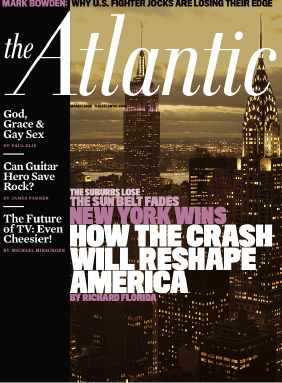 A profile of Rowan Williams, the archbishop of Canterbury, focuses on this gifted theologian’s attempts to lead the Anglican communion in its effort to make up its mind about homosexuality. Williams himself has many friends who are gay and took a consistently liberal line on gay issues before 2002, when he became the nominal leader of Christianity’s third most popular tradition. In 1989 Williams gave a speech to the Lesbian and Gay Christian Movement called “The Body’s Grace,” in which he argued that a Christian understanding of grace requires us to understand that persons need to be seen in particular ways. Sexual relationships provide one of these ways of being seen that are key to the development of the human person. Christians must therefore find value, not only in persons who are inclined to engage in homosexual acts, but in those acts and the relationships of which they are part. The essay is, from one point of view, quite conservative- Williams claims that the kind of being seen that deserves this value is a kind that must be developed over time and that only one person may do the seeing. He thus sets his face against sexual liberationists who would resist the imposition of couplehood as the one appropriate form of human sexuality, and aligns himself with those who would merely extend that imposition to same sex relationships. Compared to other Christian leaders, of course, Williams does not seem conservative at all. Even the view that same-sexers should be allowed to imitate opposite-sex couples and to assimilate their behavior to norms that have traditionally been imposed on them is daringly progressive in the world where the Archbishop of Canterbury moves.
Since most of the Anglican communion’s 80,000,000 members live in African countries where homosexuality is the object of extreme cultural disapproval, it has been quite difficult for Williams to hold to his liberal, assimilationist stand while at the same time meeting the first requirement of his job and keeping the communion united.
Atlantic editor James Bennet recalls his meeting with recently assassinated Hamas leader Nizar Rayyan. A theologian of a very different stripe from that of Rowan Williams, Rayyan’s “bigoted worldview, and his rich historical imagination, gave him a kind of serenity.” This serenity was nothing daunted when Rayyan sent his own son on a suicide mission against an Israeli settlement and planned to send another on a similar mission.
Those of us who call for the abolition of the US presidency (what with today being Presidents’ Day and all) will thank the Atlantic for its note of “Politicians: Be Killed or Survive,” a study finding that the only political figures who face a significant risk of assassination are those who operate in systems where power is so highly centralized that assassinating one person will effect significant change in the policies of the state.
Brian Mockenhaupt reports on an effort to persuade US combat veterans that it’s okay to seek help for psychological injuries by showing them performances of Sophocles’ plays about wounded warriors, Ajax and Philoctetes.
Posted by acilius on February 15, 2009
https://losthunderlads.com/2009/02/15/the-atlantic-monthly-march-2009/
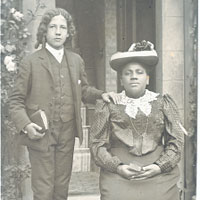
A picture of Lawrence Dennis as a boy
Here’s a picture of Lawrence Dennis and his aunt as they were when they toured England in 1910. In those days he was billed as “the boy evangelist.” Before long Dennis would be sent from his boyhood home in Atlanta to elite schools in the North, schools where he began passing for white. After graduating from Harvard, Dennis would serve as a US Army officer in World War I, a diplomatic agent in Central America in the 1920s, and a banker on Wall Street in the days before the Great Crash. In a series of books published in the 1930s, he would argue that the USA was destined to become a fascist state in which dissent would be greeted with criminal prosecution. For predicting the end of free speech in America, he would be arrested and tried for sedition in 1944. I guess that showed him.
Posted by acilius on February 15, 2009
https://losthunderlads.com/2009/02/15/a-picture-of-lawrence-dennis-as-a-boy/
Is Your Marriage Ever Legal? Ask Ken Starr!
Posted by CMStewart on February 11, 2009
https://losthunderlads.com/2009/02/11/is-your-marriage-ever-legal-ask-ken-starr/
A novel interpretation of academic freedom
Thanks to 3quarksdaily for linking to this column by Stanley Fish. I’ve copied four excerpts below:
My assessment of the way in which some academics contrive to turn serial irresponsibility into a form of heroism under the banner of academic freedom has now been at once confirmed and challenged by events at the University of Ottawa, where the administration announced on Feb. 6 that it has “recommended to the Board of Governors the dismissal with cause of Professor Denis Rancourt from his faculty position.” Earlier, Rancourt, a tenured professor of physics, had been suspended from teaching and banned from campus. When he defied the ban he was taken away in handcuffs and charged with trespassing.
What had Rancourt done to merit such treatment? According to the Globe and Mail, Rancourt’s sin was to have informed his students on the first day of class that “he had already decided their marks : Everybody was getting an A+.”
Later:
Rancourt is a self-described anarchist and an advocate of “critical pedagogy,” a style of teaching derived from the assumption (these are Rancourt’s words) “that our societal structures . . . represent the most formidable instrument of oppression and exploitation ever to occupy the planet” (Activist Teacher.blogspot.com, April 13, 2007).
Among those structures is the university in which Rancourt works and by which he is paid. But the fact of his position and compensation does not insulate the institution from his strictures and assaults; for, he insists, “schools and universities supply the obedient workers and managers and professionals that adopt and apply [the] system’s doctrine — knowingly or unknowingly.”
It is this belief that higher education as we know it is simply a delivery system for a regime of oppressors and exploiters that underlies Rancourt’s refusal to grade his students. Grading, he says, “is a tool of coercion in order to make obedient people” (rabble.ca., Jan. 12, 2009).
It turns out that another tool of coercion is the requirement that professors actually teach the course described in the college catalogue, the course students think they are signing up for. Rancourt battles against this form of coercion by employing a strategy he calls “squatting” – “where one openly takes an existing course and does with it something different.”
And then:
Rancourt first practiced squatting when he decided that he “had to do something more than give a ‘better’ physics course.” Accordingly, he took the Physics and Environment course that had been assigned to him and transformed it into a course on political activism, not a course about political activism, but a course in which political activism is urged — “an activism course about confronting authority and hierarchical structures directly or through defiant or non-subordinate assertion in order to democratize power in the workplace, at school, and in society.”
Clearly squatting itself is just such a “defiant or non-subordinate assertion.” Rancourt does not merely preach his philosophy. He practices it.
How did Rancourt’s supervisors respond to his activities?
The record shows exchanges of letters between Rancourt and Dean Andre E. Lalonde and letters from each of them to Marc Jolicoeur, chairman of the Board of Governors. There is something comical about some of these exchanges when the dean asks Rancourt to tell him why he is not guilty of insubordination and Rancourt replies that insubordination is his job, and that, rather than ceasing his insubordinate activities, he plans to expand them. Lalonde complains that Rancourt “does not acknowledge any impropriety regarding his conduct.” Rancourt tells Jolicoeur that “Socrates did not give grades to students,” and boasts that everything he has done was done “with the purpose of making the University of Ottawa a better place,” a place “of greater democracy.”
Posted by acilius on February 10, 2009
https://losthunderlads.com/2009/02/10/a-novel-interpretation-of-academic-freedom/
The Nation, 16 February 2009
 Gary Younge points out that Barack Obama is in fact the President of the United States. From this fact, he draws the conclusion that the time has come to put away the posters and other artwork endorsing him and get to work pressing him from the left, as others will surely do from the right.
Akiva Gottlieb reviews two novels by Bulgaria’s Angel Wagenstein, novels replete with heretical rabbis, lazy Nazis, and other exemplars of moral ambiguity. The review opens with a reference to Joshua Cohen’s “Untitled: A Review,” from Cohen’s short-story collection The Quorum. A reviewer finds on his doorstep a volume of six million crisp, white, blank pages. He decides that this book is a history of the Holocaust, in fact “the only way to write about the event, the idea.”
Eric Alterman takes on Rabbi Abraham Foxman and the Anti Defamation League of B’nai B’rith. Alterman contends that “Anti-Defamation League” is a double misnomer for this organization. He contends that it launches harsh attacks indiscriminately at all critics of Israel, attacks which less often counter defamation than they themselves amount to defamation; and that under Rabbi Foxman it is so much a one-man operation as hardly to qualify as a “league.”
The editors endorse Tom Geoghegan for Congress. (Others have done so since.) Geoghegan has written for many publications regularly noted here. A piece of his appeared in the final issue of The Baffler, for example, the only one that appeared after I started these notes.
Posted by acilius on February 9, 2009
https://losthunderlads.com/2009/02/09/the-nation-16-february-2009/
The Nation, 9 February 2009
 Alexander Cockburn quotes an interesting-sounding new book, Bad for Democracy: How the Presidency Undermines the Power of the People, by Dana Nelson. Unfortunately, Nelson does not recommend abolishing the presidency. She does have as set of proposals to reduce its power, and she exhorts her readers to find ways of participating in political life that do not involve voting or require fixing national attention on one man.
This issue includes part one of “Adventures in Editing,” Ted Solotaroff’s recollections of his time as an associate editor of Commentary in the early 60s. Anyone interested in writing will enjoy Solotaroff’s description of how he learned to do that job. Anyone interested in narcissists will enjoy his description of how Norman Podhoretz behaved as the editor-in-chief of the magazine in those days. One bit that sticks in my mind is near the end of the piece:
Shortly after I’d come to Commentary, I’d had a conversation with Norman about recruiting writers for the magazine. It didn’t seem to me such a big deal; I said I knew of four or five people at the University of Chicago alone who could write for Commentary.
“You think you do, but you don’t,” said Norman. “You don’t realize how unusual you were for an academic.”
I said I wasn’t that unusual: I’d lucked into an opportunity my friends hadn’t had. “I’ll bet you a dinner that I can bring five writers you’ve never heard of into the magazine in the next year.”
“I don’t want to take your money,” he said. “I’ll bet you won’t bring three.”
We turned out to both be right. With one exception, the novelist Thomas Rogers, none of the former colleagues I had in mind sent in a review or piece that was lively enough to be accepted. A former fellow graduate student, Elizabeth Tornquist, who was turning to political journalism, also managed to crack the barrier. The others had fallen into one or another mode of scholarly dullness or pedagogical authority and, despite my suggestions, had trouble climbing out to address the common reader. My efforts to point their prose and sense of subject in a broader direction brought little joy to either party. “How dare you revise my formulation of an intellectual problem” was a fairly typical reaction.
Which may explain why so few “little magazines” really make it. It certainly explains why someone Podhoretz was needed to make Commentary into the magazine it was. Only someone who didn’t mind losing friends could edit their work as mercilessly as was necessary to make a periodical worth reading and talking about; only someone who didn’t mind sucking up to the rich and famous could raise the money and generate the publicity necessary to keep it afloat.
Posted by acilius on February 9, 2009
https://losthunderlads.com/2009/02/09/the-nation-9-february-2009/
 Panther Red