
They say there’s a “rule of threes,” that celebrities always die three at a time. It’s nonsense, of course, but it often seems that way. So, the other day we lost Harvey Pekar. Yesterday, we heard that George Steinbrenner had died. And now, news comes to us of the death of Tuli Kupferberg. We featured Tuli’s song “Nobody for President” here in November 2008; here it is again.
All posts in category Politics
Tuli Kupferberg, RIP
Posted by acilius on July 14, 2010
https://losthunderlads.com/2010/07/14/tuli-kupferberg-rip/
Some hide themselves, and some are hidden; some are forgotten, and some forget themselves
 July’s issue of The American Conservative features a piece by Sydney Schanberg arguing that American prisoners of war were left over in Vietnam after direct US involvement in the war there ended in the early 1970s. Several other pieces pick up on Schanberg’s claims, drawing various dire conclusions about the nature of the political leadership in the USA.
In October 2008, The Nation ran an article in which Schanberg made this same case. I noted that article here, remarking that I had never given that idea much credence, but that I was impressed by what Schanberg wrote. Amid the pro-Schanberg pieces in this issue of The American Conservative is a short article by Gareth Porter titled “The evidence doesn’t stack up.” Unlike the readers who wrote The Nation to protest the appearance of Schanberg’s piece there , Porter does not list his credentials as a scholar of the US military involvement in Vietnam. Also unlike them, he does not declare himself to be displeased that the topic is being discussed. Most profoundly unlike them, he looks at Schanberg’s evidence and judges it on its merits. Indeed, the only way in which Porter resembles the outraged letter writers of The Nation is that he finds Schanberg’s case entirely unconvincing. Porter argues that the document to which Schanberg has attached the greatest weight is almost certainly a forgery, and in any case doesn’t say what Schanberg claims it says. Porter goes on to find many other faults with Schanberg’s argument.
Something that is, I think, quite well-founded appears in Andrew Bacevich’s contribution to the discussion:
Like slavery or the Holocaust, Vietnam is part of the past not yet fully consigned to the past.
The practice of publicly displaying the POW/MIA flag testifies to this fact. On the one hand, it represents a lingering communal acknowledgment of loss and more broadly of massive national failure. On the other, it sustains the pretense—utterly illusory—that a proper accounting, not only of the missing but of the entire Vietnam experience, is still forthcoming. “You deserve to be brought home,” the flag implicitly states, “And we deserve to know why you were sent in the first place.”
Yet to undertake a serious accounting would find Americans facing a plethora of discomfiting truths, not only about the knaves and fools who concocted the Vietnam War but about the American way of life and the premises on which it is based. Tell the whole truth about Vietnam and you crack open a door that few Americans wish to peer behind. To do so is to come face-to-face with troubling questions about the meaning of freedom and democracy as actually practiced in the United States.
Few Americans are willing to confront such questions, the answers to which could oblige us to revise the way we live. So we salve our consciences by flying flags, sustaining the pretense that we care when what we desperately want to do is to forget as much as possible.
In the same issue, Paul Gottfried finds it odd that many Americans who stand on the political Right are so fond of calling their opponents “fascists” and of claiming that fascism was a left-wing movement. Gottfried is himself very, very conservative in his politics. Much as he might like to disassociate himself and his fellow Rightists from the taint of fascism, Gottfried also has a scholarly reputation and a lifetime of intellectual integrity, both of which he would like to preserve. Gottfried lists a number of facts which, he says, make it impossible for a serious person of any disposition to see fascism as anything other than a phenomenon of the extreme Right, and ridicules those who disregard these facts.
If the idea of fascism as a leftist movement is so ludicrous, why does it have so much support among American right-wingers? Gottfried gives four possible reasons. First, Leftists who keep their cool when they are accused of being Communists or utopians tend to sputter and look silly when they hear themselves being called fascists. While this might be fun for conmservatives who are frustrated to meet opponents who don’t take their ideas seriously, Gottfried says that “only a cultural illiterate could believe that interwar fascists were intent on pursuing a massive welfare state centered on the achievement of social equality, with special protection for racial minorities, feminists, alternative lifestyles, and whatever else the latter-day Left is about.”
Second, some American right-wingers in the 1930s “had a very limited understanding of the European Right or the European Left” and so “made the unwarranted leap from thinking that all forms of economic planning were unacceptable to believing that all were virtually identical.” Thus they came to believe that the New Deal of Franklin Roosevelt, the Five-Year Plans of Stalin, and the corporatism of Mussolini were three names for the same thing. Those thinkers started a tradition that is still alive and well in some circles in today’s USA.
Third, the use of “fascism” as an all-purpose term of abuse represents an appeal to the argumentum ad Hitlerem, in which any resemblance between one’s opponent and Adolf Hitler, no matter how superficial or strained, is treated as if it released one from the obligation to answer that opponent’s claims. Fourth, by attempting to brand what Gottfried calls “the latter-day Left” as fascist, the latter-day Right can pretend to be more different than it in fact is from its opposition.
I can think of a fifth possible reason. American economic analyst Lawrence Dennis became notorious in the 1930s and 1940s for a series of books in which he argued that market-driven capitalism was doomed, and that representative democracy would go down with it. The economic system of the future, Dennis decided, was one in which capitalists retained nominal ownership and day-to-day control of the means of production, but government coordinated their activities. The political system that would go along with this corporatist economy might be dressed up to look like a democracy, but would in fact be dominated by an elite that would remain in power regardless of the outcome of any elections that might be held. To keep the public in support of this system and to keep the money supply from contracting, the elite would likely encourage an attitude of militant nationalism and a warlike foreign policy. This system Dennis called fascism.
Dennis consistently said that when fascism came to America, it would not be called by that name. Rather, it would be marketed as a new form of democracy, as the very antidote to fascism. He predicted that he himself would be among the first dissidents prosecuted once the USA had become fascist. Indeed, in 1944 Dennis was put on trial for sedition. The prosecution collapsed, and Dennis wrote a book about it.
In his 1969 book Operational Thinking for Survival, Dennis reviewed the arguments he had made in the 1930s and early 1940s. He concluded that his predictions had been substantially correct. Avoiding the word “fascism,” he wrote that our current political and economic system “is one that has no generally accepted name.”
So, perhaps the reason Left and Right are so eager to fling the word “fascism” at each other is that each is haunted by the fear that it is powerless to keep the country from becoming fascist. For all that Rightists might long to restore the Old Republic and Leftists might long to create a new system “centered on the achievement of social equality, with special protection for racial minorities, feminists, alternative lifestyles,” each looks on helplessly as events make a mockery of these ambitions. Whatever success each side might have in its attempts to promote its vision of freedom, the movement towards fascism goes on relentlessly.
Posted by acilius on May 30, 2010
https://losthunderlads.com/2010/05/30/some-hide-themselves-and-some-are-hidden-some-are-forgotten-and-some-forget-themselves/
A place for everyone
 Laws against prostitution are usually supported by people who want to help women break free of men who are coercing them into that line of work. When one asks why it is that such laws usually include criminal penalties for the very women they are supposed to help, the answer is often that only when police and prosecutors have such penalties to use as threats can they be sure that women will turn against their exploiters.
In practice, those laws often seem to have the opposite effect. Arrested, a woman needs money to make bail. If she is under the influence of a pimp, she will likely call him or an associate of his. Labeled a criminal, she will find it no easier than it was before the police picked her up to find other employment. So, the law which may have been advertised as a way of helping her find a way out of prostitution may in its actual operation push her deeper into it. The law marks prostitution as her place and acts to keep her in that place.
What reminded me of this was a column by Katha Pollitt in the 14 June 2010 issue of The Nation. Pollitt does not mention prostitution, but mentions a set of proposed laws that seem to be designed to work the same way: bills pending before the French and Belgian parliaments that would prohibit Muslim women from wearing headscarves, face veils, or other garb traditional to women of their persuasion. Like laws against prostitution, these bills are marketed as means to pry women loose from men who are coercing them into a demeaning way of life. Also like those laws, the bills include penalties against the women themselves. Pollitt expresses the fear that men who are in fact coercing women who live with them into covering up more than they would like would respond to a ban by keeping them from going out at all; surely this fear is well-founded. Moreover, whether a woman wears the veil freely or under compulsion, the threat that if she does go out the police will arrest and search her, then take the men of her family into custody and threaten her with criminal sanctions unless she gives information against them will hardly convince her that France is her home and the Franks are her ancestors. Quite the contrary, I should think; with such a threat looming in the background, even a woman who would not have been likely to cover up otherwise might feel herself a traitor to the only community that really wants her unless she does put on traditional Muslim attire.
In the same issue, a number of experts argue that the direction education policy has been taking in the USA in the last 20 years has been gravely counterproductive. I only wanted to note one of these, by Linda Darling-Hammond of Stanford University’s education school. Darling-Hammond looks at the country-by-country league tables for average student achievement in various subjects, pointing out that American students were not performing especially well in 1989 and that their average performance has been declining ever since. In some subjects, the decline has been steady, in others catastrophically rapid. Meanwhile, American schools have become more thoroughly segregated by race, the number of subjects offered has shrunk, and the prison population is booming. Darling-Hammond not only points out these evils; she also gives examples of countries where the same years have seen movement in the opposite direction. While the current system tends to lock students into whatever social position they inherited from their parents, Darling-Hammond argues that it is still possible for public education to open doors for social mobility.
Movement from one social status to another often comes in tandem with physical movement from one place to another. A review of a couple of books about African American history, under the title “Movement and Rootedness,” discusses ways in which the theme of migration has reshaped thinking about that subject in recent years. It includes a quote from scholar Ira Berlin: “The history of the United States rests upon movement, and then embrace of place.” The new scholarship on which the review focuses finds ways in which African Americans managed to embrace some places that would strike most of us as quite unembraceable. While the integrationist story that has been the academic orthodoxy since the 1960s tends to reduce African American history to the relationship between African Americans and whites, so that relationships among African Americans are pushed into the shadows, the new scholars want to find out what sort of communities African Americans built for themselves even during the grimmest days of slavery and Jim Crow.
Posted by acilius on May 29, 2010
https://losthunderlads.com/2010/05/29/a-place-for-everyone/
Steve Sailer contradicts himself

Is it gone forever?
Regular readers of this blog know that I often read Steve Sailer’s site, and that I disagree more or less violently with everything I find there. One of the things that interests me about Sailer are the many ways in which he contradicts himself. Indeed, a person with nothing better to do could follow Sailer’s output and publish a daily feature called “Steve Sailer Contradicts Himself.” Usually he’s fairly subtle about his self-contradictions; in this old post, I gave one of my favorite examples.
Recently, Sailer contradicted himself far more obviously than usual. On Monday, he mocked the US media for spending time covering Rand Paul’s views on the 1964 Civil Rights Act. Dr Paul is the Republican nominee for US Senate from Kentucky, and the son of Congressman Ron Paul (no word yet on how he is related to 1990s TV personality RuPaul.) Sailer’s summary of this coverage is as follows: “assuming the country got into a giant time machine and went a half century back into the past — would Senate candidate’s Rand Paul’s position on laws on the public accommodations portion of the 1964 Civil Rights Act be a good thing or not.”
The very same post includes a newspaper article quoting Supreme Court Justice Antonin Scalia explaining some recent cases about the use of civil service tests in hiring and promoting municipal firefighters. The Supreme Court handed down rulings in these cases that appear to contradict each other. In the second of these rulings, Scalia wrote for a unanimous Court that the problem was at the heart of the 1964 Civil Rights Act, and that it can be solved only if Congress revises that law.
So, the USA may not have to get “into a giant time machine” and travel back to the early 1960s in order for a potential US Senator’s views on the 1964 Civil Rights Act to be relevant. All nine justices of the Supreme Court just demanded that Congress reopen the law; if Rand Paul is a member of the upper house when that reopening takes place, it is quite likely that he would be in a position to change it, perhaps substantially.
Posted by acilius on May 27, 2010
https://losthunderlads.com/2010/05/27/steve-sailer-contradicts-himself/
World Values Survey
I learned some wonderful news the other day. One does not have to be a graduate sudent to have access to World Values Survey data. It’s online!! This is a lot of rich information concerning about 99 countries. It is a sociologist’s dream. Check it out. I just did a research project using this as my data source.
Religion and Politics: will you be Filing Jointly or Separately?
By Believer 1
Abstract
This study looks at how people respond to four key statements that explore the relationship between religion and politics. I use the 2005 World Values Survey to try to answer the questions: What types of people support a link between politics and religion, and what types of people support a separation of politics and religion? Although there are differences in how people responded to each statement, there are also some similarities. The variables for religious person, and highest educational attainment play an important role in explaining people’s responses to all four statements. The variable for voted in the most recent elections does not explain people’s responses to any of the statements.
Introduction and Literature Review
This study tries to answer the questions: What types of people support a link between politics and religion, and what types of people support a separation of politics and religion? American scalars rarely talk about the relationship between politics and religion without mentioning the first amendment of the United States constitution (Van Alstyne, 1963; Tamney, 1974; Esbeck, 1985; Rohrer, 1987; Stephen, 2002). Van Alstyne starts his article by saying, “Congress shall make no law respecting an establishment of religion, or prohibiting the free exercise thereof….” (Van Alstyne , 1963, P. 863).
For the United States in particular, the debate about the proper relationship between religion and politics really heats up with the start of the conflict over Sunday mail in 1810. Prior to this, there is a connection between the government, especially state government, and religion that goes relatively unchallenged. At this time, many states have what they call “moral laws” which among others include not working on Sunday (Rohrer, 1987).
The Sunday mail debate consists of two opposing camps of people the Sabbatarians and the Anti-Sabbatarians. The Sabbatarians believe in a covenant theology. Put simply, this means the United States has a covenant with God that says that if Americans obey God, the country will be blessed by God. However, the Sabbatarians do not use their covenant theology to argue against Sunday mail. They use the constitution instead. They argue that the first amendment prohibits the government from keeping people from practicing their religion, and that since it is against many people’s religion to work on Sunday, Sunday mail is unconstitutional. They also argue that Sunday mail violates the moral laws of several states, and that the federal government should not go against state government (Rohrer, 1987).
At first, the Anti-Sabbatarians, consisting of less dominate religious groups such as Unitarians, Universalists, and Baptists, simply argue that not having Sunday mail hurts businesses. Later, they express a fear of one government endorsed religion. This fear is brought a head,
“when, in 1827, Presbyterian minister Ezra Stiles Ely issued an influential call for the creation of a ‘Christian party in politics’. Ely proclaimed that a moral reformation of America could be accomplished only if Christians selected leaders ‘orthodox in their faith’. The Presbyterians alone, he argued, ‘could bring half a million electors into the field,’ while the five largest protestant denominations ‘could govern every public election in our country’” (Rohrer, 1987, P. 64-65).
Stephen Carter, a law professor at Yale, says this about the separation of church and state argument in America’s early days, “It is vital that we in our legalist ahistoricism not forget that the Protestant separatists believed in dividing church from state, not God from state. The purpose of the separation was not to protect the state from religious believers but to protect the church…” (Stephen, 2002). The Sabbatarians try to distance themselves from Ely claiming that he acted alone, but their efforts are in vain. By 1830, the Sabbatarians loose the Sunday mail debate paving the way for a pro-separation of church and state viewpoint to prevail (Rohrer, 1987).
Carl Esbeck writes about five viewpoints concerning the relationship between politics and religion. The first two are the strict separatists, and the pluralistic separatists viewpoints. Like the Anti-Sabbatarians in Rohrer’s article about Sunday mail, people who subscribe to these viewpoints fear that a close link between religion and politics results in a loss of freedom, especially religious freedom, for those in less dominate groups (Esbeck, 1985; Rohrer, 1987).
As one might imagine, based on the title strict separatists, people with this viewpoint want a strict and complete separation of politics and religion. Pluralistic separatists want a separation between politics and religion, but when moral issues such as those involving social welfare and peace are involved, these people have no trouble inserting their religious views into their political participation. It is important to note that both of these groups may contain religious, as well as, nonreligious people. The third point of view concerning religion and politics is referred to as the institutional separationists viewpoint. People in this group want a stronger connection between politics and religion, but are not in favor of a theocracy. They believe that both the religious realm, and the political ream are ordained by God. As a result, there should, and will be some interplay between the realms. At the same time however, each real has its own purpose and destiny (Esbeck, 1985).
People who subscribe to the forth viewpoint are referred to as nonpreferentialists. Like institutional separationists and other separatists, these people are against the government supporting a particular religion. Nonpreferentialists attack this issue from a different angle than the separatists. They argue the government should support all religious organizations, as opposed to not supporting any religious organizations. American nonpreferentialists may not be alone in their approach. Joseph Tamney argues that people in Indonesia believe that their government should support every religion. Nonpreferentialists argue that supporting religious organizations reduces government costs, because these organizations provide services to communities at a lower cost, and in a more personal manner than the government. As one might accept, political conservatives are often nonpreferentialists (Tamney, 1974; Esbeck, 1985).
Lastly, “restorationists believe that the United States is a Christian nation or was originally intended as one, and they often argue for the restoration of the nation’s high view of Christianity as it existed in the founding period. Not only is the public theology explicitly Christian in its creed, but much of restorationism has a decidedly Puritan or at least a ‘chosen people’ cast to it” (Esbeck, 1985, P. 371). For these people, religion and politics cannot be separated. The government must protect the church; while at the same time avoid interfering with the church (Esbeck, 1985).
Based on the literature, I hypothesis that the variable for religious person will explain more of the variance in the dependent variables, than will the variable for religious denomination. I argue that the dominance of particular religions are different depending on the society considered. Put another way, one country’s dominate religion, may be another country’s least dominate religion, and vice versa. Therefore, I argue that for a world sample, such as the sample for this study, religiosity is more important that religious denomination. I hypotheses that the variable for voted in most recent elections will play an important role in explaining the variance in the dependent variables. It makes sense that people who participate politically have probably thought about how government interacts with other social institutions, such as religion. Lastly, I hypothesis that several demographic variables will play an important role in explaining the variance in the dependent variables.
Methodology
I use the 2005 World Values Survey for my study. The World Values Survey consists of face-to-face interviews of a randomly selected, representative sample of people living in 99 countries. There are 67,268 respondents. The sample is made up of individuals with very low income all the way up to individuals with very high income, with each income level fairly represented. Highest educational level attained includes people with no formal education all the way up to people with college degrees. Age is presented as an open-ended question. There are more than thirty categories for religious denomination, and the sample is 48% male and 52% female. Nearly three quarters of respondents said they voted in recent parliament elections, and a majority of the respondents said they are religious.
My dependent variables are four key statements that explore the relationship between religion and politics. Statement number one is: Politicians who do not believe in God are unfit for public office. People who agree with this statement support a link between religion and politics, and people who disagree with this statement favor a separation between religion and politics. Statement number two is: Religious leaders should not influence how people vote in elections. People who disagree with this statement support a link between religion and politics, and people who agree with this statement favor a separation between religion and politics. Statement number three is: It would be better for (insert Country) if more people with strong religious beliefs held public office. People who agree with this statement support a link between religion and politics, and people who disagree with this statement favor a separation between religion and politics. Statement number four is: Religious leaders should not influence government decisions. People who disagree with this statement support a link between religion and politics, and people who agree with this statement favor a separation between religion and politics.
My independent variables are country/region, religious denominations, religious person, voted in most resent parliament elections, sex, age, highest educational attainment, and income. The answer options for religious person are religious, nonreligious, and committed atheist. Voted in most resent parliament elections is a yes or no question. The answer options for sex are male and female. Income data is coded in a scale of income. I used linear regression to analysis the data for my study.
Results
Table 1 explains some of the variance in the dependent variable: Politicians who do not believe in God are unfit for public office. The variable for religious person, which explains the most, explains 9.5% of the variance in the way people respond to the statement. Table 1 shows religious people are significantly more likely, than nonreligious people or atheists to agree with the statement. The variable for religious denomination explains .5% of the variance in the way people respond to the statement. When explaining this dependent variable, Hypothesis 1 is correct. The variable for voted dose not explain any of the variance in the way people respond to the statement. Therefore, hypothesis 2 is incorrect.
The variable for highest educational attainment, which explains the second largest amount, explains 1.9% of the variance in the way people respond to the statement. Table 1 shows that those with less education are significantly more likely, than those with more education to agree with the statement. Because only one demographic variable plays an important role in explaining the variance in the dependent variable, hypothesis 3 is incorrect. Model 9 shows that considering all of the independent variables explains 7.5% of the variance in the way people respond to the statement.
Table 1
| Regression Results for Dependent Variable:Politicians who do not believe in God are unfit for public office. | |||
| Model 1 | ConstantCoefficient | CountryCoefficient | RSquared
as % |
| 2.893*** | .002 | .5% | |
| Model 2 | ConstantCoefficient | Religious DenominationCoefficient | RSquared
as % |
| 3.447*** | -.006*** | .5% | |
| Model 3 | ConstantCoefficient | Religious PersonCoefficient | RSquared
as % |
| 3.980*** | -.734*** | 9.5% | |
| Model 4 | ConstantCoefficient | VotedCoefficient | RSquared
as % |
| 3.055*** | -.050*** | 0% | |
| Model 5 | ConstantCoefficient | SexCoefficient | RSquared
as % |
| 2.880*** | .080*** | .1% | |
| Model 6 | ConstantCoefficient | AgeCoefficient | RSquared
as % |
| 3.139*** | -.003*** | .2% | |
| Model 7 | ConstantCoefficient | Highest EdCoefficient | RSquared
as % |
| 3.402*** | -.076*** | 1.9% | |
| Model 8 | ConstantCoefficient | IncomeCoefficient | RSquared
as % |
| 3.229*** | -.050*** | .8% | |
| Model 9 | ConstantCoefficient | All inCoefficients | RSquared
as % |
| CountryReligious Denomination
Religious Person Voted Sex Age Highest Ed Income |
4.936*** | .002***-.007***
-.640*** -.095*** -.009 -.005*** -.046*** -.027*** |
7.5% |
| P Value = * < .05, ** < .01, *** < .001 | |||
Table 2 explains very little of the variance in the dependent variable: Religious leaders should not influence how people vote in elections. The variable for religious person, which explains the most, explains 1.1% of the variance in the way people respond to the statement. Table 2 shows religious people are significantly less likely, than nonreligious people or atheists to agree with the statement. The variable for religious denomination explains does not explain any of the variance in the way people respond to the statement. When explaining this dependent variable, Hypothesis 1 is correct. The variable for voted only explains .1% of the variance in the way people respond to the statement. This demonstrates further that hypothesis 2 is incorrect. Nevertheless, table 2 shows that those who voted are significantly more likely, than those who did not to agree with the statement.
The variable for highest educational attainment, which explains the second largest amount, explains 1% of the variance in the way people respond to the statement. Table 2 shows that those with more education are significantly more likely, than those with less education to agree with the statement. Because no demographic variables play an important role in explaining the variance in the dependent variable, there is still no support for hypothesis 3. Model 18 shows that considering all of the independent variables only explains 1.2% of the variance in the way people respond to the statement.
Table 3 explains some of the variance in the dependent variable: It would be better for (insert Country) if more people with strong religious beliefs held public office. The variable for religious person, which when considered by itself, explains 13% of the variance in the way people respond to the statement. Table 1 shows religious people are significantly more likely, than nonreligious people or atheists to agree with the statement. The variable for religious denomination explains .1% of the variance in the way people respond to the statement. When explaining this dependent variable, Hypothesis 1 is correct. The variable for voted dose not explain any of the variance in the way people respond to the statement. This demonstrates further that hypothesis 2 is incorrect.
Table 2
| Regression Results for Dependent Variable: Religious leaders should notInfluence how people vote in elections. | |||
| Model 10 | ConstantCoefficient | CountryCoefficient | RSquared
as % |
| 3.810*** | .000* | 0% | |
| Model 11 | ConstantCoefficient | Religious DenominationCoefficient | RSquared
as % |
| 3.722*** | .001* | 0% | |
| Model 12 | ConstantCoefficient | Religious PersonCoefficient | RSquared
as % |
| 3.527*** | .204*** | 1.1% | |
| Model 13 | ConstantCoefficient | VotedCoefficient | RSquared
as % |
| 3.886*** | -.062*** | .1% | |
| Model 14 | ConstantCoefficient | SexCoefficient | RSquared
as % |
| 3.843*** | -.029** | 0% | |
| Model 15 | ConstantCoefficient | AgeCoefficient | RSquared
as % |
| 3.727*** | .002*** | .1% | |
| Model 16 | ConstantCoefficient | Highest EdCoefficient | RSquared
as % |
| 3.559*** | .045*** | 1% | |
| Model 17 | ConstantConfident | IncomeCoefficient | RSquared
as % |
| 3.718*** | .017*** | .1% | |
| Model 18 | ConstantCoefficient | All inCoefficients | RSquared
as % |
| CountryReligious Denomination
Religious Person Voted Sex Age Highest Ed Income |
3.264*** | .000.002***
.120*** -.042** -.002 .002*** .039*** .002 |
1.2% |
| P Value = * < .05, ** < .01, *** < .001 | |||
Table 3
| Regression Results for Dependent Variable: It would be better for (insert Country)If more people with strong religious beliefs held public office. | |||
| Model 19 | ConstantCoefficient | CountryCoefficient | RSquared
as % |
| 2.973*** | .002*** | 1.1% | |
| Model 20 | ConstantCoefficient | Religious DenominationCoefficient | RSquared
as % |
| 3.388*** | -.002*** | .1% | |
| Model 21 | ConstantCoefficient | Religious PersonCoefficient | RSquared
as % |
| 4.198*** | -.802*** | 13% | |
| Model 22 | ConstantCoefficient | VotedCoefficient | RSquared
as % |
| 3.142*** | -.028* | 0% | |
| Model 23 | ConstantCoefficient | SexCoefficient | RSquared
as % |
| 2.951*** | .115*** | .2% | |
| Model 24 | ConstantCoefficient | AgeCoefficient | RSquared
as % |
| 3.283*** | -.004*** | .3% | |
| Model 25 | ConstantCoefficient | Highest EdCoefficient | RSquared
as % |
| 3.616*** | -.093*** | 3.3% | |
| Model 26 | ConstantCoefficient | IncomeCoefficient | RSquared
as % |
| 3.373*** | -.054 | 1% | |
| Model 27 | ConstantCoefficient | All inCoefficients | RSquared
as % |
| CountryReligious Denomination
Religious Person Voted Sex Age Highest Ed Income |
4.960*** | .002***-.004***
-.704*** -.091*** .015 -.006*** -.059*** -.021*** |
10.7% |
| P Value = * < .05, ** < .01, *** < .001 | |||
The variable for highest educational attainment, which explains the second largest amount, explains 3.3% of the variance in the way people respond to the statement. Table 3 shows that those with less education are significantly more likely, than those with more education to agree with the statement. The fact that only one demographic variable plays an important role in explaining the variance in the dependent variable, further shows that hypothesis3 is incorrect. Model 27 shows that considering all of the independent variables explains 10.7% of the variance in the way people respond to the statement.
Table 4 explains very little of the variance in the dependent variable: Religious leaders should not influence government decisions. The variable for religious person, which explains the most, explains 1.6% of the variance in the way people respond to the statement. Table 4 shows that religious people are significantly less likely, than nonreligious people, or atheists to agree with the statement. The variable for religious denomination explains none of the variance in the way people respond to the statement. When explaining this dependent variable, Hypothesis 1 is correct. The variable for voted dose not explain any of the variance in the way people respond to the statement. This demonstrates further that hypothesis 2 is incorrect.
The variable for highest educational attainment, which explains the second largest amount, explains .2% of the variance in the way people respond to the statement. Table 4 shows that those with more education are significantly more likely, than those with less education to agree with the statement. The fact that no demographic variables play an important role in explaining the variance in the dependent variable, further shows that hypothesis 3 is incorrect. Model 36 shows that considering all of the independent variables explains only 1% of the variance in the way people respond to the statement.
Table 4
| Regression Results for Dependent Variable: Religious leaders should notInfluence government decisions. | ||||
| Model 28 | ConstantCoefficient | CountryCoefficient | RSquared
as % |
|
| 3.665*** | .000*** | 0% | ||
| Model 29 | ConstantCoefficient | Religious DenominationCoefficient | RSquared
as % |
|
| 3.658*** | .000 | 0% | ||
| Model 30 | ConstantCoefficient | Religious PersonCoefficient | RSquared
as % |
|
| 3.350*** | .256*** | 1.6% | ||
| Model 31 | ConstantCoefficient | VotedCoefficient | RSquared
as % |
|
| 3.736*** | -.039** | 0% | ||
| Model 32 | ConstantCoefficient | SexCoefficient | RSquared
as % |
|
| 3.788*** | -.064 | .1% | ||
| Model 33 | ConstantCoefficient | AgeCoefficient | RSquared
as % |
|
| 3.628*** | .002*** | 0% | ||
| Model 34 | ConstantCoefficient | Highest EdCoefficient | RSquared
as % |
|
| 3.574*** | .022*** | .2% | ||
| Model 35 | ConstantConfident | IncomeCoefficient | RSquared
as % |
|
| 3.604*** | .018*** | .1% | ||
| Model 36 | ConstantCoefficient | All inCoefficients | RSquared
as % |
|
| CountryReligious Denomination
Religious Person Voted Sex Age Highest Ed Income |
3.197*** | .001***.001*
.199*** -.029* -.030* .002*** .011*** .013*** |
1% | |
| P Value = * < .05, ** < .01, *** < .001 | ||||
Dissection
This study tries to answer the questions: What types of people support a link between politics and religion, and what types of people support a separation of politics and religion? The first hypothesis is that the variable for religious person will explain more of the variance in the dependent variables, than will the variable for religious denomination. This hypothesis is supported by several scalars mentioned previously (Tamney , 1974; Esbeck, 1985; Rohrer, 1987). First Rohrer states that at first, the Anti-Sabbatarians, consisting of less dominate religious groups such as Unitarians, Universalists, and Baptists, simply argue that not having Sunday mail hurts businesses. Later, they express a fear of one government endorsed religion. He says that both groups in the Sunday mail controversy are made up religious people. The Anti-Sabbatarians do not fear religion: The fear dominance (Rohrer, 1987).
In his article discussing different viewpoint of the relationship between religion and politics, Esbeck says that nonpreferentialists argue the government should support all religious organizations, as opposed to not supporting any religious organizations. American nonpreferentialists may not be alone in their approach. Joseph Tamney argues that people in Indonesia believe that their government should support every religion (Tamney , 1974; Esbck, 1985). Given all of this information, one might wonder how my first hypothesis is supported. I argue that the dominance of particular religions are different depending on the society considered. Put another way, one country’s dominate religion, may be another country’s least dominate religion, and vice versa. Therefore, I argue that for a world sample, such as the sample for this study, religiosity is more important that religious denomination. The first hypothesis is correct. When determining what kind of relationship people support beteen religion and politics, it is more important to know whether a person is religious or not, than it is to know their religious denomination. This importance of this finding stretches beyond the church-state issue. The finding shows commonality between religions.
My second hypothesis is that the variable for voted in most recent elections will play an important role in explaining the variance in the dependent variables. When starting my study, It made sense that people who participate politically have probably thought about how government interacts with other social institutions, such as religion. My second hypothesis is incorrect. My error in thinking may have been the result of my extensive training as a sociologist. Maybe political participation dose not result in thinking about how government interacts with other social institutions, such as religion for the average person. Future studies could explore this in more depth by looking at other forms of political participation.
My third hypothesis is that several demographic variables will play an important role in explaining the variance in the dependent variables. This hypothesis is incorrect. Highest educational attainment is the only demographic variable that plays an important role in explaining differences in the way people respond to the statements.
In conclusion, this study makes a modest yet important contribution to answering the questions: What types of people support a link between politics and religion, and what types of people support a separation of politics and religion? It is more important to know whether a person is religious or not, than it is to know their religious denomination. Religious people tend to support a link between politics and religion. Nonreligious people and atheists tend to support a separation of politics and religion. People with higher levels of education tend to support a separation of politics and religion. People with lower levels of education tend to support a separation of politics and religion.
Bibliography
Carter, S. L. . (2002). The J. Byron Mccormick Lecture: Reflections on the Separation of Church and State. Arizona Law Review, 44(293), Retrieved from http://sb6nw2tx4e.scholar.serialssolutions.com/?sid=google&auinit=SL&aulast=Carter&atitle=Reflections+on+the+Separation+of+Church+and+State&title=Arizona+law+review&volume=44&date=2002&spage=293&issn=0004-153X
Esbeck, C. H. (1985). Five Views of Church-State Relations in Contemporary American Thought. Brigham Young University Law Review, Retrieved from http://lawreview.byu.edu/archives/1986/2/esb.pdf
Rohrer, J. R. (1987). Sunday Mails and the Church-State Theme in Jacksonian America . Journal of the Early Republic, 7(1), Retrieved from http://www.jstor.org/stable/3123428?seq=1
Tamney , J. B. (1974). Church-State Relations in Christianity and Islam. Review of Religious Research, 16(1), Retrieved from http://www.jstor.org/stable/3510193?cookieSet=1
Van Alstyne, W. W. (1963). Constitutional Separation of Church and State: The Quest for a Coherent Position. The American Political Science Review, 57(4), Retrieved from http://library.csus.edu/guides/amatab/History/jstorex.pdf
Posted by believer1 on April 29, 2010
https://losthunderlads.com/2010/04/29/world-values-survey/
Interesting things on political blogs
The other day, I looked through the sites we link on our “General Interest and Miscellaneous” page, and recommended a few things from them. Now I do the same with our “Political Blogs” page.
Something I missed when it went up in February, an interview about feminism and disability with artist Sunuara Taylor. (Feministing)
An Afghan politician whom the New York Times identifies as a “reformer” says that “We need U.S. support. If they don’t support us for one day, we cannot survive to the next day.” (The Angry Arab)
Elite groups in the USA have made a habit of explaining high levels of immigration by claiming that there are some dirty, dangerous jobs Americans just won’t do. (The Anti-Gnostic)
Via Bitch PhD, “People of color are not a story of suffering… or resistance.” (Restructure!)
Via Digby’s Hullaballoo, an account of Arizonans who support legislation giving more power to the police because they are afraid the police will come after them if they don’t.
Why the Taliban is likely to win the war in Afghanistan. (Juan Cole)
How big are the biggest American banks, really? (Matthew Yglesias)
Via Secular Right, a review by British philosopher John Gray of a book by British philosopher A. C. Grayling. Secularist Grayling sets out to argue against religion, equally secularist Gray points out that what Grayling is in fact arguing against is religion conceived of as simply a belief system, a view that has now been obsolete for centuries.
Posted by acilius on April 26, 2010
https://losthunderlads.com/2010/04/26/interesting-things-on-political-blogs/
Barack Obama, Secret Agent Man
 Yesterday, beloved public figure Steve Sailer posted some circumstantial evidence suggesting that Barack Obama’s parents might have been connected to the Central Intelligence Agency, and that their connections might have been of value to Mr O himself at various points in his career. The evidence is scattered over three continents and several decades, and as such can hardly be called conclusive. Sailer mentions that Stanley Ann Dunham’s employment at the US embassy in Jakarta in the late 1960s, when that embassy was regarded throughout the region as the hub for the agency’s activities in Southeast Asia; and that Barack Obama, Senior was a close associate of Tom Mboya, a strongly pro-American political leader in Kenya in the same period. As for Mr O, after graduating from Columbia in the 80s he took a job at a company called Business International, a newsletter firm which the New York Times in 1977 identified as a CIA front organization. None of this information is new; Sailer himself has been publicizing it for years. But it is handy to have it in one place.
Sailer’s post opens with these sentences:
The more I think about it, the more likely it seems to me that Barack Obama had a little bit of help along the way from the CIA. Yet, the more I think about it, the less important that seems.If you conceive of the CIA not as an omnipotent puppet-master, but as a player in an international version of the municipal Favor Bank familiar from The Wire and The Bonfire of the Vanities in which various players scratch each others’ backs, then the idea that Obama might have had a little help along the way (e.g., perhaps a recommendation that helped him transfer from Occidental to Columbia’s International Relations program despite spending most of his time at Oxy getting high), the more likely and less significant it seems.
The concept of the “Favor Bank” is one Sailer has developed at some length. Among his interests are the traditional strategies various non-Muslim minority communities in Southwest Asia have used to get by in the centuries since the rise of Islam, and the ways offshoots of these communities in the Americas have adapted those traditional strategies to their new social environments. So he’s always writing about Armenians, Jews, and others. Sailer’s citations of a TV show and an 80s airport novel show that he isn’t particularly concerned with the scholarly literature on this subject. He doesn’t have to give citations; he’s a blogger, not an academic. Still, it would be nice if he occasionally pointed his readers toward some of already-published anthropological and sociological research.
I want to make two points. First, rather than the “Favor Bank,” I would invoke C. Wright Mills’ concept of the “Power Elite.” In his 1956 book of that title, Mills argued that national policy in the USA is formulated by a “Power Elite” consisting of senior figures in business, the military, and politics. This elite did not spring into existence overnight, but grew up gradually as American capitalism and military power grew. Thinking of this elite, I would agree with Sailer that the CIA is not an “omnipotent puppet-master,” and not an alien mechanism foisted on the old Republic, but that it is of a piece with the rest of the American establishment.
I should think it would be rather interesting if Mr O in fact owed part of his rise to cozy relations with an institution so close to the heart of the Power Elite. That would show that his left-of-center admirers and his right-of-center detractors are equally foolish in their shared belief that he might bring radical change to the USA. That Sailer does not see this story as interesting tells us, I think, something about his view of the president. Sailer wrote a book-length analysis of Mr O’s memoir Dreams from My Father: A Story of Race and Inheritance. The subtitle “A Story of Race and Inheritance” is clearly music to Sailer’s ears; he occasionally ridicules authors whom he believes to be understating the importance of race in the president’s life story, and race and inheritance are the two lodestars of Sailer’s own writing. If the idea of Mr O’s CIA connections is getting steadily less interesting to Sailer, therefore, perhaps the reason might be that he wants to reduce the president’s biography to a “Story of Race and Inheritance,” and as Sailer learns more about those connections he finds it ever harder to do that.
Sailer calls himself a “race realist,” arguing that race, which he defines as “a partly inbred extended biological family,” is by itself capable of explaining many social phenomena, including mean IQ scores among various population groups, crime rates, etc. If Sailer is right and Mr O did inherit connections to the CIA, then his “Story of Race and Inheritance” suddenly drifts outside the scope of that sort of thinking. He would have inherited those ties through a bureaucratic organization, not through a network of kinsmen. While the fact that most of the people he has met would classify the president as African American might have given a particular shape to those connections, we cannot know what that shape might be unless we know a great deal about the institutional culture of the CIA in the later decades of the Cold War and something about the personal interactions among the young Mr O and the CIA men concerned with him.
So, Sailer, despite his eagerness to identify circumstances in which race stands alone as an explanation of social phenomena, seems to have come upon a story which could serve as a perfect illustration of what social scientists mean when they argue that race and inheritance are not things that stand on their own, but that they exist only as features characterizing particular social encounters. Ideas about race and customs relating to inheritance may shape a social encounter. What is real, though, are particular social encounters and people who share them, not the ideas and customs that shape those encounters.
Posted by acilius on April 20, 2010
https://losthunderlads.com/2010/04/20/barack-obama-secret-agent-man/
The Baroque Embalmer
 I can’t believe that only after hearing the name “Barack Obama” daily for six years did it finally pop into my head this morning that it sounds vaguely similar to “Baroque Embalmer.” My talent for pointless wordplay must have deserted me in my old age. The only consolation is that others have also overlooked it. So a Google search for “Baroque Embalmer” this morning brought up only three hits, only one of which appears to be a reference to Mr O. The others are just random word strings.
Posted by acilius on April 6, 2010
https://losthunderlads.com/2010/04/06/the-baroque-embalmer/
Barack Obama Looking at Awesome Things
Via Zompist, a slide show revealing how Mr O spends his time.
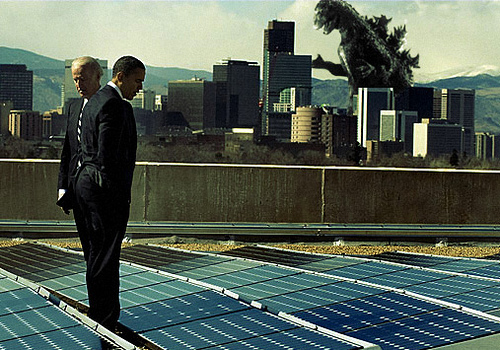
Posted by acilius on April 2, 2010
https://losthunderlads.com/2010/04/02/barack-obama-looking-at-awesome-things/
Secular Calvinism?
 Adherents of the political tendency known as libertarianism often defend their positions with appeals to economic theory. They do not often show a high regard for the concerns of environmentalism. So when a libertarian think tank publishes a book that equates the academic discipline of economics with the environmentalist movement, one may well take notice.
In The New Holy Wars: Economic Religion vs Environmental Religion in Contemporary America, Robert H. Nelson of the Independent Institute argues that the forms of academic economics that have influenced policymaking in the US in recent decades, like the forms of environmentalist thought that have begun to play a role in public affairs, are secularized versions of Calvinism. How so? To quote the Independent Institute’s summary:
The deepest religious conflicts in the American public arena today—the New Holy Wars—are crusades fought between two secular religions: economic religion and environmental religion. Each claims to be scientific, even value-neutral, yet they seldom state their underlying commitments explicitly, let alone subject them to scrutiny. Environmental religion views wilderness as sacred, seeks salvation through the minimization of humankind’s impact on nature, and proselytizes using imagery meant to stir spiritual longings. In contrast, economic religion worships technological innovation, economic growth (as measured by GDP), and efficiency (as revealed by cost-benefit analysis) and is presided over by a priesthood of Ph.D. economists who communicate in a liturgical language unintelligible to the layperson.
Nelson is himself an economics Ph.D, having received that degree from Princeton University in 1971. If one of the tenets of the religion of economics is that economics is not a religion, that would make him a wayward priest. The summary goes on:
Although rarely acknowledged, environmental religion owes its moral activism, ascetic discipline, reverence for nature, and fallen view of man to the Protestant theology of John Calvin. A remarkable number of American environmental leaders, including John Muir, Rachel Carson, David Brower, Edward Abbey, and Dave Foreman, were raised in the Presbyterian church (the Scottish branch of Calvinism) or one of its offshoots. Earlier forerunners of modern environmentalism who were influenced by Calvinism include the American transcendentalists Ralph Waldo Emerson and Henry David Thoreau and the French philosopher Jean-Jacques Rousseau, who offered a secular version of the fall of man from the original “state of nature [in which] man lived happily in peace.”
That’s an interesting claim, and a list of very diverse people. Nelson seems to focus on the USA, but it would be interesting to contrast the environmentalisms that have taken hold in countries with histories of Calvinism with the environmentalisms that have taken hold where Calvinism was never ascendant. Onward:
Economists often rely on assumptions that are better categorized as theological than as scientific. Many economists assume that human welfare is a product of the consumption of goods and services alone and that the institutional arrangements that produce those goods and services can be ignored. Some economists assume that eradicating poverty will end crime and usher in a new era of morality. Also, economists typically assume that psychological stress caused by an economic transition to a more efficient allocation of resources is negligible and not worth factoring in. “If [emotional burdens] were actually given full account, it would be impossible to say in principle whether a market system is economically efficient,” writes Robert Nelson.
Coming from a libertarian economist, the statement that “If [emotional burdens] were actually given full account, it would be impossible to say in principle whether a market system is economically efficient” is as amazing as Luther’s Ninety Five Theses were coming from a Roman Catholic priest in 1520.
The missionaries of environmental religion have managed to get some of their dogmas implemented in poor countries, often with devastating consequences for local populations. Under the banner of saving the African environment, they have promoted conservation objectives that have displaced and impoverished Africans. This catastrophe has occurred because environmental religion has misunderstood African wildlife management practices and problems.
To the extent that this is true, I suspect it is not because of the intellectual forebears of contemporary environmentalists, but because those environmentalists have come to Africa as agents of Western bureaucracies. As such, they have been constrained to act and think in the terms those bureaucracies made available to them, terms which often have little connection to the social and ecological realities of Africa.
There is another, shorter, summary on the same page:
“Economics and environmentalism are types of modern religions.” So writes Independent Institute Senior Fellow Robert H. Nelson, author of The New Holy Wars: Economic Religion versus Environmental Religion in Contemporary America, an in-depth study of the origins and implications of the conflict between these two opposing belief systems.
“If it makes a reader of this book more comfortable, he or she may think of it as an examination of the ‘spiritual values’ of economics versus the ‘spiritual values’ of environmentalism,” writes Nelson in his introduction. “For me, though, it is a distinction without a difference.”
In The New Holy Wars, Nelson probes beneath the rhetorical surface of economic and environmental religion to reveal their clashing fundamental commitments and visions. By interpreting their conflict as theological, Nelson is able to show why these creeds almost invariably talk past each other and why their conflict is likely to continue to dominate public discourse until one party or the other backs down—or unless an alternative outlook rises to challenge their influence in the public arena.
In addition, by exploring little-known corners of American intellectual history, Nelson shows how environmentalism and economics have adapted Judeo-Christian precepts in ways that make them more palatable in an age of secularism. In many cases, Nelson is able to demonstrate a direct lineage from traditional religious beliefs to tenets held by mainstream economists and environmentalists.
Some readers of this blog have expressed interest in “political theology,” the idea that there are no truly political belief systems, but that all political theories are simply theological doctrines in disguise. This notion is often associated with the German legal scholar (and onetime Nazi) Carl Schmitt (1888-1985.) Say what you will about Schmitt’s detestable activities from 1933 to 1937, he made a powerful case for political theology. Nor did he originate the notion; it can be traced back to Cicero’s Laws (especially book 1, chapter 8), and back of Cicero to the Stoics, with the idea that a certain memory of the Divine lingers in the human mind and that the various legal codes and religious practices of the world result from the attempts of various peoples to translate that memory into a guide for action. If there is truth in political theology, then we would expect both economics and environmental theories to be driven by unacknowledged theological commitments.
Posted by acilius on February 26, 2010
https://losthunderlads.com/2010/02/26/secular-calvinism/
Who writes this?
 acilius
 believer1
 lefalcon
 losthunderlads
 vthunderlad
