Seven recent issues of The Nation

Ever since I started writing here, I’ve been referring to “Mrs Acilius.”  Until last month, that was a bit of an exaggeration, as I had not actually married the lady in question.  We tied the knot 12 May.  So lately, I’ve had things on my mind other than this blog.  That’s why I haven’t been posting “Periodicals Notes” regularly.  But I’ve vowed to catch up.  So here are my notes on the last seven, yes seven, issues of The Nation.
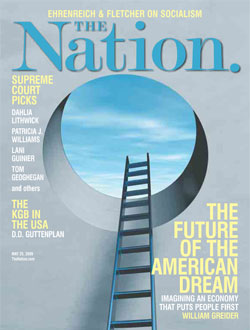
nation 25 may 200925 May: It’s been almost 60 years since a jury found that former State Department official Alger Hiss was lying when he denied that he had passed classified documents to an agent of Soviet military intelligence during the years 1934-1938.  The Nation has never let go of the Hiss case, and still publishes articles, columns, and reviews at regular intervals maintaining his innocence.  When Hiss died in 1996, I read a few books about the case.  Hiss’ own book, In the Court of Public Opinion, and his son Tony’s memoir of him, Laughing Last; Alistair Cooke‘s A Generation on Trial; and Allan Weinstein’s Perjury.  I mention the fact that I read these four books not because they qualify me as an expert on a matter as complex and hotly disputed as the Hiss case; obviously they do not.   All I want to do is explain that I have a certain familiarity with the Hiss case, and that I take an interest in discussions of it. 

D. D. Guttenplan reviews two recent books, Susan Jacoby‘s Alger Hiss and the Battle for History and Spies: The Rise and Fall of the KGB in America, by John Earl Haynes, Harvey Klehr, and Alexander Vassiliev.  In regard to Spies, Guttenplan’s main goal is disprove the book’s accusation that journalist I. F. Stone was a Soviet agent.  I would be inclined to say that Guttenplan achieves that goal easily.  I haven’t read the book, but unless there is a great deal more to it than Guttenplan acknowledges it would seem that its authors have not only failed to make the case against Stone, but have actually made a compelling case that Stone could not have been the man the Soviets codenamed “Blin” “”Pancake.”)  

Guttenplan’s contribution to the Hiss debate is less of a triumph.  The review goes on and on about the absence of Hiss’ name from declassified KGB documents.  It would be difficult to imagine a less relevant point.  Hiss was never accused of spying for the KGB.  The KGB was an organ of Soviet State Security.  Hiss was accused of passing documents, not to Soviet State Security, but to Soviet Military Intelligence (the GRU.)  The man who identified himself as Hiss’ contact was Whittaker Chambers, whom no one denies was an operative of Soviet Military Intelligence.  In the Soviet system, Military Intelligence was a bitter rival of State Security; they most assuredly did not share with each other the names of highly placed agents whom they had recruited. 

Hiss’ defenders are not alone in ignoring this point.  So, those who are most convinced of his guilt often bring up the “VENONA Intercepts,” cables sent by KGB station chiefs in Washington to Moscow and intercepted by the FBI in the years 1946-1980.  These cables use the codename “ALES” to refer to a man who sounds more like Alger Hiss than anyone else, and describe him as an agent of Soviet intelligence.  They do not report direct contacts with ALES, however, nor do they include any intelligence gathered from him.  The likeliest explanation, then, is that the station chief had heard a rumor that Hiss was working for Soviet Military Intelligence and was reporting this rumor to headquarters.  That such rumors were circulating about Hiss in various intelligence services around the world before Chambers made his charges public has been known for some time; in the first edition of Perjury, published in 1978, Allan Weinstein devoted a whole appendix to indications that a number of European intelligence services believed Hiss was a Soviet agent.  VENONA does nothing but add Soviet State Security to the list of these services.   

nation 1 june 20091 June:  Akiva Gottlieb reviews Clint Eastwood’s latest bout of macho self-pity masquerading as a movie.  The last two paragraphs sum up Gottlieb’s view:

In the closing scene of Gran Torino, a lawyer reads from the dead man’s will, which Walt had written himself. It turns out that he had chosen to bequeath the titular totem of middle-class luxury to Thao, “on the condition that you don’t chop-top the roof like one of those beaners, don’t paint any idiotic flames on it like some white trash hillbilly and don’t put a big gay spoiler on the rear end like you see on all of the other zipperheads’ cars.” In other words, Walt gets to keep his racial epithets and be the hero, too. The closing credits roll over a shot of Thao cruising in his new vehicle of assimilation, with Eastwood’s raspy voice cooing gently on the soundtrack, reminding the next generation just who we have to thank for our liberty.

(more…)

Obama the Exterminator; or, Obama Commits Funny

Wounded Knee, nanotech, Serbian broadcasting, and the car industry

The headquarters of Radio Television Serbia after the 23 April 1999 bombing

The headquarters of Radio Television Serbia after the 23 April 1999 bombing

Go away for a month, and things pile up.  Time to get back at it.  Here are “Periodicals Notes” on three recent issues of Counterpunch

16-30 April: Tiphaine Dickson reports on the case of Dragoljub Milanovic, the only person ever to have been tried and punished for NATO’s 23 April 1999 bombing of Radio Television Serbia (RTS), an attack on an undefended target that killed 16 civilians and served no military purpose other than to disrupt broadcasting between the hours of 2 and 5 AM that morning.  The attack followed an ultimatum NATO issued to the Serbs that the station would be considered a legitimate target unless they consented to broadcast six hours a day of NATO-approved western programs, an ultimatum NATO dropped when the Serbs accepted it.  Mr Milanovic has been in prison for seven years because of his role in this wanton act of murder.  What was that role?  He was one of NATO’s intended victims.  The director of RTS, Mr Milanovic was at his desk in the building less than an hour before the bombing.  Dickson details a story of the dizzyingly absurd injustices that Mr Milanovic has suffered, illustrating the workings of the West’s anti-Serb policies of the last couple of decades. 

In the same issue, former US Senator James Abourezk (Democrat of South Dakota) gives a synopsis of the relations between the Minneconjou tribe of the Sioux nation and the US government before, during, and after the 1890 massacre of Minneconjou people at Wounded Knee in South Dakota.  This is to serve as an introduction to Senator Abourezk’s recollections in the next issue of the 1973 occupation of Wounded Knee by militant American Indian Movement (AIM) activists.  

1-15 May: Senator Abourezk tells the story of his trip to Wounded Knee in 1973, when he and George McGovern (his senior colleague in the US Senate from South Dakota) tried to mediate between AIM and the federal agents surrounding them.  The senators left thinking that they had negotiated a peaceful resolution to the standoff, only to find that the Nixon administration had blocked the deal.  Senator Abourezk suspects that the president wanted to keep the crisis going in order to stoke anti-Native feeling among whites.  

In the same issue, Steven Higgs looks at nanotechnology.  After listing such applications as self-cleaning eyeglasses (very attractive to me!), he quotes experts who are concerned that carbon nanotubes strongly resemble the microstructure of asbestos and that exposure to them may pose some of the same risks as does exposure to asbestos.  Other nanotechnologies also seem to represent considerable dangers; for example, the minute portions of silver used in high-end washing machines can enter living cells and may alter DNA there, threatening cancer.  Higgs notes that after years of federal inaction, the Obama administration has issued notice that it may begin a review of regulations in this area.   

16-30 May: Eamonn Fingleton points out that all the explanations for the decline of the US auto industry favored by corporate media are bogus.  For example, one often reads that the Big Three fail to produce any models with the steering wheel on the right, and that this explains why the Japanese won’t buy American cars.  In fact, Fingleton reports, Detroit makes dozens of models with the steering wheel on the right, and has done so for years.  We also hear that closing a country to imports will doom its manufacturers to eventual irrelevance in the global contest for shares of the export market.  Yet the Japanese and Korean car markets have been the most tightly closed in the world for decades, as Japanese and Korean car makers have gone from strength to strength and now dominate the US market. 

In the same issue, Bill Hatch reports on Michelle Obama’s visit to the University of California’s new campus at Merced.  Hatch quotes Mrs O’s criticism of the University of Chicago’s development of the Hyde Park neighborhood as abuffer between itself and the South Side of Chicago, then points out that UC-Merced is trying to do exactly the same thing.  Hatch tells how UC-Merced was built during the California real estate bubble, and how the construction of the university and the bubble worked together to shatter the working class town that had existed there.  In Hatch’s telling, Merced sounds like a ghost town in the making.

The Nation, 18 May 2009

nation-18-may-2009It was William Wordsworth who asked “Where are they now, those wanton boys/ for whose free range the daedal earth/ was filled with animated toys/ and implements of frolic mirth;/  with tools for ready wit to guide,/ and ornaments of seemlier pride,/ more fresh, more bright, than princes wear;/ for what one moment flung aside,/ another could repair; what good or evil have they seen/ since I their pastime witnessed here,/ their daring wiles, their sportive cheer?”   

That was what Wordsworth asked.  As a columnist for The Nation, Katha Pollitt isn’t allowed to ask such congenial questions.  In this issue, she asks where the Bush-Cheney administration officials responsible for the torture regime are now.  Wanton boys they are, indeed.  But no longer do they range quite so freely over the daedal earth; Judge Baltasar Garzón has ruled Europe off limits for them.   Former assistant attorney general, now federal judge Jay Bybee gave an opinion that treatment which did not result in permanent physical injury could not be considered torture; as if “what one moment flung aside, another could repair.”  Their “animated toys” are to be released from the Satanic toyboxes of Guantanamo Bay and the leftover Gulags of eastern Europe; the “implements of frolic mirth” the wanton boys once directed to be used are to be relegated to the ever-more distant past, along with the photos that came from Abu Ghraib prison five years ago.  True, the new administration’s reluctance to prosecute the architects of the torture regime does raise the worry that they may be looking on that regime as so many “tools for ready wit to guide.”  And the wanton boys themselves do not seem to be suffering; banks, investment firms, universities, and think tanks have given the worst of them positions that could pay for “ornaments of seemlier pride, more fresh, more bright, than princes wear.”  Pollitt jokes that she herself would be better off had she quit journalism and taken a job marketing torture:

I could have nicknamed waterboarding “drinking tea with Vice President Cheney,” although come to think of it, waterboarding is a euphemism already. Maybe that’s why people didn’t catch on that it was the same thing we prosecuted Japanese interrogators for doing in World War II. In the Tokyo trials it was called “the water treatment,” or “the water cure,” or just plain “water torture.” Calling it “water torture” was probably what got those Japanese into trouble. That, and losing the war.

(more…)

Water Torture

Torture- I mean “enhanced interrogation”- for charity . . 


Being asked the same question 183 times in 1 month while being bound and asphyxiated might be 183 times as unpleasant as this . .


The Nation, 11 May 2009

nation-11-may-2009

The recent release of Bush-era “torture memos” occasions an argument to the effect that those responsible for the writing of those memos and the implementation of the procedures described in them must be held to account.  This must be done, less to honor a duty to the past than to establish a precedent for the future:

As a former constitutional law lecturer, Obama should have a firmer grasp of the point of executive accountability. It is not merely to “lay blame,” as he suggests; it is to set boundaries on presidential behavior and to clarify where wrongdoing will be challenged. Presidents, even those who profess honorable intentions, do not get to write their own rules. Congress must set and enforce those boundaries. When Obama suggested that CIA personnel who acted on the legal advice of the Bush administration would not face “retribution,” Illinois’s Jan Schakowsky, chair of the House Permanent Select Committee on Intelligence’s subcommittee on oversight and investigations, offered the only appropriate response. “I don’t want to compare this to Nazi Germany, but we’ve come to almost ridicule the notion that when horrific acts have been committed that people can use the excuse that, Well, I was just following orders,” explained Schakowsky, who has instructed aides to prepare for a torture inquiry. “There should be an open mind of what to do with information that we get from thorough investigations,” she added.

There must also be a proper framework for investigations. Gathering information for the purpose of creating a permanent record is only slightly superior to Obama’s banalities about wanting to “move forward.” Truth commissions that grant immunity to wrongdoers and bipartisan commissions that negotiate their way to redacted reports do not check and balance the executive branch any more than “warnings” punish speeding motorists.

A short piece remarks on the success leading neocons have had in publicizing the view that piracy off the Horn of Africa is a national security threat to the USA.  The Washington Post, for example, the other day tossed off a reference to “ties between al Qaeda and” the group that recently hijacked the Maersk Alabama, ties which appear to be wholly imaginary. 

(more…)

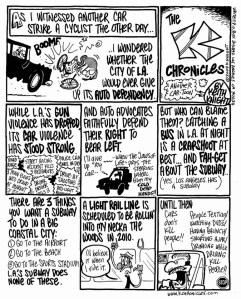
Car Violence

Keith Knight is writing about Los Angeles (the city he’ll soon be leaving, perhaps for Seattle), but might be writing about any number of places in the USA.  Including, unfortunately, Seattle.  

keith-knight

Torture Memo Set to Music

Via Alison Bechdel’s website,  a way to take some words that have become all too familiar and give them back their power to shock us.  

Here’s the artist’s website.

Victoria Fontan

Victoria Fontan in Baghdad

The 16-31 March issue of Counterpunch features an article by Victoria Fontan, a scholar in “Human Dignity and Humiliation Studies,” a growing subfield of Peace Studies.  Fontan studies conditions under which people who have been humiliated are more likely than others to become terrorists.  She has interviewed members of several violent groups in Lebanon and Iraq.  In this article, Professor Fontan tells what happened when she taught at Colgate University in upstate New York and a group of right-wingers launched a smear campaign against her.  The smear mongers managed to hound her out of her job and to get her name on an official terrorism watchlist.  A French citizen, Professor Fontan did research in Iraq after leaving Colgate, and now teaches at The University for Peace in Costa Rica.  While Colgate’s campus rightists may consider Professor Fontan to be a stooge of America’s enemies and congratulate themselves on having performed a patriotic service by driving her off campus and out of the country, much of the US national security apparatus disagrees.  Her work is still assigned to cadets at West Point, and the FBI agents who interview her every time she flies into the USA (she’s on a terrorism watchlist, remember) have become her friends, recognizing in her research something indispensible to them as they try to figure out how to look for terrorists without making more terrorists. 

Fontan’s article reminds me of two things.  First, I’ve often thought that in the Aeneid Vergil represents warfare as primarily a matter of humiliation.  One of these days I might get around to developing that idea in a scholarly article about books 7 through 12 of the Aeneid, the “battle books.”  

Second, an idea popped into my head which I don’t believe is original with me, though I can’t seem to find where I may have picked it up.  It doesn’t seem to be Fontan’s idea.  The idea is that the road from “humiliated person” to “terrorist” may tend to run in three stages:  humiliation→ isolation→ radicalization. 

(more…)

The American Conservative, 20 April 2009

http://www.amconmag.com/issue/2009/apr/20/

humane-economyAn old, and possibly apocryphal, story anchors Dermot Quinn’s appreciation of twentieth century German-Swiss economist Wilhelm Röpke.   Röpke was walking along a road with Ludwig von Mises, the great champion of free-market economics.  The two saw a neighborhood garden in a crowded urban center.  Seeing land that was in high demand for residential and commercial development given over to an elaborate tangle of separate plots and shared irrigation,Mises sniffed that it was “a most inefficient way of producing vegetables.”  Perhaps so, said Röpke.  “But it is a most efficient way of producing human happiness.”  Röpke has attracted every label in economics, from socialist to free marketer.  None of those labels really fit Röpke, because they all classify thinkers by which answer they offer to questions about what sort of economic system allocates resources most efficiently.  These questions struck Röpke as absurd.  Though as a technical economist Röpke had few peers, his interests were always in human beings and their development, not in any of the fashionable abstractions of his time such as “The Economy” or “The Market” or “The State” or “The Proletarian Revolution” or “The Aryan Race.”     

Barack Obama was elected president with the votes of millions of Americans who had had enough of war.  Now that Mr O has announced plans to increase troop levels in Afghanistan and officials of his administration have suggested that they may expand the Afghan war into Pakistan, his antiwar supporters are hardly raising a peep.  This leads Justin Raimondo to ask “Was the Left antiwar or just anti-Bush?”  Raimondo started antiwar.com when President Bill Clinton ordered US forces to bomb Serbia in 1999.  At the same time, your humble correspondent was also active in the antiwar movement.  Like Raimondo, I was struck by the passivity with which the supposedly dovish members of the Democratic Party went along with that adventure.  I’d always been curious about the antiwar Right, ever since I was a little kid hearing my parents reminisce about how their staunchly Republican parents had opposed FDR’s military interventionism with the same fervor that they opposed his economic interventionism.  After 1999, I was convinced that the “Old Right” was indispensible to any effort to break America of its addiction to warfare. 

The “Deep Background” column is less pessimistic about Afghanistan, pointing out that while “the nation-building agenda” that Mr O has publicly espoused for Afghanistan “is unrealistic and likely unattainable, a security framework to facilitate the kind of limited political consensus that would permit American withdrawal might just be achievable.”  So, the grounds for hope is that the stated purposes of Mr O’s actions in Afghanistan are so patently absurd that they likely mask an unstated plan to withdraw American forces from the country. 

Peter Hitchens, whose brother is also a magazine journalist, worries that all is not well in the new South Africa.  President-designate Jacob Zuma’s fondness for the song “Bring Me My Machine Gun,” his closeness to the South African Communist Party, his refusal to be interviewed by journalists, his open practice of polygamy, his public boasts that he used to make a habit of beating homosexuals senseless, his apparent belief that HIV-AIDS is something that can be cured by a nice hot shower, and his former role as the defendant in a rape trial all combine to suggest to Hitchens that Zuma might be something less than the ideal leader for South Africa at this particular moment in its history.