A peace movement begins in Afghanistan

Truthout has a report about a movement that started among peace-minded young people in central Afghanistan and that is beginning to attract followers elsewhere.  Here’s a quote:

In the United States, we may find it hard to believe that anything good can actually come out of Afghanistan, or we may have fallen into a trap of thinking that Afghans cannot accomplish anything useful without foreign aid and assistance. I confess that I struggle to live outside the shadow of this narrow-mindedness and ethno-centrism. Certainly, if the scope of our imaginations is limited by CNN and Fox News, we would not be likely to imagine an indigenous peace group forming in Bamiyan Province. But this is exactly what has happened.

More information is available here and here and here.


Philip Weiss’ latest

A powerful cri de coeur from Mondoweiss, titled “The occupation is the Stanley Milgram experiment for American Jews,” turns on this paragraph:

The general U.S. Jewish position is like the Stanley Milgram experiment, the famous Yale study in which paid research subjects were instructed by a researcher to apply higher and higher levels of shock to someone on the other side of a curtain every time he got an answer wrong on a test. And with increasing levels of shock that other subject– who wasn’t really a subject but a confederate of the researcher– howled louder and louder and passed out from pain. Still the students applied the shock. That is the American Jewish community. They hear the Palestinians screaming for 60 years but they have been told by an authority figure that the Palestinians deserve the shocks they are getting– because they are resisters, because they are terrorists, because they are animals, because they are violent, because their women cover themselves, because they live off the land, because they want their houses back, because they don’t have gay rights, because they read the Koran, because they want to return to their homes, because they elected Hamas… on and on the instructor justifies it with lies and bullshit, still the community cranks the dial and ignores the screams.

The Milgram experiment seems to have a powerful resonance for a certain kind of American intellectual.  For example, in his 1999 book The Holocaust in American Life, Peter Novick suggested that the USA might be a better place if, instead of recurring so often to the Holocaust as the ultimate index of political evil, Americans were in the habit of referring to the findings of the Milgram experiment.  I attended a talk Professor Novick gave in that year; from the podium, he made such a strong claim for the symbolic power of the Milgram experiment that half the Q & A session consisted of expressions of disbelief.  Still, I highly recommend Weiss’ essay, and for that matter Novick’s works.


What Fred Reed understands

From a column by Fred Reed:

I understand that Americans have no interest in Mexico other than to give jobs to illegals and then complain that they have them. And of course to buy drugs and then complain that Mexicans sell them. But a bit of attention, even of realism, might have its virtues. Afghanistan is somewhere else. Mexico isn’t.”

The Political Stupidity Index; or, What separates the USA from the world to its south

Some US presidents not powered by petroleum

The July issue of Counterpunch just showed up in my mailbox; I suppose I could have read it weeks ago if I subscribed to the email version rather than the paper-and-ink one.  If I did that, however, I wouldn’t be able to leave old copies in laundromats and doctor’s offices and wonder who is getting a shock from them. 

There are three pieces remembering the late and much lamented Ben Sonnenberg, founder of the (alas, equally late and much lamented) literary quarterly Grand Street and a longtime eminence of the American Left.  I want Alexander Cockburn and Jo Ann Wypijewski to write my obituary.  As they went on about Sonnenberg’s historical greatness, profound learning, unfailing humility, inexhaustible compassion, and cheerful lovable-ness, I started to wonder why he hadn’t risen from the tomb on the third day.  Still, they do show that Sonnenberg devoted his life to celebrating and advancing the achievements of the human intellect, and that he was fearless in bringing reason to bear when entrenched interests intimidated others into accepting the official story.  

Two muckraking pieces tackle official stories which claim that the US government protects its citizens from menaces approaching the country from the south.  Jeffrey Saint Clair’s “How BP and the Obama Administration Have Been Joined at the Hip” tells how Mr O has overseen “a profound bureaucratic lethargy that ceded almost almost absolute control over the response to the spill to BP.”  While he might have invoked powers under the 1968 National Contingency plan and “seized control of both the well and the cleanup operations,” leaving BP’s officers with nothing to do but “sign checks for billions of dollars,” Mr O in fact sidelined all advisors who showed any sign of independence from the oil giant, instead relying on former lobbyists for and executives of BP.  The administration did little to nothing to contain the damage the leak would do to the Gulf coast, its wildlife and fisheries, but a great deal to help BP contain the damage to its public relations.  Most of Saint Clair’s facts are also reported in this Rolling Stone piece.   

Frank Bardacke’s “Why the Border Can Never Be ‘Secured'” introduces the phrase “the Political Stupidity Index,” which Bardacke defines as “the difference between the words politicians say and the way we actually live.”  Bardacke argues that the national debate about immigration registers a remarkably high level of this sort of stupidity, taking it to a level where “the words at the top have nothing to do with life at the bottom.”  “Despite what may be said in the public debate, people know there is no way to stop Mexicans coming to the USA, as long as Mexico remains poor and the USA relatively rich,” writes Bardacke.  More enforcement at the border only means more corruption among border patrol agents and more power for criminal enterprises that have set out “to make border crossing a big, corporate business.”  Amnesty for undocumented workers, whether marketed under the label “a path to citizenship” or under some other brand name, will only increase the rate of illegal immigration, as the upsurge in immigration after 1986 legalization definitively proved.  Guest-worker programs are “a bad idea all around,” as the experience of the Bracero Program showed.  By the mid 1960s, the poor working conditions to which braceros were subjected had raised the ire of liberals who objected to the program because it was a form of indentured servitude, while conservatives were alarmed by number of braceros who left their places of indenture to blend into the general population of the USA. 

I’m not at all sure Bardacke is right that the border cannot be “secured.”  Israel has certainly shown that walls can keep highly motivated people from crossing borders, and enforcement of citizenship requirements at points of employment need not be any more difficult than enforcement of laws  that require employees to be at least a particular age or paid at least a particular wage.  In order to implement those measures, the US government would have to confront the people who profit from the current system.  Considering the absurd timidity our current government has shown in its dealings with BP, it is rather difficult to imagine a future government that would be prepared to take on all the interests that benefit from keeping US wages from rising too far above the Mexican average.  Difficult though it may be, it is hardly impossible that such a thing might happen, and therefore unjustified to say that “the border can never be ‘secured’.” 

Whether it should be secured is of course another question.  If a government ever does come to power in the USA that has the backbone to stand up to the low-wage lobby, that government would likely be the result of a profound change in the country’s whole political culture.  If that change ever does come about, it might reveal more attractive possibilities for the US-Mexican economic relationship than fortifying the border and adding a new layer of policing in employment.  Maybe if working people get hold of real political power they will find ways to work together to develop the US and Mexico in tandem, rather than submitting to policies that exacerbate economic inequality and hollow out industry on both sides of the border.

What James K. Polk Knew

President James Knox Polk

I’ve long tended to look at American history and see in the presidency of James Knox Polk (1845-1849) the origin of a great curse.  President Polk led the United States into war with Mexico.  In consequence of that war, the United States forced Mexico to cede its claims on all territory north of its present boundaries.  The US victory was quick and easy; for a loss of about 13,000 soldiers, the USA gained an internationally undisputed claim to almost a million square miles of territory, stretching from the Missouri River to the Pacific Ocean.  Americans would flood into this territory, displacing and slaughtering the native peoples on whom the Mexicans had made so little impression during their years of nominal rule.  Northern and Southern states vied with each other for influence over this newly secured territory, a contest that laid the political groundwork for the Civil War twelve years later.  As the USA’s first successful attack on a sovereign nation, the invasion of Mexico crossed a psychological boundary which previous attacks on native peoples and British possessions had left in place.  Moreover, the relatively low cost and fantastically rich rewards of the US victory fed in Americans the cannibal appetites of militarism.  So the curse that I have seen as the legacy of the Polk administration includes nearly all of America’s subsequent wars.    

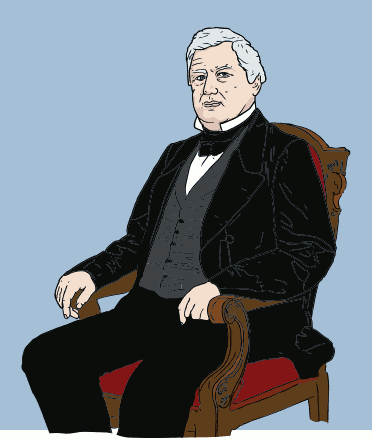
President Polk represented the Democratic Party; his chief opposition was the Whig Party.  I’m a bit of a Whig myself, which is one reason why I chose a cartoon image of Millard Fillmore as my WordPress avatar.*  Leading Whigs like Fillmore spoke out against the invasion of Mexico.  The Whig-dominated Massachusetts legislature passed a resolution during the war denouncing the US effort as the result of a criminal conspiracy to extend slavery into the West.  When Polk claimed that Mexico’s hostile greeting to a US cavalry column he had dispatched into Mexican territory between the Rio del Norte and the Nueces somehow constituted an act by which “American blood was shed on American soil,” Illinois’ Whig Congressman Abraham Lincoln introduced a resolution into the US House of Representatives demanding that the president show the Congress the spot on which this had occurred.  The so-called “Spot Resolution” had the support of the congressional Whig party, and made Lincoln a national figure.  Among future President Lincoln’s colleagues in the House was former President John Quincy Adams.  Technically an independent, Adams was a hero to the Whigs, a friend to Whig Party mastermind Henry Clay, and a reliable supporter of the Whigs’ core policies.  Adams would collapse on the House floor and die in the Capitol; virtually his last earthly act was to vote against a resolution commending US veterans of the war against Mexico.  Many young Whigs who fought in the war would afterward match their elders in the fervor with which they denounced it; Ulysses S. Grant, for example, would write in his memoirs that as a young captain he had won his medals as a perpetrator of “the most unjust war ever waged.”     

The Whigs championed industrialization.  They saw economic centralization as indispensible to industrialization.  Therefore, they were allies of big business and generally sympathetic to established elites.  As such, they would have to be called a conservative party, and their opposition to the war against Mexico would qualify them, if only for the duration of the Polk  administration, as specimens of the antiwar Right.  Chronicles magazine is a voice of today’s antiwar Right, but not of renewed Whiggery.  Their July issue included a review of Robert W. Merry’s A Country of Vast Designs: James K. Polk, the Mexican War, and the Conquest of the American Continent which praises Merry for making a case that Polk was right.  Since I’m so far out of sympathy with Polk and his war, I will quote at length from this review:

Here is the geopolitical reality that Polk grasped.  In the 1840’s, the western third of the North American continent was in play.  The players were the United States, Great Britain, Russia, and Mexico.  Each claimed some portion of that vast territory.  Polk understood that the question was not which of those claims was most legitimate (who, after all, would decide that?),  but which of the four powers had the means and will to enforce their own claims.  Mexico did not.  She “was a dysfunctional, unstable, weak nation whose population wasn’t sufficient to control all the lands within its domain.”  Bernard deVoto made the same point two generations ago:

[I]t is a fundamental mistake to think of Mexico in this period, or for many years before, as a republic, or even as a government.  It must be understood as a late stage in the breakdown of the Spanish Empire. 

There was no stability or institutional legitimacy in Mexico.  Revolution followed revolution, coup succeeded coup.  Mexican governments could neither govern, protect, nor populate the country’s far northern provinces.  That incapacity was most obvious in New Mexico, where the people were oppressed by taxes and terrorized by Indian raids, and consequently not inclined to fight in its defense.  Thus did Gen. Manuel Armijo’s army of conscripts flee at the approach of the Americans.  Col. Stephen Watts Kearney’s army of frontier dragoons and Missouri volunteer cavalry took Santa Fe without a fight.   

There are some good points in this.  What Mexico ceded to the USA in the Treaty of Guadalupe Hidalgo was not land that was populated by people loyal to Mexico and protected by its government, but was instead a claim on territory chiefly inhabited by native people who were barely aware of the existence of Mexico.  It is not too harsh to say that by 1846 Mexico had failed to make good on this claim.  And it is also true that in the mid-1840s Russia and Britain were both very active in the nortwestern parts of North America.  So if Polk had lost 1844 election to Whig nominee Henry Clay, and Clay had as president refused to make war on Mexico, then there would have been a considerable likelihood that instead of confronting each other in a the Crimea in 1854-1856 Britain and Russia would have had their showdown in San Francisco Bay.  But I’m still not for the Mexican War.        

*Here’s the cartoon Fillmore, for those of you who’d like a look:

Tuli Kupferberg, RIP

They say there’s a “rule of threes,” that celebrities always die three at a time.  It’s nonsense, of course, but it often seems that way.  So, the other day we lost Harvey Pekar.  Yesterday, we heard that George Steinbrenner had died.  And now, news comes to us of the death of Tuli Kupferberg.  We featured Tuli’s song “Nobody for President” here in November 2008; here it is again.

Tom Tomorrow, Today

A quote from General David Petraeus, commander of US forces in Afghanistan.  As always, click on the picture to go to the original site:

Harvey Pekar, RIP

Obits for Harvey Pekar from NPR, The New York Times, and the Cleveland Plain Dealer.

Some hide themselves, and some are hidden; some are forgotten, and some forget themselves

July’s issue of The American Conservative features a piece by Sydney Schanberg arguing that American prisoners of war were left over in Vietnam after direct US involvement in the war there ended in the early 1970s.  Several other pieces pick up on Schanberg’s claims, drawing various dire conclusions about the nature of the political leadership in the USA.   

In October 2008, The Nation ran an article in which Schanberg made this same case.  I noted that article here, remarking that I had never given that idea much credence, but that I was impressed by what Schanberg wrote.  Amid the pro-Schanberg pieces in this issue of The American Conservative is a short article by Gareth Porter titled “The evidence doesn’t stack up.”  Unlike the readers who wrote The Nation to protest the appearance of Schanberg’s piece there , Porter does not list his credentials as a scholar of the US military involvement in Vietnam.  Also unlike them, he does not declare himself to be displeased that the topic is being discussed.  Most profoundly unlike them, he looks at Schanberg’s evidence and judges it on its merits.  Indeed, the only way in which Porter resembles the outraged letter writers of The Nation is that he finds Schanberg’s case entirely unconvincing.  Porter argues that the document to which Schanberg has attached the greatest weight is almost certainly a forgery, and in any case doesn’t say what Schanberg claims it says.   Porter goes on to find many other faults with Schanberg’s argument. 

Something that is, I think, quite well-founded appears in Andrew Bacevich’s contribution to the discussion:

Like slavery or the Holocaust, Vietnam is part of the past not yet fully consigned to the past.

The practice of publicly displaying the POW/MIA flag testifies to this fact. On the one hand, it represents a lingering communal acknowledgment of loss and more broadly of massive national failure. On the other, it sustains the pretense—utterly illusory—that a proper accounting, not only of the missing but of the entire Vietnam experience, is still forthcoming. “You deserve to be brought home,” the flag implicitly states, “And we deserve to know why you were sent in the first place.”

Yet to undertake a serious accounting would find Americans facing a plethora of discomfiting truths, not only about the knaves and fools who concocted the Vietnam War but about the American way of life and the premises on which it is based. Tell the whole truth about Vietnam and you crack open a door that few Americans wish to peer behind. To do so is to come face-to-face with troubling questions about the meaning of freedom and democracy as actually practiced in the United States.

Few Americans are willing to confront such questions, the answers to which could oblige us to revise the way we live. So we salve our consciences by flying flags, sustaining the pretense that we care when what we desperately want to do is to forget as much as possible.

In the same issue, Paul Gottfried finds it odd that many Americans who stand on the political Right are so fond of calling their opponents “fascists” and of claiming that fascism was a left-wing movement.  Gottfried is himself very, very conservative in his politics.  Much as he might like to disassociate himself and his fellow Rightists from the taint of fascism, Gottfried also has a scholarly reputation and a lifetime of intellectual integrity, both of which he would like to preserve.  Gottfried lists a number of facts which, he says, make it impossible for a serious person of any disposition to see fascism as anything other than a phenomenon of the extreme Right, and ridicules those who disregard these facts.    

If the idea of fascism as a leftist movement is so ludicrous, why does it have so much support among American right-wingers?  Gottfried gives four possible reasons.  First, Leftists who keep their cool when they are accused of being Communists or utopians tend to sputter and look silly when they hear themselves being called fascists.  While this might be fun for conmservatives who are frustrated to meet opponents who don’t take their ideas seriously, Gottfried says that “only a cultural illiterate could believe that interwar fascists were intent on pursuing a massive welfare state centered on the achievement of social equality, with special protection for racial minorities, feminists, alternative lifestyles, and whatever else the latter-day Left is about.”    

Second, some American right-wingers in the 1930s “had a very limited understanding of the European Right or the European Left” and so “made the unwarranted leap from thinking that all forms of economic planning were unacceptable to believing that all were virtually identical.”  Thus they came to believe that the New Deal of Franklin Roosevelt, the Five-Year Plans of Stalin, and the corporatism of Mussolini were three names for the same thing.  Those thinkers started a tradition that is still alive and well in some circles in today’s USA. 

Third, the use of “fascism” as an all-purpose term of abuse represents an appeal to the argumentum ad Hitlerem, in which any resemblance between one’s opponent and Adolf Hitler, no matter how superficial or strained, is treated as if it released one from the obligation to answer that opponent’s claims.  Fourth, by attempting to brand what Gottfried calls “the latter-day Left” as fascist, the latter-day Right can pretend to be more different than it in fact is from its opposition.  

I can think of a fifth possible reason.  American economic analyst Lawrence Dennis became notorious in the 1930s and 1940s for a series of books in which he argued that market-driven capitalism was doomed, and that representative democracy would go down with it.  The economic system of the future, Dennis decided, was one in which capitalists retained nominal ownership and day-to-day control of the means of production, but government coordinated their activities.  The political system that would go along with this corporatist economy might be dressed up to look like a democracy, but would in fact be dominated by an elite that would remain in power regardless of the outcome of any elections that might be held.  To keep the public in support of this system and to keep the money supply from contracting, the elite would likely encourage an attitude of militant nationalism and a warlike foreign policy.  This system Dennis called fascism. 

 Dennis consistently said that when fascism came to America, it would not be called by that name.  Rather, it would be marketed as a new form of democracy, as the very antidote to fascism.  He predicted that he himself would be among the first dissidents prosecuted once the USA had become fascist.  Indeed, in 1944 Dennis was put on trial for sedition.  The prosecution collapsed, and Dennis wrote a book about it

In his 1969 book Operational Thinking for Survival, Dennis reviewed the arguments he had made in the 1930s and early 1940s.  He concluded that his predictions had been substantially correct.  Avoiding the word “fascism,” he wrote that our current political and economic system “is one that has no generally accepted name.” 

So, perhaps the reason Left and Right are so eager to fling the word “fascism” at each other is that each is haunted by the fear that it is powerless to keep the country from becoming fascist.  For all that Rightists might long to restore the Old Republic and Leftists might long to create a new system “centered on the achievement of social equality, with special protection for racial minorities, feminists, alternative lifestyles,” each looks on helplessly as events make a mockery of these ambitions.  Whatever success each side might have in its attempts to promote its vision of freedom, the movement towards fascism goes on relentlessly.

A place for everyone

Laws against prostitution are usually supported by people who want to help women break free of men who are coercing them into that line of work.  When one asks why it is that such laws usually include criminal penalties for the very women they are supposed to help, the answer is often that only when police and prosecutors have such penalties to use as threats can they be sure that women will turn against their exploiters. 

In practice, those laws often seem to have the opposite effect.  Arrested, a woman needs money to make bail.  If she is under the influence of a pimp, she will likely call him or an associate of his.  Labeled a criminal, she will find it no easier than it was before the police picked her up to find other employment.  So, the law which may have been advertised as a way of helping her find a way out of prostitution may in its actual operation push her deeper into it.  The law marks prostitution as her place and acts to keep her in that place.

What reminded me of this was a column by Katha Pollitt in the 14 June 2010 issue of The Nation.  Pollitt does not mention prostitution, but mentions a set of proposed laws that seem to be designed to work the same way: bills pending before the French and Belgian parliaments that would prohibit Muslim women from wearing headscarves, face veils, or other garb traditional to women of their persuasion.  Like laws against prostitution, these bills are marketed as means to pry women loose from men who are coercing them into a demeaning way of life.  Also like those laws, the bills include penalties against the women themselves.  Pollitt expresses the fear that men who are in fact coercing women who live with them into covering up more than they would like would respond to a ban by keeping them from going out at all; surely this fear is well-founded.  Moreover, whether a woman wears the veil freely or under compulsion, the threat that if she does go out the police will arrest and search her, then take the men of her family into custody and threaten her with criminal sanctions unless she gives information against them will hardly convince her that France is her home and the Franks are her ancestors.  Quite the contrary, I should think; with such a threat looming in the background, even a woman who would not have been likely to cover up otherwise might feel herself a traitor to the only community that really wants her unless she does put on traditional Muslim attire. 

In the same issue, a number of experts argue that the direction education policy has been taking in the USA in the last 20 years has been gravely counterproductive.  I only wanted to note one of these, by Linda Darling-Hammond of Stanford University’s education school.  Darling-Hammond looks at the country-by-country league tables for average student achievement in various subjects, pointing out that American students were not performing especially well in 1989 and that their average performance has been declining ever since.  In some subjects, the decline has been steady, in others catastrophically rapid.  Meanwhile, American schools have become more thoroughly segregated by race, the number of subjects offered has shrunk, and the prison population is booming.  Darling-Hammond not only points out these evils; she also  gives examples of countries where the same years have seen movement in the opposite direction.  While the current system tends to lock students into whatever social position they inherited from their parents, Darling-Hammond argues that it is still possible for public education to open doors for social mobility.

Movement from one social status to another often comes in tandem with physical movement from one place to another.  A review of a couple of books about African American history, under the title “Movement and Rootedness,” discusses ways in which the theme of migration has reshaped thinking about that subject in recent years.  It includes a quote from scholar Ira Berlin: “The history of the United States rests upon movement, and then embrace of place.”  The new scholarship on which the review focuses finds ways in which African Americans managed to embrace some places that would strike most of us as quite unembraceable.  While the integrationist story that has been the academic orthodoxy since the 1960s tends to reduce African American history to the relationship between African Americans and whites, so that relationships among African Americans are pushed into the shadows, the new scholars want to find out what sort of communities African Americans built for themselves even during the grimmest days of slavery and Jim Crow.