Why didn’t Mitt Romney know he was going to lose?

For a week now, articles, columns, blog posts, and wisecracks have been appearing in their thousands about the fact that former Massachusetts governor Willard M. “Mitt” Romney seems to have been surprised that he lost the presidential election.  The foremost of these publications so far is Conor Friedersdorf’s post on the Atlantic‘s website, “How Conservative Media Lost to the MSM and Failed the Rank and File.”  Also of note are blog posts by Josh Marshall and Claire Potter, a column by Maureen Dowd, and an article on Slate by John Dickerson.

The most quoted section of Mr Friedersdorf’s piece is probably this:

It is easy to close oneself off inside a conservative echo chamber. And right-leaning outlets like Fox News and Rush Limbaugh’s show are far more intellectually closed than CNN or public radio. If you’re a rank-and-file conservative, you’re probably ready to acknowledge that ideologically friendly media didn’t accurately inform you about Election 2012. Some pundits engaged in wishful thinking; others feigned confidence in hopes that it would be a self-fulfilling prophecy; still others decided it was smart to keep telling right-leaning audiences what they wanted to hear.

But guess what?

You haven’t just been misinformed about the horse race. Since the very beginning of the election cycle, conservative media has been failing you. With a few exceptions, they haven’t tried to rigorously tell you the truth, or even to bring you intellectually honest opinion. What they’ve done instead helps to explain why the right failed to triumph in a very winnable election.

Why do you keep putting up with it?

Conservatives were at a disadvantage because Romney supporters like Jennifer Rubin and Hugh Hewitt saw it as their duty to spin constantly for their favored candidate rather than being frank about his strengths and weaknesses. What conservative Washington Post readers got, when they traded in Dave Weigel for Rubin, was a lot more hackery and a lot less informed about the presidential election.

Conservatives were at an information disadvantage because so many right-leaning outlets wasted time on stories the rest of America dismissed as nonsense. WorldNetDaily brought you birtherism. Forbes brought you Kenyan anti-colonialism. National Review obsessed about an imaginary rejection of American exceptionalism, misrepresenting an Obama quote in the process, and Andy McCarthy was interviewed widely about his theory that Obama, aka the Drone Warrior in Chief, allied himself with our Islamist enemies in a “Grand Jihad” against America. Seriously?

Mr Dickerson makes the case that Mr Romney himself was among those deluded by right-wing media into the belief that he was likely to win the election by a comfortable margin:

Mitt Romney says he is a numbers guy, but in the end he got the numbers wrong. His campaign was adamant that public polls in the swing states were mistaken. They claimed the pollsters were over-estimating the number of Democrats who would turn out on Election Day. Romney’s campaign was certain that minorities would not show up for Obama in 2012 the way they did in 2008. “It just defied logic,” said a top aide of the idea that Obama could match, let alone exceed, his performance with minorities from the last election. When anyone raised the idea that public polls were showing a close race, the campaign’s pollster said the poll modeling was flawed and everyone moved on. Internally, the campaign’s own polling—tweaked to represent their view of the electorate, with fewer Democrats—showed a steady uptick for Romney since the first debate. Even on the morning of the election, Romney’s senior advisers weren’t close to hedging. They said he was going to win “decisively.” It seemed like spin, but the Boston Globe reports that a fireworks display was already ordered for the victory. Romney and Ryan thought they were going to win, say aides. “We were optimistic. More than just cautiously optimistic,” says one campaign staffer. When Romney lost, “it was like a death in the family.”

Professor Potter draws harsh conclusions from Mr Romney’s apparent belief in his chances:

Peculiarly, since the race was consistently described as tight for most of the month prior to election day, and Obama had been gaining ground in all the states he needed to win, Mitt was entirely unprepared for the possibility that he was not going to be president. According to the HuffPo, Romney was “shellshocked” that he was not winning on Tuesday night, having genuinely believed that voter suppression would work all the major media polls were wrong. Paul Ryan and both wives were also stunned. According to CBS, “Their emotion was visible on their faces when they walked on stage after Romney finished his [concession speech], which Romney had hastily composed, knowing he had to say something….They all were thrust on that stage without understanding what had just happened.”

Let’s underline this: Romney had no concession speech, despite available data demonstrating that he could lose the election. None of the four adults who had planned to run the United States government, and lead the rest of what we used to call the “Free World,” seem to have understood that this outcome was possible. “On the eve of the election,” Daniel Lippman writes,” a number of polling aggregators, including HuffPost‘s Pollster and New York Times’ FiveThirtyEight, showed Obama with a huge statistical advantage over Romney.” And yet, despite the fact that Nate Silver, the boy genius of FiveThirtyEight, is almost never wrong, Romney chose to believe that these polls were just partisan attempts to persuade his supporters to stay home.

This is the outcome of lying: you have no real compass for when other people are telling the truth and you need to pay attention to it.

Ms Dowd echoes this point:

Until now, Republicans and Fox News have excelled at conjuring alternate realities. But this time, they made the mistake of believing their fake world actually existed. As Fox’s Megyn Kelly said to Karl Rove on election night, when he argued against calling Ohio for Obama: “Is this just math that you do as a Republican to make yourself feel better?”

Much of this growing literature seems to be driven by the desire of those who supported the reelection of President Barack Obama to gloat over Mr Romney’s defeat and to make hostile remarks about his party.  Mr Dickerson’s Slate colleague Katherine Goldstein has appealed for a limit to this gloating, but her piece has attracted far fewer readers than his, and there is no end in sight.  Conservatives had raised similar points, speaking from of course different motivations, shorty before the election.  For example, on Election Day Michael Brendan Dougherty provided a list of five points to make in trying to explain Mr Romney’s defeat to Republicans who get their news from Fox and Rush Limbaugh, starting with “Lots of Republican voters died” between 2008 and 2012, and growing more trenchant as it goes.  Political scientists have been wary of entering the fray; political science blog The Monkey Cage has only featured one post that could be construed as part of the discussion, and that was structured as a conventional media-criticism piece, not a jeer of “Hey everybody, look at the dumbass!”

Turning back for a moment, Professor Potter’s remarks struck me as somewhat oversimplified.  So I replied to them.  I wrote:

I agree with most of what you say, but I do want to register one demurrer.   “Mitt was entirely unprepared for the possibility that he was not going to be president… This is the outcome of lying: you have no real compass for when other
people are telling the truth and you need to pay attention to it.”  I often think of George McGovern’s response when he was asked when he realized he was going to lose the 1972 presidential election.  He said the first time the thought entered his head that President Nixon might possibly beat him was about 10 PM on election night.  Granted, Nate Silver wasn’t around then, but there were quite a few polls, and they all turned out to be right.  What kept the senator from taking those polls seriously wasn’t that he was addicted to lies; he was a remarkably honest man, in fact.  Nor did he surround himself with sycophants.

So why did it not enter Senator McGovern’s mind that he could lose, when it was clear to most observers that he was on his way to the short end of an enormous landslide?  I don’t think it really is such a mystery.  If you’re goal is to win a major party’s presidential nomination, it helps to be the sort of person who never for a moment considers the possibility that s/he might fail in anything s/he sets out to do.  Donors who write big checks, activists who give up their free time to volunteer on campaigns, journalists who bet their next promotions on the campaigns they are assigned to cover, and other major players in the political system all want to attach themselves to the eventual winner.  If you’re given to self-doubt and you’re opponent is certain that s/he will win, you are at a disadvantage in the contest to attract the attention of those players.  Besides, major campaigns make extremely heavy demands on the time, energy, and finances of candidates.  If one candidate is doing a realistic cost-benefit analysis while another is proceeding from the never questioned assumption that s/he will win, the first candidate is less likely to meet those demands.

What about Mr Romney?  I would point out, first, that he has enjoyed considerable success throughout his life.  It’s true that he has only won one of the four elections in which he offered himself as a candidate, and that by a narrow margin, but in his years as a businessman he reaped huge profits no matter what he did.  Moreover, as the son of George Romney and a descendant of Parley Pratt, Mr Romney grew up as a sort of crown prince of Mormonism.  All his life he has been surrounded by people who expected great things of him.  It would be very strange indeed if someone coming from that background and going through a career in which hundreds of millions of dollars devolved upon him were not to believe himself to be a man of destiny.

In other words, I agree that Mr Romney’s privileged background and the overall intellectual climate of his party are probably factors in his placid self-assurance.  However, a highly competitive system like those which have produced major-party nominees for US president will select for candidates who exhibit that precisely that quality, and it is hardly a surprise when a nominee is so deeply shaped by it that s/he cannot see defeat coming even when all indications point to it.

I’d also like to add one point to the comment I posted on Professor Potter’s site.  Every candidate who represents a political party is expected to help that party raise money, build organization, and get its voters to the polls.  Even a nominee who is universally regarded as a sure loser will therefore, if s/he is living up to the terms of his or her covenant with the party, campaign until the moment the last ballot is cast.  Few people are interested in giving money, volunteering, or voting for a candidate who says that s/he is unlikely to win.  Imagine your telephone ringing, and a voice on the other end greeting you with: “Hello, I’m Peter Politician, and I’d like to ask you to devote your resources and efforts to my doomed campaign.  As you know, I have no chance of winning this election.  Can I count on your active support?  It will cost you a great deal of inconvenience, and buy you nothing but a share of my inevitable, humiliating defeat.”  I doubt you’d respond very favorably.  Right up to the moment when the candidate delivers his or her concession speech, s/he is telling potential donors, volunteers, and voters that s/he expects to win.  That’s a lot easier to do if you actually believe what you’re saying.

And they’re off!

So the results are finally in from the 2012 US presidential election, or as it is also known, the first tracking poll for the 2016 US presidential election.

In the last couple of days, I’ve posted a few comments in miscellaneous places making guesses about 2016.  On political science blog The Monkey Cage, I responded to Andrew Gelman’s prediction that the Republican and Democratic nominees in 2016 would be Paul Ryan and Hillary Clinton thus:

The Republicans have a strong history of settling on a presidential nominee early, and defeated vice-presidential candidates need time to put space between themselves and the slough of resentment that follows a loss. So I’d say that Mr Ryan is very unlikely to be the Republican nominee in 2016. The Democrats tend to look for fresh faces and to favor youth; someone like Ms Clinton, who has been a household name for decades, would therefore labor under a disadvantage in a 2016 bid, though her odds would surely not be as long as those confronting Mr Ryan. If I had to guess, I would say a likelier pair of finalists would be Mike Huckabee for the Republicans and Martin O’Malley for the Democrats. I hasten to add emphasis to the words “guess” and “likelier”; I’d be surprised if that were the matchup, just not quite as surprised as I would be to see a Clinton vs Ryan contest.

In response to a post by Daniel Larison on The American Conservative’s website, I expressed the same surmise about Mr Huckabee.
In response to another of Mr Larison’s posts, I explained why I don’t think that the Republicans will be nominating any Mormons for president any time soon.


Illegals

On October 15, linguist Neal Whitman wrote a piece on his blog in which he conceded that there are several good reasons to avoid the term “illegal immigrant.”  He cites three of these:

  1. It is politically divisive or inflammatory.
  2. It presumes guilt before due process has been done.
  3. It is inaccurate in characterizing people who entered legally but overstayed their visa, or did not come here of their own accord.

Mr Whitman accepts all of these arguments, and grants that the term “illegal alien” is dehumanizing and should be avoided at all times.  He does register a dissent from a fourth argument, however:

[The phrase “illegal immigrant”] is nonsensical, because illegal refers to acts, not to people.

Mr Whitman categorizes this claim as “just plain silly, and grasping at straws.”  He explains:

When the noun is the agentive form of a verb, and the adjective is the morphological analog of a manner adverb, there is a common, productive rule of semantic composition that gets you to the accepted meaning. Let me illustrate with an example unburdened by controversy. If I were to say, “Sandy is a deep thinker,” it would be willfully obtuse to say, “Hey, wait a minute! People can’t be deep!” If I were to tell you, “Lee is a beautiful dancer,” I could be telling the truth even if Lee’s face, when covered by a paper bag, could still make clocks lose two minutes per hour. In short,

dances beautifully : beautiful dancer :: thinks deeply : deep thinker :: immigrates illegally : illegal immigrant

Object to the term illegal immigrant on ethical, political, or legal grounds if you want to. But don’t resort to claiming the term embodies sloppy semantics, when it’s the most natural way to refer to someone who immigrated illegally. That just makes it look like you’ll accept any old argument that favors your side, and weakens the more valid ones.

On October 17, I commented on Mr Whitman’s post as follows:

I have a reservation about “illegal immigrant.” It is a long, awkward expression (six syllables, two lexical items, several highly abstract notions embedded in it,) so people will naturally want to shorten it. And the form to which it always seems to be shortened is “illegal.” As in, “How many illegals are in the USA?” That usage doesn’t exactly invite the full range of opinions as to what our policies should be with regard to immigration. Granted, a phrase like “undocumented worker” also signals a strong preference in the same regard. Using either term suggests that the speaker has set his or her face firmly against one side of the discussion. Perhaps if we as a society declared both expressions off-limits in polite conversation, people would come up with a truly neutral term. Of course, there would always be the danger that one or both of the expressions would sneak back into the language and steel American jaws, but that’s just something we’d have to guard against.*

On October 22, functional linguist Daniel Ginsberg wrote this comment:

Full disclosure: I’m a functional linguist, so I tend to be skeptical of people talking about what “words mean” in the absence of a person who used those words to encode a specific message. Also, I’m pretty far to the left of mainstream in American politics, and I’ve spent years working with immigrants, so you can guess what my personal choice of phrase is.

That said, my intuition is that the problem with “illegal immigrant” isn’t as much in the semantics of adjective-noun compounds as in the associations with the word “illegal.” The top hits of a COCA** search for “illegal [*nn]” are “immigrants, immigration, aliens,” and after that we get into “drugs, weapons, substances, acts, dumping, gambling, arms,” as well as “workers,” which seems to be a euphemism for “immigrants.” Going down the list, other collocates that refer to human beings are always other terms for *ahem* undocumented workers: “residents,” “entrants” (into the U.S.), “population.” The top 100 collocations in COCA don’t show any “illegal” + person pairings except for “illegal immigrants” and synonyms.

So the question becomes, if the language permits “illegal N” to mean “person who did N in an illegal way,” why is N nearly exclusively reserved to signify “immigrate into the United States”? Why isn’t Bernie Madoff an “illegal banker,” or Jack Kevorkian an “illegal doctor,” or Lance Armstrong an “illegal cyclist”?

The CDA*** researcher in me says, we’re making a class of “illegal things” here, that is implicitly expressing an ideology about the nature of illegality. The contents of that class include assault weapons, addictive drugs, the pollution of waterways with industrial runoff, cutting trees on protected land, running a casino out of your basement … and sneaking across the US border because conditions in your home country are so dire that you have no hope for a better life there.

Mr Whitman’s post and the discussion appended to it presaged a news story that broke a few days later.  On October 19, the Associated Press released a statement announcing that it would continue to use the phrase “illegal immigrant” to refer to people who have entered and established residence in the United States without the permission of the legal authorities.  The wire service‘s defense of this decision reads eerily like what Mr Whitman had posted a few days before:

Finally, there’s the concern that “illegal immigrant” offends a person’s dignity by suggesting his very existence is illegal. We don’t read the term this way. We refer routinely to illegal loggers, illegal miners, illegal vendors and so forth. Our language simply means that a person is logging, mining, selling, etc., in violation of the law — just as illegal immigrants have immigrated in violation of the law. (Precisely to respect the dignity of people in this situation, the Stylebook warns against such terms as “illegal alien,” “an illegal” or “illegals.”)

The press release goes on to describe circumstances in which the AP would avoid the phrase or add qualifications to it, descriptions which again recall Mr Whitman’s agreement that the first three arguments he cites constitute good reasons for using another expression:

The first thing to note is that “illegal immigrant” is not the only term we use. The Stylebook entry on this subject was modified a year ago to make clear that other wording is always acceptable, including “living in the country without legal permission.”

In fact, there are cases where “illegal immigrant” doesn’t work at all. For instance, if a young man was brought into the country by parents who entered illegally, he didn’t consciously commit any act of “immigration” himself. It’s best to describe such a person as living in the country without legal permission, and then explain his story.

There are also cases where a person’s right to be in the country is currently in legal dispute; in such a case, we can’t yet say the person is here illegally.

But what about the cases where we do write “illegal immigrants”? Why not say “undocumented immigrants” or “unauthorized immigrants,” as some advocates would have it?

To us, these terms obscure the essential fact that such people are here in violation of the law. It’s simply a legal reality.

Terms like “undocumented” and “unauthorized” can make a person’s illegal presence in the country appear to be a matter of minor paperwork. Many illegal immigrants aren’t “undocumented” at all; they may have a birth certificate and passport from their home country, plus a U.S. driver’s license, Social Security card or school ID. What they lack is the fundamental right to be in the United States.

Without that right, their presence is illegal. Some say the word is inaccurate, because depending on the situation, they may be violating only civil, not criminal law. But both are laws, and violating any law is an illegal act (we do not say “criminal immigrant”).

Mr Whitman’s blog is titled “Literal-Minded“; its tagline is “Linguistic Commentary from a Guy Who Takes Things Too Literally.”  So when he argues that the rules of English semantics permit a construction like “illegal immigrant,” it is quite believable that his agenda does not go beyond the explication of those rules.  The sheer fact that the phrase is well-formed does not mean that anyone should ever use it, and so his argument is by no means a defense of its use.  He recognizes this; the AP does not.  Its press release offers no defense of the phrase beyond its formal admissibility as a semantic structure, and does not answer any of the objections Mr Whitman had so readily acknowledged.

On October 31, Slate magazine carried a piece by Kerry Howley, associated with the title “Is Saying ‘Illegal Immigrant’ Like Saying ‘Illegal Logger‘?”  Ms Howley reports on the AP’s decision; a photo accompanying the piece carries the caption “Support for undocumented immigrants at the Democratic National Convention. Supporters of illegal loggers never showed.”  Neither Mr Whitman nor the AP had mentioned any particular group or individual that had asked the wire service to discontinue use of the phrase “illegal immigrant”; Ms Howley links to a website associated with the campaign known as “Drop the I Word.”  In response to the AP’s observation that “[t]erms like ‘undocumented’ and ‘unauthorized’ can make a person’s illegal presence in the country appear to be a matter of minor paperwork,” Ms Howley argues:

“Illegal” suggests fault with immigrants rather than the system of laws in which they are ensnared. It’s possible that illegal loggers are illegal because of poorly drawn statutes about public land—maybe they’re really freedom loggers—but that’s not the connotation.

“Undocumented” places the burden on the bureaucracy rather than on the moral integrity of any particular person. That’s the correct position in my view, and I reveal prior judgments when I use the word “undocumented” just as restrictionists do when they say “illegal.” What’s bizarre is that the Associated Press, having deemed “undocumented” a loaded term, thinks “illegal” to be perfectly descriptive, sprung from nowhere, privileging no side of the debate. It may be that there is no objective term with which to describe people guilty of being in a particular space without state permission. You have to pick one and own it, which “Drop the I-word” seems to recognize. They suggest you start saying “NAFTA Refugee.”

Here Ms Howley echoes my comment of the 17th, though without my suggestion that we might try to invent a new term that will be neutral.  Of course, I made that suggestion in less than total earnestness- there doesn’t seem to be any great demand for detached, objective discussion of immigration policy, much less for new vocabulary to promote such discussion.  All sides of the debate are driven by people who favor policies which they regard as indispensable to their livelihoods.  In that position, people look at words as weapons with which to fight the enemies who threaten them, not as laboratory equipment with which to gain understanding.  So when you choose your words, you choose your battles.

*None of the subsequent commenters said anything about “steel American jaws,” a line of which I was somewhat proud.  I would have been happy if they had said it made them laugh, but I’m not upset that they didn’t. 

**COCA = the Corpus of Contemporary American English

***CDA = Critical Discourse Analysis

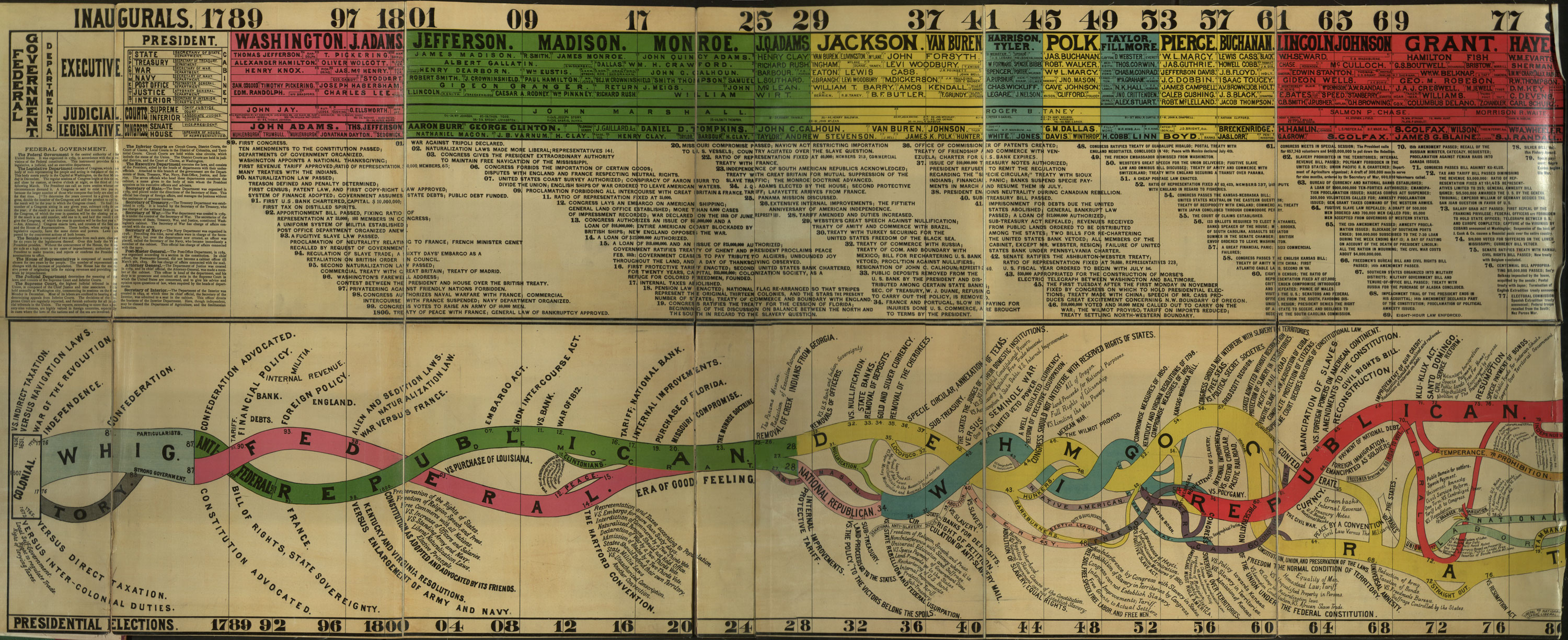
The political history of the USA in two charts

This chart was published in 1880, in a book called Conspectus of the History of Political Parties, by Walter R. Houghton.  In July, Susan Schulten put it on her blog, Andrew Sullivan mentioned it on his, and I put it up on Tumblr.  Here it is full-size.

This was today’s xkcd comic.  Click on it for a zoomable version.

I think the chart from the Houghton book is more elegant, but this one is nice also.


Is the Republican Party strong enough to survive a Romney presidency?

The other day,Jack Balkin of Yale Law School posted an item on The Atlantic‘s website in which he argued that, if former Massachusetts governor Willard M. “Mitt” Romney is elected president of the United States a week from Tuesday, his administration will likely come with great cost to the Republican Party which he nominally leads.  Professor Balkin links to the Amazon listings for two books by political scientist Stephen Skowronek (The Politics Presidents Make and Presidential Leadership in Political Time.)  Professor Skowronek classifies US presidents by the relationship they and their parties have to each other and to what Professor Balkin summarizes as the “interests, assumptions, and ideologies that dominate public discussion.”  Together, these interests, assumptions, and ideologies set the boundaries of the political “regime” of the period.  Professor Skowronek asks two questions about each of the US presidents*: “Skowronek’s key insight is that a president’s ability to establish his political legitimacy depends on where he sits in “political time”: Is he allied with the dominant regime or opposed to it, and is the regime itself powerful or in decline?”  Presidents who lead strong parties that oppose declining regimes can sweep those regimes away and implement sweeping new policies.  Professor Skowronek’s label for the few presidents who have held and capitalized in this enviable position is “reconstructive president.”  If the regime that takes shape under the administration of a reconstructive president continues to thrive after his time in office, his successors can be either “affiliated presidents,” who support the  regime and try to extend it, or “preemptive presidents,” who oppose the regime and try to modify it.  When the regime goes into terminal decline, affiliated presidents go down to political defeat, as “disjunctive presidents,” while preemptive presidents can attempt to join the list of reconstructive presidents.

Professor Balkin argues that the current regime in the USA emerged when the Reagan-Bush administration cut personal income taxes and increased defense spending on big-ticket weapons systems.  These measures were intended to solve certain problems the USA faced at the beginning of the 1980s; the tax cuts did in fact precede an end to the “stagflation” that had plagued the 1970s, and the military buildup did in fact worry the Soviet Union.  These measures, apparently successful as solutions to those particular problems, have been the foundation stones of national policy for nearly a third of a century.  Thus, Professor Balkin classifies Ronald Reagan as a reconstructive president, the two George Bushes as affiliated presidents, and Bill Clinton and Barack Obama as preemptive presidents.  Like observers well to his right, Professor Balkin has come to the conclusion that lower taxes and higher spending on big-ticket weapons systems have run their course.  Our current economic woes are not an example of stagflation, and even if they were it is by no means certain that in an age of global capital further reductions in personal income tax could relieve them.  Nor does the Soviet Union, or any other potential adversary against which the weapons systems that eat up most of our military budget would be useful, exists at present.  Tied to a party that has become increasingly doctrinaire in its attachment to these anachronistic policies, a President Romney would be doomed to join the ranks of the disjunctive presidents.  He might be comfortable in their company; the last two disjunctive presidents were Herbert Hoover and Jimmy Carter, like Mr Romney businessmen who campaigned on their abilities as technocratic managers.  Professor Balkin goes so far as to declare that “The next Jimmy Carter will be a Republican president — a Republican who, due to circumstances beyond his control, unwittingly presides over the dissolution of the Reagan coalition.”

I’m not altogether convinced that a Romney administration would necessarily end as the Hoover and Carter administrations ended, with a landslide defeat for the president after one term and a new American regime created by his successor.  I suppose if I were a Democratic politician considering a bid for the presidency in 2016, I would find the idea irresistible, but it strikes me that an incumbent president does have some influence over his party.  If it is so obvious that the policies that carried Ronald Reagan to reelection in 1984 are no longer applicable to the problems of our day, then a President Romney might not only see this himself, but might well be able to find powerful forces in the Republican Party that will support him in an effort to reorient the party towards some new agenda.  He, not a Democratic successor of his, might then emerge as a reconstructive president who creates a new regime.

If Mr Romney is elected and rises to his historical moment in this way, I would suggest a parallel to the presidencies of William McKinley (1897-1901) and Theodore Roosevelt (1901-1909.)  Those presidents together enacted an agenda of territorial expansion, commercial regulation, and political centralization that marked a significant departure from main line of post-Civil War politics, and established the regime that Herbert Hoover was trying to preserve thirty years later.  Surely we ought to would classify them as reconstructive presidents.  Yet the regime they replaced had been created during the Civil War, when their fellow Republican Abraham Lincoln had played the role of reconstructive president.  By this reckoning Democrat Grover Cleveland was at once a preemptive president ( 1885-1889 and 1893-1897) and a disjunctive president, opposing typical postbellum Republican policies of high tariffs and military pensions, and a disjunctive president, being the last to govern within the bounds set by the old regime.  Barack Obama might follow President Cleveland in this regard, with such measures as his health insurance reform and his moderate stand on social issues qualifying him as a preemptive president while his warmaking and support for Republican-devised subsidies to the financial firms would place him in the line of post-Reagan presidents.

I should add that I am not at all optimistic that a new political regime founded by Mr Romney and his associates would be desirable.  Given his platform, his background, and his associates, I suspect it would be pretty nearly intolerable, with taxes paid directly to the moneyed elite, frequent wars, and an end to civil liberties.  In these ways, such a regime could fairly be labeled fascist.  However, Professor Skowronek’s system focuses, not on what is desirable or undesirable, but on what is sustainable or unsustainable in a particular period of history.  And I suspect that fascism of that sort might very well be sustainable for quite some time.

*No, not about how they would do in a mass knife fight to the death, unfortunately.

Time and cartoons

In the comic books, Superman is quitting his day job as a newspaperman.  The company that publishes the Superman titles, DC Comics, explains that, as part of an effort to make the character more relevant to “the 21st century,” he will become- a blogger!  Evidently the part of the 21st century they want him to be relevant to is the part that ended about 6 years ago.

Nina Paley summarizes the history of the Levant in 3 minutes and 32 seconds of animation.

Despite what you’d expect from a webcomic with its name, Doghouse Diaries rarely deals with dogs.  Yesterday’s strip is therefore in rare company.

Neither Zach Weiner nor Randall Munroe is at all impressed with the level of statistical discourse in mass media.


Wasted votes

In a couple of weeks, voters in the USA will go to the polls to fill a number of offices, including the electors who will either return Barack Obama to the White House for another four years as the country’s president or replace him with former Massachusetts governor Willard M. “Mitt” Romney.  To be more precise, that is when the last voters will cast their ballots; millions of of Americans, Mrs Acilius and I among them, have already cast absentee ballots.

The missus and I did not, as it happens, vote for either Mr O or his leading opponent.  We had planned to vote for Ross “Rocky” Anderson, former mayor of Salt Lake City, Utah, whose independent bid focuses, first, on opposition to the wars the USA is currently waging or underwriting in Afghanistan, Pakistan, Syria, Libya, Mali, Mauretania, and heaven knows how many other countries; second, on opposition to “anti-terrorism” policies that have compromised the rule of law so drastically that Mr O openly boasts of murders he has ordered and plans to order in the future;  third, on support for investigation and prosecution of any and all war crimes that recent US presidents have sponsored.  But Mr Anderson did not gain sufficient support to be certified as a candidate in our state.  So we voted instead for Green Party nominee Jill Stein.  Dr Stein agrees with Mr Anderson on all of those points, but focuses her campaign on environmental policy and poverty issues.

Many people like to say that, because Mr O and Mr Romney are the only candidates with any chance of winning next month’s election, votes for any other candidate are “wasted.”  On its face, this expression is nonsensical.  It isn’t as if the polling places were casinos where the machines pay out if voters cast a ballot for a winner.  I have often asked people what they meant they say that votes for candidates unlikely to win are “wasted,” and have read many internet comment threads where people have been asked to explain what they mean by it.  The response is invariably a repetition of the claim that some candidate or other is unlikely to win, usually accompanied by a lot of bluster asserting that it is a sign of some moral deficiency to vote for anyone other than a likely winner.

Incoherent as these responses are, they seem to reflect a distinction that political scientists make between two kinds of voting behavior.  They talk about “instrumental voting” and “expressive voting.”  Instrumental voting, in its most basic form, represents a voter’s hope that s/he will cast the decisive ballot; expressive voting represents the voter’s attempt to make his or her policy preferences clear.

Political scientists sometimes go to great lengths to defend the rationality of instrumental voting.  Yet a moment’s reflection should suffice to show that in any election where the electorate is more than 600 or 700 people, the likelihood that there will be a single decisive ballot is quite small.  In a race like that for US president, where over one hundred million ballots will be cast and the electoral process is indirect, the probability that the outcome will be decided by a single ballot is effectively nil.  Meanwhile, if it is generally expected that the same electorate will vote again in the future and that such voting will be comparable in importance to the present election, political actors will analyze the results of the election as they formulate their plans for governing and campaigning.  The more votes a losing candidate receives, the more likely the policies associated with that candidate are to receive serious consideration in the interval before the next election.  Nowadays, the methods of analysis that parties, advocacy groups, candidates, and other political actors apply to election returns are so sensitive that even tiny numbers of votes can provide elected officials with information that they may profitably use in forming their approach to governing and campaigning.  Therefore, it is not too much to say that expressive voting is in fact the only rational form of voting behavior wherever the electorate is larger than a few hundred people.

What brought all this to my mind were three pieces I recently read dealing with the 2012 campaign.  Two of them were from lefties exasperated with Democrats telling them that any vote not cast for Mr O is effectively an endorsement of Mr Romney’s worst proposals; these were from Ted Rall and M. G. Piety of Counterpunch.  Another was from a right-wingers exasperated with Republicans telling him that any vote not cast for Mr Romney is effectively an endorsement of the misdeeds of the Obama administration; this was from Mark P. Shea.  In particular, Mr Rall’s arguments, and even his presentation of them as a series of replies to Frequently-Asked-Questions, are remarkably similar to Mr Shea’s.  Of course, the two are poles apart on most issues, but do unite in opposition to the idea of voting for either Mr O or his Republican counterpart.

The respectable voice

The Nation magazine has a pretty clear line about US policy towards Israel; it is whatever the Israeli Left, especially the Meretz Party, is calling for at any given moment.  Any number of influential groups in the USA are willing to speak up for whatever position the Israeli Right, especially the Likud, might take, so it’s useful to have a nationally circulated weekly with an impressive list of writers and editors that will provide that view to an American audience.  The magazine has a far less clear view about US policy towards the Arab states.  In fact, sometimes they are just muddled, as for example in this recent editorial about the violence that has been perpetrated ostensibly as an objection to some video a guy in California posted on YouTube.  There are some good remarks in it, like these:

While it is true that freedom of expression has not been as firmly established, either culturally or constitutionally, in the Muslim world as it has in the West, this is far from a clash of civilizations, and there’s much more behind the demonstrations than rage at one bigoted YouTube clip. For one thing, the video was first widely disseminated by Salafi media outlets, which called for the first protests at the US embassy in Cairo. And the Salafis, who preach a fundamentalist strain of Islam, are motivated as much by domestic politics as by US policy or obscure videos (for more, see Sharif Abdel Kouddous’s report “What’s Behind the US Embassy Protests in Egypt”). Among the many seismic reverberations set off by the more democratized politics of the Arab Awakening are fierce contests between Salafis and more moderate Islamists, notably the Muslim Brotherhood, to define political Islam. For the Salafis, the video was useful both to rally followers and as a wedge issue against Egypt’s vulnerable Brotherhood, which is torn between the desire to placate Washington and the IMF—which hold the purse strings to billions in desperately needed aid—and a domestic constituency fed up with decades of imperial manipulation and support for autocrats.

So far, so good.  The video may be obnoxious and stupid, but so are millions of other videos, including thousands that insult Muhammad and Islam.  No one can explain what quality this particular specimen of idiocy exhibits that elevates it above the general run of ignorant garbage that fills the internet.  It is patently the case that individuals engaged in power struggles within predominantly Muslim countries chose it at random as a tool with which to provoke a confrontation in which they would be able to present themselves as the defenders of Islam.  I think Kenan Malik put it more forcefully on his blog than The Nation puts it here:

It is true that Innocence of Muslims is a risibly crude, bigoted diatribe against Islam. But the idea that this obscure film that barely anyone had seen till this month is the source of worldwide violence is equally risible. As in the Rushdie affair, what we are seeing is a political power struggle cloaked in religious garb. In Libya, Egypt and elsewhere, the crisis is being fostered by hardline Islamists in an attempt to gain the political initiative. In recent elections hardline Islamists lost out to more mainstream factions. Just as the Ayatollah Khomeini tried to use the fatwa to turn the tables on his opponents, so the hardliners are today trying to do the same by orchestrating the violence over Innocence of Muslims, tapping into the deep well of anti-Western sentiment that exists in many of these countries. The film is almost incidental to this.

Of course, that “deep well of anti-Western sentiment” is fed from the groundwater of imperial ventures like the recent war on Libya that brought down the Gadhafi regime and created a power vacuum that many groups are now jockeying to fill.  In Egypt also, the US has long been a violently intrusive presence in the country’s internal affairs.  As the Egyptian army’s 60-year grip on power weakens, a political space therefore opens in which anti-Western voices are likely to be heard.  And, as it is unclear who will emerge as Libya’s new leaders, so it is unclear who will rise to the head of affairs in Egypt.  One hears much about the Muslim Brotherhood, but of course the Brotherhood is not organized along lines of command and control like an army or the Communist Parties of the century gone by.  So even we knew that the Muslim Brotherhood would provide Egypt’s leadership, we would be very far from knowing who the members of that leadership would be or how they would relate to each other, to the population at large, or to Egypt’s neighbors abroad.  There is therefore much to play for in the politics of these countries, and it is hardly surprising that many political actors there are eager to establish themselves as the defenders of Islam.

The Nation‘s editors seem to agree with that assessment in the paragraph above, about the “Salafi media outlets” that were the first to pick the video up and publicize it.  Things get a little bit shaky in the next paragraph, however:

Indeed, the deepest wellsprings of resentment lie in US policy on the region. From backing dictatorships, to the strangulation by sanctions and eventual evisceration of Iraq, to drone strikes across the Muslim world, to steadfast support for Israel’s occupation of Palestine, now in its fifth decade—the list of grievances is long (see Adam Baron, “Yemen Inflamed,” for insight into the roots of the latest protests in one country). And Muslims are well aware of the Islamophobia permeating American society and government (for more, see our special issue “Islamophobia: Anatomy of an American Panic,” July 2/9). The video is just one particularly nasty example of a bigotry that has become pervasive throughout the Western world. Mitt Romney’s attack on President Obama for “sympathizing” with those who attacked the US consulate in Benghazi was, of course, a grossly opportunistic slander. But [Mr. Romney’s] ridicule of those who would “apologize” for America reflected an all-too-common cultural insensitivity toward Muslims—a bigotry many would not tolerate if leveled against Christians or Jews.

The first sentences here are pretty good, if oddly selective- the most violent episodes have occurred in Egypt and Libya, so why not mention US interference in Egypt’s internal affairs and the recent war on Libya?  Why only mention specific US actions in Iraq, Palestine, and Yemen, waving a hand at every other country, including the two countries most affected, with general remarks about “backing dictatorships” and “drone strikes across the Muslim world”?  Surely the more information one provides about the harm that US policy has done to these countries under administrations past and present, the clearer it becomes that “the Islamophobia permeating American society and government” is a clear and present danger to the well-being of their inhabitants.   In that way, anti-Islamic sentiment in the USA is at present in a different category than “bigotry” that might from time to time be “leveled against Christians or Jews”; the USA is not, at least at the moment, waging war in multiple countries where the majority is associated with these religions.  The comparison at the end of the paragraph is therefore another example of odd selection of material.

Meanwhile, the president who has ordered the vast majority of the drone strikes the US has committed in majority-Muslim countries, who was the author of the war on Libya, and who has made clear time and again that he will continue all of the other policies that the paragraph opens by condemning figures in it only as the victim of a “grossly opportunistic slander” emitted by his chief opponent in the upcoming election.  I would say that this presentation of Mr O as a poor maligned statesman explains the other oddities of the paragraph.  The Nation is edited, written, underwritten, and read by people most of whom would very much like to support Mr O for a second term as president.  At the same time, the magazine’s whole purpose is to denounce unjust policies pursued by the US government and powerful interests associated with it.  This creates a bit of tension.  How can one be simultaneously an uncompromising opponent of US policy and a vigorous supporter of the US’ chief policymaker?  One way is to be loudest about expressing one’s opposition to policies that had run their course before he took office.  So, note the emphasis on the 1990-2003 sanctions against Iraq, sanctions that were imposed when Mr O was still in law school and that dissolved in an invasion staged when he was a not-very-senior member of the Illinois state legislature.  Another is to dilate on those aspects of policy that had been in place for decades when he took office and to leave out the fact that he has done nothing to change them.  So, “backing dictatorships,” “steadfast support for Israel’s occupation of Palestine,” etc, appear by themselves, not as verbs with subjects or agents, but as abstract noun constructions untethered to the action of any person.

There is also a weasel word in the last sentence of the paragraph.  That word is “many.”  Mr Romney is judged guilty of “a bigotry many would not tolerate if leveled against Christians or Jews.”  Who are these “many,” and what form would their intolerance take?  That vagueness becomes the more troubling as we turn to the next paragraph:

Washington’s support for the Arab Spring was too inconsistent and came too late to outweigh America’s troubled history in the region. The collapse of longstanding dictatorships has allowed antipathy against the United States to surface more visibly; it has also left weapons and money in the hands of Islamist radicals, many of them funded by the Persian Gulf monarchies. Indeed, Washington must finally confront the fact that our oldest regional ally, Saudi Arabia, happens to be controlled by Wahhabi fundamentalists who have spent billions spreading their ideology throughout the Muslim world. We should hardly be surprised when it blows back in our face.

This is the sort of thing one sees on the editorial page of The New York Times, or would see there if one were sufficiently masochistic to read the editorial page of The New York Times.  As in those columns, logical consistency is thrown to the winds and the empty slogans familiar in the corridors of power take the place of facts.  “Washington’s support for the Arab Spring” was too little and too late, apparently; yet “the collapse of longstanding dictatorships” which was the point of the Arab Spring “allowed antipathy against the United States to surface more visibly” and “left weapons and money in the hands of Islamist radicals.”  What possible Washington government could regret its tardiness to promote these outcomes?  Also, note the change of direction- earlier, the piece had explained that groups which it designates by the labels “Salafis” and “the Brotherhood” (a ridiculously simplistic taxonomy to be sure, but come on, they’re trying) are jockeying with each other for power and that their positions on the controversy regarding this preposterous YouTube clip are to some extent the product of this jockeying.  In the quote I gave from Mr Malik, I saw this same point taken much further.  Now, however, it seems that the “Islamist radicals” were already there, already in their present condition and posture, with nothing added except weapons and money.  Finally, notice the complaint about Saudi Arabia’s promotion of the ideology of “Wahhabi fundamentalists” abroad.  Given the fact that the paragraph starts with a lament that “Washington” (presumably not meaning President George Washington, whose administration ended in 1797, but his current successor, whatever his name might be) was not fast or aggressive about supporting the Arab Spring,* I can only assume that their preferred response to Saudi promotion of Wahhabist ideology is not learning from the example of that policy’s bad effects and refraining from official promotion of ideologies, but a contest in which the USA, led by the president who must not be named, will try to outdo the Saudis in the promotion abroad of an official US ideology.  What this ideology might be is too depressing to contemplate, given the dismal state of intellectual life and the political system in the United States.  I can’t stifle a suspicion that such a thing, were it ever announced, might make even Wahhabism look appealing by contrast.

The conclusion of the editorial is as follows:

The United States needs a radically new Middle East policy, based on respect for the democratic aspirations of Arabs and Muslims, with economic assistance focusing on jobs and justice, and an end to military solutions that seek control rather than cooperation. If we want a change in attitudes, we need a change in policy.

How about a radically new Middle East policy based on the fact that the USA is on the other side of the world from the Middle East, has a culture that is deeply discontinuous with the predominant cultures of most Middle Eastern societies, and has no business telling Middle Easterners what sort of “aspirations” they are allowed to have, or what economic policies “justice” permits them to adopt?  How about we start minding our own business and letting the rest of the people in the world mind theirs, in other words?  Don’t look for that proposal in this piece.  It sounds good to call for “an end to military solutions,” but to qualify that call with “that seek control rather than cooperation”- who’s kidding whom?  “Military solutions” is a euphemism for war.  As the saying goes, “War means fighting and fighting means killing.”  Replace “military solutions” with “killing,” and the editorial is calling for “an end to killing that seeks control rather than [killing that seeks] cooperation,” and you see what nonsense that expression is.  Killers can use the fear of death to control a population, but they can hardly expect cooperation.  In that nonsense, as in the rest of the New York Times editorial page-style sloganeering that crops up so often when Americans try to sound respectable, one finds a wish to be simultaneously known as a peacemaker and to be received respectfully among warmakers.  Before we can change the policies that sow such fear and anger in the Muslim world, the idea that these two wishes are compatible is the first attitude we must stamp out.

Elsewhere in the issue,  Eric Alterman notices that nobody with many interesting things to say is appearing on television in support of Mr Romney’s presidential campaign.  Apparently Mr Alterman takes this to mean that there are, really, no conservative intellectuals.  Indeed, the title of his column is “The Problem of Conservative ‘Intellectuals,'” and every time he mentions supporters of Mr Romney he calls them “conservative ‘intellectuals,'” with quotation marks suggesting that these two terms don’t go together.  Readers of this site know that I am continually reading and talking about conservative intellectuals; magazines like Chronicles and The American Conservative are written and edited by thinkers who are highly intellectual and, with some exceptions, very, very conservative.  Mr Alterman’s focus on Campaign 2012 may have misled him, as none of these intellectuals is at all enthusiastic about Mr Romney.  More contributors to The American Conservative will probably vote for third party candidates than for Mr Romney, and several contributors to Chronicles might demand that their states to secede from the Union if either he or the president wins in November.

Akiva Gottlieb reports from the Whitney Biennial’s 2012 exhibition of American cinema, and puts forth a sobering hypothesis: “from now until the final reel of celluloid is shot and projected, every film’s primary subject will be film itself.”  Arid as this prospect is, it gets worse.  Apparently film’s primary subject will be low-quality film stock, as Kodachrome and other excellent brands of film are no longer in production and projection equipment suited to them will soon be hard to find.  For some reason, the only film that can be produced during this period when digital is rising is film that is in no way way superior to digital.

*May I put scare quotes around the phrase “the Arab Spring”?  I would very much like to put scare quotes around the phrase “the Arab Spring.”  It is precisely the sort of phrase for which scare quotes were invented.

The Romney strategy

Earlier today, I posted two long comments at Secular RightOne was about philosopher Alvin Plantinga.   That one I’ll just leave there, as I doubt that anyone who reads this blog would be much interested in it.

The other was about US presidential candidate Willard M. “Mitt” Romney.  I’ll copy it below.  Mr Romney recently made news by saying this:

So, in what are obviously prepared remarks Mr Romney is declaring that “47, 48, 49%” of US voters will never support him under any conditions.  That wouldn’t seem to be a statement that a candidate who expects to win an election would make.  It has been widely reported as a gaffe, and on Secular Right blogger “David Hume” (alias Razib Khan) joins those who say that Mr Romney faces “a longer shot than he had one week ago.”

I’m not so sure.  I explained there (links added):

When you say that Mr Romney’s chances of winning the election are less than they were a week ago, I assume you’re thinking of his remarks about the “47, 48, 49%” of voters who will never support him because their household incomes are too low. If that is an incorrect assumption, please let me know.

I don’t know whether those remarks will hurt him in the end. What does seem clear is that they are part of a deliberate strategy on Mr Romney’s part. A few days before the release of this video, he had said that an annual household income of $100,000 was insufficient to qualify for the middle class, that it took at least $250,000 to be a middle-income family. And there have been so many other remarks of the same kind, from “Corporations are people, my friend” to his challenge to Rick Perry to a $10,000 wager, to “Some of my best friends are NASCAR team owners,” that it is clearly a strong pattern. Mr Romney is an extremely intelligent man, and is continually receiving high-quality market research about the voting public’s response to his statements. Therefore, it is unlikely that he would exhibit such a strong pattern unless he believed that it would help him achieve some goal.

What is that goal? I’d say the answer is in the “47, 48, 49%” formulation. The last survey I saw that asked Americans to rank themselves by the level of household income showed that something like 17% of them thought that they were in the top 1%. That survey is pretty old now, but I suspect that far fewer than 49% of Americans think of themselves as part of the poorest 49%. Those who do know that they are in the bottom half of the income distribution are certainly no less likely to vote for Mr Romney now than they were before these remarks were released; if anything, those voters with sub-median incomes who would consider voting Republican are likely to cheer when they hear a politician casting aspersions on those of their neighbors and coworkers who express concern about the future of public assistance programs.

In other words, I think that Mr Romney is trying to position his candidacy as a luxury brand. He knows that people like to feel rich, and that they sometimes choose luxury products or services because the act of buying them will give them that feeling. He is in fact betting his entire candidacy on this sort of luxury appeal.

Will this wager pay off? It seems very unlikely now. Mr Romney started running for president shortly after he was elected governor of Massachusetts, in George W. Bush’s first term. At that time, he evidently hoped that, in 2008, he would be the Republican Party’s nominee for president, that because of the Bush-Cheney record the Republican Party would be very popular, and that the economy would be booming. Under those conditions, a strategy like Mr Romney’s might very well have won a presidential election.

As it happened, Mr Romney was not nominated until 2012, the Bush-Cheney record made and continues to make the Republican Party unpopular, and the economy has not been truly strong for a good many years. So it would be surprise if his strategy were to succeed. What is not surprising is that he continues to pursue it. On the one hand, Mr Romney’s own personal history is such that he could prove his independence from the plutocracy only by advocating a genuinely populist economic policy. That, obviously, is something which he has absolutely no desire to do. On the other hand, the Republican Party in general has been moving towards a more frankly pro-rich posture in recent years. Look at all the talk from leading Republicans about “broadening the base” of the tax system, that is to say, raising taxes on the non-rich. If that is the direction they are going, the only asset the Republicans are going to have in future elections is their luxury appeal. So, slim as Mr Romney’s chances may be, his decision to base his campaign on the fact that he and his social circle are all very, very rich is in fact a rational one.

Good editing separates a sage from a provocateur

I’ve seen some good stuff on the internet lately.  There are people who read this blog who won’t like some of it.

1. Kenan Malik writes:

One thing should be clear. The violence across the Muslim world in response to an American anti-Islamic film has nothing to do with that film. Yes, The Innocence of Muslims is a risibly crude diatribe against Islam. But this obscure film that barely anyone had seen till last week is no more the source of the current violence than God is the source of the Qur’an.

I don’t presume to know whether God is the source of the Qur’an, but Mr Malik is surely right to argue that these acts of violence spring from efforts by their perpetrators to present themselves as the champions of Islam.  As such, they are symptoms of the internal politics of the countries where they take place, politics which may well be shaped by military and other interventions from outside powers, but which must always be analyzed in terms of the interests and understandings of their actual participants.

2. An article about cartoonist R. Crumb in Vingt Paris Magazine lists many of Mr Crumb’s more unwholesome obsessions, then goes on:

I suppose the uncomfortable truth about Crumb’s reputation as a comic satirist is that he’s no good when he really needs to be. Unlike, say, Dick Gregory or even Randy Newman (whose song Rednecks is also written from a racist’s point of view), Crumb is too happy to wield irony like a sledgehammer when it comes to discussing race.

As a result of Mr Crumb’s lack of subtlety, his irony often collapses and his depictions of racist imagery are left without satiric point, as racism plain and simple.  Likewise, his sadomasochism-inspired sexual imagery rarely has much point beyond the confessional, and is merely disgusting.

Mr Crumb does not attempt to defend his work; last year, faced with the prospect of demonstrations against him, he canceled plans to appear at the Sydney Opera House, saying “‘I can’t explain why I drew all those crazy pictures’, he told the press. ‘I had to do it. Maybe I should have my pencils and pens taken away from me. I don’t know.'”  The author of the article mentions that Mr Crumb had given him the identical response when he’d asked him to justify his work some years previously, then remarks “It’s a stock response that’s so polished it shines. It makes you wonder if, one day, he might get bored of saying it and try for an answer instead.”

I would not defend the racial imagery in Mr Crumb’s work.  I still chuckle when I think of the moment in the 1994 documentary Crumb when one of his critics looks at a comic strip depicting the crudest possible African American stereotype and says “This is actually an attack on black people.”  What made me laugh then and now is the word “actually.”  As if it were apparently something else, but a close analysis by the most sophisticated methods available would show that it was actually an attack on black people.  It was so obviously an attack on black people that the existence of a debate about the question of whether it is such an attack is hilarious.

The article summarizes Mr Crumb’s attitude towards his subject matter thus:

Using racial stereotypes in his work is something that Crumb freely admits to, saying that ‘there’s a perverse part of me (that) likes to take the heat for all that stuff’. One of his most famous examples is here in the exhibition – a picture called Jive with Angel Food McSpade. It’s a drawing of a freakish, thick-lipped, bug-eyed woman, who seductively raises her leg and claims she was ‘Attacked in the mud because I was a SEXY TEASE’.

The arguments about drawings like Jive with Angel Food go like so: ‘He’s subverting those images and throwing our own racism back at us’. Or ‘he’s just trying to shock you, Liberal’. Or ‘he’s genuinely a racist. He’s not even being ironic’. And they play out like a game of rock, paper, scissors that nobody knows how to stop.

For his part, Crumb says the controversial stuff pours out of him because it’s wired into his brain, from all the pop-imagery he saw on television and in comics and magazines. He’s certainly not a racist, he says, but he’s even less of a censor – and if this kind of stuff is in there, then who is he to keep it in?

This strikes me as a fair statement, and a sad one.  At his best, as in his illustrated version of Genesis, Mr Crumb shows that the feverish, undigested contents of his psyche are unsettlingly similar to the feverish, undigested ideas at the heart of the most powerful ideologies in the modern world.  It is a shame that Mr Crumb has not been consistently subject to a stringent and demanding editor who fully understands his project and capabilities.  It is unreasonable to expect the same person to serve as author and editor of the same work; in that sense, Mr Crumb is quite right to ask “who is he to keep it in?”

3. Blogger Steve Sailer lists the following as the categories of Americans whose opinions about foreign policy are taken seriously in official Washington:

Today, the acceptable limits of foreign policy discourse in America are set by:
– The good old military-industrial complex
– Saudi bribery
– Liberal Democratic Zionists
– Right 2 Protect liberal crypto-imperialist/busybodies
– Angry Likudniks
– Quasi-CIA “democracy” endowments that organize color-coded revolutions
– Foreign policy thinktanks (who are more important the more activist the foreign policy)
– White guys who need to serve in the military so they can get affirmative action points to become firemen
– Yahoos who should be apprised that when football isn’t on TV, professional wrestling can always be found year-round, so there’s no need to watch the news
– Oil companies (who are left to quietly play the “Can’t we all just get along?” Rodney King role)
They are all overseen by a national media that sometimes seems most concerned about the looming threat that an isolationist Father Coughlin could arise again.
So, the only feasible foreign policy alternative to stake out is: “The President’s foreign policy isn’t quite crazed enough!”

When Mr Sailer expresses his right-wing opinions about race or sex or economics, I can usually find good reasons to disagree with him.  I wish I could disagree with him here as well.

4. Via Arts & Letters Daily, here’s a sensational little essay about Ezra Pound by Luciano Mangiafico at Open Letters Monthly.  Mr Mangiafico presents the following as an “excerpt from Canto 81”:

What thou lovest well remains,
the rest is dross
What thou lov’st well shall not be reft from thee
What thou lov’st well is thy true heritage…
Pull down thy vanity, it is not man
Made courage, or made order, or made grace,
Pull down thy vanity, I say pull down.
Learn of the green world what can be thy place…
Pull down thy vanity
How mean thy hates
Fostered in falsity,
Pull down thy vanity,
Rathe to destroy, niggard in charity,
Pull down thy vanity, I say pull down…

These lines do appear in Pound’s Canto 81, but Mr Mangiafico has edited them heavily.  Here is how of the ending of the poem looks in the edition of the Cantos I read (New Directions, 1996):

What thou lovest well remains,

the rest is dross

What thou lov’st well shall not be reft from thee

What thou lov’st well is thy true heritage

Whose world, or mine or theirs

or is it of none?

First came the seen, then thus the palpable

Elysium, though it were in the halls of hell,

What thou lovest well is thy true heritage

What thou lov’st well shall not be reft from thee

The ant’s a centaur in his dragon world.

Pull down thy vanity, it is not man

Made courage, or made order, or made grace,

Pull down thy vanity, I say pull down.

Learn of the green world what can be thy place

In scaled invention or true artistry,

Pull down thy vanity,

Paquin pull down!

The green casque has outdone your elegance.

“Master thyself, then others shall thee beare”-

Pull down thy vanity

Thou art a beaten dog beneath the hail,

A swollen magpie in a fitful sun,

Half black half white

Nor knowst’ou wing from tail

Pull down thy vanity

How mean thy hates

Fostered in falsity,

Pull down thy vanity,

Rathe to destroy, niggard in charity,

Pull down thy vanity,

I say pull down.

But to have done instead of not doing

This is not vanity

To have, with decency, knocked

That a Blunt should open

To have gathered from the air a live tradition

or from a fine old eye the unconquered flame

This is not vanity.

Here error is all in the not done,

all in the diffidence that faltered…

Last night I read Pound’s original aloud to Mrs Acilius; it is undeniably thrilling, but just as undeniably Mr Mangiafico’s redaction, spare and direct, takes on a splendor that fades in Pound’s profusion of images and references.  And the first half of the poem is Pound’s usual, barely tolerable, complete with quotations from Theocritus and John Adams.  I only wonder why he neglected to tattoo it with Chinese characters.

Pound, like Mr Crumb, reminds me of the old story about the town with only two barbers.  One barber is faultlessly shaven, with a perfectly presented head of hair; the other wears stubble on half his face, and a shapeless mop of hair.  The discerning customer goes to the slovenly barber, since he is the one who cut the well-coiffed one’s hair.  Likewise, as an editor of poetry Pound made inestimable contributions to the works of T. S. Eliot and other eminences of the High Modern; it is our great loss that Pound found no one to do for his work what he did for theirs.