
Obits for Harvey Pekar from NPR, The New York Times, and the Cleveland Plain Dealer.
All posts in category Comics
Harvey Pekar, RIP
Posted by acilius on July 12, 2010
https://losthunderlads.com/2010/07/12/harvey-pekar-rip/
The future ain’t what it used to be
In the twentieth century, many people looked ahead and saw high-tech solutions to high tech problems. In the twenty first century, we have the high tech solutions, but as Tom the Dancing Bug points out, many low tech problems still leave us stumped.
Posted by acilius on July 7, 2010
https://losthunderlads.com/2010/07/07/the-future-aint-what-it-used-to-be/
Funny Times, June 2010
 They haven’t posted the cover for this month’s Funny Times online yet, so I’ve put up this Keith Knight cartoon with a link to the magazine’s homepage.
Jon Winokur’s “Curmudgeon” quotes Emile Capouya on the high school teacher’s mission: “A high school teacher, after all, is a person deputized by the rest of us to explain to the young what sort of world they are living in, and to defend, if possible, the part their elders are playing in it.” That’s one of many reasons I rejoice in not being a high school teacher.
Matt Bors wonders what people really mean when they say “teach the controversy.”
Zippy the Pinhead wishes he could to travel back in time to the year 1885. He changes his mind when a disembodied head with a neatly waxed mustache announces that in that year, “schoolchildren were routinely flogged, pigs ran loose in th’ streets, and heroin was sold over the counter as ‘cough medicine.'” In related news, I now wish I could travel back in time to 1885.
 Click on the image to the left to see a genuinely funny installment of This Modern World from April.
Lloyd Dangle’s Troubletown calls on the state of Virginia to “Let Confederate History Month be the festival of self-loathing it should be.” I hold no brief for the Confederate States of America or for Virginia’s official commemoration of it, but I’m decidedly against all festivals of self-loathing. For one thing, self-loathing usually seems to be a form of narcissism. That same cartoon shows how that is. Dangle depicts a bunch of yahoos waving Confederate flags and exclaiming “We used to own human slaves.” Well, they didn’t, did they. Perhaps their great-great-great-grandparents owned human slaves, but a great-great-great-grandparent is after all a very distant relative. Beating yourself up over the misdeeds of someone so remote is merely a way of keeping attention focused on oneself rather than others. If your ancestors created a system that continues to privilege you and to do injustice to groups of which you are not a member, staging a festival of self-loathing may be the very worst thing you can do. Your privilege puts you in the spotlight, your self-loathing just keeps you there.
Posted by acilius on May 25, 2010
https://losthunderlads.com/2010/05/25/funny-times-june-2010/
Funny Times, May 2010
 It’s always been my habit to go to ground during the summers, so it isn’t much of a surprise that I’ve fallen behind in my “Periodicals Notes.” Not that anyone has complained, but I’ll be catching up a bit over the next few days. First up is May’s Funny Times.
There’s an installment of Lloyd Dangle’s Troubletown that I thought was hilarious when it first appeared back in February. It’s about the political movement known as the “teabaggers,” Americans of a rightward bent who have been vocal about their opposition to the Obama administration. Dangle is mystified that the teabaggers have been the object of so much publicity. My favorite line from the comic is “600 people showed up for their convention. That’s almost as many as the Sheboygan High School science fair!”
Matt Bors has a good comic about privacy, I was reminded of it by this recent xkcd.
Jon Winokur’s “Curmudgeon” compiles quotes about money, including this from Brigid Brophy: “Whenever people say, ‘We mustn’t be sentimental,’ you can take it they are about to do something cruel. And if they add, ‘We must be realistic,’ they mean they are going to make money out of it.” Not exactly laugh-out-loud funny, but she does have a point. So did Mary Gordon, when she wrote: “The use of money is the purest act of faith; no anchorite who has followed a vision into the desert has acted on an idea as far-fetched as our belief that if we put a dollar in a machine we will be drinking a Diet Coke in a minute.” Andrea Dworkin is a name you don’t expect to encounter in a humor column, but she’s here: “Money talks, but it speaks with a male voice.” Given Dworkin’s personal history as a woman who was once forced into sex work to escape an abusive partner, I can’t imagine laughing at that line, but I can certainly take it seriously.
Some would say that laughter is the ultimate form of seriousness. If so, Dave Maleckar’s “Hundred Word Rant” may have hit on a way to take sex work seriously. Arguing that people who like to cook should not open restaurants, he concludes thus: “You probably like sex, too. You may be very good at it. That doesn’t mean you should start doing it for money.”
Posted by acilius on May 22, 2010
https://losthunderlads.com/2010/05/22/funny-times-may-2010/
Books of short stories by Tatsumi
Looks like they’re putting out material by Tatsumi on a chronological plan. Each book below represents material from a stretch of 1 or 2 yrs.
 I like the design for this series. These are really pleasing hardcover books. You might be able to check them out from a local library – but they’re worth buying outright ($19.95 each) if you believe you’ll be returning to them repeatedly.
 These came out, respectively, in 2005, 2006, & 2008. The last couple yrs, D&Q has put out other Tatsumi stuff – but not in the specific format \ design used for these three volumes.

Posted by lefalcon on May 10, 2010
https://losthunderlads.com/2010/05/10/books-of-short-stories-by-tatsumi/
Yoshihiro Tatsumi
 Tatsumi wasn’t well known in North America until his work started appearing in English translation several years ago. But he’s apparently been known to Japanese audiences for decades. The Canadian company Drawn & Quarterly has come out with five different Tatsumi volumes since 2005. D&Q appear to be issuing new Tatsumi volumes on approximately an annual basis. The thickest of these books is the 834-page A Drifting Life.
 A Drifting Life chronicles Tatsumi’s early development from a manga-crazed schoolboy to an established artist in his mid-20s (a period of about 15 years). It’s divided into 48 chapters of about 16 pages each. I prefer to think of this book not as a unified graphic novel but rather as a 48-issue comic series joined into a single binding. Each chapter opens with a striking splash page. (One of these was used for the book’s cover. See above.) Here’s a sample of some typical panels, so you can see what his drawing style is like:
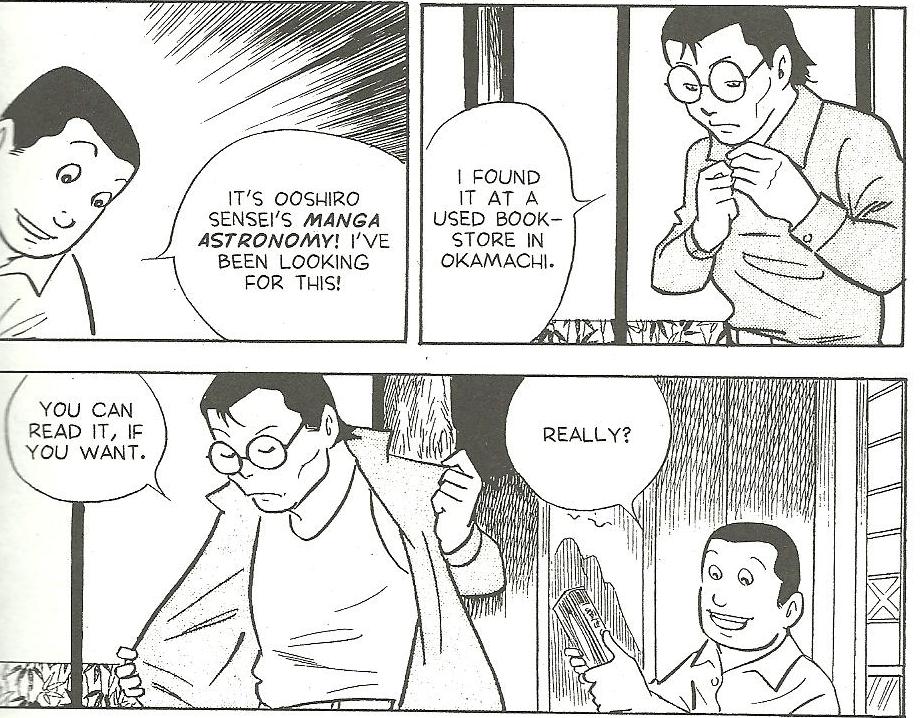 For comics aficionados, definitely a work to be read, enjoyed, studied, and returned to. For anyone interested, here are the titles of the 48 chapters:
THE BIRTH OF MANGA
MANGA OBSESSION
THE JOURNALIST FROM MAINICHI SHIMBUN
ENTER TEZUKA
SIBLING RIVALRY
TEZUKA VANISHES
BELOVED MANGA
TORN APART
SUMMERTIME DREAMS
THE CON ARTIST
THE ROAD TO SUCCESS
DEBUT
THE SUN SETS ON HIGH SCHOOL DAYS
DESERT TRAVELER
A DREAM FULFILLED
COLD CALLING
HINOMARU BUNKO, RENTAL MANGA PUBLISHER
NOM DE PLUME
AN INFINITELY FREE WORLD
THE MANGA MONSTER
SEARCHING FOR A NEW METHOD
SHADOW
EXPERIMENTAL WORK
LIFE DRAWING
MASAMI KURODA’S PAST
SUMMER TRAINING CAMP
IN THE BALANCE
ESCAPE FROM CAMP
PASSION AND SEDUCTION
A TIME FOR GOOD-BYE
THE JOY OF CREATION
THE FALL OF HINOMARU BUNKO
MANAGING EDITOR
THE SHORT STORY BOOM
DRUNK WITH POWER
TO TOKYO, AND “GEKIGA”
KOTOBUKISO DAYS
THE BOOM CONTINUES
RENTAL MANGA WARS
DRAWING FROM TURMOIL
REACHING TOWARDS GEKIGA
THE BIRTH OF THE GEKIGA WORKSHOP
PROS AND CONS
THE VAMPIRE KILLER BECOMES A VAMPIRE
PASSION FOR GEKIGA DWINDLES
JEALOUSY AND FRUSTRATION
THE QUICK DISSOLUTION OF THE GEKIGA WORKSHOP
FUELED BY ANGER
[EPILOGUE]
Posted by lefalcon on May 2, 2010
https://losthunderlads.com/2010/05/02/yoshihiro-tatsumi/
I like Pickles
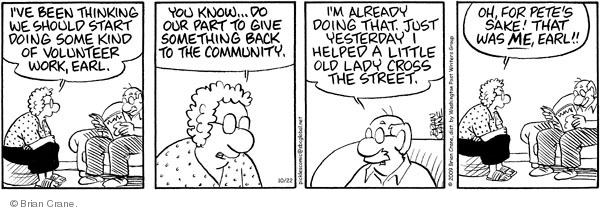
Those in authority have decreed that reading the comic strip Pickles makes a person unhip. I for one care nothing for hipness if I must sacrifice my daily reading of Pickles to attain it, and so I defy their judgment.
Posted by acilius on March 26, 2010
https://losthunderlads.com/2010/03/26/i-like-pickles/
Terrible Freedom
Yesterday’s Ferd’nand strip:

Ferd'nand, 16 March 2010
I wrote something here several weeks ago remarking on a tendency I’ve observed in myself. I’ve often thought that the reason I’m more relaxed outdoors in a natural setting than inside my apartment or my office is that when I’m in a space that belongs to me, my eye constantly lights on things I might control, or that I have controlled, or that I should control. There’s the computer; I might control that, and do any number of things. There’s a bookcase; I bought those books and put them into order on the shelves. There’s a pile of papers; I should file them in an orderly way. Outdoors, I see the trees, the soil, the sky; they get along quite all right without my control. I’m glad to see I’m not the only one who is bothered by an urge to take control of my environment, to put things in order.
Here’s an xkcd from a couple of weeks ago:
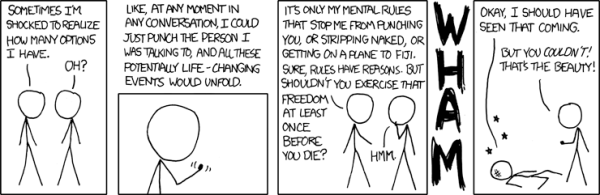
xkcd 706
This also reminds me of something I’ve observed in my own psychology. Many years ago, I was in the dentist’s chair, having a cavity filled. They didn’t give me one of those contour pillows that usually cradles your neck at the dentist’s. I became aware that I could, if I wished, turn my head abruptly to one side or the other and cause myself great pain. Not that I wanted to do that, of course, but the sensation of freedom, the realization that nothing was stopping me from doing that, was quite unsettling. Back in 2007, Keith Knight did a whole cartoon about just this point:

Click for full size
One of our first posts on Los Thunderlads was a link to this strip. That post is titled “The Imp of the Perverse,” a nod to Edgar Allan Poe’s story of the same name. Poe’s story includes these paragraphs:
We have a task before us which must be speedily performed. We know that it will be ruinous to make delay. The most important crisis of our life calls, trumpet-tongued, for immediate energy and action. We glow, we are consumed with eagerness to commence the work, with the anticipation of whose glorious result our whole souls are on fire. It must, it shall be undertaken to-day, and yet we put it off until to-morrow; and why? There is no answer, except that we feel perverse, using the word with no comprehension of the principle. To-morrow arrives, and with it a more impatient anxiety to do our duty, but with this very increase of anxiety arrives, also, a nameless, a positively fearful, because unfathomable, craving for delay. This craving gathers strength as the moments fly. The last hour for action is at hand. We tremble with the violence of the conflict within us, – of the definite with the indefinite – of the substance with the shadow. But, if the contest has proceeded thus far, it is the shadow which prevails, – we struggle in vain. The clock strikes, and is the knell of our welfare. At the same time, it is the chanticleer-note to the ghost that has so long over-awed us. It flies – it disappears – we are free. The old energy returns. We will labour now. Alas, it is too late!
We stand upon the brink of a precipice. We peer into the abyss – we grow sick and dizzy. Our first impulse is to shrink from the danger. Unaccountably we remain. By slow degrees our sickness, and dizziness, and horror, become merged in a cloud of unnameable feeling. By gradations, still more imperceptible, this cloud assumes shape, as did the vapor from the bottle out of which arose the genius in the Arabian Nights. But out of this our cloud upon the precipice’s edge, there grows into palpability, a shape, far more terrible than any genius, or any demon of a tale, and yet it is but a thought, although a fearful one, and one which chills the very marrow of our bones with the fierceness of the delight of its horror. It is merely the idea of what would be our sensations during the sweeping precipitancy of a fall from such a height. And this fall – this rushing annihilation – for the very reason that it involves that one most ghastly and loathsome of all the most ghastly and loathsome images of death and suffering which have ever presented themselves to our imagination – for this very cause do we now the most vividly desire it. And because our reason violently deters us from the brink, therefore, do we the more impetuously approach it. There is no passion in nature so demoniacally impatient, as that of him, who shuddering upon the edge of a precipice, thus meditates a plunge. To indulge for a moment, in any attempt at thought, is to be inevitably lost; for reflection but urges us to forbear, and therefore it is, I say, that we cannot. If there be no friendly arm to check us, or if we fail in a sudden effort to prostrate ourselves backward from the abyss, we plunge, and are destroyed.
Examine these and similar actions as we will, we shall find them resulting solely from the spirit of the Perverse. We perpetrate them merely because we feel that we should not. Beyond or behind this, there is no intelligible principle. And we might, indeed, deem this perverseness a direct instigation of the Arch-Fiend, were it not occasionally known to operate in furtherance of good.
I’m no psychologist, but I wonder if there is a connection between the urge to take control of our environment that makes Ferd’nand unable to rest if he can see his unmowed grass and untrimmed hedge-row and the impulses Knight, Poe, and xkcd’s stick figures who enjoy math describe. Seized by the imp of the perverse, we might find ourselves doing any of an endless list of things. If we act “merely because we feel that we should not,” there is no telling what we might do. Likewise, at the first moment we are seized by the urge to take control of our environment our subsequent behavior is highly unpredictable. If we act merely because we feel that we should, we confront a list of possible actions that is just as endless as the list of things we should not do.
Not only do the imp of the perverse and the urge to take control of our environment resemble each other in that we become unpredictable when we first succumb to either; they resemble each other also in their characteristic outcome, which is that we accomplish nothing. Occasionally the imp of the perverse may lead us all the way off the precipice, all the way to punch the other person, all the way to scream from the audience during the stage play; but far more often we simply shift in our seat, uncomfortable to recognize such an urge in ourselves. And occasionally the urge to take control of our environment will lead us to complete one task after another and put a space into good order; more often, I would say, it distracts us from each task, preventing us from completing anything satisfactorily.
Posted by acilius on March 17, 2010
https://losthunderlads.com/2010/03/17/terrible-freedom/
Conway’s Game of Life
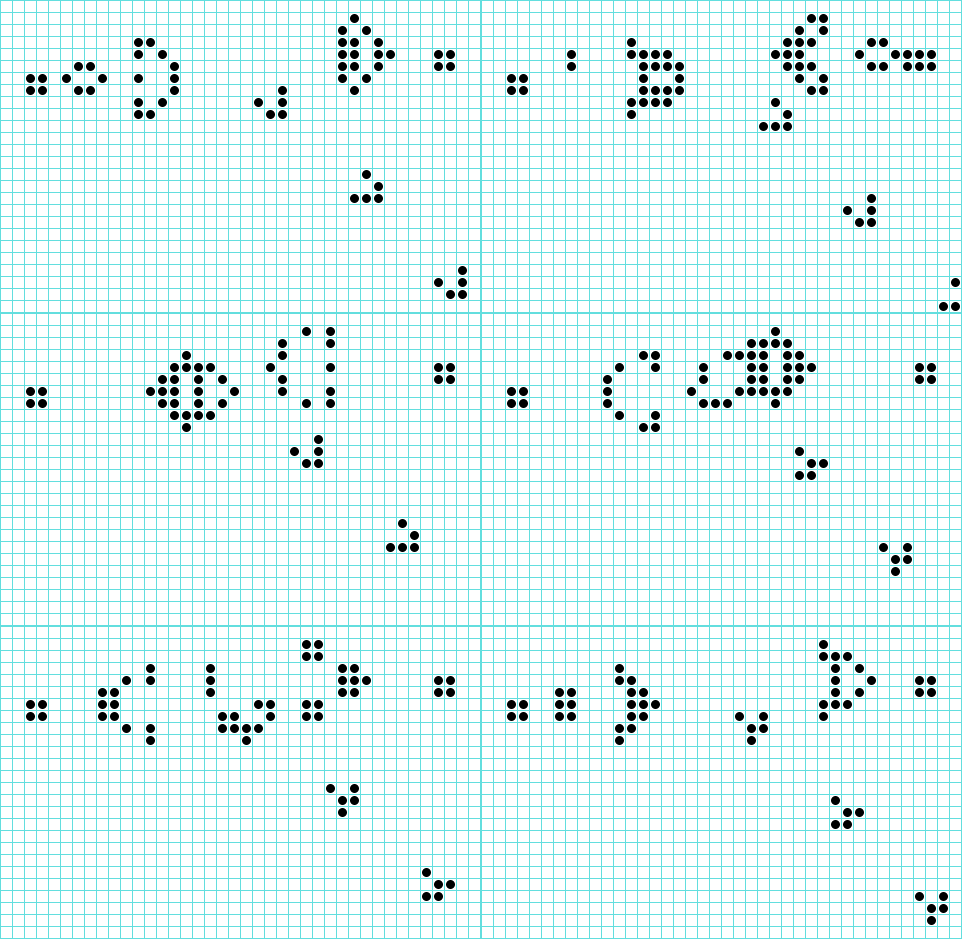
A celebrated Conway Life pattern, the "Gosper Glider"
Years ago, I read a piece in The Atlantic about something demographer Thomas Schelling had figured out:
In the 1960s he grew interested in segregated neighborhoods. It was easy in America, he noticed, to find neighborhoods that were mostly or entirely black or white, and correspondingly difficult to find neighborhoods where neither race made up more than, say, three fourths of the total. “The distribution,” he wrote in 1971, “is so U-shaped that it is virtually a choice of two extremes.” That might, of course, have been a result of widespread racism, but Schelling suspected otherwise. “I had an intuition,” he told me, “that you could get a lot more segregation than would be expected if you put people together and just let them interact.”
One day in the late 1960s, on a flight from Chicago to Boston, he found himself with nothing to read and began doodling with pencil and paper. He drew a straight line and then “populated” it with Xs and Os. Then he decreed that each X and O wanted at least two of its six nearest neighbors to be of its own kind, and he began moving them around in ways that would make more of them content with their neighborhood. “It was slow going,” he told me, “but by the time I got off the plane in Boston, I knew the results were interesting.” When he got home, he and his eldest son, a coin collector, set out copper and zinc pennies (the latter were wartime relics) on a grid that resembled a checkerboard. “We’d look around and find a penny that wanted to move and figure out where it wanted to move to,” he said. “I kept getting results that I found quite striking.”
Programming computers to play this game, Schelling found that strong residential segregation arose even if he assumed that each member of the set would stay put with only a single neighbor of the same category. This provided evidence, not only that Schelling might be right about residential segregation, but also that social order in general can arise in ways that do not directly reflect the intentions of any particular member of that society. All of Schelling’s virtual people wanted to live in integrated neighborhoods, yet it was precisely the actions they took to pursue that goal that inexorably led to the creation of segregated neghborhoods.
Schelling’s tests reminded me of Conway’s Game of Life, a cellular automaton that mathematician John Conway invented in 1970. The procedure of Conway is very similar to Schelling’s. An indefinite number of square cells are arranged in a square grid. Each cell is in one of two conditions, live or dead. Each cell is in contact with eight other cells: one directly above, one directly below, one directly to the right, one directly to the left, and one on each of the four corners. If a cell is alive, it remains alive if and only if it is in contact with two or three other live cells. If a cell is dead, it remains dead unless it is in contact with exactly three dead cells. Some very simple initial patterns take a surprisingly long time to stabilize in Conway Life: for example, this fellow (which Conway called the R-pentomino, though others call it the F-pentomino) goes on generating new forms for 1103 generations, and along the way produces a number of spectacular structures:

You can easily test out patterns here; some especially famous patterns are collected here and here.
Conway’s Game of Life came back to mind a couple of weeks ago, when this xkcd strip appeared:

Someone came up with a cellular automaton that could qualify as “Strip Conway’s Game of Life”:

Various commenters tried to put humans in the role of the automated cells, and tried to devise rules based on what the people around each human are wearing that would determine which clothes the human was required to remove. It occurred to me that a more promising approach would be to have one person start by wearing a great many articles of clothing, leaving those clothes on that were touching either two or three other articles of clothing, removing those that were touching fewer than two or more than three articles of clothing, and putting clothes on bare spots that were bordered by exactly three articles of clothing. Eventually, somebody might get naked.
Then yesterday, Alison Bechdel announced on her blog that she’d drawn a comic for McSweeney’s magazine. The comic represents a modified version of Milton Bradley’s board game called The Game of Life.

Bechdel's Life
In the comments on that post, I brought up Conway’s Game of Life. So, I decided the time had come to post about it here.
Posted by acilius on February 17, 2010
https://losthunderlads.com/2010/02/17/conways-game-of-life/
Some stuff on our daily reads
Yesterday at Ukulele Hunt, Al Wood opened a contest to award the title of best internet ukulele video of 2009. Each commenter is entitled to nominate five videos. My five nominees are: Ukulele Loki and the Gadabout Orchestra, “Prague:1998″; Poopy Lungstuffing, “Dolly Got a Haircut”; Ukulelezo, “When I Grow Up I’m Gonna Wear a Bikini”; Gensblue, “All That Ukulele Xmas”; and Ken Middleton, “Time After Time.” I can’t resist embedding Poopy’s haunting original:
Meanwhile, Language Log featured a link to one of the funniest things I’ve ever seen on the web, “This is the title of a typical incendiary blog post” by Chris Clarke. Each sentence starts with the words “This sentence” and describes what sort of sentence you would find in that position in a typical incendiary blog post. Trust me, it’s funnier than that description makes it sound.
Eight days ago, Josh Fruhlinger, “The Comics Curmudgeon,” posted something that I’m still snickering about. He gave us this “Herb and Jamaal” strip:

And added this comment:
Herb seems to have been possessed by an extremely mellow demon, which has compelled him to casually pull the Bible off the shelf and spit on it. The holy book responds to this assault by releasing thick clouds of acrid smoke. Who will win this low-stakes battle for Herb’s immortal soul?
Posted by acilius on January 29, 2010
https://losthunderlads.com/2010/01/29/some-stuff-on-our-daily-reads/
Who writes this?
 acilius
 believer1
 lefalcon
 losthunderlads
 vthunderlad
 Panther Red