From the BBC, a report that ancient Persians used poison gas in a battle with the Romans.
All posts in category Ancient World
Ancient Gas Warfare
Posted by acilius on January 23, 2009
https://losthunderlads.com/2009/01/23/ancient-gas-warfare/
Poems by Conrad Aiken and Robert Frost

Aurora e Titone, by Francesco de Mura
(image)
In Greek myth, Tithonus was a Trojan prince, the brother of King Priam. According to a poem of the early seventh century BC, the Homeric Hymn to Aphrodite (lines 218-238,) Tithonus’ youthful good looks attracted the attentions of Eos, the goddess of the dawn. Aphrodite had condemned Eos to lust after mortal men. Eos abducted Tithonus and kept him in her mysterious land in the east. She lavished him with gifts. Eos went so far in her generosity to Tithonus as to ask Zeus to make Tithonus immortal. That may have been going too far, or not far enough- Eos neglected to ask Zeus to stop Tithonus’ aging. So he grew old, lost all ability to move his limbs, and took to babbling incessantly. Eos locked him up in a golden chamber when this happened. The hymn’s detail about Tithonus’ babbling may be reflected in later traditions that represent him as a great singer. The fifth-century BC writer Hellanicus of Lesbos says that Eos took pity on him and turned him into a cicada, a creature whom the ancients suspected might be immortal. In the poem below, Aiken follows the modern tradition of representing Tithonus as a grasshopper rather than a cicada.

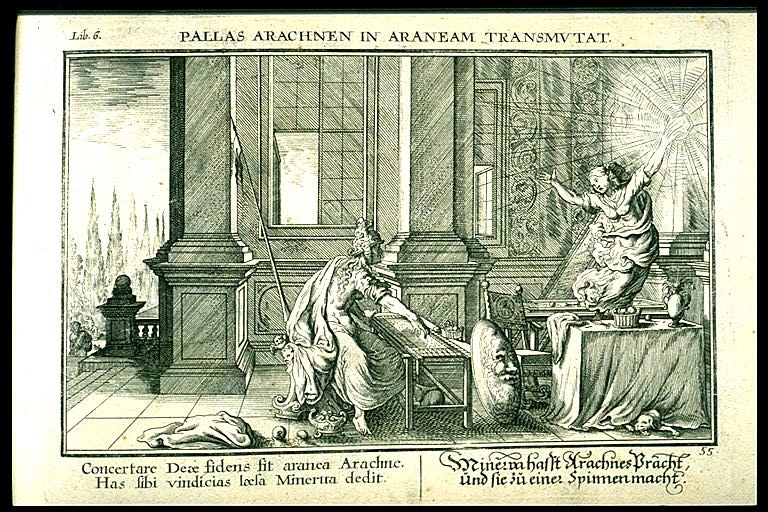
Arachne transformed, from a 1703 edition of the Metamorphoses of Ovid illustrated by Johann Wilhelm Bauer
(image)
According to Ovid’s Metamorphoses, Arachne was a maiden from Lydia in Asia Minor who challenged the goddess Minerva (the Greeks would have said the goddess was Athena) to a weaving contest. When Arachne won this contest, the goddess responded with such fury that Arachne hanged herself. Taking pity on her victim, Minerva revived the girl in the form of a spider. Ovid represents Arachne as an innocent, though she has been thought of in other ways at other times. The story of Arachne’s encounter with Tithonus appears to be Aiken’s own invention. Aiken also takes some further liberties with the story, as you will see.
Posted by acilius on December 27, 2008
https://losthunderlads.com/2008/12/27/poems-by-conrad-aiken-and-robert-frost/
Cuneiform tablets

A Mesopotamian cuneiform tablet in the British Museum
Thanks to 3quarksdaily for linking to this article in The London Review of Books about an ongoing British Museum show called “Babylon: Myth and Reality.” Apparently the exhibition concentrates on cuneiform tablets. The article explains what we know about cuneiform tablets as a medium and speculates on what we may yet learn about them.
Posted by acilius on December 10, 2008
https://losthunderlads.com/2008/12/10/cuneiform-tablets/
The Midas Touch
Thanks to haha.nu for linking to this video offering a new version of an ancient myth.
Here’s another reimagining, from a few years back:
Posted by acilius on December 5, 2008
https://losthunderlads.com/2008/12/05/the-midas-touch/
Phoenician remains
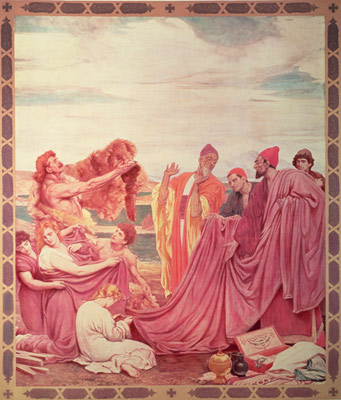
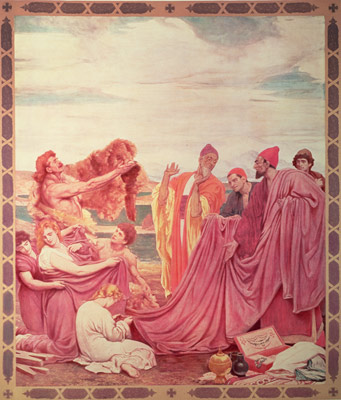
Phoenicians bartering
(image)
The ancient Phoenicians made the MSN homepage today, with this article about a 2900 year old cemetery unearthed near Beirut.
Posted by acilius on November 12, 2008
https://losthunderlads.com/2008/11/12/phoenician-remains/
President-Elect Obama
It’s appropriate that Election Day should come so shortly after Halloween. As the ghosts and ghouls vanish into their occult places when day breaks, so the bogeymen and superstars of the campaign season pass out of view once the election is over. It’s back to Alaska with Sarah Palin, back to work for “Joe the Plumber,” back to the political science textbooks with the Bradley Effect, back to a museum of the 60s with the Weather Underground. Four years from now another set of entertainments will rise from some unknown quarter and haunt us for a season.
The candidates themselves do not go anywhere; they cease to exist. The winning candidate is replaced by the office holder, the losing candidates are replaced by somewhat older, somewhat sadder versions of the people they were before they ran. That’s why there’s a richer vein of literature about losing contenders for power than about winners. Try to dramatize the winner and the best you can do is hint at what Shakespearean actors call “the man inside the king.” The king is a symbol, he is power, he is majesty, he is order, and he is empty. Art and literature can focus on the king only when the symbol fails and the human being emerges. I think the Horace illustrates that process in his Ode 1.37. As long as she is a contender for power, Cleopatra is at best a monster. Defeated, she is one of us.
Here’s Cedric Whitman’s translation of that poem. Robert Frost defined poetry as “that which is lost in translation”; I’m afraid Whitman does not manage to defeat that definition. But it does show the major gestures in Horace’s original, and unlike some other versions it is possible to read Whitman’s aloud. I’ve appended Edward Wickham’s edition (from his Oxford Classical Text) of the original below.
Drink, comrades, drum the ground, now it is time
for freedom’s dance; and call on all the gods
to come, lay out their gorgeous couches,
and let them recline at the feast of Mars.
It had been crime till now to pour good wine
from the crypts of our forefathers, while ruin poised
over the Capitol, and fevered madness
was winding cerecloth round our realm-
Dreams of the queen of half-men, girt by her crew
of sickly shame, and drunk with delirious hopes
grown fat and reckless on easy fortune!
But all that glare of frenzy waned
When scarce one vessel of her fleet sailed home
unscorched by flame; her mind, long tranced and dazed
on heady Egypt’s wine, now waking
to terror’s truth, found Caesar’s oars
hard pressing on her flight from Italy,
swift hawk on downy dove, hunter on hare
in snowy fields of Thrace, and ready
to fling her into chains, a beast
of ominous wonder. But she had loftier thoughts,
to find out death; blades could not make her cheek
blanch like a girl’s, or drive her flying
with huddled sails to lurking shores.
Her courage soared; with placid face she scanned
her fallen palace, and valorously reached
her hands to rasping snakes, sucking
their venom’s blackness through her limbs.
Once death was fixed, the fiercer grew her mind:
Indeed, she scorned his cruel galleys, and men
who would have had her walk uncrowned,
no spiritless woman, in triumph’s pride.
Posted by acilius on November 5, 2008
https://losthunderlads.com/2008/11/05/president-elect-obama/
What have the Romans ever done for us?
Apparently when the Romans went to Wales, they took leeks. The BBC reports on research giving the old empire credit for introducing that signature vegetable to Welsh gardens.
Posted by acilius on September 24, 2008
https://losthunderlads.com/2008/09/24/what-have-the-romans-ever-done-for-us/
Aulus Gellius Online
I’m sure you’re all as fascinated by the second-century miscellanist Aulus Gellius as I am. Who isn’t? Here’s his book, the Attic Nights, online, in Latin with some of the English from the Loeb translation.
http://penelope.uchicago.edu/Thayer/E/Roman/Texts/Gellius/home.html
Here’s Gellius referenced in Irving Babbitt’s Literature and The American College.
Here’s the frontispiece from an early edition of the Attic Nights.

Posted by acilius on September 5, 2008
https://losthunderlads.com/2008/09/05/aulus-gellius-online/
Blame the Romans!
Quoth the BBC:
“The spread of the Roman Empire through Europe could help explain why those living in its former colonies are more vulnerable to HIV.”
http://news.bbc.co.uk/2/hi/health/7596532.stm
How so?
The claim, by French researchers, is that people once ruled by Rome are less likely to have a gene variant which protects against HIV…
They say that the frequency of the variant corresponds closely with the shifting boundaries of the thousand-year empire.
In countries inside the borders of the empire for longer periods, such as Spain, Italy and Greece, the frequency of the CCR5-delta32 gene, which offers some protection against HIV, is between 0% and 6%.
Countries at the fringe of the empire, such as Germany, and modern England, the rate is between 8% and 11.8%, while in countries never conquered by Rome, the rate is greater than this.
However, the researchers do not believe that the genetic difference is due to Roman soldiers or officials breeding within the local population – history suggests this was not particularly widespread, and that invading and occupying armies could have been drawn not just from Italy but from other parts of the empire.
Instead, they say that the Romans may have introduced an unknown disease to which people with the CCR5-Delta32 variant were particularly susceptible.
A slightly more detailed account of this study can be found on The New Scientist‘s website.
The original article is available only to subscribers. Here’s the link anyway.
Posted by acilius on September 4, 2008
https://losthunderlads.com/2008/09/04/blame-the-romans/
Who writes this?
 acilius
 believer1
 lefalcon
 losthunderlads
 vthunderlad
 Panther Red